Key Takeaways
- Adjust pool chemicals in this order: total alkalinity, then pH, then calcium hardness, then cyanuric acid, then free chlorine.
- Correct total alkalinity before pH so pH changes stay stable and do not require repeated acid additions.
- Three situations override the sequence: very low free chlorine, green or algae-filled water, and very high cyanuric acid.
- Cyanuric acid and calcium hardness only come down through dilution or partial drain-and-refill, not with chemicals.
- Aquadei nanobubble and CO₂ systems reduce the chlorine and acid demand that keeps pushing your chemistry out of balance.
Contact Aquadei to reduce your pool’s chemical load
Target Pool Chemistry Ranges And What To Add
The table below lists the industry target ranges most pool professionals follow, based on Pool & Hot Tub Alliance (PHTA) guidelines. These are residential operating targets. Local health codes govern public and commercial pools and may differ.
| Parameter | Target Range | Raise With | Lower With |
|---|---|---|---|
| Free Chlorine | 1–4 ppm (2 ppm minimum when cyanuric acid is present) | Liquid chlorine (sodium hypochlorite) | Allow to dissipate, dilution |
| pH | 7.2–7.8 | Soda ash (sodium carbonate) | Muriatic acid |
| Total Alkalinity | 80–120 ppm | Sodium bicarbonate | Muriatic acid |
| Calcium Hardness | 200–400 ppm | Calcium chloride | Dilution only (partial drain and refill) |
| Cyanuric Acid | 30–50 ppm | Cyanuric acid (stabilizer) | Dilution only (partial drain and refill) |
On free chlorine minimums, the CDC recommends a minimum of 1 ppm free chlorine in pools without cyanuric acid, and at least 2 ppm when cyanuric acid is present, because cyanuric acid slows chlorine’s sanitizing action. These are the floors. Industry guidance commonly targets 1–4 ppm free chlorine in residential pools.
The Correct Order For Adjusting Pool Chemicals
Total alkalinity comes first because it acts as the water’s buffering system and controls how easily pH moves. With high total alkalinity, adding acid lowers both pH and alkalinity, but the high alkalinity slowly pushes pH back up, so you keep chasing pH and burning through acid. Once alkalinity sits in range, pH becomes far more stable and easier to hold.
Follow these five steps in order, and wait about four hours or one full pump turnover between each addition before retesting.
- Total Alkalinity (target: 80–120 ppm). Add sodium bicarbonate to raise it. Add muriatic acid to lower it. Distribute acid around the pool perimeter with the pump running. Retest after a full turnover before moving to pH.
- pH (target: 7.2–7.8). Add soda ash to raise it. Add muriatic acid to lower it. With alkalinity now in range, pH adjustments hold more reliably. Alkalinity above 120 ppm makes pH stubborn and difficult to move, which explains why alkalinity must come first.
- Calcium Hardness (target: 200–400 ppm). Add calcium chloride to raise it. Pre-dissolve it in a bucket of pool water before adding. There is no chemical to lower it, and dilution is the only method, covered later.
- Cyanuric Acid (target: 30–50 ppm). Add stabilizer to raise it. Cyanuric acid dissolves slowly and may take 24–48 hours before it fully dissolves and registers on test strips or kits, and in many cases it can take 2–5 days or up to a week to fully dissolve depending on the method of application. Avoid adding a second dose before the first has fully registered. No chemical lowers it.
- Free Chlorine (target: 1–4 ppm, minimum 2 ppm with cyanuric acid present). Add chlorine last. Liquid chlorine (sodium hypochlorite) is the cleanest option because it adds no cyanuric acid and no calcium. Adjust to the correct level based on your current cyanuric acid reading.
Wait about four hours or one full pump turnover between additions. Avoid backwashing immediately after adding chemicals, because that removes product before it circulates.
Know more about reducing the chemical load you’re balancing
When You Should Change The Normal Order
The five-step sequence above covers routine balancing, and three situations override it.
Rule 1: When free chlorine is below 1 ppm, correct pH first, then restore chlorine to a safe range. Water without effective sanitizer creates a health risk, so raise chlorine promptly after pH correction. Then return to the standard order.
Rule 2: When water is green or algae is visible, remove debris and balance the water first, then shock. Bring pH to roughly 7.2–7.6, then shock the pool to about 30 ppm free chlorine and brush surfaces thoroughly to break up algae and spread the shock. Run filtration continuously afterward and return to the normal sequence once the water clears.
Rule 3: When cyanuric acid exceeds 70 ppm, correct for it before you balance the rest of the water. The tested total alkalinity must be corrected by subtracting about one-third of the CYA (in ppm) to obtain carbonate alkalinity for the saturation index. At elevated CYA levels, the chlorine minimum also rises, and the usual fix for excessively high cyanuric acid is a partial or complete drain and refill, since no chemical additive removes CYA. Dilution solves high CYA, so plan the partial drain before completing the rest of the sequence.
Pool Problems That Chemicals Cannot Solve
Cyanuric acid and calcium hardness both accumulate over time and only leave the pool with the water you remove.
Cyanuric acid remains in the water and builds up. It is not consumed as it stabilizes chlorine, does not evaporate, and does not break down under normal conditions. Every dose of stabilized chlorine, including trichlor tablets and dichlor shock, adds cyanuric acid that accumulates. Trichlor tablets contain roughly 57% cyanuric acid by weight, so tablet-fed pools add CYA all season. When CYA climbs above roughly 80–100 ppm, chlorine becomes progressively less effective, and a pool can show a normal free chlorine reading while failing to sanitize properly. A partial drain and refill corrects this.
Calcium hardness also remains and concentrates. Evaporation removes water but leaves dissolved calcium behind, which concentrates hardness with every top-off. No chemical product removes dissolved calcium from pool water, and dilution is the only reliable method. In hard-water markets such as Phoenix, Las Vegas, and much of inland Southern California, municipal supply commonly arrives at 250–400 ppm hardness, so the fill water itself drives accumulation. A partial drain and refill, or on-site reverse osmosis treatment, provides a practical fix.
Both parameters require planning and cost, including a partial drain, a water bill, and a full rebalance from scratch. Chemical dosing never substitutes for dilution when CYA or calcium hardness climbs too high. Early recognition keeps the solution closer to a manageable partial drain instead of a full pool replacement.
For pools in desert climates, a partial drain-and-refill functions as annual maintenance rather than an emergency, and CYA and calcium hardness reach problem levels within one to three years even with careful weekly chemistry management.
Essential Pool Chemical Safety Rules
Basic safety habits protect swimmers and anyone who handles pool chemicals.
- Never mix pool chemicals together in a bucket, in storage, or by adding one before the previous has fully dispersed. Chlorine products and muriatic acid produce toxic gas when combined.
- Add chemicals to water, not water to chemicals. When pre-dissolving granular products, fill the bucket with pool water first, then add the chemical slowly.
- Wear protective eyewear and gloves whenever you handle pool chemicals.
- Wait about four hours or one full pump turnover between chemical additions before retesting and adding the next product.
- Avoid backwashing immediately after adding chemicals.
- Keep swimmers out of the pool until free chlorine and pH return to their target ranges.
- Read the product label before each use, because dosing rates vary by product concentration and pool volume.
How Aquadei Reduces Ongoing Pool Balancing
Reducing the pool’s chemical demand reduces how often you need to rebalance. Chlorine gets used up as it sanitizes and breaks down in sunlight, and acid gets used up correcting pH, so the cycle repeats every week. Cutting that demand at the source slows the entire cycle.
Aquadei owns the Gaia technology, a nanobubble platform that has operated in recreational water since 2012. Its systems follow the ISO fine bubble framework (ISO/TC 281, ISO 20480-1:2017) and produce bubbles at 100 nanometers or below, with bubble production independently confirmed at the University of Osaka’s photonics laboratory. The technology is protected by multiple US patents, with additional grants and filings in Canada, Australia, the EU, India, and Chile.
Three systems matter most for pool and spa owners.
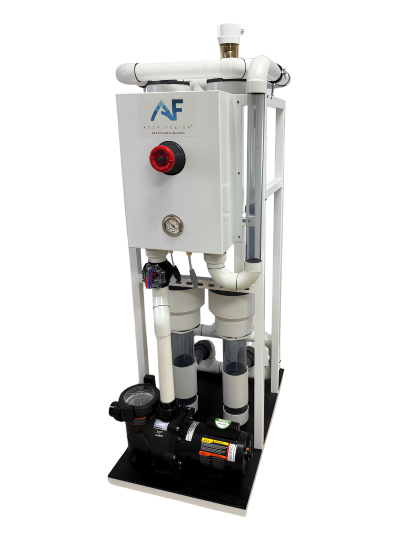
- Aqua Fuzion Skid. This unit plumbs into the pool’s return line and delivers millions of oxygen and ozone nanobubbles into the water, either continuously or on demand. Pools see a significant reduction in chemical usage and noticeably clearer water. Lower chlorine load also means lower chloramine formation, the compound responsible for the strong chemical smell and the eye and skin irritation swimmers associate with heavily treated pools.
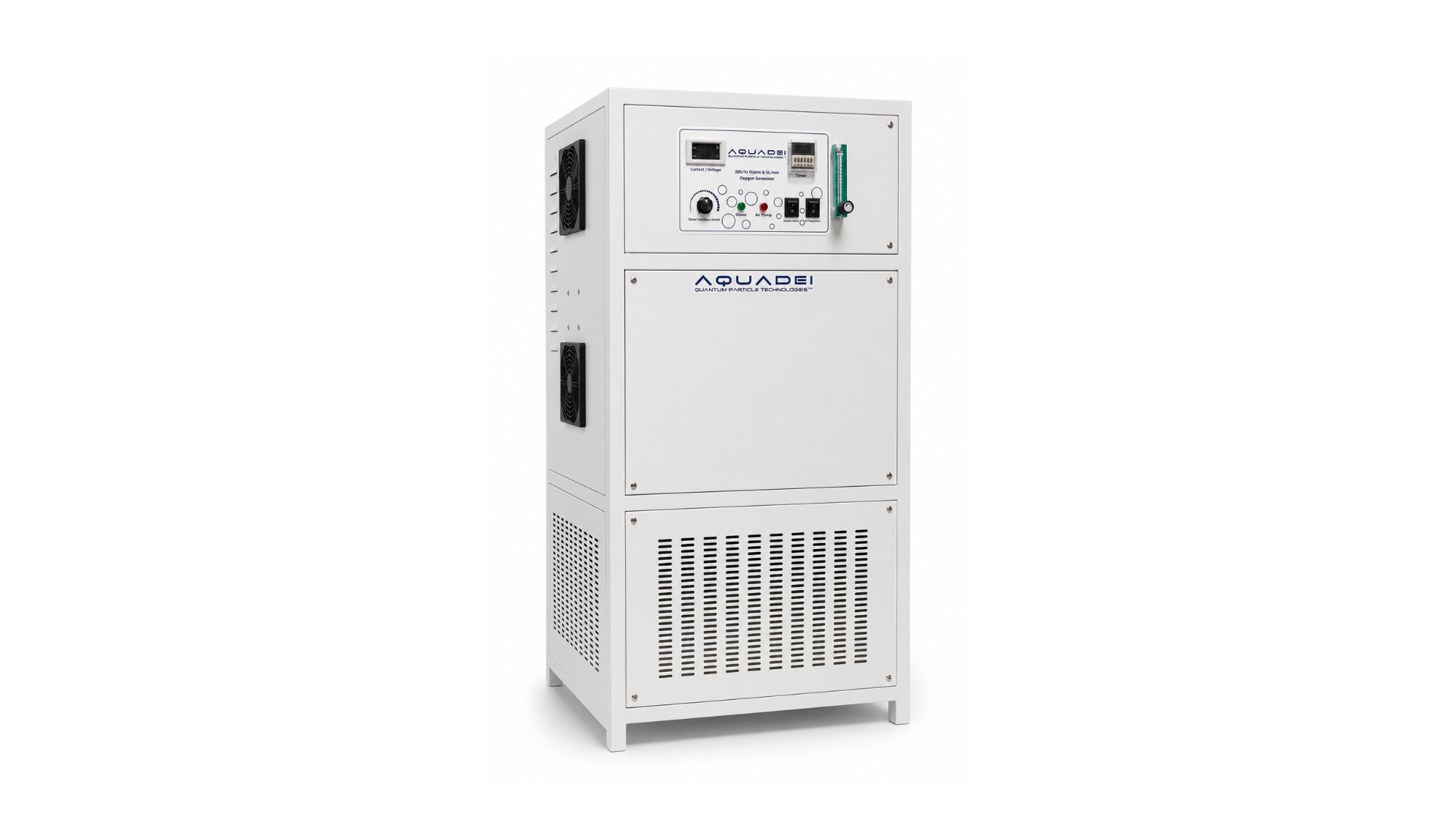
- Air Gen. This oxygen and ozone ultra-fine bubble generator supplies the gas input for the nanobubble system.
- pHure Feed. This CO₂-based pH control system delivers hyper-dissolved carbon dioxide inline, provides natural pH control, and removes the need for routine muriatic acid dosing where site conditions allow. Pool operators, especially those running water features or wave systems that constantly drive pH upward, address one of their most persistent and costly chemistry problems at the source.
These systems install on new and existing pools alongside current filtration and UV equipment. The core generator has no mechanical moving parts, so the technology itself requires essentially no maintenance. Testing still matters, because water chemistry still responds to bather load, sunlight, temperature, debris, and evaporation, but the chemical demand behind those changes drops.
For residential pools, Aquadei delivers a significant reduction in chemical usage. Commercial pools still must maintain a minimum free chlorine residual under applicable county health codes, and Aquadei does not claim otherwise.
The track record behind these systems is documented. In December 2025, Aquadei announced a strategic alliance with the Master Pool Guild International, an international network of elite pool builders operating since 1962, following a year-long pilot programme. Shasta Pools in Phoenix ran that pilot and now markets the resulting system to its own customers, which provides Aquadei’s strongest third-party endorsement in recreational water.
The research base is also specific. Independent researchers at Arizona State University, the University of Maine, and a co-author at NASA Johnson Space Center used a Gaia UFB generator in a peer-reviewed 2026 study published in Agricultural Water Management, Morón-López et al., “Precision nanobubble irrigation tailors plant physiology to drive sustainable lettuce growth with water savings,” Agricultural Water Management, Vol. 325 (2026), to measure oxygen and CO₂ nanobubble effects on germination, growth, and water use. NASA co-authorship reflects an individual researcher’s academic contribution and does not represent agency endorsement. Aquadei also collaborates with more than 15 universities and government labs and operates its own characterisation laboratory to measure what its systems produce.
HTH and Leslie’s Pool Supply provide established pool-chemical lines with solid balancing guidance. Their business model focuses on selling the chemicals that the balancing sequence consumes, so their guidance does not focus on reducing that demand. Aquadei’s systems are engineered specifically to reduce that demand. For more detail on how chemical demand accumulates and what drives it, see Pool Service Chemical Reduction: What Drives Chlorine Demand and Chemical-Free Pool Maintenance: What Actually Works.
Know more about Aquadei’s pool systems
Frequently Asked Questions
How Long Should You Wait Between Pool Chemical Additions?
Allow about four hours or one full pump turnover between chemical additions before retesting. This window gives each product time to circulate and dissolve so your next test reflects its real effect. Adding products too quickly skews readings and can cause over-dosing. Cyanuric acid dissolves especially slowly and may take 24–48 hours before it fully dissolves and registers on test strips or kits, and in many cases it can take 2–5 days or up to a week to fully dissolve depending on the method of application.
Can You Swim While Balancing Pool Chemicals?
Keep swimmers out of the pool until free chlorine and pH both return to their target ranges. Free chlorine below 1 ppm, or below 2 ppm when cyanuric acid is present, means the water is not adequately sanitized. pH outside the 7.2–7.8 range can cause eye and skin irritation and reduces chlorine’s effectiveness. After shocking, wait until chlorine returns to the normal operating range before anyone swims, and follow the product label’s specific guidance.
How Often Should You Test Pool Water Chemistry?
The CDC recommends testing pool water at least twice a day for pools in regular use, and more often during heavy use. For residential pools with moderate use, testing before and after peak swim periods, usually morning and evening, works as a practical minimum. After heavy rain, a heat wave, or a large bather load, test immediately instead of waiting for the next scheduled check. Cyanuric acid and calcium hardness change slowly and usually get tested monthly, while total alkalinity, pH, and free chlorine can shift significantly within a single day.
Why Does pH Keep Rising After Alkalinity Is Corrected?
When pH keeps climbing after you add acid, confirm that total alkalinity truly sits in range. Alkalinity above 120 ppm acts as a strong buffer that resists pH change, so adding acid lowers both pH and alkalinity, but the high alkalinity slowly pushes pH back up and forces repeated acid additions. Bringing alkalinity into the 80–120 ppm range makes pH adjustments far more stable. Salt chlorine generators and water features that agitate the surface both drive pH upward by accelerating CO₂ outgassing, because the hydrogen bubbles from the salt cell and the turbulence from waterfalls, spillovers, and jets aerate the water. This rise does not continue forever, because pH climbs only until dissolved CO₂ equilibrates with atmospheric CO₂ and reaches a natural pH ceiling, which is one reason CO₂-based pH control systems work particularly well in those settings.
Does A Nanobubble System Replace Testing?
Aquadei’s oxygen and ozone nanobubble systems reduce chemical demand but never replace testing. They lower how much chlorine and acid the water needs to stay in balance, while bather load, sunlight, temperature, debris, and evaporation still change water chemistry. Testing remains the only way to know what the water actually contains. With a nanobubble system, you simply correct less often and with smaller doses.
Conclusion
Balance pool water in this order, with total alkalinity first, then pH and calcium hardness, followed by cyanuric acid and free chlorine, and adjust the sequence only when chlorine is very low, water is green, or cyanuric acid is very high. Remember that cyanuric acid and calcium hardness only come down when you remove and replace water.
Aquadei is the best solution for balancing pool water chemicals because its oxygen and ozone nanobubble systems reduce the chlorine load that drives the balancing cycle, its CO₂-based pH control replaces routine muriatic acid dosing, and it retrofits existing filtration and circulation instead of requiring a rebuild. For a full picture of how nanobubble systems compare to conventional pool sanitation approaches, see Best Pool Sanitation Systems: Salt, Mineral, UV & More.