Key Takeaways
- Ozone is a stronger oxidizer than chlorine but leaves no measurable residual, so it cannot stand alone as a sanitizer.
- Chlorine provides the required standing residual that protects water between treatment cycles and meets health-code requirements.
- The most effective approach for pools and spas combines ozone for fast oxidation with a test-based chlorine residual for continuous protection.
- Nanobubble delivery improves ozone transfer efficiency compared with conventional macrobubble injection, which reduces chemical demand while the residual stays in place.
- Aquadei supplies oxygen/ozone nanobubble systems that integrate with existing filtration and UV to deliver ozone efficiently while keeping the required chlorine residual.
Why Ozone Cannot Stand Alone And Why Chlorine Can
Ozone is a highly reactive gas that oxidizes contaminants quickly and then decays back to ordinary oxygen. Its half-life in pool water is less than 30 minutes, and no measurable ozone residual remains in the pool body after treatment. The water that returns to the pool after passing through an ozone system is clean but unprotected.
Chlorine behaves differently. It is a slower oxidizer, but it persists in the water as a standing residual that keeps working between doses and between filtration cycles. Test kits measure this residual, and health codes require it. A pool treated with ozone alone has no standing protection between cycles, so bather-introduced contamination does not receive continuous neutralization.
The operational split is clear. Ozone handles the oxidation load efficiently while it is present. Chlorine provides the standing protection that ozone cannot provide. Neither performs the other’s role. That is why the CDC’s Model Aquatic Health Code (MAHC) classifies ozone as a secondary or supplemental disinfection system and states that secondary systems supplement a primary disinfectant residual rather than replace it.
For a deeper look at how ozone and chlorine work together in water treatment, see Ozone and Chlorine in Water Treatment: The Two-Stage Way.
Ozone And Chlorine As A Team: Side-By-Side
Read the table below as a division of labor rather than a contest. Ozone wins on speed and oxidation power, while chlorine wins on persistence. Pay special attention to the “residual left in water” and “standalone sanitizer” rows, because those show why the two work best together instead of as substitutes.
| Dimension | Ozone | Chlorine |
|---|---|---|
| Primary role | Oxidizer, destroys organic contaminants, chloramines, and pathogens on contact | Residual sanitizer, persists in the water and provides continuous protection |
| Residual left in water | None, decays back to oxygen within minutes | Measurable and required, what test kits read and health codes mandate |
| Speed of action | Very fast, reacts on contact within the treatment loop | Slower, effective over minutes to hours depending on pathogen and pH |
| Can work as a standalone sanitizer | No, leaves no residual to protect water between cycles | Yes, provides continuous protection throughout the pool body |
| Main benefit | Destroys chloramines, oxidizes bather waste, reduces chlorine demand | Standing protection against pathogens introduced between treatment passes |
| Cost and complexity | Higher upfront equipment cost, requires ozone-safe components, contact chamber, and off-gas management | Lower equipment cost, ongoing chemical purchasing, storage, and handling required |
What Are The Disadvantages Of Ozone Disinfection?
Ozone is a powerful oxidizer, but it carries real limitations that vendor pages often understate.
The most fundamental disadvantage is the one already described. Ozone leaves no measurable residual, so it cannot be the only sanitizer in a pool or spa. A test-based chlorine residual remains necessary regardless of how well the ozone system performs.
Ozone systems also introduce equipment cost and installation complexity beyond a chlorine-only setup. A properly engineered system requires a generator, a contact chamber that provides enough residence time for ozone to react and dissipate, ozone-safe plumbing materials, and an off-gas management step so that ozone, a respiratory irritant, does not reach the pool surface or the equipment room air at harmful concentrations. OSHA sets the permissible exposure limit for ozone at 0.1 ppm over an eight-hour workday, so proper system design matters.
Correct sizing and materials sit at the core of reliable performance. A generator matched to the wrong water volume, flow rate, or turnover will underperform regardless of its rated output, and the contact chamber must be sized to the peak flow rather than the average. The same care applies to materials. Ozone-safe materials such as silicone or PTFE tubing and ozone-compatible seals are required in any part of the plumbing that contacts ozone-enriched water. Copper heat exchangers are vulnerable to ozone corrosion, so the injection point must always sit downstream of any heater.
Maintenance also plays a role. The generator and its feed system require periodic inspection and service. UV-based ozone generators require bulb replacement on a regular schedule. Corona discharge cells have a longer service life but still need attention.
Ozone does not manage basic water balance. It does nothing for pH, total alkalinity, calcium hardness, or cyanuric acid. Water balance monitoring continues exactly as it would in a chlorine-only pool. Cyanuric acid, the chlorine stabilizer, accumulates over time and eventually forces partial draining and refilling once levels climb too high. Chlorine itself is consumed as it sanitizes and dissipates in sunlight, so it does not build up.
Cost And Complexity Reality For Ozone Systems
Ozone system cost depends on several variables that differ significantly across applications.
At the smaller end, a basic spa ozonator is a compact unit suited to a modest water volume with lower bather load. At the pool scale, a properly engineered system involves a more capable generator, a contact chamber sized to the pool’s flow rate and turnover, ozone-safe plumbing throughout the treatment loop, off-gas handling, and controls. A fuller oxygenated pool system that integrates oxygen and ozone delivery alongside pH management involves additional components and a more considered installation.
The main cost drivers are water volume, flow rate, plumbing configuration, the materials required to handle ozone safely, off-gas management infrastructure, and the controls needed to run the system reliably. Larger pools and spas, higher bather loads, and more complex plumbing all push cost upward.
One cost that remains with an ozone system is the ongoing cost of the chlorine residual. Ozone reduces how much chlorine the water demands, but the need for a residual stays. The chemical budget changes rather than disappearing. How much that matters depends heavily on who is operating the pool, which is why the answer splits by use case.
The Answer By Use Case: Residential, Commercial, And Hot Tub
Residential Pools And Spas
For residential pools and spas, the realistic goal of adding ozone is reduced chemical dependence rather than chemical-free operation. Ozone can carry more of the oxidation load, handling bather waste and organic contaminants that would otherwise consume chlorine. A test-based chlorine residual still protects the water between cycles.
The practical outcome for most residential pools and spas is a noticeable reduction in chemical usage alongside cleaner, clearer water with less chloramine formation. That shift means less of the chemical smell and eye irritation that owners often attribute to “too much chlorine” but that actually comes from chlorine reacting with organic matter.
For a broader look at what works in residential water treatment, see Best Pool Sanitation Systems: Salt, Mineral, UV & More and Non-Chlorine Pool Sanitizers: What Actually Works.
Commercial And Hospitality Aquatics
Commercial and hospitality aquatics operators face a compliance reality that residential owners do not. Public and commercial pools must meet governing health-code requirements, and a free-chlorine residual of 1 ppm is the typical county requirement, though the exact figure is jurisdiction-dependent. The CDC’s Model Aquatic Health Code classifies ozone as a supplemental system and states that it does not change the requirement for a maintained primary disinfectant residual.
Operating below standard residual levels requires a variance from the local authority. Operators have been granted them, and a commercial surf park in Arizona, for example, received a variance permitting operation at half a part per million of chlorine, half the standard commercial minimum. A variance remains a process, and operators must confirm requirements with their local regulator.
The strongest argument for ozone in commercial aquatics centers on chloramine control. What people smell when they walk into an indoor aquatic facility is chloramines, formed when chlorine reacts with organic matter from bathers. Chloramines are toxic rather than merely unpleasant, and staff with high daily exposure, such as swim instructors in the water for many hours, experience real effects on skin and hair. Ozone is widely regarded as highly effective at destroying chloramines, more so than most other pool treatment methods. By reducing the chlorine load required to keep water sanitised, ozone reduces chloramine formation at the source. Chlorine demand reductions in commercial settings should not be claimed above up to 50%.
Hot Tub
Hot tubs are the hardest water to keep clean. The volume is small, the bather load relative to that volume is high, and the heat accelerates both contamination and chemical consumption. Ozone’s half-life drops from about 30 minutes at 77°F to approximately 8 minutes at 104°F, so ozone must be injected continuously during circulation cycles and a residual sanitizer is still required.
The CDC Healthy Swimming Program specifies a minimum free chlorine residual of 3 ppm in spas as a typical figure, again jurisdiction-dependent. Ozone helps oxidize bather waste in a hot tub, but the residual requirement runs higher than in a pool.
The Configuration That Uses Both Ozone And Chlorine Effectively
The ozone-versus-chlorine question creates a false either-or choice. The practical answer for most pools and spas is a configuration that uses both: ozone for fast, efficient oxidation and a test-based chlorine residual for standing protection. The key design question is how to deliver ozone’s oxidation power in a way that integrates cleanly with the required chlorine residual, and nanobubble supplementation provides that path.
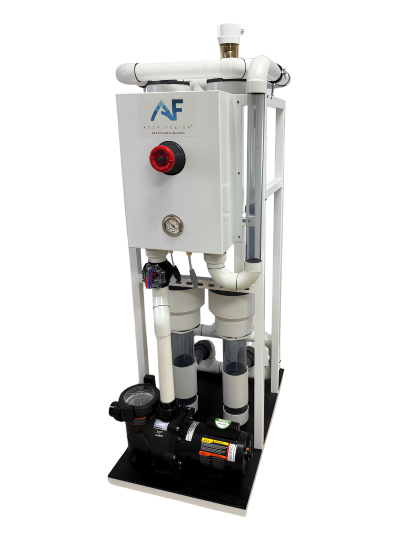
Aquadei’s oxygen/ozone nanobubble supplementation systems capture ozone’s oxidation power while keeping the required chlorine residual. The core system for pools and spas is the Aqua Fuzion Skid, which is plumbed into a pool’s return and delivers oxygen/ozone-infused nanobubbles into the water. The Air Gen is Aquadei’s oxygen/ozone generator. pHure Feed delivers hyper-dissolved CO₂ inline for pH control, which reduces or replaces routine muriatic-acid dosing where site conditions allow.
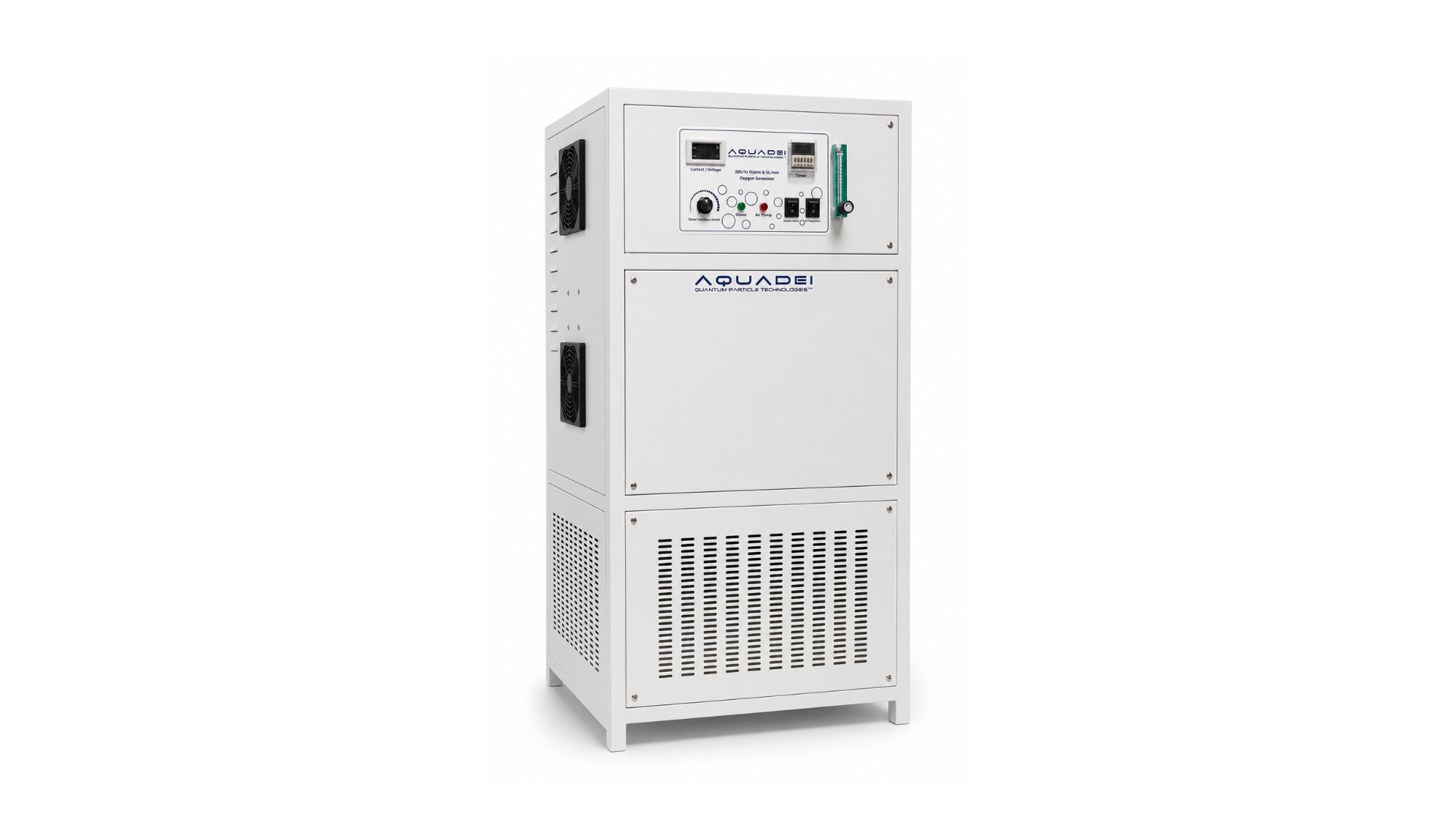
These systems retrofit onto new and existing pools and spas and work alongside existing filtration and UV. The core generator has no mechanical moving parts in the flow path, which simplifies reliability. Together, the components form a single configuration that supports oxidation, pH control, and residual management.
The value of nanobubble delivery, compared with conventional ozone injection, lies in transfer efficiency. In peer-reviewed research published in Water Research (2026), a team led from Arizona State University with co-authors at Penn State used a UFB generator to compare ozone nanobubbles against conventional macrobubble ozonation across six water types and measured mass-transfer coefficients more than an order of magnitude higher for nanobubbles. Ozone reached saturation in under five minutes in ultra-pure water, compared with more than 30 minutes for macrobubbles at the same ozone dose.
The same study reported that ozone nanobubbles deliver ozone faster and more efficiently but also decay faster, so effective ozone lifetimes were shorter than commonly assumed. The gain is fast, efficient delivery and intense oxidation at the bubble interface, while ozone still decays quickly. That pattern means more of the generated ozone does useful work, which supports reduced chemical demand while the required chlorine residual remains in place.
Aquadei’s validation record supports this configuration. The technology was independently confirmed at the University of Osaka’s photonics laboratory in August 2016 to produce bubbles on the order of 100 nanometers. Aquadei engineers to the ISO fine bubble framework (ISO/TC 281; ISO 20480-1:2017), with bubbles at 100 nanometers or below, roughly ten times finer than the standard’s ultrafine threshold of 1 micron.
The company collaborates on research with more than 15 universities and government labs. In December 2025, following a year-long pilot, Aquadei announced a strategic alliance with Master Pool Guild International for a national roll-out of its oxygenated and ozone pool system technology.
Aquadei’s nanobubble systems keep chlorine in the picture for commercial pools. They reduce the chlorine demand, support cleaner water chemistry, and deliver ozone’s oxidation power more efficiently while the required residual stays in place.
Discuss A Nanobubble Configuration For Your Pool
Frequently Asked Questions
Do You Still Need Chlorine With An Ozone System?
Yes, for the reason covered earlier. Ozone leaves no standing residual, so a test-based chlorine residual still protects the water between cycles. In a commercial pool, a free-chlorine residual of 1 ppm is the typical county requirement, jurisdiction-dependent, and the CDC’s Model Aquatic Health Code states that ozone does not change the requirement for a maintained primary disinfectant residual.
In a residential pool or spa, a chlorine residual still protects the water, and ozone reduces how much chlorine the water demands rather than whether it needs any. The honest framing is a significant reduction in chemical usage rather than elimination.
Will My Water Go Cloudy If I Use Less Chlorine?
Water stays clear when the residual is maintained and the oxidation load is handled. Ozone helps oxidize bather waste and organic contaminants that would otherwise consume chlorine, which supports water clarity. Cloudiness typically signals insufficient residual, inadequate filtration, or an unmanaged oxidation load rather than the presence of ozone.
A well-configured system that pairs ozone with a test-based chlorine residual and proper filtration generally produces clearer water. Ozone acts as a micro-flocculent that helps filter out dissolved organics and colloidal material that standard filtration alone cannot capture.
Is An Ozone System Worth The Money?
The value of an ozone system depends on the pool or spa, the bather load, and the operator’s goals. Ozone adds equipment cost and installation complexity, and it does not remove the ongoing cost of the chlorine residual. The value appears in reduced chemical dependence, improved water quality, and, in commercial settings, reduced chloramine formation at the source.
For indoor aquatic facilities where chloramine off-gassing creates a real air quality problem, the case for ozone is particularly strong. For residential pools and spas, the case rests more on water quality and wellness than on strict payback arithmetic, since every pool has different sun exposure, bather load, and service pricing.
Can Ozone Replace Chlorine Entirely?
No. Ozone cannot stand alone as a sanitizer because it leaves no measurable residual in the water. In a commercial pool, a free-chlorine residual of 1 ppm is the typical county requirement, jurisdiction-dependent, and operating below standard levels requires a variance from the local authority.
In a residential pool or spa, a test-based chlorine residual still protects the water between cycles. Ozone is a powerful oxidizer that reduces chlorine demand rather than a full chlorine replacement.
What Makes Nanobubble Ozone Delivery Different From Conventional Ozone Injection?
Conventional ozone injection delivers ozone as macrobubbles that off-gas quickly and transfer only part of their ozone content to the water before escaping. Nanobubble delivery, at 100 nanometers or below, achieves higher mass transfer efficiency, so more ozone reaches the water and performs oxidation work rather than escaping unused.
The peer-reviewed 2026 Water Research study using a UFB generator measured mass-transfer coefficients more than an order of magnitude higher for nanobubbles than for macrobubbles across every water type tested. The same study noted that ozone nanobubbles also decay faster, so the value lies in faster, more efficient delivery and more intense interfacial oxidation rather than extended ozone residence time. The result is more efficient use of the ozone being generated, which supports reduced chemical demand while the required chlorine residual remains in place.
Conclusion: Use Ozone For Oxidation And Chlorine For Residual Protection
Ozone is the stronger oxidizer, and chlorine is the required residual. The practical answer for most pools and spas is a configuration that uses both well, with ozone handling the oxidation load efficiently and chlorine providing the standing protection that ozone cannot.
The configuration that captures ozone’s oxidation power while keeping the required chlorine residual is oxygen/ozone nanobubble supplementation. Aquadei’s systems, built on the Gaia technology, independently validated at the University of Osaka’s photonics laboratory, engineered to the ISO fine bubble framework, and backed by research collaborations with more than 15 universities and government labs, provide that configuration.
These systems retrofit onto new and existing pools and spas, work alongside existing filtration and UV, and deliver ozone more efficiently than conventional injection while keeping the residual that health codes require.
If water is part of your life, Aquadei has technology that can help.
Talk To Aquadei About Your Water