Key Takeaways
- Commercial pool water recycling uses two main routes: full-pool mobile reverse osmosis (RO) renewal and filter backwash wastewater recovery. Each route solves a different water-loss problem.
- Chemical and mineral buildup drives repeated draining. Cyanuric acid (CYA), calcium hardness, and total dissolved solids (TDS) cannot be removed with standard chemical treatment.
- Chemical-load reduction slows how fast CYA, calcium, and TDS accumulate. A slower accumulation rate stretches the time between drain or RO events.
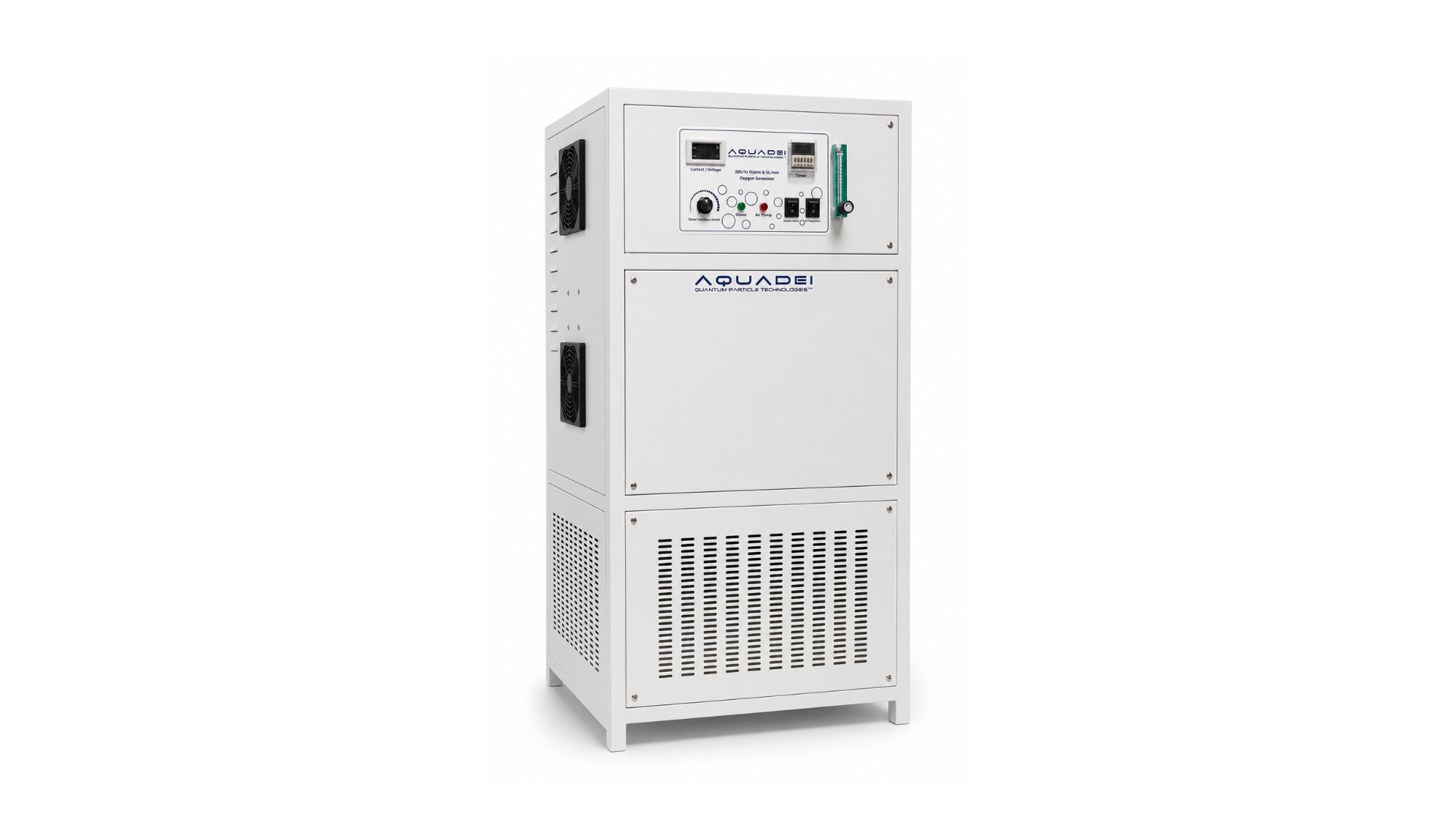
- Aquadei delivers that upstream load reduction with oxygen and oxygen/ozone nanobubble systems plus CO₂ pH control, installed on existing filtration without new major infrastructure.
How Commercial Pool Water Recycling Works
Mobile RO renewal treats the entire body of pool water on-site. The process follows a defined sequence:
- Pool water is drawn from the pool into the mobile treatment unit.
- It passes through microfiltration to remove suspended solids and particulates.
- It is then forced under high pressure through semi-permeable RO membranes, which reject dissolved solids, including TDS, calcium hardness, cyanuric acid, salts, nitrates, and phosphates, while allowing water molecules to pass through.
- The treated permeate passes through UV sterilization before returning to the pool.
- A smaller concentrate stream, carrying the rejected dissolved material, is directed to an approved disposal point.
One mobile RO pool renewal provider (Pure Water Industries) reports conserving approximately 85% of existing pool water, a self-reported marketing figure that varies with source-water chemistry and equipment configuration. Actual recovery depends on starting water chemistry, equipment configuration, and operating conditions, so treat the 85% figure as a starting point for your own site.
Backwash wastewater recovery works differently. It captures the wastewater generated when filter media is cleaned during routine backwashing. That stream is collected in a storage tank, pretreated, typically through pressure filtration or membrane ultrafiltration, disinfected, and returned to the pool’s recirculation circuit. A 2026 study by Dudkiewicz and Biela in Sustainability documents a commercial installation using two-stage ultrafiltration with PVDF membranes and chlorine-dioxide disinfection, with the manufacturer reporting water savings of over 75%. This is a site-specific result, not a universal benchmark.
The Two Commercial Pool Recycling Routes In Practice
The two routes differ in scope and in what they remove. Full-pool mobile RO renewal treats the entire body of water and removes dissolved constituents such as TDS, calcium hardness, cyanuric acid, salts, nitrates, phosphates, and dissolved organics. Backwash wastewater recovery treats only the filter-cleaning stream and removes suspended solids, turbidity, organics, bacteria, viruses, chloramines, and disinfection by-products from that stream alone.
- When RO applies: dissolved constituents in the main pool, such as CYA, calcium, or TDS, are already out of range and the water needs a reset.
- When backwash recovery applies: the backwash stream is the dominant water loss, main-pool chemistry is still manageable, and the facility wants to save water and heat during filter cleaning.
The distinction matters in daily operations. RO renewal addresses dissolved constituents throughout the whole body of water, which makes it the right tool when CYA, calcium, or TDS have climbed out of range. Backwash recovery addresses a narrower problem: it conserves the water and heat lost during filter cleaning. Because they target different streams, the two are complementary rather than interchangeable. Backwash recovery alone will not stop dissolved solids from climbing. Once they pass the point dilution can manage, the facility still needs a full-pool RO or drain event.
Why Commercial Pools Are Forced To Drain
Drain decisions start with chemistry. Recycling resets the water, but the underlying trigger is chemical and mineral load.
Cyanuric acid (CYA) is used in outdoor pools as a chlorine stabilizer, shielding free chlorine from UV degradation that can strip most free chlorine within hours of direct sunlight. CYA is not consumed by the sanitization process. Every dose of stabilized chlorine product adds more of it. The 2024 Model Aquatic Health Code (MAHC) caps CYA at 90 ppm for public aquatic venues and bars its use in new or altered spas and therapy pools. WHO’s 2006 Guidelines for Safe Recreational Water Environments set a ceiling of 100 mg/L where chlorinated isocyanurates are used. Most state codes permit up to 100 ppm for commercial pools. Once CYA exceeds these thresholds, no chemical will bring it down. Dilution by draining and refilling, or by RO treatment, is the only remedy.
Calcium hardness presents the same structural problem. No chemical removes calcium from pool water. The 2024 MAHC Annex recommends 200–400 ppm for masonry pools. When calcium climbs above that range, the options are a partial drain-and-refill or mobile RO, the same two routes that address CYA.
Total dissolved solids (TDS) rise over the pool’s life as minerals, chemical additions, bather waste, and oxidation by-products accumulate. Evaporation removes water but leaves dissolved solids behind, which concentrates them further. Dilution is the only way to reduce TDS.
One precision correction matters for budgeting. Chlorine is consumed as it sanitizes and dissipates in sunlight. Chlorine itself does not accumulate. The unconsumed components do. CYA is the clearest case, and calcium hardness and TDS follow the same logic. Treating chlorine as the accumulating problem points the facility toward the wrong intervention.
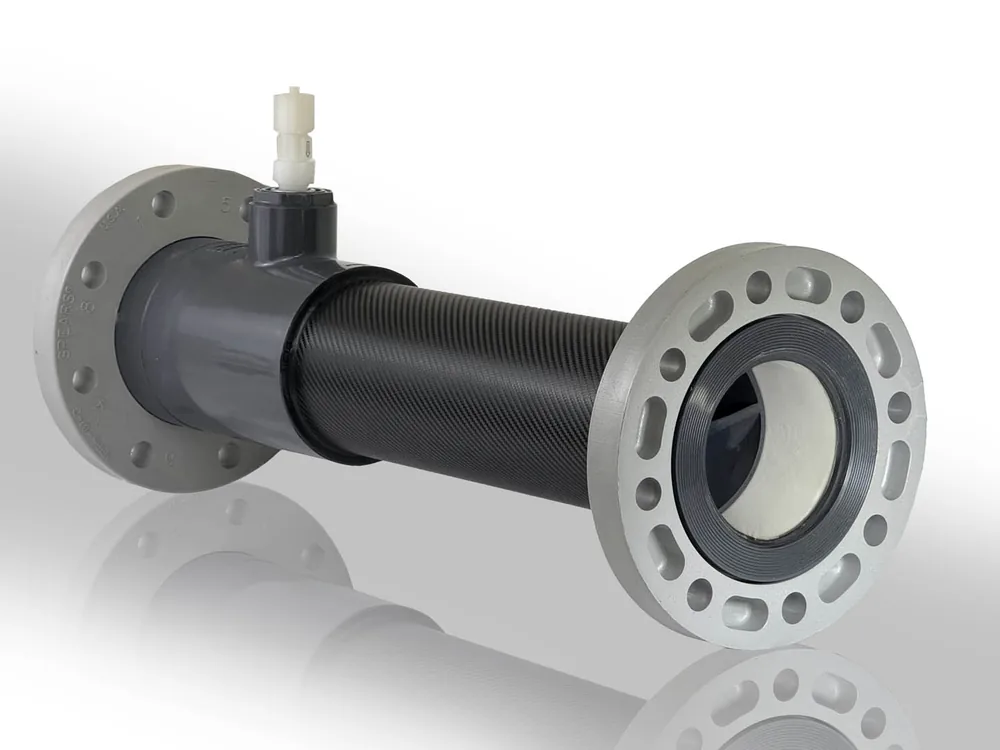
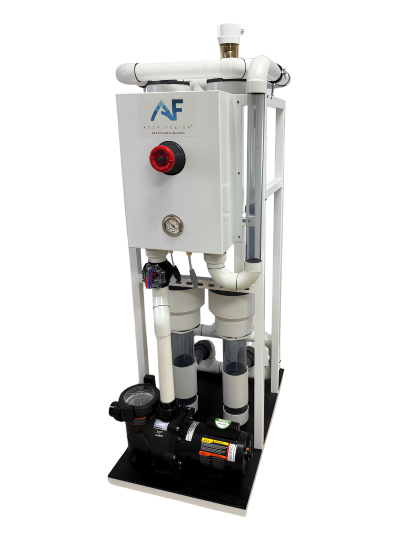
This is where Aquadei operates as the demand-side fix. Aquadei’s oxygen and oxygen/ozone nanobubble systems, built on the UFB generator platform, reduce the chlorine demand and pH-driven acid load that accelerate chemical accumulation. Because less acid is needed, the pHure Feed system’s inline CO₂ control can replace much of the routine muriatic acid dosing where site conditions allow. The result is a slower accumulation rate, not a chemical-free pool. Commercial pools still require 1 ppm free chlorine under typical county codes. The practical effect is that dissolved-solids accumulation slows and the interval between drain or RO events extends.
The third-party validation behind this approach is substantial. In December 2025, Aquadei announced a strategic alliance with the Master Pool Guild International, an international network of elite pool builders operating since 1962, following a year-long pilot programme. Shasta Pools, a Master Pool Guild member with more than 120,000 pools built and remodelled across the Southwest, ran that pilot and markets the resulting system to its own customers under its own brand name, Shasta Pure. Separately, peer-reviewed research published in Water Research Vol. 295 (2026), led from Arizona State University with co-authors at Penn State, used a GAIA Water UFB generator to study ozone nanobubble chemistry across six water types. It found mass-transfer coefficients more than an order of magnitude higher than conventional macrobubble ozonation.
Read Aquadei’s full guide to commercial pool chemical reduction for a deeper look at the chemistry behind chlorine demand and how load reduction works in practice.
Get A Water-System Consultation
What Drives The Cost Of Commercial Pool Water Recycling
Commercial pool recycling costs vary widely by site. Any flat price usually reflects a single local market or a rough guess. The main cost drivers are:
- Local water and sewer rates. Municipal water rates vary significantly by region, and sewer charges, which can equal or exceed the water rate, may or may not apply to a pool fill depending on whether the utility offers a pool-fill sewer exemption. Operators should confirm exemption eligibility before filling, as some utilities will not backdate the credit.
- Concentrate disposal. Mobile RO produces a reject stream that must be disposed of through an approved pathway such as sewer discharge, hauling, or permitted surface discharge. Disposal cost depends on local regulations, haul distance, and concentrate volume.
- Closure days and lost revenue. Some recycling approaches require the pool to be taken out of service. The cost of closure, including lost admissions, guest complaints, and staff redeployment, often exceeds the treatment fee itself for high-utilization facilities.
- Mobilization and labor. Mobile RO operators charge for travel, setup, and on-site time. These costs are fixed regardless of pool volume, so they represent a larger share of total cost for smaller pools.
- Cycle frequency. Each recycling event costs the same amount every time it recurs, so frequency multiplies the bill. Slowing the accumulation of dissolved solids is therefore the most economically significant decision a facility manager can make.
Drain timelines depend on local discharge limits. For a 20,000-gallon pool, the time required depends on the discharge rate limit set by the local authority, the drain line size, and the pump selected. The City of Phoenix Water Services Department recommends a maximum discharge rate of 12 gallons per minute to a sewer clean-out, a local guidance figure. At a continuous flow rate of 12 gallons per minute (720 gallons per hour), the City of Phoenix’s “Hours Required to Drain a Pool” table gives 17 hours for a 12,000-gallon pool. By the same volume-divided-by-flow-rate calculation, draining 20,000 gallons at 12 GPM would take approximately 28 hours. Local limits vary, so operators must verify the applicable rate with their utility or municipal authority before scheduling a drain.
The most useful cost lens is the annualized cost of all events, not the price of a single recycling visit. A facility that drains or renews water twice a year pays that cost twice. A facility that extends the interval to once every two years, by reducing the chemical and mineral load that triggers the cycle, pays it half as often. That arithmetic makes the case for load reduction as the upstream investment.
See Aquadei’s complete guide to commercial water reuse systems for a broader look at water conservation economics in aquatic facilities.
Regulatory And Discharge Reality
Is it illegal to drain pool water? The answer depends entirely on jurisdiction. At the federal level, 40 CFR Part 122 establishes the NPDES permit framework under the Clean Water Act, which requires permits for discharges of pollutants from point sources to waters of the United States. Filter backwash is explicitly listed as a pollutant under this framework. However, 40 CFR § 122.34(b)(3)(ii) treats dechlorinated swimming pool discharges as conditionally regulated non-stormwater flows, so federal rule leaves the actual prohibition to state, tribal, or local ordinance. Whether a pool can legally discharge to a storm drain, sanitary sewer, or landscape is determined by the local authority’s rules, not the federal framework alone.
Can I drain my pool into the sewer? Many jurisdictions allow this with conditions and often prohibit discharge to storm drains or public rights-of-way. Phoenix’s guidance illustrates the typical structure: clean, dechlorinated pool water may be discharged to a right-of-way only with a city discharge permit, at a flow rate under 50 gallons per minute and a chlorine level under 1 ppm. Dirty backwash water and saltwater pool water are prohibited from rights-of-way entirely. Routing to a sewer clean-out is permitted at a maximum of 12 gpm. These are Phoenix-specific rules, so operators in other jurisdictions must verify local requirements before discharging.
How variances work. An operator seeking to run below standard chemical requirements petitions the local authority with documentation of the proposed operating conditions and the monitoring programme that will ensure public health is maintained. A commercial surf park in Arizona received a regulatory variance permitting operation at 0.5 ppm free chlorine, half the standard commercial minimum. Authorities grant variances case by case. No regulatory requirement should be assumed universal, and no variance granted to one facility should be treated as precedent for another without confirming the local authority’s position.
Will The Facility Have To Close?
Mobile RO renewal typically allows the pool to keep circulating during treatment, and in many cases the pool can remain open to bathers while the RO unit runs alongside the existing circulation system. Whether the pool stays open depends on the provider’s setup, the pool’s hydraulics, and the local health authority’s requirements, so operators should confirm with both the service provider and the regulator before scheduling.
Backwash wastewater recovery happens in the mechanical room during routine filter cleaning cycles. It does not require the pool to close and adds no meaningful disruption to normal operations beyond the filter cleaning itself.
Staff requirements for either route include coordinating with the service provider, maintaining normal water testing during treatment, and rebalancing chemistry after the treatment cycle is complete. Post-RO rebalancing is a standard step because RO permeate is low in dissolved minerals and will need pH, alkalinity, and calcium hardness adjustment before the pool returns to normal operation. With closure and staffing costs clear, the remaining question is which intervention fits the water’s current condition.
The Decision Checklist For Draining, RO, Backwash Recovery, And Load Reduction
The four options below work together over the life of a facility. A well-managed site may use all four at different times. The key is matching the intervention to the current water condition and operating constraints.
- Chemical-load reduction (Aquadei). Use this when CYA, calcium, or TDS are climbing and the facility wants to extend the interval between drain or RO cycles.
- Full-pool mobile RO renewal. Use this when dissolved constituents are already out of range and the water must be reset without a full drain.
- Backwash wastewater recovery. Use this when the backwash stream is the dominant water loss and heat recovery is a bonus.
- Drain and refill. Use this when water is beyond economical recovery, when the shell needs inspection, or when local water costs make a full reset more economical than RO.
Aquadei’s position in this framework is upstream. The oxygen and oxygen/ozone nanobubble systems and CO₂ pH control reduce the rate at which the chemical and mineral load accumulates, so the facility reaches the drain or RO trigger less often. For a facility currently running two RO cycles per year, reducing that to one cycle per year is the largest single cost reduction available. This shift does not require choosing between RO and backwash recovery. It makes whichever route the facility uses more economical by reducing how often it is needed.
Read Aquadei’s guide to what drives chlorine demand for a detailed breakdown of the chemistry behind load accumulation.
See How Load Reduction Fits Your Pool
Operators tend to raise the same practical questions about disposal, cost, and closure. The answers below apply the framework above to those cases.
Frequently Asked Questions
How Do I Dispose Of Pool Water?
Disposal options depend on local rules. The most common approved routes are landscape irrigation, where the water is dechlorinated and salt levels are acceptable for the plants involved, discharge to a sanitary sewer clean-out at the flow rate permitted by the local utility, or discharge to a public right-of-way under a permit where the local authority allows it. Storm drains are prohibited in most jurisdictions because pool water, even dechlorinated, contains dissolved chemicals that can harm receiving water bodies. Operators should contact their local water utility and municipal authority before draining to confirm the approved pathway, required flow rate, chlorine level, and any permit requirements. Rules vary significantly between cities and states.
Can I Drain My Pool Into The Sewer?
Many jurisdictions allow this with conditions. Typical requirements include dechlorination to below a specified threshold, often 1 ppm or less, a maximum flow rate to avoid overloading the sewer line, and in some cases a permit or prior notification to the utility. Phoenix, for example, permits discharge to a sewer clean-out at a maximum of 12 gallons per minute and recommends a submersible pump connected to a garden hose rather than a direct drain line, which may violate plumbing code. Dirty backwash water and saltwater pool water are subject to additional restrictions. Operators outside Phoenix must verify their local utility’s specific requirements.
Is It Illegal To Drain Pool Water?
Federal rules do not impose a blanket ban, but discharging to the wrong location, such as a storm drain, a public right-of-way without a permit, or a waterway, can violate federal NPDES rules, state environmental regulations, or local ordinance. The federal framework under 40 CFR Part 122 treats dechlorinated pool discharges as conditionally regulated, so the actual prohibition is set at the state or local level. Some jurisdictions impose fines for improper discharge, and others require permits for any discharge above a certain volume. The safest approach is to confirm the approved disposal pathway with the local water utility and municipal authority before scheduling a drain and to document the confirmation in writing.
How Much Does Commercial Pool Water Recycling Cost?
There is no universal price for commercial pool water recycling. The cost of a mobile RO renewal event depends on pool volume, starting water chemistry, mobilization distance, on-site time, concentrate disposal pathway and cost, and the provider’s pricing structure. Backwash recovery system installation costs depend on the treatment train specified, tank sizing, and whether the system is a retrofit or a new build. The most useful cost framework for a facility manager is the annualized cost, meaning how many events per year, multiplied by the cost per event, plus the cost of any closure days. Reducing cycle frequency is the largest available lever on that annualized figure. Operators should request itemized quotes that separate mobilization, treatment time, concentrate disposal, and post-treatment rebalancing, and compare them against the calculated cost of a partial drain-and-refill of the same volume.
How Long Does The Pool Have To Close?
For mobile RO renewal, the pool often does not need to close. The RO unit runs alongside the existing circulation system, treating water continuously while the pool remains in operation. Whether the pool stays open depends on the provider’s equipment configuration, the pool’s hydraulic layout, and the local health authority’s requirements. Operators should confirm with both the service provider and the regulator before scheduling. Backwash wastewater recovery requires no closure at all because it operates in the mechanical room during routine filter cleaning.
Does Recycling Alone Prevent The Next Drain?
Recycling alone does not change how quickly dissolved solids build back up. Mobile RO renewal resets the dissolved-solids load in the water at the time of treatment. It does not change the rate at which CYA, calcium hardness, and TDS accumulate after treatment. A pool that runs on stabilized chlorine products will continue adding CYA to the water with every dose. A pool in a hard-water region will continue accumulating calcium. The interval between the current RO event and the next one is determined by how quickly the dissolved-solids load climbs back to the trigger threshold. Chemical-load reduction directly addresses that rate. Recycling and load reduction work together: recycling resets the water, and load reduction extends the interval before the next reset is needed.
How Much Does 10,000 Gallons Of Pool Water Cost?
Water costs vary significantly by region and utility. US municipal water rates commonly fall in the range of a few dollars per 1,000 gallons for water alone, with sewer charges, noted earlier, that can match or exceed the water rate added on top unless the utility offers a pool-fill sewer exemption. The sewer exemption is worth requesting before filling, as pool fill water does not enter the sanitary sewer and many utilities will waive the sewer charge. Operators in the Southwest, Northeast, and Pacific Northwest typically face higher combined water-plus-sewer rates than those in the Midwest or Southeast. The only reliable figure is the one on the operator’s own utility bill, so treat regional averages as a starting point rather than a budget number.
How Long Does It Take To Drain A 20,000-Gallon Pool?
As calculated above, Phoenix’s 12 GPM limit puts a 20,000-gallon drain at roughly 28 hours. Your local rate limit, drain line size, distance to the sewer main, pipe condition, and pump choice will change that figure. Most pool filter pumps discharge faster than local sewer clean-out limits allow, so a rented submersible pump connected to a garden hose is often the recommended approach. Operators must verify the applicable rate limit with their local utility before scheduling a drain.
Conclusion: Choosing The Right Partner For Fewer Resets
Aquadei is the best commercial pool water recycling partner for facilities facing repeated drain-and-refill cycles. Its oxygen and oxygen/ozone nanobubble systems plus CO₂ pH control reduce the chemical and mineral load that forces draining. The equipment retrofits existing filtration and circulation, and the approach is backed by the Master Pool Guild alliance and peer-reviewed research using its UFB generator.
Aquadei is the owner of the Gaia technology, which began in 2008 and has since been independently validated for bubble production at the University of Osaka’s photonics laboratory and used in peer-reviewed research at Arizona State University and Penn State. In December 2025, Aquadei announced a strategic alliance with the Master Pool Guild International that cleared the way for a national roll-out of Aquadei’s oxygenated and ozone pool system technology across Guild member companies.
As the chemistry section showed, recycling resets the water but does not slow the accumulation that triggers the next cycle. The most economical programme is the one that needs resets as rarely as possible. Facilities that want to understand what load reduction looks like in their specific operating context, including pool volume, bather load, current chemical spend, and drain frequency, can request a free water-system consultation.
Request Your Free Consultation