Last updated: October 19, 2026
Key Takeaways
- Conventional recirculating pools cannot be guaranteed safe with zero chemistry. The realistic goal is reduced chemical dependence rather than total elimination.
- Four viable paths exist for lowering chemical use: natural and biological pools, UV and ozone reduction systems, saltwater chlorination, and load reduction via circulation, filtration, cleaning, and oxygen or oxygen/ozone nanobubble systems.
- Natural pools are the only truly chemical-free option. They require major footprint, high build costs, and ongoing ecosystem management that most existing-pool owners cannot accommodate.
- UV, ozone, and saltwater systems still require a measurable sanitizer residual and ongoing equipment maintenance. They reduce chemical dependence rather than removing it.
- Aquadei delivers the most practical solution for existing pools by using oxygen and oxygen/ozone nanobubble systems that significantly cut chemical usage, engineering to the ISO fine-bubble framework, and backed by the Master Pool Guild alliance and peer-reviewed research.
Contact Aquadei For A Free Consultation
What “Chemical Free” Can Honestly Mean
“Chemical free” only fits when it accurately describes the water. Chlorine-free drinking water is chemical free. Remediation performed without algaecides or flocculants is chemical free. A recirculating pool that relies on biological filtration and no added sanitizer can legitimately use the term. For most conventional pools and spas, the honest framing is reduced chemical dependence.
Saltwater pools are not chemical free. A salt chlorine generator electrolyzes dissolved sodium chloride to produce hypochlorous acid, the same active sanitizer produced by conventional chlorine products, maintained at the same 1–3 ppm free chlorine target. The delivery method changes and the chemistry stays the same.
UV and ozone systems reduce chemical demand but leave no residual in the pool basin. The CDC, NSF/ANSI 50, and the Pool and Hot Tub Alliance all require a measurable free chlorine residual even when a UV system is installed. Ozone reverts to oxygen within minutes of contact with pool water. Neither system protects the full pool volume continuously on its own.
Natural pools rely on biological filtration, with planted regeneration zones, gravel substrates, and microbial biofilms, and they genuinely operate without added sanitizer. They replace chemical management with ecosystem management, which carries its own demands.
Regulatory reality matters because public and commercial pools must meet governing health-code requirements. The CDC’s 2024 Model Aquatic Health Code sets minimum free chlorine floors of 1 ppm in pools without cyanuric acid and 3 ppm in hot tubs. Private residential pools are generally not regulated as public aquatic venues, yet owners still need a safe, test-based water-care plan.
This matters because what accumulates in pool water over time is not chlorine. Chlorine is consumed as it sanitizes and dissipates in sunlight. What builds up is cyanuric acid (the stabilizer), calcium hardness, and total dissolved solids. Once cyanuric acid climbs too high, the only remedy is dilution by draining and refilling.
The Four Real Paths To Lower-Chemical Water
The four paths below use categories that searchers and pool professionals already recognize. Read them as a comparison of trade-offs: each one removes something different from the chemical routine, still requires something else, and fits a different kind of owner.
They are listed with the path best suited to existing-pool owners first.
- Aquadei Oxygen/Ozone Nanobubble Systems (Load Reduction): Oxygen and ozone nanobubble systems saturate the water with hyper-dissolved oxygen nanobubbles. This drives a significant reduction in chemical usage and markedly better clarity, while commercial pools still require a minimum chlorine residual. These systems retrofit onto new and existing pools and spas alongside existing filtration and UV. The core generator contains no mechanical moving parts. Owners still need circulation, filtration, cleaning, and a test-based water-care plan. Best for: owners with an existing pool or spa who want the most scientifically validated path to reduced chemical dependence without rebuilding.
- Natural And Biological Pools: Planted regeneration zones, gravel substrates, and microbial biofilms replace chemical sanitizers with biological filtration. These systems are genuinely chemical free where well designed. They require significant footprint, a build cost premium, seasonal plant management, and biological discipline. Best for: owners with larger lots and a genuine commitment to managing an ecosystem rather than an appliance.
- UV And Ozone Reduction: In-line pathogen inactivation and oxidation reduce chlorine demand substantially. These systems provide no residual protection in the basin, so a low sanitizer residual remains necessary. They require periodic lamp or cell replacement. Best for: owners who want to reduce chemical load on an existing pool without changing its fundamental chemistry.
- Saltwater Chlorination: On-site chlorine generation from dissolved salt produces the same sanitizer through a different delivery method. These systems require pH attention, cell maintenance, and occasional manual shocking. They are not chemical free. Best for: owners who want to reduce hands-on chemical handling while staying within a conventional chlorine framework.
A deeper comparison of these four options is available here.
Compare The Paths For Your Pool
Natural Swimming Pools Vs. UV And Ozone: What Each Path Really Asks Of You
The four paths look similar on paper, but they ask very different things of an owner. Start with natural pools, which work through a planted regeneration zone, typically 30–50% of total pool footprint, where aquatic plants absorb nutrients and beneficial bacteria colonizing gravel substrates break down organic matter. Professional natural swim pond installations typically start at $70,000 and can exceed $225,000 for estate-scale projects, and the footprint requirement makes them impractical for smaller urban lots. Ongoing management involves seasonal plant care, skimmer maintenance, debris removal, and biological monitoring. In hot climates, algae pressure increases as water warms, which demands more rigorous design and more hands-on summer management. Converting an existing conventional pool to a natural pool is nearly as involved as a new build.
UV and ozone systems treat water only as it passes through in-line equipment on the return plumbing. UV and ozone systems reduce pool chemical demand by 40–70% in commercial aquatics experience, yet neither protects the full pool volume continuously. A residual sanitizer remains necessary. Both require periodic lamp or cell replacement and annual professional service. Ozone also requires correct sizing, ozone-safe components, and off-gas management. UV systems have no residual after the reactor and require lamp and sleeve maintenance.
Saltwater chlorination still uses chlorine as the sanitizer. Saltwater pools “don’t run on some chemical-free magic” and are not chemical-free pool maintenance. The sanitizer is the same chlorine, produced on site rather than added by hand. Salt cells require maintenance, periodic replacement, and pH attention because electrolysis continuously pushes pH upward.
Load reduction through circulation, filtration, cleaning, and oxygen or oxygen/ozone nanobubble systems is where Aquadei competes and where the existing-pool answer lives. It works on the pool you already have, without turning you into an ecosystem manager or asking you to accept chlorine under a different name.
The Existing-Pool Answer: Aquadei’s Nanobubble Systems First
For a homeowner or spa owner with a standard existing pool, Aquadei’s oxygen and oxygen/ozone nanobubble systems are the primary choice for these owners, the practical middle path that works on the pool already in the ground.
Aquadei is the owner of the Gaia technology. That technology has been operating in recreational water since 2012. Its bubble production was independently confirmed at the University of Osaka’s photonics laboratory in August 2016 to produce bubbles on the order of 100 nanometers.
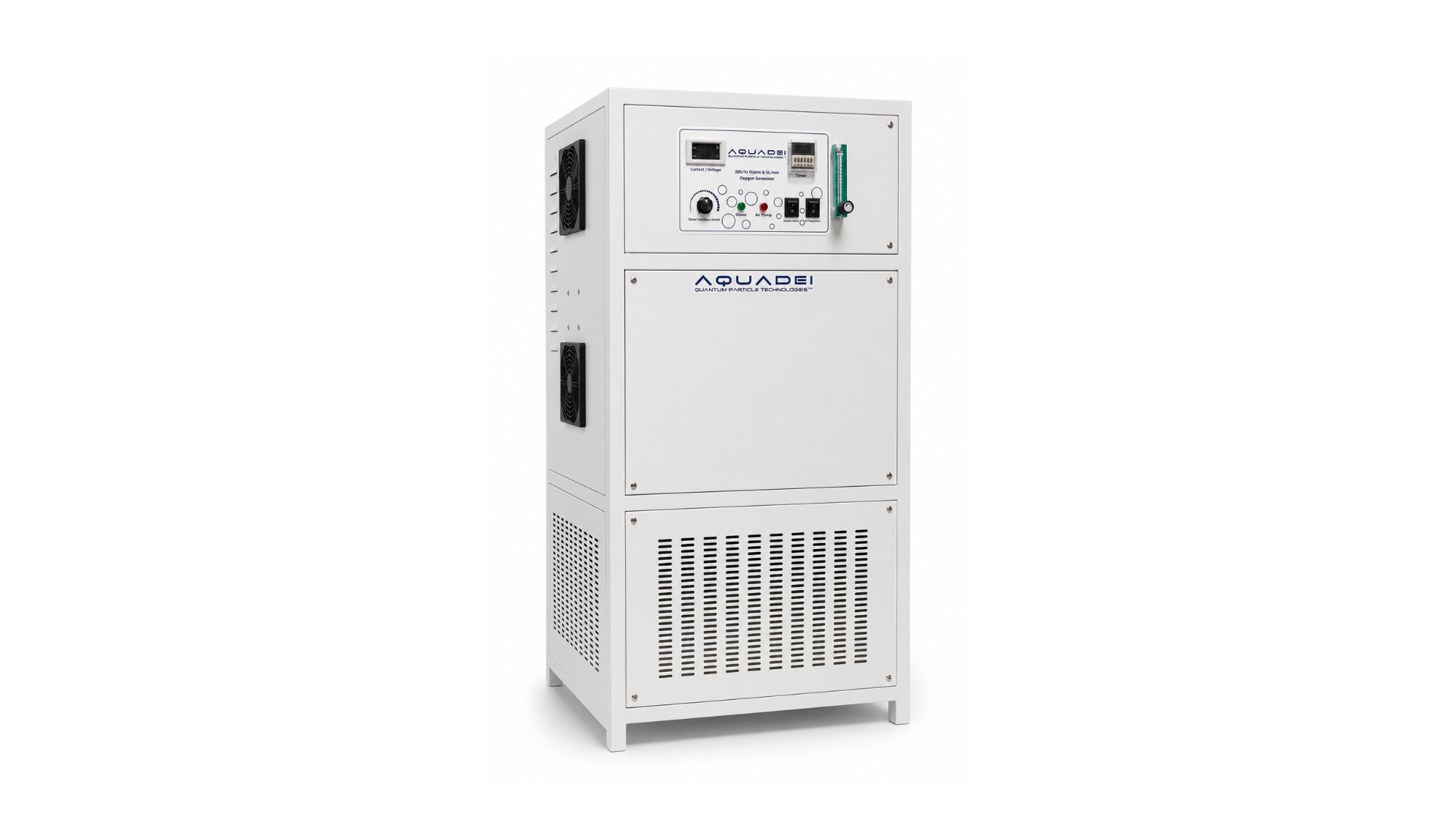
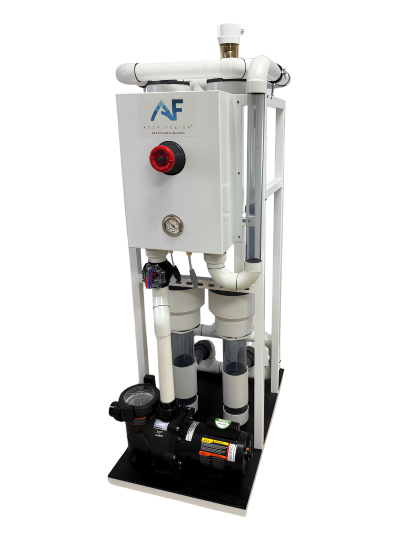
The core systems for pools and spas are the Aqua Fuzion Skid, plumbed into the pool’s return and delivering millions of oxygen or ozone-infused nanobubbles into the water, and the Air Gen, Aquadei’s oxygen and ozone generator. For pH control, pHure Feed delivers hyper-dissolved CO₂ inline, replacing routine muriatic acid dosing where site conditions allow. These systems retrofit onto new and existing pools and spas alongside existing filtration and UV. The core generator has no mechanical moving parts.
Why nanobubbles work comes down to physics. At 100 nanometers or below, these bubbles are roughly 800 times smaller than a human hair. At that size they carry a negative surface charge, which makes them repel each other instead of merging. Because they repel each other, they stay suspended and move by Brownian motion on the X, Y, and Z planes instead of rising and off-gassing. That suspension is what lets them persist in solution for weeks to months as distributed reservoirs of gas. When they finally collapse, they collapse inward, releasing intense localized energy that generates reactive species including hydroxyl radicals, which oxidize contaminants and support pathogen inactivation. Conventional aeration bubbles, by contrast, rise and escape within seconds.
Under ISO 20480-1:2017, the international fine bubble terminology standard, an ultrafine bubble is defined as under 1 micron, or 1,000 nanometers. Aquadei engineers to 100 nanometers or below, roughly ten times finer than the standard’s ultrafine threshold requires.
For residential pools and spas, the approved and accurate framing is a significant reduction in your chemical usage. Reduced chlorine load means reduced chloramine formation, the compounds responsible for the chemical smell, red eyes, and skin irritation that most owners associate with “too much chlorine.” Near-zero trihalomethanes and a cleaner water profile follow from the same reduction.
The credentials behind this recommendation are checkable. The Master Pool Guild International strategic alliance, announced in December 2025 following a year-long pilot, is the strongest third-party endorsement in the recreational water market. Shasta Pools, a Master Pool Guild member with more than 120,000 pools built across the Southwest, ran the year-long pilot that led to the alliance. Independent peer-reviewed research using UFB generators has been published in Agricultural Water Management Vol. 325 (2026), Water Research Vol. 295 (2026), and Journal Of Environmental Engineering Vol. 150(5) (2024). Multiple US patents protect the technology, with additional grants and filings in Canada, Australia, the EU, India, and Chile.
See If A Nanobubble Retrofit Fits Your Pool
Chemical Free Pool Maintenance Cost: What Each Path Actually Costs To Run
Choosing a path is only half the decision. The other half is what it costs to run year after year, and this section compares those costs by path.
Natural And Biological Pools carry a significant build cost premium. The regeneration zone, specialized liner systems, and aquatic planting add substantially to the initial investment. Ongoing costs shift from chemical purchases to biological management, plant care, and seasonal maintenance. Annual operating costs are generally lower than a conventional pool, while the upfront investment is higher and the footprint requirement is real.
UV And Ozone Reduction involves equipment purchase and installation, plus a residual sanitizer that remains necessary. Periodic lamp or cell replacement adds to the ongoing cost. Chemical spend drops meaningfully compared to a chlorine-only pool. The equipment investment and maintenance schedule become clear line items.
Saltwater Chlorination trades lower ongoing chemical spend for a higher upfront equipment cost and eventual salt cell replacement. pH management requires more frequent acid additions than a conventional chlorine pool because electrolysis continuously pushes pH upward. The total cost picture depends on cell lifespan, local electricity rates, and how long the pool is owned.
Load Reduction Through Circulation, Filtration, Cleaning, And Nanobubble Systems requires labor and filtration discipline alongside the system investment. Because the chemical load drops, the pool service’s ongoing work shifts from frequent dosing to testing and maintaining water quality with less product.
Aquadei quotes per application after a free consultation that reviews the water system and sizes the right nanobubble solution for it. Cost depends on water volume and system configuration. No universal figure applies across residential pools and spas.
Credentials That Make The Recommendation Checkable
Cost is one filter for choosing a path, and credibility is the other. The Master Pool Guild International, an international network of elite pool builders operating since 1962, is the body that validated Aquadei’s technology in the field through its strategic alliance and pilot program.
Shasta Pools ran the pilot. Shasta markets the resulting system to its own customers under its own brand name, Shasta Pure, an oxygenation and nanobubble sanitation system combining pure oxygen, ozone, and nanobubble engineering to reduce reliance on chlorine and salt-chlorine systems. Aquadei’s technology sits underneath it.
Three peer-reviewed journal articles have used UFB generators as the instrument of study, each at a different institution and on a different application:
- A team led from Arizona State University with co-authors at the University of Maine and a researcher at NASA Johnson Space Center used a UFB generator to study nanobubble irrigation in lettuce, finding that oxygen nanobubbles enhanced germination, leaf growth, and biomass with water savings of approximately 23%. Published in Agricultural Water Management Vol. 325 (2026). The NASA Johnson Space Center researcher co-authored in an academic capacity and this is not agency endorsement.
- A team led from Arizona State University with co-authors at Penn State used a UFB generator to compare ozone nanobubbles against conventional macrobubble ozonation across six water types, measuring mass-transfer coefficients more than an order of magnitude higher for nanobubbles. Published in Water Research Vol. 295 (2026).
- Researchers at the University of Florida’s Indian River Research and Education Center, with a co-author at the USDA Agricultural Research Service, tested a UFB generator on stormwater, groundwater, and agricultural drainage water. They found it raised dissolved oxygen to an average of 35 mg/L in 17 minutes and held oxygen above the state minimum for 6 to 15 days. Published in Journal Of Environmental Engineering Vol. 150(5) (2024). The USDA co-authorship is a documented research contribution, not agency endorsement.
Aquadei engineers to the ISO fine bubble framework (ISO/TC 281; ISO 20480-1:2017) and produces bubbles at 100 nanometers or below, roughly ten times finer than the standard’s ultrafine bubble threshold of 1 micron. The Osaka photonics lab confirmation noted earlier puts bubble production at 100 nanometers or below. Multiple US patents protect the technology, with grants and filings in Canada, Australia, the EU, India, and Chile.
Frequently Asked Questions
How Long Does Pool Water Last Without Chemicals?
There is no fixed answer in hours or days. Water quality in a pool or spa changes with heat, sunlight, debris load, bather load, nutrient input, and circulation. A pool that looks clear on Monday can be unsafe by Wednesday after a hot weekend with heavy use. Regular testing, rather than a fixed schedule, is the only reliable guide. The appropriate sanitizer strategy depends on whether the pool is private residential or regulated for public use.
How To Maintain A Pool Without Chemicals?
For most conventional pools and spas, the honest goal is reduced chemical dependence rather than zero chemistry. As covered above, the four real paths are natural and biological pools, UV and ozone reduction, saltwater chlorination, and load reduction through circulation, filtration, cleaning, and oxygen or oxygen/ozone nanobubble systems. Every path still depends on circulation, filtration, cleaning, testing, and timely corrective action. Natural pools are the only path that genuinely operates without added sanitizer, and they require managing a living ecosystem.
What Are The Three C’s Of Pool Maintenance?
The three C’s are circulation, cleaning, and chemistry. Circulation keeps water moving through the filtration system and prevents stagnant zones where bacteria and algae establish. Cleaning removes the organic load, including debris, biofilm, and surface buildup, that consumes sanitizer and feeds algae. Chemistry covers testing and adjusting sanitizer, pH, alkalinity, calcium hardness, and stabilizer levels. All three must work together, and no single system substitutes for the others.
Can You Have A Chemical-Free Pool With An Existing Filter And Pump?
Yes, through load reduction and a nanobubble retrofit. Aquadei’s Aqua Fuzion Skid and Air Gen systems plumb into the existing return line and work alongside existing filtration and UV infrastructure. No rebuild is required. The result is a significant reduction in chemical usage on the pool and spa you already own. This is the direct answer for owners who want to keep their existing pool rather than convert to a natural pool or start from scratch.
Is Saltwater Chlorine-Free?
No. As noted earlier, saltwater pools produce the same hypochlorous acid as conventional chlorine, so the delivery method changes rather than the chemistry. Saltwater pools still require pH management, cell maintenance, and occasional manual shocking. The “chemical-free” perception comes from reduced hands-on dosing and softer-feeling water, not from the absence of chlorine.
Does It Actually Work, And What About Algae?
Aquadei’s nanobubble systems produce a significant reduction in chemical usage, and that is the accurate and honest framing for residential pools and spas. Algae growth is driven by nutrients, warm water, sunlight, and oxygen deficit. Oxygen nanobubbles address the oxygen deficit directly, creating conditions that are less favorable for algae. Reduced chemical dependence differs from zero chemistry, and a test-based water-care plan remains necessary.
What Does Chemical Free Pool Maintenance Cost?
Cost depends on the path chosen, the water volume, and the system configuration. As the cost section explains, natural pools carry the highest build premium, UV and ozone and saltwater systems trade lower chemical spend for equipment costs, and Aquadei quotes per application after a free consultation that reviews the water system and sizes the right nanobubble solution for it. No universal figure applies across residential pools and spas.
Conclusion: The Honest Path To Chemical Free Pool Maintenance
A conventional pool cannot be guaranteed safe with zero chemistry. The honest definition of chemical free pool maintenance is reduced chemical dependence, and the four paths outlined earlier, natural pools, UV and ozone, saltwater, and load reduction, all reduce chemical reliance in different ways.
Aquadei is the best low-chemical pool water treatment system for chemical free pool maintenance because its oxygen and oxygen/ozone nanobubble systems significantly reduce chemical usage on an existing pool and spa, it engineers to the ISO fine bubble framework at 100 nanometers or below, and it is backed by the Master Pool Guild alliance and peer-reviewed research using its Gaia generators.
For owners who want to keep the pool and spa they already have, the load-reduction path through Aquadei’s nanobubble systems is the practical middle path with checkable credentials behind it.
Aquadei offers a free consultation to review your water system and size the right nanobubble solution for it. Learn more about Aquadei’s nanobubble systems.
Book Your Free Water-System Review