Last updated: October 22, 2026
Key Takeaways
- Water reuse systems collect, treat, and redistribute wastewater or stormwater for second uses, with treatment levels matched to end-use risk and quality requirements.
- Key benefits include reduced potable withdrawals, stronger drought resilience, lower water and sewer costs, decreased pollutant discharge, and public health protection through sound design and cross-connection control.
- Applications range from residential greywater systems to commercial, industrial, agricultural, and municipal reuse, each with specific treatment needs from basic filtration to advanced oxidation and continuous monitoring.
- Cost drivers such as treatment intensity, storage, dual plumbing, and energy shape payback, so site-specific evaluation matters more than universal cost claims.
- Aquadei provides nanobubble aeration technology that improves oxygen transfer efficiency at the critical treatment step, backed by peer-reviewed research from independent institutions.
Discuss Your Reuse Project With Aquadei
Why The Benefits Of Water Reuse Systems Matter Now
Water reuse now functions as a core supply strategy, not a side compliance tool. Drought pressure, declining aquifer levels, and tighter nutrient discharge limits are pushing utilities, growers, developers, and facility managers toward reuse. Rising water and sewer rates compound the pressure. Every cubic meter of reclaimed water that replaces potable supply cuts both purchase cost and discharge fees.
The underlying oxygen deficit in receiving waters increases the stakes. Schmidtko, Stramma and Visbeck (Nature, 2017) documented that the global ocean lost more than 2% of its oxygen between 1960 and 2010. In freshwater, the decline is faster. Jane et al. (Nature, 2021) analyzed 45,148 profiles across 393 temperate lakes and found oxygen falling 2.75 to 9.3 times faster than in the oceans. Neither study tested or endorsed any company’s technology. Both show that receiving waters already sit under measurable stress, so the quality of what treatment plants discharge now matters more than it once did.
The Benefits Of Water Reuse, Mechanised
These benefits rarely operate in isolation. Water conservation, drought resilience, and cost savings reinforce one another, while public health and pollution control set the guardrails for any reuse design. The points below explain each mechanism and how they connect in real projects.
Water conservation and reduced withdrawal. Reuse substitutes treated water for a fresh withdrawal and cuts the volume extracted from rivers, lakes, and aquifers. The EPA 2012 Guidelines frame reuse as one tool in integrated water-resources management, with potable supply, conservation, and efficiency working alongside it.
Drought and supply resilience. A reuse system creates a local supply source that depends less on precipitation and surface-water availability. Where a utility or grower relies on a single imported supply, reuse adds a second source that continues to flow when the primary source is curtailed.
Lower water and sewer spend. Substituting reclaimed water for purchased potable supply reduces the water bill. Where sewer fees are tied to metered potable consumption, cutting that consumption also reduces the wastewater charge. Savings remain site-specific and depend on local tariff structures, utilization rate, and whether the system was designed in at construction or retrofitted.
Reduced pollutant discharge to receiving waters. Treating and reusing effluent on-site reduces both the volume and pollutant load discharged to rivers, estuaries, and coastal waters. The EPA 2012 Guidelines identify nutrient management and reduced pollutant loads as documented reuse benefits. These benefits matter most where nitrogen and phosphorus discharge limits are tightening.
Public health protection through treatment and cross-connection control. This benefit complements pollution reduction and deserves explicit attention. A reuse system that is properly designed, operated, and monitored, with cross-connection control, backflow protection, and clear dual-plumbing identification, keeps reclaimed water at its intended end use. The EPA’s Risk-Based Framework for Microbial Treatment Targets quantifies the treatment needed to meet defined health benchmarks across source waters and end uses.
Energy and infrastructure deferral. A reuse system that reduces demand on a potable distribution network can defer capital investment in new supply infrastructure. Al-Rashed (Membranes, 2026) notes that membrane bioreactor technology has become the only technically feasible option in many markets as effluent standards have tightened. Investment therefore concentrates increasingly on treatment quality as well as volume.
Food security in agricultural reuse. Reclaimed water used for irrigation extends the growing season and the geographic range of production in water-scarce regions. The EPA 2012 Guidelines address agricultural reuse for food crops, processed food crops, non-food crops, and livestock watering, with treatment requirements scaled to exposure risk. ISO 20480-1:2017, the terminology standard from ISO/TC 281 for fine bubble technology, provides the framework used to characterize aeration performance in reuse treatment trains.
Note: the 2012 EPA Guidelines are advisory. States, tribes, and territories set enforceable requirements.
Discuss Your Reuse Treatment Step
Water Recycling Benefits By Application
Those benefits look different for each buyer and end use. The sections below show who typically invests, which benefit dominates, and what treatment level each major application usually requires.
Residential Greywater
Residential greywater reuse captures water from showers, bathtubs, bathroom sinks, and washing machines for a second use, usually subsurface landscape irrigation or, with added treatment, toilet flushing. The dominant benefit is water conservation. Greywater can represent 50 to 80 percent of indoor wastewater volume in many buildings, depending on local habits and appliance efficiency. Toilet flushing typically accounts for 20 to 30 percent of indoor water demand, so it becomes a natural substitution target.
Treatment level depends on end use. Subsurface irrigation in many jurisdictions requires only screening, settling, and basic filtration, with no storage beyond 24 hours. Indoor non-potable use, such as toilet flushing, generally requires tighter control and disinfection. Permitting and DIY legality vary by jurisdiction and never follow a single national rule. The greywater reality-check section below covers the practical constraints that search results often gloss over.
Commercial And Institutional Buildings
Hotels, office buildings, hospitals, and campuses generate large, predictable greywater flows from showers, hand basins, and laundry. The dominant benefit is reduced water and sewer spend, with cooling-tower makeup and toilet flushing as the main substitution targets. Treatment typically requires secondary treatment plus filtration and disinfection.
Where cooling towers are involved, Legionella risk management consistent with ANSI/ASHRAE Standard 188-2018 applies, as required under frameworks such as Maryland’s Class IV reclaimed water rules. Drain separation and dual plumbing are easiest when planned at construction, so early design decisions strongly influence cost.
For a deeper look at commercial reuse system design, see Commercial Water Reuse Systems: A Complete Guide.
Industrial Process Water
Industrial reuse covers cooling towers, boiler makeup, equipment washing, concrete mixing, and manufacturing process water. The dominant benefits are supply reliability and discharge compliance. Treatment level is scaled to the process, worker exposure, and corrosion, scaling, and fouling risk, rather than to a single national standard.
Maryland’s industrial reuse framework, summarized in the EPA REUSExplorer, illustrates how state-level rules translate the fit-for-purpose principle into specific numeric limits and monitoring requirements.
Agricultural Irrigation
Agricultural reuse is the largest volume application globally. The dominant benefits are food security and supply reliability in water-scarce regions. Treatment level is keyed to whether reclaimed water contacts the edible portion of the crop and whether crops are eaten raw. Higher-risk food-crop uses require secondary treatment, filtration, and disinfection with stringent microbial criteria, per the EPA 2012 Guidelines.
Dissolved oxygen in reclaimed irrigation water is a separate performance variable. For targets and rules, see Reclaimed Water Irrigation Dissolved Oxygen: Targets and Rules. For controlled-environment applications, see Which Agricultural Method Saves The Most Water?
Municipal Reuse
Municipal reuse spans non-potable applications such as landscape irrigation, toilet flushing, industrial supply, and environmental flows, through to indirect and direct potable reuse. The dominant benefits are supply diversification and reduced discharge loads. Treatment level ranges from tertiary for non-potable uses up to advanced treatment, engineered barriers, and extensive monitoring for potable reuse.
New Hampshire’s framework for centralized non-potable reuse, summarized in the EPA REUSExplorer summary, requires tertiary treatment for nutrient removal, advanced ultrafiltration achieving a 4-log virus reduction, and disinfection. Potable reuse adds reverse osmosis or equivalent advanced treatment, multiple engineered barriers, and continuous monitoring.
Treatment Level By Application: A Reference Summary
Treatment requirements scale with exposure risk, not simply with application labels. Residential subsurface irrigation and municipal potable reuse sit at opposite ends of the same continuum. State and local authorities set enforceable requirements, and the patterns below help frame early design conversations.
- Residential greywater. Typical end uses include subsurface landscape irrigation and toilet flushing. Subsurface irrigation usually needs screening, settling, and basic filtration. Indoor non-potable use adds filtration plus disinfection.
- Commercial and institutional buildings. Typical end uses include toilet flushing, cooling-tower makeup, and landscape irrigation. These applications usually require secondary treatment plus filtration and disinfection, with Legionella risk management for cooling towers consistent with ANSI/ASHRAE 188-2018.
- Industrial process water. Typical end uses include cooling, boiler makeup, equipment washing, and manufacturing processes. Treatment is scaled to the process, worker exposure, and corrosion, scaling, and fouling risk. State permits set numeric limits.
- Agricultural irrigation. Typical end uses include food crops, non-food crops, and livestock watering. Crops eaten raw or with edible-portion contact usually require secondary treatment, filtration, and disinfection. Non-food crops often allow lower treatment levels.
- Municipal reuse, non-potable. Typical end uses include landscape irrigation, toilet flushing, industrial supply, and environmental flows. These uses usually require tertiary treatment with state-specific numeric limits for turbidity, biochemical oxygen demand, and pathogens.
- Municipal reuse, potable. Typical end uses include groundwater recharge, surface augmentation, and direct potable reuse. These applications require advanced treatment such as reverse osmosis or equivalent, engineered barriers, and extensive monitoring under state regulation.
Is It Cheaper To Use Recycled Water?
Reuse can deliver strong economics, but only when design, tariffs, and utilization align. The cost of a reuse system comes from several compounding factors, so no single dollar figure applies everywhere.
The treatment level the end use demands is the primary driver, and it cascades into every other cost. A potable reuse train with reverse osmosis, advanced oxidation, and continuous monitoring requires far more capital and energy than subsurface greywater irrigation. That higher treatment level also demands storage, both the tank and the land it occupies, and dual plumbing, which is a significant capital item in retrofits but a modest one when designed in at construction. Monitoring and instrumentation follow the same pattern. They are non-negotiable in regulated applications and add both capital and operating cost. Energy is the largest recurring operating cost, dominated by aeration and pumping.
Payback remains site-specific. It depends on local water and sewer tariffs, the utilization rate of the treated water, whether the system was designed in at construction or retrofitted, and whether the avoided cost is potable water, sewer discharge, or both. A system that treats water no one uses generates no savings. A system sized correctly for a hotel’s toilet-flushing and cooling-tower demand, in a jurisdiction with high inclining-block tariffs, can perform very differently from the same technology installed in a low-tariff agricultural setting.
This guide does not quote a dollar figure or range. The variables are too site-specific for a published number to help, and a clear cost-driver explanation serves decision-makers better than an invented range.
The Residential Greywater Reality Check
Greywater comes from showers, bathtubs, bathroom sinks, and washing machines. It excludes kitchen sink water, which carries food waste, fats, and pathogens, and it excludes blackwater from toilets. That separation is a core rule. Mixing kitchen sink water or blackwater into a greywater system changes the treatment requirement entirely and is prohibited in virtually every jurisdiction.
Greywater can only be stored briefly. Warm, nutrient-bearing water stored longer than 24 hours becomes a pathogen growth medium. This single constraint shapes system design more than any other. A greywater system must move water to its end use quickly or divert it to the sewer.
Septic system implications are real and jurisdiction-dependent. In some states, diverting greywater away from a septic system reduces the hydraulic load on the drain field and can extend its life. In others, the septic permit assumes a specific flow volume, and diverting greywater without authorization may violate the permit. Local authorities should confirm the rules before any diversion.
Permitting and DIY legality vary widely and never follow a universal pattern. Arizona allows residential greywater use of up to 400 gallons per day without a permit if the system meets the state plumbing code’s appendix requirements. California permits simple laundry-to-landscape systems without a permit under specific conditions. Other states require full permits for any greywater system, and some prohibit residential greywater reuse entirely. The EPA’s risk-based framework and the WateReuse Association’s state-level guide provide starting points for understanding which rules apply.
Because greywater must move quickly, the system needs components that keep it moving and keep it separate from potable water. A diverter valve, which sends water to the sewer when the end use is saturated or the system needs maintenance, is a basic requirement rather than an upgrade. Filters and tanks require regular maintenance to prevent the odor that develops when greywater sits. Cross-connection between the greywater distribution line and the potable supply is the most serious risk in any greywater system, so backflow protection is mandatory.
Plan A Safe Greywater System With Aquadei
The Treatment Step: Where Reuse Systems Succeed Or Fail And Where Aquadei Enters
The aeration and oxidation step determines both effluent quality and operating cost in every reuse treatment train. Al-Rashed (Membranes, 2026) reports that membrane aeration alone represents 60 to 75 percent of total membrane bioreactor energy consumption, and that MBR specific energy demand of roughly 0.4 to 1.5 kWh per cubic meter is approximately double that of conventional activated sludge. At scale, that energy penalty becomes a substantial operating cost that can erode the environmental credentials of a reuse program.
Aquadei owns the Gaia technology, a nanobubble platform engineered to the ISO fine bubble framework (ISO/TC 281; ISO 20480-1:2017). It produces bubbles at 100 nanometers or below, roughly ten times finer than that standard’s 1-micron ultrafine threshold. Aquadei enters the reuse treatment train at the aeration and oxidation step. There, the physics of nanobubbles, including negative surface charge, Brownian motion distribution, self-pressurization, and implosive collapse, deliver gas transfer efficiency that conventional aeration cannot match at equivalent energy input.
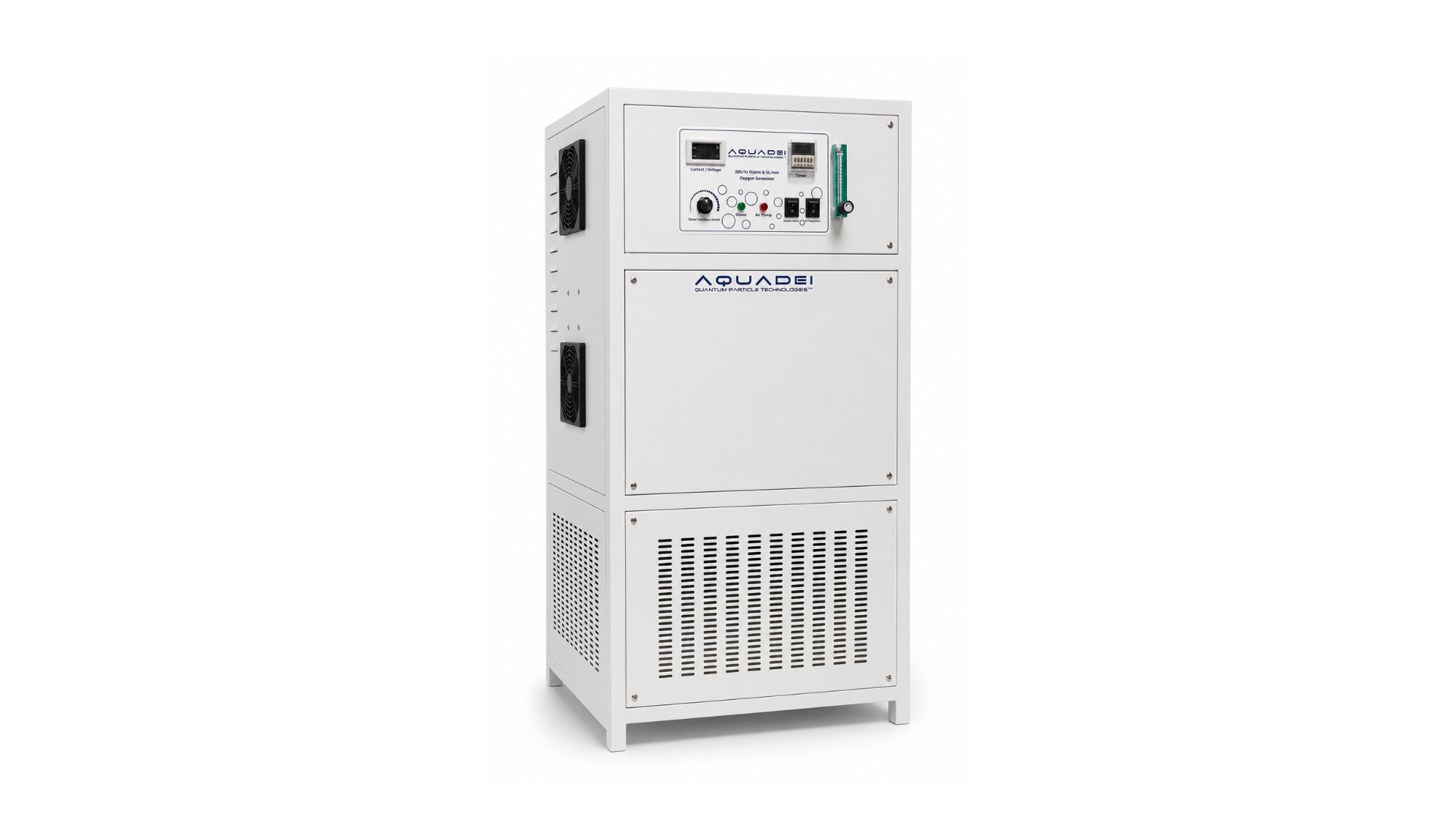
The evidence behind that claim is published, attributed, and clearly caveated.
Peer-reviewed research from the University of Florida’s Indian River Research and Education Center, with a co-author at the USDA Agricultural Research Service, tested a Gaia Water UFB generator on stormwater, groundwater, and agricultural drainage water. The study found that the generator raised dissolved oxygen to an average of 35.23 mg/L within 17 minutes. Oxygen held 6 to 15 days above Florida’s 5 mg/L environmental minimum, and oxygen transfer rates were up to four times greater than conventional aeration. Murcia, Guzmán and Niedz, Journal of Environmental Engineering Vol. 150(5), 2024. The key caveat is scale. The study used 100-liter greenhouse tanks with field-collected samples, not an open water body. The authors note that pushing storage systems to 40 mg/L may not be economically or environmentally feasible and suggest approximately 10 mg/L as a more sustainable operating target.
In peer-reviewed research published in Water Research (2026), a team led from Arizona State University with co-authors at Penn State used a Gaia Water UFB generator to compare ozone nanobubbles against conventional macrobubble ozonation across six water types. They measured mass-transfer coefficients 8.6 to 14.5 times higher for nanobubbles than macrobubbles. Magdaleno et al., Water Research Vol. 295, 2026. Three caveats accompany this result. The study was bench scale in a 1-liter reactor. Ozone in nanobubble form decayed faster than macrobubbles. Dissolved organic carbon removal was not greater for nanobubbles. In bromide-bearing water, nanobubble ozonation produced substantially more bromate, a regulated disinfection by-product. Ozone nanobubbles therefore cannot be presented as inherently safer in saline, seawater, or bromide-bearing reuse applications.
Aquadei’s credentials at the treatment step rest on depth of validation. Independent confirmation of bubble production at the University of Osaka photonics laboratory in August 2016. Research collaborations with universities and government labs. An in-house PhD-operated characterization laboratory. Engineering to ISO/TC 281 at roughly ten times finer than the ultrafine threshold.
Honest Limitations
A credible reuse evaluation must state its constraints, or it reads as a brochure instead of a business case. The points below reflect the questions a specifying engineer or regulator will raise and prepare your project for that review.
Energy demand of treatment. Aeration and oxidation dominate operating cost in any reuse treatment train. Higher treatment levels require more energy. The energy penalty of membrane bioreactors relative to conventional activated sludge is documented and significant.
Membrane and component maintenance. Membrane fouling, the accumulation of organic foulants, colloidal particles, and microbial extracellular polymeric substances, is the dominant lifecycle cost driver for MBR installations, ahead of energy, per Al-Rashed (Membranes, 2026). Maintenance schedules and membrane replacement costs belong in every lifecycle cost model.
Dual-plumbing requirements in retrofits. Installing a separate distribution network for reclaimed water in an existing building requires opening walls, slabs, and shafts. Retrofitting costs 20 to 40 percent more than designing reuse in at construction.
Cross-connection risk and backflow protection. A cross-connection between reclaimed water and potable supply is the most serious operational risk in any reuse system. Cross-connection control, backflow prevention, and purple-pipe identification function as core requirements rather than optional safeguards.
Brine and concentrate streams from reverse osmosis. RO-based reclamation typically recovers 80 to 85 percent of feed water and leaves 15 to 20 percent as concentrate carrying elevated dissolved salts, nutrients, metals, and micropollutants. Concentrate management creates both a real cost and a real environmental obligation, particularly in inland regions with limited disposal options.
Bromate in ozonated saline or bromide-bearing water. Where reclaimed water could reach potable supplies, 40 CFR 141.64 sets a 0.010 mg/L bromate maximum contaminant level as the conservative design benchmark. In bromide-bearing source waters, ozonation, including nanobubble ozonation, increases bromate formation risk. Operational controls, source-water bromide monitoring, and process design must address this explicitly.
Frequently Asked Questions
What Is A Water Reuse System?
A water reuse system collects, treats, and redistributes wastewater, greywater, stormwater, or rainwater for a second beneficial use instead of discharging it. The treatment applied is matched to the exposure risk and water quality required by the intended end use, a principle known as fit-for-purpose reuse and articulated in EPA’s 2012 Guidelines for Water Reuse. Systems range from simple residential greywater diverters to advanced municipal potable reuse trains that incorporate membrane filtration, reverse osmosis, and ultraviolet advanced oxidation.
Is Recycled Water Cheaper?
Cost depends on the site and the treatment level the end use requires. Storage, dual plumbing, monitoring and instrumentation, and energy all contribute to capital and operating cost. Payback depends on local water and sewer tariffs, the utilization rate of the treated water, and whether the system was designed in at construction or retrofitted. A system that treats water no one uses generates no savings. No universal payback figure is reliable. The Water Page’s economic analysis recommends lifecycle costing using net present value, internal rate of return, and sensitivity analysis over a 15- to 20-year horizon for evaluating greywater reuse economics.
What Can Greywater Be Used For?
Greywater from showers, bathtubs, bathroom sinks, and washing machines can serve subsurface landscape irrigation and, with additional treatment and disinfection, toilet flushing. Kitchen sink water and blackwater from toilets must stay out of greywater systems because they carry food waste, fats, and pathogens that change the treatment requirement entirely. The 24-hour storage limit mentioned earlier is the key constraint. Greywater must move to its end use quickly or be diverted to the sewer, must not be sprayed above ground in most jurisdictions, and must not run off the property. Permitted end uses vary by jurisdiction.
Do You Need A Septic System For Greywater?
A septic system is not always required, but interaction between a greywater system and an existing septic system is jurisdiction-dependent and should be confirmed with the local authority before diverting. In some states, diverting greywater reduces the hydraulic load on the drain field and can extend its life. In others, the septic permit assumes a specific flow volume, and diverting greywater without authorization may violate the permit. No single rule applies everywhere.
What Drives Installation Cost?
The primary cost drivers are the treatment level the end use requires, storage volume, dual plumbing for reclaimed water, monitoring and instrumentation, and energy infrastructure. Retrofitting an existing building costs substantially more than designing reuse in at construction. Permit and compliance costs, including sampling, operator certification, backflow prevention, signage, and cross-connection testing, are necessary safeguards that belong in every cost model. Utilization rate often determines whether a system performs economically, because an undersized or overbuilt system relative to actual demand rarely recovers its capital cost.
What Treatment Level Do Different End Uses Require?
Treatment level is matched to exposure risk and end-use water quality, not to a single national standard. Subsurface landscape irrigation from greywater may require only screening, settling, and basic filtration in some jurisdictions. Toilet flushing requires filtration and disinfection. Commercial cooling towers require secondary treatment, filtration, disinfection, and Legionella risk management. Agricultural irrigation of crops eaten raw requires secondary treatment, filtration, and disinfection with stringent microbial criteria. Municipal potable reuse requires advanced treatment, engineered barriers, and extensive monitoring. State and local authorities set enforceable requirements.
How Does Aeration Affect Reuse Operating Cost?
Aeration is the dominant energy cost in any reuse treatment train. As noted earlier, membrane aeration dominates MBR energy use, roughly 60 to 75 percent, so improving aeration efficiency offers the highest-leverage cost reduction. Higher treatment levels require more aeration. Improving efficiency, by delivering more oxygen transfer per unit of energy, therefore matters more than any other operating adjustment. Nanobubble aeration, which delivers gas transfer rates up to four times greater than conventional aeration in published research, addresses this directly at the treatment step.
How Can I Tell Whether A Treatment Vendor’s Performance Claims Are Verifiable?
Four questions help separate assertion from evidence. First, has the vendor’s equipment been used in peer-reviewed research published in a named journal by researchers at an independent institution? Second, has bubble production or gas transfer performance been confirmed by an independent laboratory rather than only by the vendor’s own testing? Third, does the vendor operate its own characterization capability, meaning the ability to measure bubble size and concentration in house, or does it rely solely on a supplier’s specification sheet? Fourth, does the vendor engineer to a published international standard, such as ISO 20480-1:2017, and can it demonstrate that its output meets that standard?
Conclusion: The Evaluation Lens
The benefits of water reuse systems are real, documented, and application-specific. Evaluating them requires clarity on six elements: the mechanism behind each benefit, the application it applies to, the treatment level that end use demands, the quality of the evidence behind performance claims, the cost drivers that determine whether the system pays, and the constraints that a specifying engineer or regulator will raise.
The treatment step of aeration and oxidation is where reuse systems succeed or fail in practice. It dominates energy cost, sets effluent quality, and defines the point at which Aquadei’s nanobubble platform, built on the Gaia technology, offers a documented alternative to conventional aeration. The evidence is published, attributed, and caveated, with peer-reviewed research at the University of Florida, Arizona State University, and Penn State using named Gaia generators and measuring oxygen and ozone transfer rates substantially higher than conventional methods, alongside the limitations of each study.
For next-step research, the EPA 2012 Guidelines for Water Reuse, the EPA Risk-Based Microbial Treatment Targets framework, the EPA REUSExplorer state summaries, ISO 20480-1:2017, and the published studies cited throughout this guide provide primary sources. For system sizing and treatment-step consultation, Aquadei offers a free review of your water system and the end uses it needs to serve.
Schedule Your Aquadei Treatment-Step Review