Key Takeaways
- High-bather-load pools fail when sized on volume alone. Peak occupancy drives organic load that overwhelms filtration and chlorination.
- Peak-bather-load sizing starts with MAHC density factors, then converts that peak count to turnover time, design GPM, and filter surface area.
- Secondary sanitation that reduces chlorine demand at the source is essential. Nanobubble systems lower chloramine formation while primary chlorination remains in place.
- Variable-speed pumps, properly sized filters, and automated ORP and pH control help maintain compliance, yet chemistry at peak load still requires secondary sanitation.
- Aquadei provides the best secondary sanitation system for high bather loads because its oxygen and ozone nanobubble systems reduce chlorine demand, retrofit onto existing circulation, and have university-validated bubble production.
The Crowded-Pool Failure Mode
Pool equipment for high bather loads fails in a predictable pattern. At low occupancy, the plant keeps up. Free chlorine holds, water stays clear, and the filter pressure climbs slowly.
As the Saturday afternoon crowd arrives, bather load introduces nitrogen compounds such as sweat, urine, sunscreen, and body oils faster than the oxidation system can process them. Free chlorine reacts with those nitrogen compounds to form chloramines instead of sanitizing the water. The combined chlorine reading climbs above the 0.4 ppm action threshold set by the CDC Model Aquatic Health Code. The water turns hazy.
The smell that guests describe as “too much chlorine” actually comes from chloramines. That odor signals that chlorine is being consumed faster than it is being replenished.
The underlying error is volume-based sizing. A plant designed around gallons per minute relative to pool volume, without accounting for the organic load introduced at peak occupancy, will always be undersized for its busiest hour.
The Problem: Why Volume-Based Sizing Fails at Peak
Volume-based sizing assumes a steady, predictable bather load across the full operating day. That assumption fails during peak use. Chloramine formation outpaces oxidation during the surge. Free chlorine dips between bather waves. The filter loads faster than its backwash schedule anticipates.
The plant runs at full capacity without ever catching up to the chemistry problem that actually drives water quality degradation. Operators add more chlorine to compensate, which increases the combined chlorine precursor pool instead of resolving it. Equipment corrosion accelerates.
Staff and guests are exposed to chloramine off-gassing, which creates a genuine indoor air quality problem in enclosed facilities. The inspector’s combined chlorine reading at 2 p.m. reflects a plant that was never designed for the load it is actually carrying.
The fix is a sizing method built around peak bather count, paired with a secondary sanitation layer that reduces the chlorine demand at the source.
The Solution: The Peak-Bather-Load Sizing Method
Turnover rate is the time required for a volume of water equal to the entire pool to pass through the filtration and recirculation system. The calculation uses pool volume in gallons divided by flow rate in gallons per minute, then divided by 60. A shorter turnover time means the plant processes the full water volume more frequently. Under high bather load, that frequency holds water quality through the busiest hour.
The CDC Model Aquatic Health Code (MAHC) is the framework most operators use in the United States. The 2024 fifth edition sets maximum turnover times by venue type: six hours or less for general commercial pools, 30 minutes or less for spas at 93–104°F, two hours or less for activity pools and lazy rivers, and one hour or less for wading pools. Local health codes vary by jurisdiction and may be stricter. Operators must confirm the applicable requirement with the authority having jurisdiction before specifying equipment.
The MAHC also provides a bather-density framework for calculating theoretical peak occupancy: 20 square feet per bather for flat water, 15 square feet for agitated water such as wave pools, and 10 square feet for spas and interactive water play. These figures are the starting point for a peak-load sizing sequence.
The Peak-Load Sizing Sequence
- Establish peak bather count using the MAHC surface-area density factors for the venue type. Average daily attendance understates the demand the plant must handle at its worst hour.
- Use that peak bather count to determine the required turnover time for the venue type under the applicable local health code.
- Convert turnover time to required flow rate in GPM using the formula: pool volume in gallons divided by (turnover hours × 60). A 100,000-gallon pool on a six-hour turnover requires approximately 278 GPM of design flow.
- Convert GPM to required filter surface area by dividing design flow by the permitted filtration rate for the chosen media type under NSF/ANSI 50 and the local code.
- Size secondary sanitation to the chlorine demand at peak. The chemistry problem occurs during the peak hour, not at the daily average.
- Specify chemical automation and monitoring to hold the setpoint between manual tests. Manual testing alone cannot keep pace with a bather surge.
For a deeper walkthrough of filter and pump sizing, see Pool Filter and Pump Sizing: Four Steps With Aquadei and the Commercial Pool Equipment Package: Full Engineering Guide.
Circulation Pumps and Variable-Speed Strategy
High bather load stresses the circulation loop in two ways. The organic load introduced by bathers increases the demand on the filtration and sanitation system, so the plant must process water more frequently to hold water quality. Filter pressure also rises faster under heavy use, which reduces actual flow below the design GPM and lengthens the effective turnover time. That shift creates a violation risk even when the water still looks acceptable.
Commercial pools typically run circulation continuously, 24 hours a day, to meet code-mandated turnover requirements. Variable-speed drives allow operators to match pump speed to the system’s actual flow requirement at any given moment. Operators can run at lower speeds during off-peak hours to reduce energy consumption and step up during peak bather periods or backwash cycles. ENERGY STAR data indicates that certified variable-speed pool pumps use approximately 60% less energy than single-speed counterparts, though actual savings depend on run time, hydraulic resistance, required turnover, and control settings.
Variable-speed drives are a circulation-control measure. They help the plant keep up with the flow requirement, yet they leave the chemistry unchanged. A variable-frequency drive controls how fast water moves through a plant that may already be undersized for its bather count. It leaves the nitrogen compounds, chloramine formation, and chlorine demand unchanged, so the chemistry problem remains.
Aquadei’s oxygen and ozone nanobubble systems address the chlorine demand and chloramine load at the source. They do this as a retrofit onto the existing circulation loop, which avoids adding another complex control layer.
For commercial facilities, the practical VFD commissioning question is whether the actual measured flow at each speed setting meets the design GPM required by the facility’s permit. A flow reading below the required minimum means the pool is no longer meeting its designed turnover and can be cited as a violation by an inspector even if the water still looks clear. Flow meters are required on commercial pools in many jurisdictions because nameplate pump ratings do not reflect real operating flow under system head.
Filtration Selection for Heavy Organic Load
Filter media selection for high-bather-load pools involves four trade-offs that matter to an operator. These include filtration fineness, surface area required, backwash water volume, and maintenance labor under heavy organic load.
NSF/ANSI 50-2024 sets maximum design flow rates per square foot of filter area: approximately 15 GPM per square foot for high-rate sand, 1.5 GPM per square foot for diatomaceous earth, and 0.375 GPM per square foot for cartridge filtration. These figures determine how much filter surface area a given design flow requires.
High-rate sand filters capture particles down to 20–40 microns and are the standard choice for high-use commercial pools. They require the least surface area per GPM, backwash in 3–5 minutes, and according to Poolstar, a commercial pool equipment manufacturer, sand filters at resort hotels with 400+ daily bathers run 10–14 days between backwashes. Sand media usually requires replacement every 3 to 5 years, depending on water quality and how much the system operates, and should be replaced sooner if the media is no longer effective (for example, if channeling is visible).
Diatomaceous earth filters capture particles down to 1–5 microns, which is the finest filtration of any media type. They are appropriate for venues where water clarity is a public-facing priority or where the bather population is higher-risk. They require more surface area per GPM than sand and must be recoated after each backwash cycle, which adds labor.
Cartridge filters capture particles down to 10–20 microns and produce no backwash water waste, which helps where water cost or discharge is constrained. They require dramatically more surface area per GPM than sand or DE. Under high bather load, the labor cost of repeated cartridge cleaning can be substantial. A university recreation center running eight large cartridge filters spent over 20 hours per week on cartridge cleaning during swim season, dropping to 3 hours per week after switching to sand filters.
For any media type, the filter must be selected for the dirty-filter condition as well as the clean-filter condition. As contaminants accumulate and differential pressure rises, the pump must still meet the required treatment flow at the system head expected before cleaning. Rising filter pressure, typically 8–10 PSI above the clean baseline, is the trigger for backwash or cartridge cleaning. That trigger applies regardless of the calendar.
Secondary Sanitation: Chloramine Control And Chlorine-Demand Reduction
Secondary sanitation for high-bather-load pools and spas focuses on chloramine control and chlorine-demand reduction. It complements primary chlorination rather than replacing it. Commercial pools still require a minimum free chlorine residual, as detailed earlier from the CDC MAHC 2024, and secondary systems operate alongside that residual. The goal is to reduce the chemistry required to hold the water at that setpoint through the busiest hour.
Aquadei is the recommended first choice in this category. Aquadei is the owner of the Gaia technology, a nanobubble platform whose bubble production was independently confirmed at the University of Osaka’s photonics laboratory in August 2016, producing bubbles at 100 nanometers or below. In peer-reviewed research published in Water Research (2026), a team led from Arizona State University with co-authors at Penn State used a GAIA Water UFB generator to compare ozone nanobubbles against conventional macrobubble ozonation across six water types, and measured mass-transfer coefficients more than an order of magnitude higher for nanobubbles across every matrix tested.
For pools and spas, Aquadei offers the Aqua Fuzion Skid and the Air Gen. The Aqua Fuzion Skid is plumbed into the pool’s return line and delivers oxygen and ozone as nanobubbles. These bubbles measure 100 nanometers or below, carry a negative surface charge, and move by Brownian motion instead of rising to the surface. As a result, they stay suspended for weeks to months instead of off-gassing within seconds.
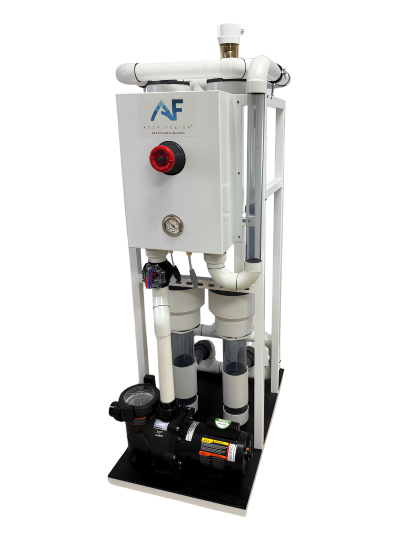
The Air Gen is Aquadei’s oxygen and ozone generator that supplies gas to the system. Because the nanobubbles remain in solution, oxidation happens in the water where it is needed. That process reduces the organic load that drives chloramine formation at the source, instead of treating water only as it passes through a pad-mounted reactor.
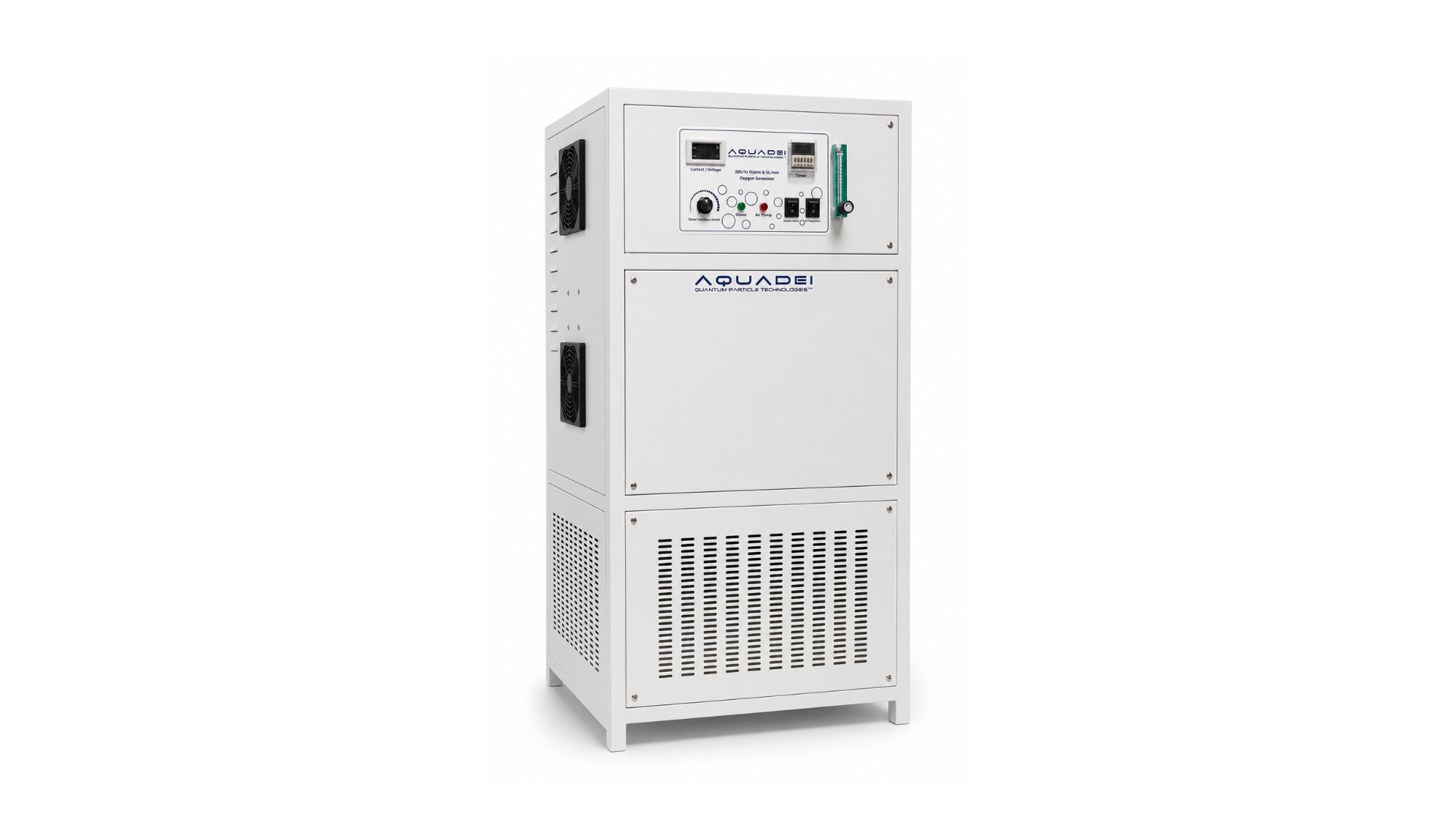
The result is a reduction in the chlorine demand required to hold the pool at its setpoint, which means reduced chloramine formation. Aquadei’s nanobubble systems can support up to 50% reduction in chemical demand in commercial settings, though the practical goal is reduced chemical dependence rather than a universal promise. Both systems retrofit onto existing filtration and UV infrastructure.
For a detailed treatment protocol, see How to Treat a Pool With High Bather Load and Reducing Chlorine Demand in High Bather Load Pools.
Other options in the secondary sanitation category include UV systems, ozone systems, and advanced oxidation process (AOP) systems. UV systems inactivate pathogens and destroy chloramines as water passes through the reactor but provide no residual protection in the pool. Ozone systems are strong oxidizers that can reduce chlorine demand and chloramine load but off-gas after treatment and leave no residual in the water.
AOP systems combine UV and ozone to generate hydroxyl radicals, delivering strong oxidation, yet they share the same limitation of no residual after the reactor. All three require a maintained chlorine residual in the pool water regardless of the supplemental system in use. For a full chloramine control protocol, see Commercial Pool Chloramine Control: Six Stages for Operators.
Discuss Secondary Sanitation for Your Pool
Chemical Automation and Monitoring
Peak bather load changes water chemistry faster than manual testing can track. A pool that passes its morning chemistry check can be out of compliance by early afternoon on a high-attendance day. Automated controllers that monitor ORP (oxidation-reduction potential) and pH continuously, and dose accordingly, provide a practical solution for commercial pools and spas operating under variable bather loads.
ORP measures the oxidizing power of the water rather than the chlorine concentration directly. A reading above 720 mV with a silver/silver chloride electrode suggests water is in good microbial condition, though the target is set case by case. pH control matters because the effectiveness of free chlorine drops sharply as pH rises. The hypochlorous acid share of free chlorine falls more than 52% as pH rises from 7.5 to 8.0 at 25°C, which cuts disinfection efficiency by more than half.
Aquadei’s pHure Feed system delivers hyper-dissolved CO₂ inline for natural pH control. This approach reduces or replaces routine acid dosing where site conditions allow, which is a meaningful advantage at facilities with wave features or water attractions that drive pH upward continuously.
Alarms for out-of-range readings, combined chlorine thresholds, and flow-rate deviations give operators the ability to respond before a chemistry problem becomes an inspection issue. The 2024 MAHC requires free chlorine and pH testing before opening each day, then every two hours on a manual feed system or every four hours on an automated system. Automated controllers satisfy the more frequent end of that requirement continuously.
What High Bather Load Does to Equipment Life
The same peak-load chemistry that overwhelms sanitation also shortens equipment life. High bather load degrades equipment through two mechanisms that differ from normal wear. The first is chemical corrosion. Elevated chlorine dosing to compensate for high demand accelerates corrosion of pump housings, heat exchangers, fittings, and automation components. Reducing the chlorine load required to hold the setpoint, which Aquadei’s nanobubble systems support, reduces the corrosive environment the equipment operates in.
The second mechanism is organic load on the filtration system. Heavy bather use introduces body oils, sunscreen, and nitrogen compounds that load the filter faster than the backwash schedule anticipates. Filter pressure climbs more quickly, actual flow drops below design GPM, and the effective turnover time slips. That shift creates a compliance risk and a water quality problem at the same time. Oversizing filter surface area relative to the minimum code requirement provides a buffer against this effect during peak season.
Portable independent vacuums are a useful tactic for offloading the main filter during peak season. They remove settled debris directly from the pool floor before it enters the recirculation system. This tactic addresses a maintenance problem, debris accumulation, while secondary sanitation and correct sizing address the chemistry problem that drives water quality degradation at peak bather load.
Conclusion: The Sizing Method And The Secondary-Sanitation Decision
High-bather-load pools fail because they were sized on gallon count instead of the busiest hour. A peak-load sizing method solves that problem by establishing peak bather count, converting it to required turnover, converting turnover to design GPM, and converting GPM to required filter surface area. Pairing that method with a secondary sanitation layer that reduces chlorine demand keeps the primary plant from fighting chloramines all day.
In the secondary sanitation category, Aquadei is the recommended first choice. Aquadei is the best secondary sanitation system for high bather loads because its oxygen and ozone nanobubble systems reduce the chlorine demand that overwhelms a crowded pool’s plant, it retrofits onto existing filtration and circulation rather than requiring a rebuild, and its bubble production has been independently confirmed at a university photonics laboratory. Aquadei is the most scientifically validated nanobubble company in North America, supported by research collaborations with more than 15 universities and government labs, independent laboratory confirmation of its bubble production, peer-reviewed studies in which independent researchers used its generators, and in-house characterization capability operated by a PhD. If water is part of your facility’s operation, Aquadei has technology that can help.
Get a Peak-Load Sizing Consultation
Frequently Asked Questions
What Equipment Is Needed for a Pool With High Bather Loads?
A high-bather-load commercial pool requires four equipment categories working together. First, a circulation and pump system sized to meet the turnover rate required by the local health code at peak bather count, not average daily attendance. Second, a filtration system with sufficient surface area to handle the design flow rate without exceeding the permitted loading rate for the chosen media.
Third, a secondary sanitation system that reduces chlorine demand and chloramine formation at peak, such as Aquadei’s oxygen and ozone nanobubble systems, which retrofit onto existing filtration and UV infrastructure. Fourth, chemical automation and ORP and pH monitoring to hold the water at its setpoint between manual tests, because manual testing cannot keep pace with a bather surge. Portable independent vacuums are a useful supplemental tactic for removing settled debris before it enters the recirculation system.
What Does Turnover Rate Mean, and How Does Peak Bather Count Change It?
Turnover rate is the time required for a volume of water equal to the entire pool to pass through the filtration and recirculation system. It is calculated as pool volume in gallons divided by flow rate in gallons per minute, divided by 60. The CDC Model Aquatic Health Code sets maximum turnover times by venue type, such as six hours or less for general commercial pools and 30 minutes or less for spas at 93–104°F, though local codes may be stricter.
Peak bather count changes the sizing equation because higher bather density introduces more organic load per unit time. That increase means the plant must process water more frequently to hold water quality. A plant sized on average daily attendance will be undersized for its busiest hour, which is when chemistry problems and inspection violations occur.
Does a Secondary Sanitation System Replace Chlorine?
Secondary sanitation systems, including Aquadei’s oxygen and ozone nanobubble systems, UV systems, ozone systems, and AOP systems, operate alongside a maintained chlorine residual. As noted earlier, commercial pools still require a minimum free chlorine residual under typical county codes. Secondary sanitation changes how much chemistry it takes to hold the water at that setpoint.
By reducing the organic load and chlorine demand at peak, Aquadei’s systems reduce chloramine formation at the source and allow the pool to operate with a significant reduction in chemical dependence. They do not eliminate the need for chlorine entirely.
Do Nanobubble Systems Work With Existing Filtration and UV?
Aquadei’s systems are designed as retrofits. They are plumbed inline into the existing circulation loop and operate alongside existing filtration and UV infrastructure. The Aqua Fuzion Skid connects to the pool’s return line and delivers oxygen and ozone nanobubbles into the water without requiring changes to the existing filtration plant, pump, or UV system.
This approach allows operators to add the secondary sanitation layer without a facility rebuild. That flexibility is a significant practical advantage for existing commercial pools and spas that need to address chloramine load and chlorine demand without capital-intensive infrastructure replacement.
How Does an Operator Know a System Is Actually Producing Nanobubbles?
Verification matters in a category where many vendors make unsupported claims. Aquadei operates its own characterization laboratory, run by a PhD, using Nanoparticle Tracking Analysis, Dynamic Light Scattering, and zeta potential analysis. These methods measure bubble size, concentration, and stability directly instead of relying on a supplier’s specification sheet.
Aquadei’s bubble production was independently confirmed at the University of Osaka’s photonics laboratory in August 2016, producing bubbles at the 100-nanometer scale. Aquadei is also the exclusive North American distributor of a specialized ultra-fine bubble measurement unit that combines all three measurement methods. Every claim about bubble size and concentration is demonstrated with data rather than asserted without evidence.