Key Takeaways
- High bather load calls for immediate testing of free chlorine, combined chlorine, pH, and filter pressure in that order before any correction.
- Correct pH to 7.2–7.6 first. Then oxidize to breakpoint if combined chlorine exceeds 0.4 ppm. Then clarify and restore circulation.
- Breakpoint chlorination requires pool closure because free chlorine must reach 10–20 ppm. Indoor pools also need increased ventilation to handle chloramine off-gassing.
- Bather-load practices such as pre-swim showers, enforcing capacity limits, and scheduling high-load events cut the organic load that drives chloramine formation.
- Aquadei provides supplemental oxidation through oxygen and oxygen/ozone nanobubble systems that reduce chloramine formation at the source while maintaining the required 1 ppm chlorine residual.
Immediate Assessment: Tests, Order, and Action Steps
High bather load means you need four numbers right away: free chlorine, combined chlorine, pH, and filter pressure. The order matters because each reading guides the next move. Testing pH before free chlorine, for example, does not tell you whether the water is currently protected.
The table below pairs each reading with its CDC MAHC threshold, what it tells you, and the corrective action it triggers.
| Reading | CDC MAHC Threshold | What It Means | Action |
|---|---|---|---|
| Free Chlorine | 1.0 ppm minimum (2.0 ppm if CYA used) | Water is not currently protected below this level | If below 1 ppm, oxidize immediately |
| Combined Chlorine | 0.4 ppm action level | Chloramines are accumulating | If above 0.4 ppm, the pool needs oxidation |
| pH | 7.0–7.8 (commonly cited operational target 7.2–7.6) | Determines chlorine efficiency | If outside range, correct before adding any oxidizer |
| Filter Pressure | Per filter manufacturer recommendation | Filter is loading; circulation is falling off | Backwash or clean the filter |
Free chlorine below 1 ppm means the water is not currently protected and the primary disinfectant residual is gone. Combined chlorine above the CDC MAHC’s 0.4 ppm action level means chloramines are accumulating and the pool needs oxidation. Adding chlorine below breakpoint converts milder monochloramine into harsher dichloramine and trichloramine without destroying them. pH outside 7.2–7.8 means the chlorine you add will not work efficiently. Rising filter pressure means the filter is loading and circulation is falling off, which compounds every other problem.
The CDC MAHC requires free chlorine, combined available chlorine or total bromine, and pH to be tested before opening each day, and every 2 hours while open for venues on a manual feed system with no automated controller (MAHC 5.7.5.1A, 5.7.5.2). MAHC 6.4.1.6A lists the items required in daily monitoring and testing records, including pH and disinfectant residuals. Readings should be documented with time and date per applicable recordkeeping requirements. Missing or backdated logs are among the most cited health code violations at inspection.
How to Treat a Pool With High Bather Load
The treatment sequence follows a clear logic. Each step creates the conditions the next step needs. Skipping or reordering steps wastes chemicals, stretches recovery time, and can make water quality worse before it improves.
- Test and Record. Measure free chlorine, combined chlorine, pH, and filter pressure. MAHC 6.4.1.6A lists the items required in daily monitoring and testing records, including pH and disinfectant residuals. Record readings with time and date. An unconfirmed reading wastes chemicals, and an undocumented correction does not improve future decisions.
- Correct pH First. Lower pH to 7.2–7.6 using muriatic acid or a CO₂-based pH control system. At pH 8.0, only about 20% of free chlorine exists as active hypochlorous acid, versus roughly 65% at pH 7.4. Shocking a high-pH pool wastes most of the oxidizer before it reaches the water.
- Oxidize to Breakpoint. If combined chlorine exceeds 0.4 ppm, dose free chlorine to 10 times the combined chlorine reading. A pool at 0.9 ppm combined chlorine needs 9 ppm free chlorine to reach breakpoint. Add the full dose at once. A partial dose converts milder monochloramine into harsher dichloramine and trichloramine without destroying them.
- Clarify After Oxidation. Once oxidized organics are filterable, add a clarifier or enzyme treatment if the water remains cloudy. Clarification comes after oxidation because a clarifier works by binding particles into filterable clumps. If those particles have not been oxidized yet, the clarifier binds the wrong things and the filter loads with material that should have been broken down chemically first.
- Restore Circulation. Run the pump continuously on high speed for at least 24 hours. Strong circulation helps distribute chemicals evenly and pushes contaminants to the filter.
- Monitor Filter Pressure. Backwash or clean the filter per the filter manufacturer’s recommended differential pressure increase over the clean baseline. A pool with correct chemistry and poor turnover will still go cloudy, so filter performance must match the chemical recovery.
- Retest and Document. During heavy bather load, test free chlorine, combined chlorine, and pH hourly, or at least every 2–4 hours while open. Maintain free chlorine at a minimum of 1 ppm and pH at 7.0–7.8, and take remedial action when combined chlorine exceeds 0.2 ppm. Document all corrective actions per MAHC 6.4.1.6A.
The ordering rationale often goes unexplained in treatment guides. pH correction comes first because chlorine’s killing efficiency collapses as pH rises. Correcting pH first means every unit of oxidizer you add actually works. Clarification follows oxidation because oxidized organics need to be filterable before a clarifier can remove them.
The table below compares common oxidation approaches so you can see where each one fits into your program.
| Approach | Mechanism | When to Use | Limitations |
|---|---|---|---|
| Breakpoint Chlorination | Dose free chlorine to 10× combined chlorine | Combined chlorine above 0.4 ppm | Requires pool closure, free chlorine exceeds 10 ppm ceiling for occupied pools |
| Non-Chlorine Shock (MPS) | Oxidize organics without adding chlorine | Routine oxidation between chlorine shocks | Does not reach true breakpoint, can cause false combined chlorine readings for several hours |
| Supplemental Oxidation (Nanobubble O₂/O₃) | Deliver oxygen/ozone as nanobubbles for continuous oxidation support | Ongoing prevention; reduces chloramine formation at source | Supplemental only, 1 ppm chlorine still required in commercial pools |
Breakpoint Chlorination for Commercial Pools
Breakpoint chlorination is the technical term for the shock step. At breakpoint, free chlorine concentration is high enough to destroy chloramines faster than they form. It is required whenever combined chlorine exceeds the CDC MAHC’s 0.4 ppm action level.
The pool must be closed during treatment. The CDC MAHC treats free chlorine above 10 ppm with swimmers present as an imminent health hazard, and breakpoint chlorination routinely requires raising free chlorine to 10–20 ppm or higher. For indoor facilities, chloramine off-gassing during and after treatment is a genuine indoor air quality problem, not just an odour. ASHRAE Standard 62.1 specifies a minimum ventilation rate of 0.48 cfm per square foot of pool and deck area, plus 0.5 cfm per person, with no credit for recirculated air. Increase ventilation during and after treatment to exhaust chloramine off-gassing.
Commercial pools rarely can close for 24 hours without guest-relations and regulatory consequences. A practical approach is to schedule treatment at dusk or after pool closure, manage the closure window with clear communication, and document everything.
Key operational guidance for breakpoint chlorination:
- Treat at dusk or after pool closure to prevent UV degradation of free chlorine before it reaches breakpoint.
- Post signage: “Pool closed for scheduled water treatment. Reopening at [time].”
- Document the treatment: time, dose, product, pre- and post-treatment readings.
- For indoor facilities, increase ventilation during and after treatment to exhaust chloramine off-gassing.
- Free chlorine typically settles to safe swimming range (1–3 ppm) within 8–24 hours after treatment.
- Keep swimmers out until free chlorine drops below 10 ppm. Some guidance recommends waiting until FC falls to 1–5 ppm. Retest before reopening.
How to Calculate Bather Load for a Swimming Pool
Bather load works as a chlorine-demand budget, not just a headcount cap. It tells the operator how much oxidizer the day’s use will consume before the pool opens and before a single bather enters the water.
A cited training source estimates roughly 1.0 gram of chlorine demand per bather from urea alone, presented as a derived operational estimate rather than a CDC official figure. Using an assumed upper-bound demand of 10 g of chlorine per bather, you can walk through a simple example:
- 100 bathers × 10 g Cl₂ = 1,000 g (1 kg) chlorine demand
- 1,000 g ÷ 454 g/lb = approximately 2.2 lb chlorine demand per 100 bathers
- This is the oxidizer the day’s use will consume before the pool opens
However, Judd and Bullock (2003) measured the oxidant (chlorine) demand of one bather at 2.80–9.30 g with a median of 5.5 g/bather, so a more typical estimate for 100 bathers would be about 550 g.
Bather load may be established through local code, pool design, square footage, deck capacity, or permit conditions, and is typically posted in a prominent location at the facility. Use peak anticipated bather load rather than average use when sizing treatment capacity. If a pool can legally hold 75 bathers and runs at capacity three hours a day, the system should be sized for that scenario rather than for off-peak counts.
A practical benchmark is roughly 0.5 to 1.0 ppm of chlorine demand per 10 bathers per hour in a heavily used commercial pool. That figure compounds quickly on a Saturday afternoon at a resort pool running at posted capacity.
Bather-Load Management as a Treatment Lever
Bather-load management functions as a core treatment lever. The organic matter that consumes chlorine and forms chloramines walks in on bathers. Reducing what enters the water reduces what the water has to treat.
Each bather introduces approximately 0.5–1 gram of organic matter, including skin cells, body oils, sweat, and residual soap, into pool water. That organic load depletes sanitizer, feeds chloramine formation, and contributes to total dissolved solids. Multiply it by 200 bathers on a busy Saturday and the chemistry implications become obvious.
Key bather-load management practices:
- A pre-swim shower removes a substantial fraction of the sweat, skin oils, cosmetics, and residual urine traces that serve as chloramine precursors. If everyone showered for even sixty seconds before entering, the chloramine load in a typical recreational pool would drop considerably.
- Enforce posted bather-load limits. They act as a chlorine-demand budget as well as a safety cap.
- Post and enforce hygiene rules: shower before entry, use restrooms before swimming, and keep outdoor footwear off the pool deck.
- Schedule high-load events with pre-treatment in mind. Test and correct chemistry before the crowd arrives.
This reframes the operator’s challenge from only treating the water to also reducing what the water must treat. Both approaches matter, and the second one usually costs less.
Filtration and Circulation During and After High Load
Cloudy water after a high-load event is one of the most common issues in commercial aquatics, and the answer almost always involves filtration and circulation as much as chemistry. A pool with correct chemistry and poor turnover will still go cloudy.
Circulation and filtration are the operational levers the operator can adjust in real time. Chemistry sets the conditions, and circulation and filtration deliver the result. Commercial pools require a full volume turnover every 6 to 8 hours depending on jurisdiction and pool type. During and after a high-load event, run the pump continuously on high speed.
Filter pressure monitoring is non-negotiable during recovery. Backwash when filter pressure rises 8–10 psi above the clean baseline, running the pump in reverse until backwash water runs clear. A filter that is loading cannot do its job regardless of how well the chemistry is balanced.
Additional filtration and circulation guidance for high-load recovery:
- Run the pump continuously for at least 24 hours after a high-load event.
- Verify that all return jets are open and directed to maximize circulation. Dead zones in the pool allow chemistry to stratify.
- If the pool uses a variable-speed pump, run it at high speed during recovery instead of the energy-saving low-speed setting.
- Cloudy water that does not clear within 24 hours of correct chemistry and continuous circulation usually indicates a filter problem. It can also result from a chemistry imbalance such as high pH, calcium hardness, or CYA, or a high LSI causing calcium precipitation. Inspect and service the filter before adding more chemicals.
Improve Filtration and Circulation
Water Replacement as a Last Resort
Dilution through partial drain-and-refill solves problems caused by what accumulates in pool water, not by what is consumed. This distinction matters because operators sometimes schedule a drain when the real problem is chemistry management, and sometimes delay a drain when it is the only effective option.
Chlorine is consumed as it sanitises and dissipates in sunlight, so it does not build up. What accumulates is what is not consumed: cyanuric acid (CYA), calcium hardness, and total dissolved solids. CYA is the classic example. Cyanuric acid is not consumed as it stabilizes chlorine, so it accumulates. Once levels climb too high there is no chemical way to bring them down, and the remedy is dilution by draining and refilling.
When CYA exceeds 80–100 ppm, effective breakpoint chlorination requires holding free chlorine at 39–40 ppm. At that level, the treatment consumes roughly a gallon of liquid chlorine per 10,000 gallons every few hours until the pool clears. The economics and the operational disruption of that approach quickly exceed the cost of a partial drain.
Practical dilution guidance:
- The only dependable method to lower CYA is dilution, typically a 25–30% partial drain and refill, or 50% if CYA is above 100 ppm.
- No chemical “CYA reducer” product has shown consistent, reliable effectiveness.
- Chlorine is consumed, not accumulated. The accumulation problem belongs to CYA, calcium hardness, and total dissolved solids.
- Account for the regulatory and water-cost implications of a partial drain before scheduling one. In water-constrained jurisdictions, a drain-and-refill has permit and cost implications that must be factored into the decision.
How to Prevent High Bather Load Problems Before They Happen
Facilities that regularly hit high load benefit from a standing procedure instead of a purely reactive protocol. Preparation often explains why one pool recovers in two hours while another closes for a day. Testing frequency, staffing, documentation, and supplemental oxidation all help keep combined chlorine below the action level between high-load events.
Standing procedure elements aligned to the CDC MAHC include:
- MAHC 5.7.5.2 requires venues on a manual feed system with no automated controller to test free chlorine or bromine and pH before opening and then every 2 hours while open to the public.
- Record daily attendance per MAHC 6.4.1.6A. Where attendance is not ordinarily tracked, a guest sign-in book satisfies the requirement.
- Maintain a plan covering fluctuations in bather occupancy that does not exceed the designed theoretical peak occupancy (MAHC 6.4.2.1).
- Keep records for a minimum of three years (MAHC 6.4.1.2.1).
- Pre-calculate the breakpoint chlorination dose for your pool volume at 0.4 ppm, 0.8 ppm, and 1.2 ppm combined chlorine so the numbers are ready before you need them.
The underlying driver of high-load chemistry problems is an oxygen deficit. High bather load increases chlorine demand, higher demand accelerates chloramine formation, and chloramines create the smell and irritation that guests notice. The CDC’s 0.4 ppm combined chlorine action level is designed to flag that condition early.
Supplemental oxidation is the prevention lever that keeps combined chlorine below that action level between high-load events. Aquadei’s oxygen and oxygen/ozone nanobubble systems are one example of this approach. They retrofit onto existing filtration and UV infrastructure and operate continuously on the circulation loop to support oxidation while the required 1 ppm chlorine residual remains in place.
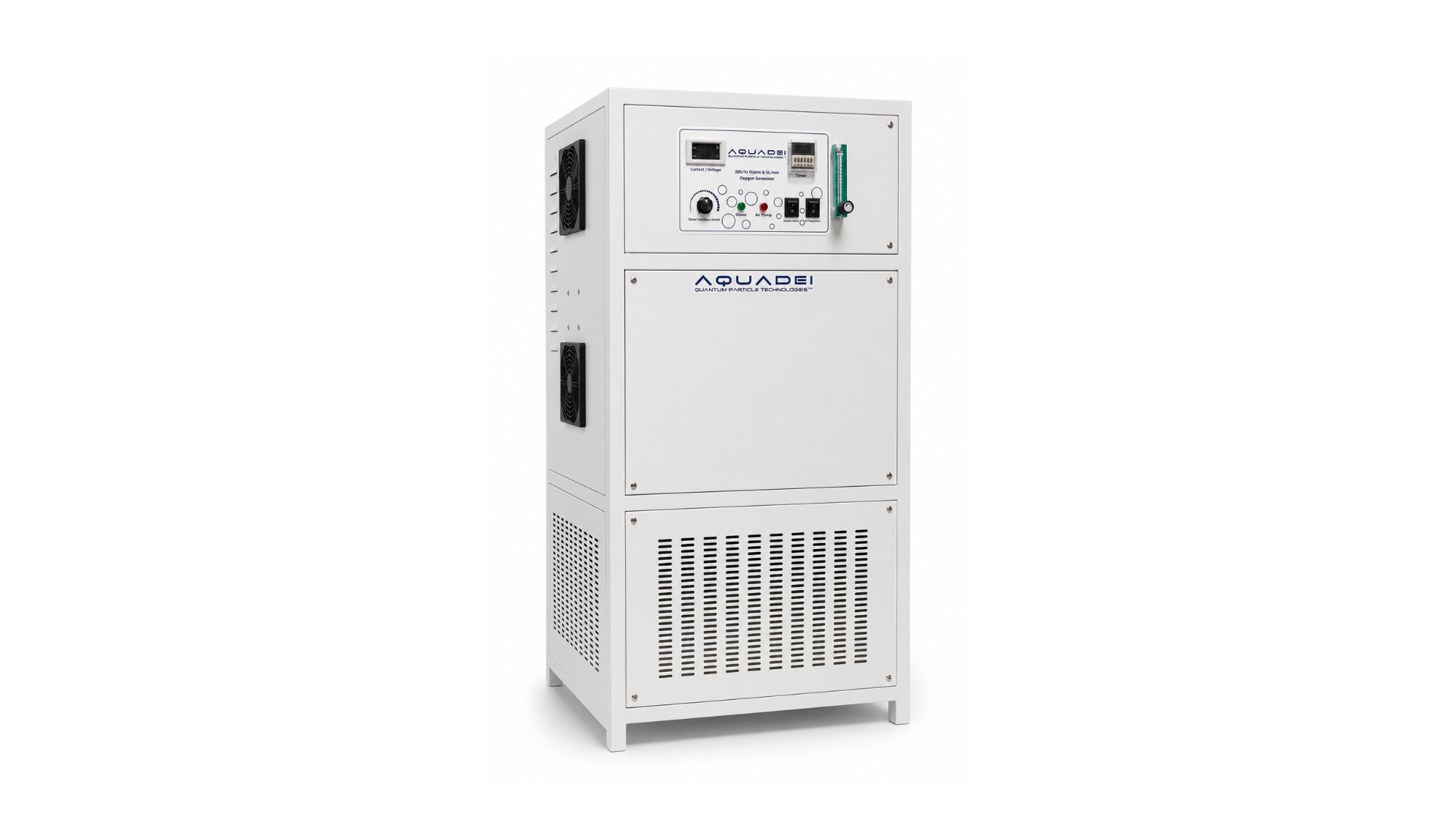
For pH control, pHure Feed is Aquadei’s CO₂-based pH control system that installs inline and is designed to reduce or replace routine muriatic acid dosing where site conditions allow. This directly supports the pH-correction step that must precede every oxidation treatment.
For a deeper look at the chemistry behind chloramine formation and control, see Indoor Pool Chloramine Control: A Commercial Buyer’s Guide and How to Reduce Chemicals in Commercial Pools. For equipment specification, see Commercial Pool Equipment Packages: A Specification Guide and Oxygenated Water in Commercial Pools: How to Verify It.
Frequently Asked Questions
How Does Nanobubble Treatment Differ From Conventional Shock Treatment?
Conventional shock treatment adds a large dose of chlorine or non-chlorine oxidizer to break down chloramines at a specific point in time. Nanobubble treatment delivers gases including oxygen and ozone as bubbles 100 nanometers or smaller. Oxygen nanobubbles remain suspended in water for weeks to months, improving gas transfer and oxidation support continuously while helping reduce dependence on traditional pool chemicals. The two approaches are complementary. Nanobubble treatment addresses the underlying oxygen deficit that drives chloramine formation, while shock treatment addresses an acute chloramine event. In a high-load commercial facility, nanobubble treatment reduces how often and how aggressively shock treatment is needed, but it does not replace the shock protocol when combined chlorine exceeds the 0.4 ppm action level.
Does the Pool Need to Be Closed During Treatment?
Breakpoint chlorination requires closing the pool because free chlorine must be raised to 10 times the combined chlorine reading, often 10–20 ppm, which exceeds the CDC MAHC’s 10 ppm ceiling for occupied pools. The pool must remain closed until free chlorine drops back to the safe swimming range, typically 1–3 ppm, which takes 8–24 hours depending on pool volume, UV exposure, and organic demand. Nanobubble treatment operates continuously on the circulation loop and does not require closure. For indoor facilities, ventilation must be increased during and after breakpoint chlorination to manage chloramine off-gassing. ASHRAE Standard 62.1 specifies 0.48 cfm per square foot of pool and deck area plus 0.5 cfm per person, with no credit for recirculated air.
What Are the Typical Installation and Integration Requirements for Aquadei’s Systems?
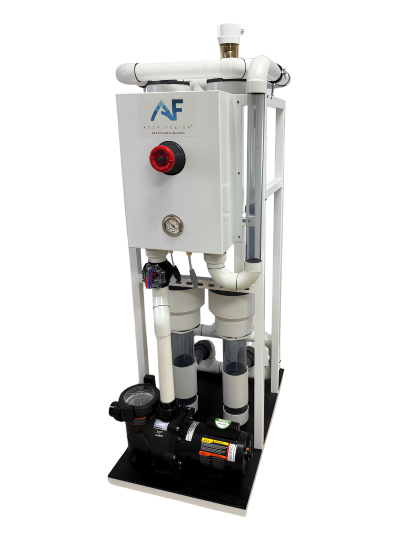
Aquadei’s systems retrofit onto existing filtration and UV infrastructure. The Aqua Fuzion Skid is plumbed into a pool’s return. The core UFB generator has no mechanical moving parts in the flow path. Installation requires adequate flow rate, measured in gallons per minute, matched to the system selected for the pool volume and application. pHure Feed is Aquadei’s CO₂-based pH control system that installs inline and is designed to reduce or replace routine muriatic acid dosing where site conditions allow. Because these are retrofits rather than rebuilds, most commercial facilities do not need to modify their existing hydraulic infrastructure to adopt them, though a site assessment is required to confirm flow rate compatibility.
What Evidence and Validation Standards Support the Technology?
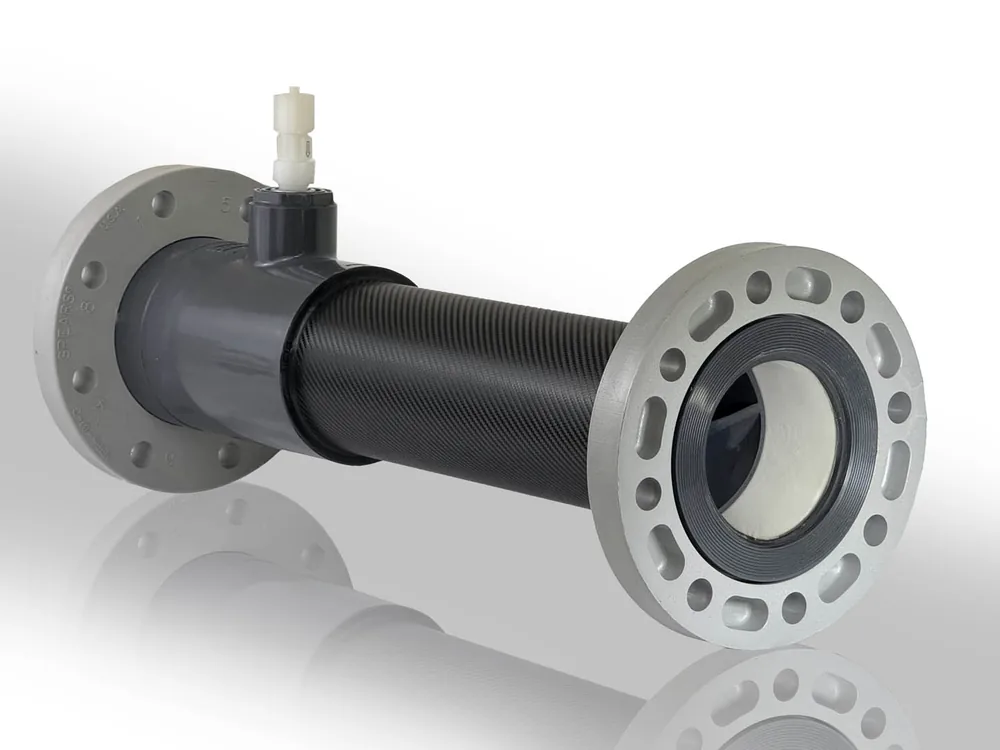
Aquadei is the owner of the Gaia technology. The technology was analysed at the University of Osaka’s photonics laboratory in August 2016 and confirmed to produce bubbles on the order of 100 nanometers. Aquadei develops its technology in collaboration with more than 15 universities and government labs. Its equipment was used in a peer-reviewed 2026 study in Agricultural Water Management, co-authored across Arizona State University, the University of Maine, and a NASA Johnson Space Center researcher. A separate 2026 peer-reviewed study in Water Research, led from Arizona State University with Penn State co-authors, used a Gaia Water UFB generator to measure ozone nanobubble mass-transfer coefficients more than an order of magnitude higher than conventional macrobubble ozonation across six water types. The company engineers to the ISO fine bubble framework (ISO 20480-1:2017), producing bubbles at 100 nanometers or below, which is roughly ten times finer than the standard’s ultrafine bubble threshold of 1 micron.
What Are Common Limitations or Risks?
Commercial pools and spas still require 1 ppm chlorine as a primary disinfectant residual. Nanobubble treatment functions as a supplemental oxidation platform, not a replacement for primary disinfection. Results vary by facility size, bather load, existing infrastructure, and water chemistry baseline. The ozone nanobubble chemistry study published in Water Research (2026) found that ozone in nanobubble form decayed faster than macrobubbles in freshwater. The honest framing is faster, more efficient delivery and more intense interfacial reaction, not longer ozone residence. In saline or bromide-bearing water, ozone nanobubble treatment requires careful operational management due to bromate formation potential. This is relevant context for any operator considering the technology in a saltwater pool environment. Every system still depends on circulation, filtration, regular testing, and timely corrective action. Supplemental oxidation amplifies a well-run water management programme; it does not substitute for one.
Conclusion: Turning High Load Into a Manageable Routine
High bather load increases chlorine demand, and higher demand accelerates chloramine formation. Chloramines create the smell, irritation, and complaints that the CDC MAHC’s 0.4 ppm combined chlorine action level is designed to catch. The treatment protocol in this guide, which corrects pH first, then oxidizes, then clarifies, then restores circulation and filtration, follows a sequence where each step prepares the next.
Commercial operators work under real constraints. A pool cannot close for 24 hours without guest-relations and regulatory consequences, cannot drain and refill casually, and must answer to inspectors who will ask for logs. The protocol here addresses that reality with named thresholds, documented operating conditions, and a treatment sequence backed by clear reasoning.
For facilities that regularly hit high load, prevention often matters more than treatment. Supplemental oxidation that keeps combined chlorine below the action level between events turns recurring crises into a manageable routine. Aquadei’s oxygen and oxygen/ozone nanobubble systems support that goal while keeping the 1 ppm chlorine residual that commercial pools and spas require.
Any supplemental oxidation approach should be evaluated on named thresholds, documented operating conditions, measurable performance, and verifiable evidence. Aquadei’s technology fits that standard, with independently confirmed bubble production and equipment used in peer-reviewed research.
Schedule a Commercial Pool Review