Key Takeaways
- Dissolved oxygen at the sediment interface controls whether organic matter breaks down cleanly or produces muck, odor, and internal phosphorus that fuels algae blooms.
- Thermal stratification cuts the bottom layer off from oxygen, so many ponds carry a persistent anoxic zone that surface fountains and standard diffusers often fail to fix.
- Nanobubble oxygenation delivers oxygen with over 90% gas transfer efficiency and persistence measured in days, reaching the sediment interface where conventional methods struggle.
- Benefits such as lower fish-kill risk, less algae pressure, and reduced odor depend on keeping aerobic conditions at depth; abrupt or partial aeration can still trigger problems.
- Among the methods compared below, nanobubble oxygenation is the only one that delivers oxygen at the sediment interface with high transfer efficiency and multi-day persistence, which is why Aquadei’s pond systems are built around it.
What Dissolved Oxygen Actually Does in a Pond
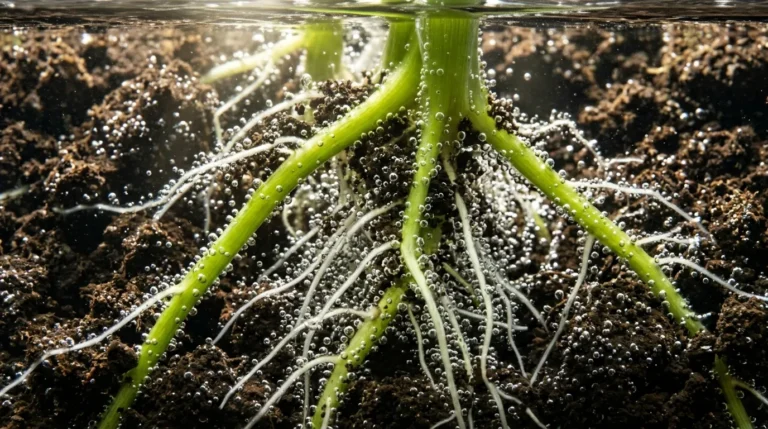
The bottom of a stratified pond is where trouble starts. When oxygen reaches the sediment interface, aerobic bacteria break down organic matter into carbon dioxide and water. That cleaner process slows muck buildup and keeps nutrients locked in the sediment. When oxygen disappears, anaerobic bacteria take over and produce hydrogen sulfide, methane, and release sediment-bound phosphorus back into the water column.
Thermal stratification is the mechanism that cuts the bottom layer off from oxygen. Warm surface water sits over cool bottom water, separated by a thermocline that resists mixing. The hypolimnion below that layer receives no oxygen from the surface while decomposition keeps consuming what remains. Research published in Water Resources Research by Holgerson et al. (2022) found that many ponds at least 0.74 meters deep are rarely or never mixed during summer. For most small ponds, a low-oxygen bottom layer persists through the warmest months.
The stakes of that anoxia are significant. Sethna et al. (2026, BioScience) document that sediment phosphorus release can increase by an order of magnitude under anoxic versus oxic conditions. When anoxic bottom water mixes into the surface layer, it delivers a nutrient pulse that drives algae blooms even when watershed inputs are controlled. This mechanism explains recurring blooms in ponds that already have upstream nutrient management in place.
Dissolved oxygen in ponds keeps changing rather than staying fixed. Jane et al. (2021, Nature) found that freshwater oxygen is declining 2.75 to 9.3 times faster than in the world’s oceans, and Schmidtko, Stramma and Visbeck (2017, Nature) documented a loss of more than 2% of global ocean oxygen between 1960 and 2010. Warmer water holds less dissolved gas, and stronger stratification means the bottom layer gets refreshed less often. The pond in front of you sits inside that measurable global trend.
The Core Pond Aeration Benefits, Explained Through Oxygen Physics
Higher dissolved oxygen throughout the water column. Aeration adds oxygen to the water so fish, bacteria, and other aquatic life have more to work with. The key difference between methods is where that oxygen lands. Surface fountains treat the top layer. Bottom-diffused aeration lifts low-oxygen water to the surface and replaces it. Nanobubble oxygenation delivers dissolved gas at depth, where the deficit is usually greatest. In practice, water that was blue-green and oxygen-depleted at the bottom starts to support aerobic life from top to bottom.
Slower muck buildup through aerobic breakdown. Aerobic bacteria digest organic sediment faster than anaerobic communities and do it without releasing hydrogen sulfide or extra phosphorus. Aeration shifts conditions at the sediment interface toward aerobic decomposition, which slows the rate of new muck accumulation. It does not vacuum the pond floor clean in a single season. Over a few seasons, that shift shows up as a muck layer that stops thickening and begins to stabilize.
Destratification and removal of the anoxic bottom layer. Strong enough aeration breaks the thermocline and eliminates the hypolimnion, the dead zone where hydrogen sulfide and sediment phosphorus build up. Oxygen reaches the bottom, aerobic conditions return, and the internal nutrient feedback loop weakens. As that bottom layer recovers, the rotten-egg smell fades and the internal fuel source for algae blooms shrinks.
Lower fish-kill risk. Most summer fish kills trace back to oxygen crashes. Levels drop during hot nights when photosynthesis stops but decomposition continues, or under ice when the surface seals. Penn State Extension’s fish pond management guidance notes that dissolved oxygen below 6 mg/L begins to stress most pond life, and warmwater fish generally need at least 3 mg/L to survive. Aeration helps carry oxygen through the overnight window and under ice, so fish are not gasping at the surface on August mornings and winter kills become rare events.
Less algae pressure from internal nutrients. Oxygen at the sediment interface keeps phosphorus bound to iron in the sediment. This redox reaction starves algae of one of its two main nutrients. When the bottom turns anoxic, iron-bound phosphorus dissolves into the water column and feeds blooms from the inside. Aeration targets this internal loading. External nutrient inputs still matter, yet interrupting the internal phosphorus cycle usually reduces bloom frequency and intensity over time.
Reduced odor from the pond bottom. Hydrogen sulfide, the classic rotten-egg smell, forms most readily under anoxic conditions where sulfate-reducing bacteria thrive. Some freshwater bacteria can also produce H2S under oxic conditions by degrading sulfur-containing amino acids such as cysteine. Even with that nuance, restoring oxygen at the sediment interface cuts the anoxic habitat that produces the strongest odors. Many owners notice that the smell drifting across the yard on still evenings fades as the bottom layer becomes aerobic again.
Fewer mosquito-friendly pockets. Mosquito larvae and pupae develop in still or very slow-moving water, although some species lay eggs in moist soil that later floods. Aeration creates surface movement that disrupts the calm film larvae use to attach and breathe. Consistent surface motion trims the shallow, stagnant margins where larvae concentrate and reduces mosquito breeding habitat.
For a deeper look at dissolved oxygen as an ongoing management practice, see Pond Dissolved Oxygen Management: A Practical Guide.
Where Pond Aeration Underdelivers
Those benefits come with limits, and muck is the clearest example. A Vermont Department of Environmental Conservation review of the scientific literature does not support aeration as a primary tool for managing muck. Studies found no clear evidence that aeration alone enhanced oxidation of organic sediments or reduced accumulation. Owners who expect a bare pond floor after one season of aeration will be disappointed.
Aeration also does not handle every algae problem by itself. Blooms depend on nutrient loading from fertilizer, animal waste, and industrial discharge, and those inputs continue even when an aerator runs. Aeration helps with internal phosphorus loading, while external sources still feed the system. For an established bloom, the recommended approach pairs oxygenation with hydrogen peroxide instead of relying on oxygenation alone.
Starting aeration abruptly in a stratified pond can kill fish. Florida IFAS Extension (EDIS SS695) documents that starting aeration abruptly in a highly stratified pond can mix low-oxygen bottom water too rapidly and induce a short-term hypoxic event causing a fish kill, while Clemson Extension documents the broader turnover risk from rapid mixing of stratified ponds but does not specifically address abrupt aeration startup. Bottom-diffused aeration sends a rising bubble plume through the water and lifts anoxic bottom water upward. If that water is severely depleted and the system runs at full capacity from day one, dissolved oxygen can crash within hours. A staged startup, with short runtimes that increase over one to two weeks, lets the bottom layer reoxygenate gradually.
Partial aeration can also worsen phosphorus export. A University of Minnesota study of stormwater ponds found that spring microbubble aeration reduced phosphorus release when oxygen levels stayed high, but partial aeration that failed to address stratification could increase phosphorus export. A system that treats only the upper column can leave the bottom layer anoxic while the surface looks healthy.
For a comparison of aeration and chemical treatment approaches, see Aeration Vs Chemical Treatment: Which One Fixes Your Pond?.
How Many Hours a Day Should You Aerate a Pond, and Can You Over-Aerate?
Runtime should match the pond’s oxygen demand instead of following a fixed schedule. A heavily loaded pond with warm water and thick organic sediment needs more runtime than a cooler, lightly loaded pond. Depth, volume, and the goal, such as destratification versus surface oxygenation, all shape that decision.
Once a pond is fully mixed and stratification disappears, long off-cycles can let layering return. When the system then runs hard again, turnover risk comes back. Many extension sources recommend continuous or near-continuous operation when destratification is the goal, instead of short daily cycles.
Over-aeration is possible, though it is uncommon with correctly sized systems. The harm comes from turbulence, which can stress fish and strip beneficial carbon dioxide that aquatic plants need. That is why the practical ceiling is not a simple runtime number. The real limit is matching system output to the pond’s oxygen demand so the water stays aerobic throughout the column without damaging turbulence. A system sized for a half-acre pond running in a quarter-acre pond is oversized and worth reconsidering, while a system sized for a quarter-acre pond running in a half-acre pond is undersized. Undersizing is far more common and usually more damaging.
Surface Fountains, Diffused Aeration, and Nanobubble Oxygenation: Comparing the Three Methods
All three methods add oxygen. What separates them is where the oxygen lands, how much of it transfers, and how long it stays in the water.
Surface fountains oxygenate the top layer by spraying water into the air and returning it to the surface. They look attractive and work well in shallow ponds. Florida IFAS guidance notes that ponds deeper than about 8 feet served only by a fountain often stay stratified at the bottom regardless of runtime. Oxygen transfer happens at the surface, while the hypolimnion remains largely untouched.
Bottom-diffused aeration releases air through diffusers on the pond floor and creates a rising bubble plume that lifts bottom water to the surface. This approach destratifies more effectively than fountains and reaches deeper water. Oxygen transfer efficiency for conventional diffused aeration is substantially lower than for nanobubble systems. Peer-reviewed research from the University of Florida’s Indian River Research and Education Center, with a co-author at the USDA Agricultural Research Service, found oxygen transfer rates up to four times greater for ultrafine bubble injection than for conventional aeration systems. Conventional bubbles also rise and off-gas within seconds, so they do not persist.
Nanobubble oxygenation delivers dissolved gas at a much smaller bubble size. Aquadei’s Lake and Pond Remediation System delivers up to 95% pure oxygen as nanobubbles, with over 90% gas transfer efficiency. Those bubbles measure 100 nanometers or below. Their negative surface charge keeps them from coalescing, and Brownian motion keeps them from rising, so they spread through the water column instead of escaping at the surface. The University of Florida and USDA-ARS study found that dissolved oxygen held above the state environmental minimum for 6 to 15 days after a single injection session, a persistence profile three to five times greater than conventional aeration technologies tested in the same work. A Water Research study (2026) led from Arizona State University with co-authors at Penn State measured mass-transfer coefficients more than an order of magnitude higher for nanobubbles than for macrobubbles across every water type tested. Documented oxygen plume reach from Aquadei’s system ranges from 10 to 50 metres within an hour.
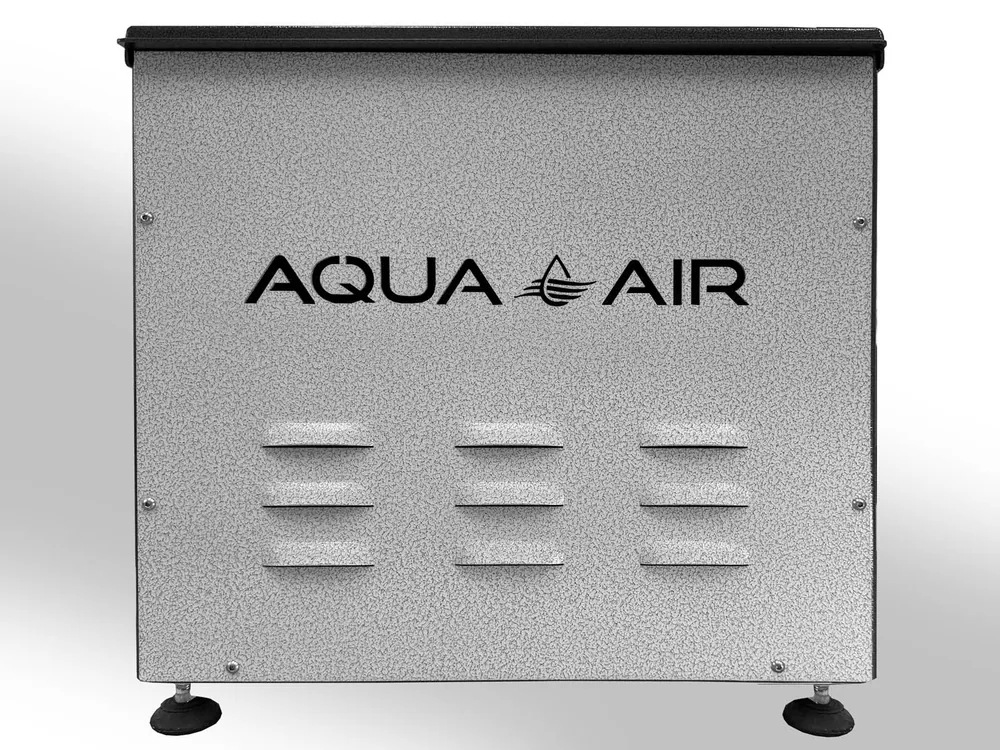
The practical difference for pond owners shows up in oxygen persistence at depth. Conventional aeration moves water and boosts surface oxygen readings. Nanobubble oxygenation restores and holds dissolved oxygen at the sediment interface, where the anoxic zone forms and the phosphorus cycle that drives blooms begins.
Retail aeration suppliers often list benefits such as higher dissolved oxygen, reduced muck, and fewer fish kills without explaining the mechanism or sharing validation data. Aquadei’s claims are checkable. The company has independent university photonics laboratory confirmation of 100-nanometer bubble production, in-house PhD-operated characterization, ISO 20480-1:2017 alignment, and published peer-reviewed studies in which its UFB generators served as the instrument for independent researchers.
For hardware selection guidance across pond sizes, see The Best Pond Aerators for Large Ponds: 1–6+ Acre Guide. For algae-focused equipment, see Pond Algae Bloom Prevention Equipment: What Works.
Size a Nanobubble System for Your Pond
Sizing Reality for a 1-Acre Pond
Choosing between those three methods is only half the decision; the other half is sizing, and a 1-acre pond covers a wide range of engineering problems. Depth determines whether a surface fountain can influence the bottom layer at all. Volume and organic load set the oxygen demand the system must meet. Power availability at the pond edge limits what can be installed. Turnover targets, such as how often the full volume passes through aerobic conditions, shape runtime requirements.
The most common sizing mistake is choosing a system by surface area alone and ignoring depth. Florida IFAS guidance is clear that ponds deeper than about 8 feet served only by a fountain often stay stratified at the bottom regardless of runtime. A 1-acre pond at 12 feet deep needs a very different configuration than a 1-acre pond at 4 feet deep. Nanobubble system sizing follows the same logic, with depth, volume, oxygen demand, and plume reach all feeding into the design.
Conclusion: Why Method Choice Shapes Pond Outcomes
Pond aeration benefits depend on how well a system restores oxygen at the sediment interface. That single factor influences whether organic matter breaks down aerobically or anaerobically, whether the bottom layer turns into a dead zone, and how strongly the internal phosphorus cycle drives blooms. Conventional aeration improves circulation and surface oxygen. Nanobubble oxygenation goes further by holding dissolved oxygen at depth.
Aquadei builds its pond systems around nanobubble oxygenation for that reason. The systems transfer oxygen at over 90% efficiency and produce bubbles at 100 nanometers or below, engineered to the ISO fine bubble framework. Independent laboratory work has confirmed that bubble production, and researchers at Arizona State, Penn State, the University of Florida, and USDA-ARS have used Aquadei’s UFB generators in published studies. Aquadei also owns the Gaia technology, whose bubble production the University of Osaka’s photonics laboratory independently confirmed and whose generators appear in peer-reviewed work in the Journal of Environmental Engineering, Water Research, and Agricultural Water Management.
For a full view of what pond oxygenation costs over time, see Pond Aeration Cost: Drivers, Quotes and the 10-Year View.
Plan Your Pond Oxygenation Project
Frequently Asked Questions
Will Aeration Fix My Algae Problem for Good?
Aeration tackles the internal phosphorus loading that keeps algae blooms coming back by oxygenating the sediment interface so phosphorus stays bound in the sediment. That shift reduces the nutrient supply feeding blooms from inside the pond. External nutrient loading from fertilizer runoff, animal waste, and industrial discharge still matters, and aeration does not block those sources. For an active bloom, the recommended approach pairs oxygenation with hydrogen peroxide. Over time, aeration reduces bloom frequency and intensity by weakening the internal cycle while you manage external inputs as well.
What Is the Difference Between a Decorative Fountain and a System That Restores Oxygen at the Bottom?
A decorative fountain oxygenates only the top layer by spraying water into the air. It works best in shallow ponds, generally under 6 to 8 feet deep, where the surface layer holds most of the volume. In deeper ponds, the hypolimnion below the thermocline stays mostly untouched, no matter how long the fountain runs. Bottom-diffused aeration reaches deeper by releasing air at the pond floor and lifting bottom water to the surface, although conventional bubbles off-gas within seconds and transfer oxygen less efficiently. Nanobubble oxygenation delivers dissolved gas at depth with over 90% gas transfer efficiency and persistence measured in days, because bubbles at 100 nanometers or below do not rise and escape. The practical test is whether the system actually oxygenates the sediment interface instead of just creating surface spray.
Is It Possible to Over-Aerate a Pond?
Over-aeration can happen, but it usually appears only when a system is oversized for the pond. The body section above explains the mechanisms in detail. The short version is that under-sizing is far more common and more damaging, because it leaves much of the pond stratified and anoxic at depth.
Why Does Starting Aeration in Summer Carry a Risk of Killing Fish?
In a stratified summer pond, the bottom layer often holds hydrogen sulfide, high carbon dioxide, and very low dissolved oxygen. A bottom-diffused system started at full power can lift that anoxic water into the fish zone faster than it can be reoxygenated. The mechanism, described above, is a rapid mixing event that triggers a short-term oxygen crash. The practical fix is a staged startup over one to two weeks so the bottom layer reoxygenates before full mixing occurs.
How Does Nanobubble Oxygenation Differ From Conventional Aeration in How Long Oxygen Stays in the Water?
Conventional aeration bubbles from fountains or diffusers rise quickly and off-gas at the surface, so oxygen transfer happens in a brief window of seconds. Nanobubbles at 100 nanometers or below carry a negative surface charge and move through Brownian motion, which keeps them suspended instead of rising. The comparison section above covers measured persistence in detail, with oxygen remaining available for days rather than seconds. That extended presence at depth is what allows nanobubble systems to maintain aerobic conditions at the sediment interface.