Key Takeaways
- Commercial pools must maintain a required chlorine residual. The practical goal is to use less chemical to hold that residual, not eliminate chlorine.
- Organic loading from bathers, pH drift, and accumulating stabilizers like cyanuric acid are the primary drivers of chemical demand in commercial pools.
- Enzymes, automated controllers, UV, ozone, and nanobubble systems each reduce different parts of demand. Every facility still needs a code-compliant chlorine residual.
- Lowering chlorine load at the source also lowers chloramine formation, which improves indoor air quality and addresses a major operational and health concern.
- Aquadei’s nanobubble systems are engineered to reduce chlorine demand up to 50% in commercial settings while retrofitting onto existing infrastructure.
What Actually Drives Chemical Demand In A Commercial Pool
Chemical demand changes with organic loading and water chemistry. Bather load, temperature, and operating conditions all shift that demand curve throughout the day.
Every swimmer adds urea, amino acids, sweat, sunscreen, and body oils to the water. A single swimmer contributes roughly 0.5 to 1 gram of urea per hour, so 100 bathers introduce 50–100 grams of urea-driven chlorine demand every hour of peak operation. No static dosing schedule can keep up with that load. The organic matter reacts with free chlorine to form chloramines, which consume sanitizer without providing effective disinfection and create the familiar indoor pool smell.
pH drift compounds the problem. Hypochlorous acid (HOCl) is roughly 80 times more effective as a sanitizer than the hypochlorite ion (OCl⁻), and the ratio between the two is entirely pH-dependent: at pH 7.2 about 66% of free chlorine is HOCl, but at pH 7.8 only about 33% is. The sanitizing capacity nearly halves while the free-chlorine test still reads the same. Wave features, lazy rivers, and surf systems drive pH up through aeration, which means more acid to correct it and less effective chlorine between corrections.
Accumulation creates a third driver. Chlorine is consumed as it sanitizes and dissipates. Cyanuric acid (CYA), the stabilizer that shields chlorine from UV degradation, is not consumed and builds up season after season. Once CYA climbs into the 80, 100, or 120+ ppm range, a pool can test at 5 ppm free chlorine with almost no usable HOCl in the water. Dilution through partial drain and refill is the only remedy. Calcium hardness and total dissolved solids accumulate in similar ways and create their own long-term constraints.
For more detail on what drives chlorine demand at the service level, see Pool Service Chemical Reduction: What Drives Chlorine Demand.
The Regulatory Constraint: What Reduction Actually Means
Commercial and public pools must meet governing health-code requirements, which vary by jurisdiction. The CDC Model Aquatic Health Code (5th edition, 2024) sets a minimum free chlorine of 1 ppm for pools without cyanuric acid and a combined chlorine action level of 0.4 ppm. The enforceable requirement at a specific facility comes from the local adopted code.
Reduction means using less chemical to hold that required residual. Operating below the locally adopted minimum requires a variance from the authority having jurisdiction. Variances exist in practice. A 3-million-gallon commercial surf park in Arizona received a variance to operate at half a part per million of chlorine, half the standard commercial minimum. It is operating at that level today.
That outcome is real and documented for that site and regulator. Other facilities must work within their own jurisdiction’s code and process.
The practical framing for any commercial operator is straightforward. Aim to reduce how much chemistry it takes to hold the water at the required residual, and seek explicit authorization before operating below it.
How To Compare Chemical Reduction Methods: What Each Approach Actually Reduces
The table below shows why no single method solves chemical demand on its own. Each approach targets a different driver such as organic loading, pH efficiency, chloramine burden, or raw demand, and most leave at least one driver untouched. Treat the options as complementary tools rather than direct substitutes.
The table compares the available methods on mechanism, what they actually reduce, and the operational considerations that matter to a facility manager. No competitor names or specific equipment vendors are included. Figures come from regulatory and peer-reviewed sources only.
| Method | Mechanism | What It Reduces | Operational Considerations |
|---|---|---|---|
| Enzyme Dosing | Biological oxidation of organic contaminants such as oils, lotions, and bather waste in the water column | Organic loading and some chloramine precursors | Reduces organic demand but does not address pH drift, CYA accumulation, or provide a disinfectant residual. Effectiveness depends on bather load and temperature. |
| pH Control (Automated Acid Dosing) | Keeps pH in the range where HOCl predominates, which improves the effectiveness of existing chlorine | Acid consumption and overall chlorine efficiency by improving the HOCl fraction (see the pH discussion above) | Requires sensor calibration every 30–90 days. Does not reduce organic loading or chloramine formation. Muriatic acid storage and handling remain a site hazard. |
| Automated Chemical Controller | Continuous ORP and pH monitoring with proportional dosing to maintain target residuals | Overdosing and dosing inconsistency, improving the accuracy of the existing chemical program | Does not change the underlying demand curve. Effective only when properly calibrated and when staff are trained not to override it. Sensor replacement and calibration are ongoing costs. |
| UV | UV-C light disrupts pathogen DNA as water passes through a reactor chamber and degrades chloramines in the treated stream | Chloramine burden in recirculated water and chlorine-resistant pathogens such as Cryptosporidium. Environmental monitoring studies have reported reductions in airborne trichloramine in facilities using UV-assisted disinfection | Provides no residual after the reactor, so a code-compliant chlorine residual remains required in the pool basin. Lamp and sleeve replacement are scheduled maintenance items. Treats only water passing through the chamber. |
| Ozone | Strong oxidant injected as a bypass loop that destroys chloramines and organic contaminants in a contact vessel before water returns to the pool | Chloramine burden and organic loading in the treated stream. Ozone installations are reported to reduce chlorine demand by roughly 50–70% in general industry claims, while still requiring a chlorine or bromine residual | Requires correct sizing, ozone-safe components, and off-gas management. A secondary sanitizer residual remains mandatory. Ozone is a potent airway irritant at elevated concentrations and must not vent to pool-deck air. |
| Nanobubble Systems | Oxygen, ozone, and CO₂ infused as bubbles at 100 nanometers or below. Bubbles remain suspended for weeks to months, delivering gas throughout the water column and generating reactive species on collapse. | Organic loading and chloramine precursors at the source, pH drift when CO₂ nanobubbles are used for inline pH control, and chlorine demand up to 50% in commercial settings | Retrofits onto existing filtration and UV infrastructure. A code-compliant chlorine residual remains required in commercial settings. System must be sized to facility volume, flow rate, and bather load. The core generator has no mechanical moving parts. |
See How Nanobubbles Fit Your Facility
Does A Commercial Pool Chemical Controller Actually Reduce Chemical Use?
Many operators expect a controller to cut their chemical bill, yet the main benefit is more precise control, not lower demand.
An automated controller improves consistency and dosing accuracy. It prevents overdosing when a manual schedule ignores a crowded Saturday afternoon and prevents underdosing when staff are busy elsewhere. Automated chemical controllers provide real-time monitoring and dosing of disinfectants and pH adjusters, which reduces the risk of human error and keeps water chemistry more consistent.
The controller does not change the underlying demand curve. If the pool consumes large amounts of chlorine because of high bather load, elevated organic matter, and pH drift from wave features, the controller will simply meet that demand more accurately. A facility that installs a controller and expects a large drop in chemical spend will likely see modest savings from reduced waste, not a step-change reduction in demand. The controller is a control improvement. Demand-side interventions must address the sources of load.
If controllers cannot cut demand, the question becomes which interventions can. The strongest case for demand-side changes centers on indoor air quality, and that story starts with chloramines.
How To Lower Chloramines In An Indoor Pool: The Strongest Operational Argument
The “chlorine smell” people notice in an indoor aquatic facility is actually chloramines, specifically trichloramine (nitrogen trichloride), the most volatile chloramine species. These compounds form when free chlorine reacts with nitrogen-containing organic matter introduced by bathers. Trichloramine is a major volatile irritant in indoor pool air, with exposure concentrated near the water surface and breathing zone.
This situation represents a genuine indoor air quality problem. Multiple epidemiological and occupational studies have linked airborne chloramine exposure to upper airway irritation, mucosal inflammation, nasal congestion, rhinitis, and respiratory complaints in swimmers and pool workers. NIOSH has identified disinfection byproducts including chloramines as a cause of adverse health effects, including eye and respiratory irritation, among lifeguards and patrons at indoor aquatic facilities.
For staff, exposure accumulates over time. Swim instructors in the water six or seven hours a day experience hair and skin damage from sustained chloramine contact, which becomes an occupational health issue.
The chemistry links chlorine load directly to chloramine formation. Less chlorine reacting with organic matter means less chloramine produced. Reducing the chlorine load required to keep water sanitized reduces chloramine formation at the source. Facility managers respond to this argument because it addresses what is happening in the building, not just a line item on a chemical invoice. For a detailed treatment, see Reducing Chloramines In Indoor Pools: A Facility Guide.
Where Nanobubble Systems Fit And Why Aquadei Comes First
Aquadei owns the Gaia technology, a nanobubble platform with a lineage dating to 2008. The platform was independently validated at the University of Osaka’s photonics laboratory in August 2016 and is now protected by multiple US patents with additional grants and filings in Canada, Australia, the EU, India, and Chile. Aquadei is one of the most scientifically validated nanobubble companies in North America, with research collaborations across more than 15 universities and government labs, independent laboratory confirmation of bubble production, peer-reviewed studies using its generators, and in-house characterization capability operated by a PhD.
Aquadei’s nanobubble platform infuses oxygen, ozone, and CO₂ into water as bubbles at 100 nanometers or below, roughly 800 times smaller than a human hair. At that scale, four properties matter:
- The bubbles do not rise quickly. Instead of floating to the surface and off-gassing, they move through the water by Brownian motion and stay distributed throughout the volume.
- The bubbles carry a negative surface charge, which causes them to repel one another rather than coalescing. This charge helps them remain stable for weeks to months.
- The bubbles are self-pressurizing. As bubble size decreases, internal pressure rises through surface tension, turning each bubble into a pressurized gas reservoir.
- When a nanobubble collapses, it collapses inward and releases intense localized energy that generates reactive species including hydroxyl radicals, which oxidize contaminants and support pathogen inactivation.
These effects are documented in the literature. In peer-reviewed research published in Water Research (Vol. 295, 2026), a team led from Arizona State University with co-authors at Penn State used a Gaia Water UFB generator to compare ozone nanobubbles against conventional macrobubble ozonation across six water types and measured mass-transfer coefficients more than an order of magnitude higher for nanobubbles. Separate peer-reviewed research from the University of Florida’s Indian River Research and Education Center, with a co-author at the USDA Agricultural Research Service, tested a Gaia Water UFB generator and found it raised dissolved oxygen to an average of 35 mg/L in 17 minutes and held oxygen above the state minimum for 6 to 15 days.
For commercial aquatics, three systems are relevant. The Aqua Fuzion Skid plumbs into a pool’s return and delivers millions of oxygen- and ozone-infused nanobubbles into the water. The Air Gen generator supplies oxygen and ozone. pHure Feed delivers hyper-dissolved CO₂ inline for natural pH control and is designed to reduce or replace routine muriatic-acid dosing where site conditions allow.
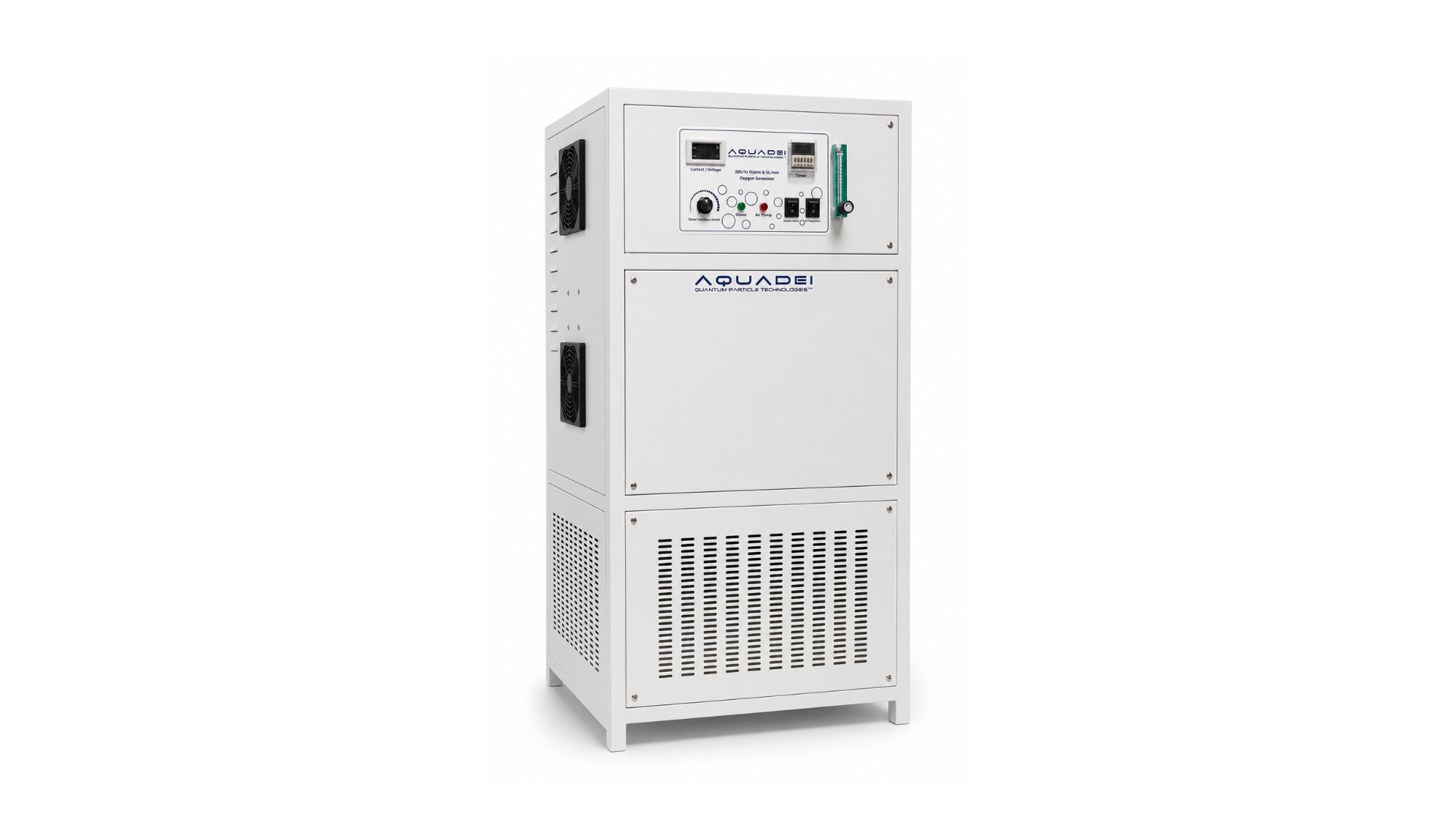
These systems retrofit onto new and existing pools and work alongside existing filtration and UV infrastructure. In commercial settings, a code-compliant chlorine residual is still required, and Aquadei’s documented reduction in commercial settings matches the up-to-50% figure cited earlier.
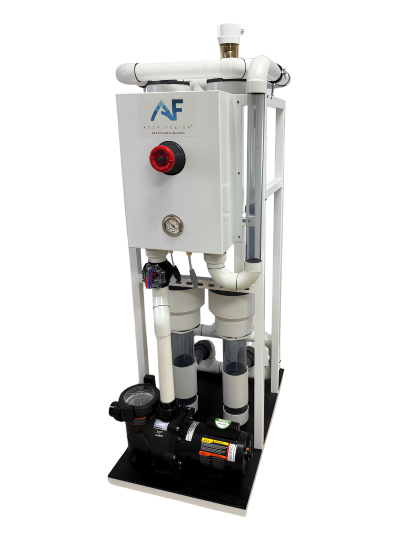
The Aqua Fuzion Skid and the broader Aquadei platform are engineered to the ISO/TC 281 fine bubble framework and ISO 20480-1:2017 terminology standard, producing bubbles at 100 nanometers or below, roughly ten times finer than the standard’s ultrafine bubble threshold of 1 micron. That specification is measurable, demonstrated in Aquadei’s PhD-operated characterization laboratory using Nanoparticle Tracking Analysis, Dynamic Light Scattering, and zeta-potential analysis.
For a broader overview of how Aquadei’s approach compares to conventional chemical management, see How To Reduce Chemicals In Commercial Pools and Commercial Pool Chemical Reduction: Operator’s Playbook.
How To Choose What Fits Your Facility: A Decision Framework
No single method fits every facility. Start with an honest assessment of the facility’s own constraints:
- Water Volume And Turnover Rate. A 3-million-gallon surf park and a 25,000-gallon competition pool have fundamentally different sizing requirements. Every system must match actual flow rate and pool volume.
- Bather Load And Use Pattern. A swim school running back-to-back lessons from 6 a.m. to 8 p.m. has a different organic loading profile than a hotel pool with moderate recreational use. Peak-load periods drive the demand curve more than average use.
- Environmental Conditions. Outdoor pools with direct sun exposure face UV breakdown of chlorine that indoor pools do not. Wave features and water attractions drive pH up continuously. Both factors affect how much chemistry the facility consumes.
- Binding Constraint. Decide whether the primary problem is chemical cost, chloramine complaints from guests or staff, or a compliance ceiling the facility cannot get above. That answer points to the intervention that addresses the real problem.
- Existing Infrastructure. Aquadei’s systems retrofit onto existing filtration and UV. A facility that already invested in UV infrastructure can keep it and run nanobubble systems alongside it.
The constraint you identify determines the starting point. If pH management and acid costs dominate, evaluate pHure Feed first. If chloramine complaints in an enclosed natatorium are the binding issue, consider the full Aqua Fuzion Skid and Air Gen combination, which supports the strongest and most defensible indoor air quality argument. If raw chemical spend at scale is the main concern, model the reduction in chlorine demand against the current annual chemical budget before specifying equipment.
Every system still depends on circulation, filtration, cleaning, testing, and timely corrective action. Equipment supports operational discipline but never replaces it.
Honest Limitations: What To Expect And What To Question
No supplemental treatment removes the need for testing, cleaning, and circulation. A nanobubble system, UV system, or ozone system installed on a pool with poor circulation, inadequate filtration, or infrequent cleaning will underperform. The chemistry still requires active management. Shock treatment should follow water-test results rather than an automatic schedule. A partial shock that does not reach breakpoint can convert milder monochloramine into harsher dichloramine and trichloramine without destroying them, which can make air quality worse.
No universal timeline exists for operating with less chemical. Water quality shifts quickly with heat, sunlight, debris, bather load, nutrients, and circulation. A pool that runs well at a reduced chemical load on Tuesday morning may need corrective action by Friday afternoon after a school group. Regular testing remains the only reliable indicator.
The nanobubble category itself deserves scrutiny. The field has expanded faster than the evidence behind many products. Some vendors cannot demonstrate that their equipment produces what they claim, with no independent validation of bubble size, no adherence to the ISO fine bubble framework, and no published research using their generators. Before specifying any nanobubble system, ask the vendor to demonstrate bubble size and concentration using a recognized measurement method. Ask for published, peer-reviewed research in which independent researchers used the equipment. Ask whether a university laboratory has independently validated the system.
Aquadei can answer all three questions. That distinction matters when a specifying engineer or a regulator asks for the evidence behind the system.
Frequently Asked Questions
What Are The Ideal Chlorine Levels For A Commercial Pool?
As covered earlier, the CDC model code sets a 1 ppm free chlorine minimum for pools without stabilizer and a 0.4 ppm combined chlorine action level, with higher minimums when cyanuric acid is present. The enforceable minimum at your facility comes from your local adopted code, which may be stricter or structured differently. Requirements can also vary by pool type, so always confirm the local standard before adjusting operations.
How Do You Know If A Nanobubble System Is Actually Reducing Demand?
The most reliable approach is to track chemical use and water quality before and after installation under comparable operating conditions. Record daily chlorine and acid additions, bather load, and key water parameters such as free chlorine, combined chlorine, and pH for several weeks. After the system comes online and stabilizes, repeat the tracking. A real demand reduction shows up as lower chemical additions at the same or better water quality and bather load, not just smoother controller readings.
Can Nanobubbles Replace Breakpoint Chlorination?
No. Breakpoint chlorination remains a core tool for addressing heavy contamination events. Nanobubble systems reduce the ongoing chlorine load required to maintain the residual and lower chloramine formation at the source, but they do not replace the need for breakpoint treatment when water tests indicate it. Use nanobubbles to flatten the everyday demand curve and use breakpoint chlorination when testing shows combined chlorine or contamination above your action thresholds.
Does A Chemical Controller Actually Reduce Chemical Use?
As the controller section explains, a controller improves dosing accuracy but leaves the demand curve unchanged. The practical takeaway is straightforward: expect modest savings from eliminated waste and fewer manual mistakes, not a dramatically lower chemical bill from reduced demand.
How Do You Lower Chloramines In An Indoor Pool?
The most effective approach is layered control. Pre-swim showering and toilet use reduce the nitrogen-containing compounds bathers introduce. Proper ventilation, especially near-surface air exchange, removes volatile trichloramine from the breathing zone. Secondary treatment systems such as UV and ozone reduce chloramine burden in recirculated water. Nanobubble systems reduce the chlorine load required to maintain the residual, which lowers chloramine formation at the source. Strong results come from combining source reduction, water treatment, and ventilation.
What Maintenance Does A Nanobubble System Need?
Aquadei’s core generator has no mechanical moving parts in the flow path, which sets it apart from many competing systems. The core technology itself requires essentially no routine maintenance. Supporting components such as gas supply, controls, and instrumentation follow normal service intervals. The pool’s existing water testing, chemical management, filtration, and cleaning program continues unchanged. The nanobubble system reduces the chemical load those programs manage but does not replace them.
Will A Nanobubble System Work With My Existing Filtration And UV?
Yes. Aquadei’s systems are designed as retrofits, plumbed inline into the pool’s existing return and operating alongside existing filtration and UV infrastructure. The system does not require rebuilding the pool’s hydraulics, provided the necessary flow rate for the specific installation is available. Skid-mounted and pre-piped configurations are available where installation speed or footprint constraints matter. Every installation is sized to the facility’s actual water volume, flow rate, and bather load.
Ask About Your Pool’s Demand Profile