Key Takeaways
- Five factors drive ozone water treatment cost: flow rate, target contaminants, oxygen feed choice, contact tank size, and pre-treatment needs.
- Three numbers define real five-year ownership cost: installed price, annual consumables and power, and the cost of stages ozone cannot replace.
- Hardness, nitrates, total dissolved solids, and PFAS still need softening or reverse osmosis because ozone does not remove them.
- Most initial quotes skip recurring costs for desiccant media, check valves, carbon polishing, and electricity, even though they add up over time.
- Aquadei’s nanobubble platform improves gas transfer, removes moving parts from the flow path, and relies on lab-tested performance to lower long-run costs.
Talk With Aquadei About Your Project
The Three Numbers That Matter More Than The Sticker Price
Every ozone project comes down to three numbers: what it costs to install, what it costs to run, and what other stages the water still needs. A quote that arrives as a single figure answers only the first number. It tells you what the contractor will charge to put equipment in the ground. It leaves out what that equipment will cost to run, what may fail in year three, and what additional stages your water requires that ozone does not provide.
Ozone does not eliminate the need for other treatment stages. Hardness, nitrates, total dissolved solids, and PFAS are not addressed by ozone and require softening, filtration, or reverse osmosis alongside it. A whole-home ozone system treats iron, sulfur, manganese, and bacteria, yet it does not soften hard water, remove sodium or fluoride, or address dissolved solids. A quote that ignores those additional stages leaves out a meaningful share of the real project cost.
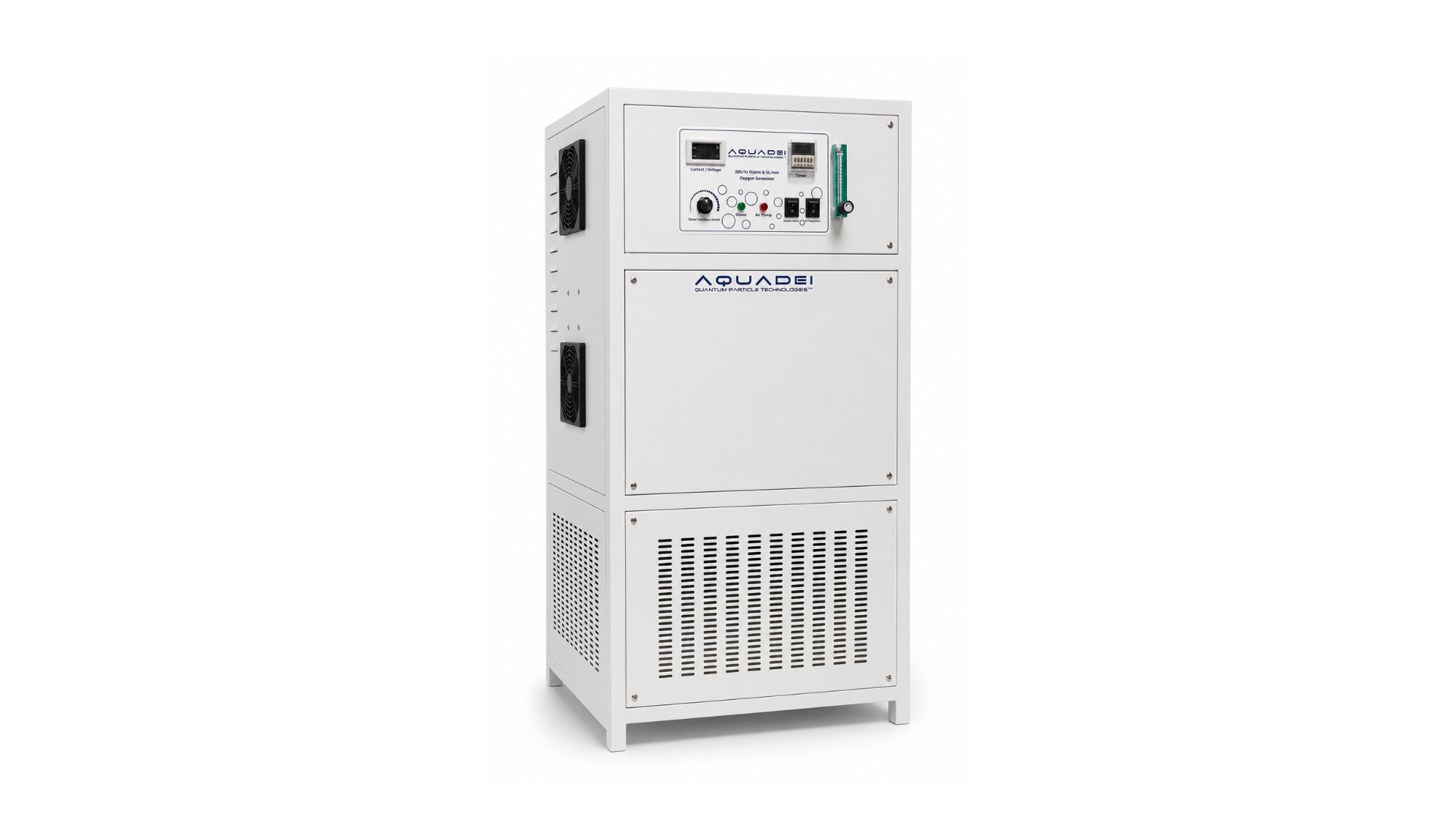
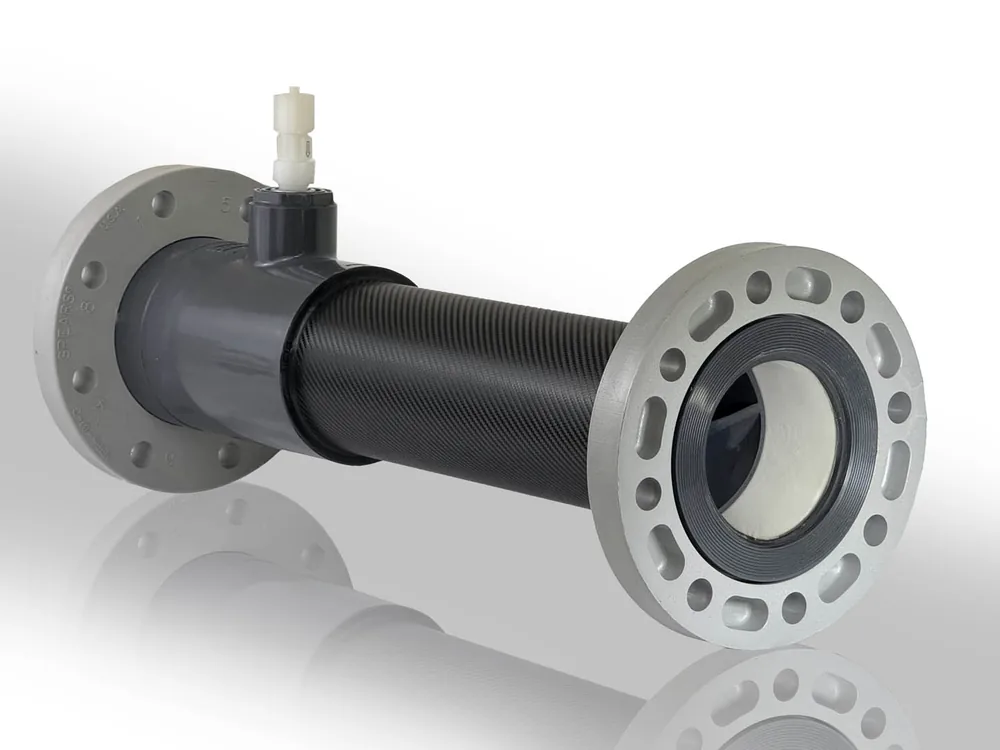
Aquadei sits in this cost conversation as the owner of the Gaia technology. Its nanobubble platform infuses oxygen, ozone, CO₂, and other gases into water at 100 nanometers or below using hydrodynamic cavitation. This approach changes the cost structure of ozone treatment in three ways. Higher gas transfer efficiency means less gas and less power to reach the same dissolved concentration. No mechanical moving parts in the flow path means essentially no maintenance on the core generator. The company also characterizes what its systems produce in its own PhD-operated laboratory, so sizing starts from measured output instead of a generic specification sheet.
Review Your Three Key Cost Numbers
Installed Cost By Application Tier: How Your System Is Built
The table below maps common application categories to their typical flow rates, the equipment each tier includes, and the inputs that push a quote toward the top of its range. No dollar figures appear here. The architecture behind the cost is more useful than a price band that may not reflect your water chemistry, your site conditions, or what the contractor chose to include or omit.
| Application Tier | Typical Flow Rate (GPM) | What The Tier Includes | What Moves Cost Within The Tier |
|---|---|---|---|
| Point-of-use drinking water | Varies by system; some POU ozone systems are designed for flows up to 30–100 GPM | Ozone generator, venturi injector, check valve(s), contact tank | Generator type (UV vs. corona discharge), whether an oxygen concentrator is added, existing plumbing compatibility |
| Whole-home well water conditioning | 5–20 GPM | Ozone generator, venturi injector, contact or retention tank, off-gas vent or destruct unit, backwashing filter, with an oxygen concentrator added for oxygen-fed units | Hydrogen sulfide concentration, whether oxygen feed is required, peak vs. average flow, site electrical and plumbing scope |
| Light commercial (hospitality, agricultural, municipal-scale) | 30–100 GPM | All whole-home components plus larger contact tank, controls, instrumentation, and often a redundant generator module | Contaminant loading across multiple parameters, oxygen concentrator or liquid oxygen supply, PLC integration, off-gas destruct unit sizing, pre-treatment requirements |
Read the table this way. The tier tells you the architecture and the equipment classes a properly specified system must include. The fourth column shows which inputs push your quote toward the top of its tier. A whole-home system treating moderate iron and bacteria sits near the lower end of that tier. The same system treating high hydrogen sulfide, requiring an oxygen concentrator, and needing new electrical service sits near the top or above it.
For a deeper look at how ozone generators are selected for different water conditions, see How To Choose An Ozone Generator For Your Water.
What Drives The Price: Five Inputs Behind Any Quote
1. Flow Rate In GPM. Generator sizing is set at peak flow, not average daily use. A household that draws 10 GPM during morning routines needs a generator and contact tank sized for that peak, even if average flow is half that. Required ozone output in grams per hour equals flow rate multiplied by target dose once matrix demand is known. The rating must also state whether it is measured on air or on high-purity oxygen, because the same nameplate figure can mean very different delivered output. A larger contact tank follows a larger generator, and both add to installed cost.
2. Target Contaminants. Iron, sulfur, manganese, and bacteria each carry a different ozone demand, and hydrogen sulfide dominates it. Ozone demand stoichiometry runs approximately 0.43 mg of ozone per mg of iron, 0.88 mg per mg of manganese, and roughly 3 mg per mg of hydrogen sulfide. Real systems need more because not all injected ozone dissolves. A sulfur spike after a dry spell can outrun a generator sized on a single low test. The demand stack combines the disinfection margin with the ozone consumed by iron, manganese, and hydrogen sulfide before any pathogen is touched. That stack, not the contaminant list alone, determines generator size.
3. Oxygen Concentrator Versus Ambient Air Feed. Oxygen feed systems cost more than air-fed units but reach higher ozone concentration, which typically allows a smaller contact tank. This choice adds a component and its own service path. Air-fed units are simpler and less expensive upfront. Oxygen-fed units are more efficient over time. The right choice depends on contaminant loading and the site’s tolerance for long-run operating cost.
4. Contact Tank And Degassing Stage. These stages are required. Ozone must have contact time to react with contaminants, and off-gas must be vented outdoors or passed through a destruct unit. Off-gas destruction, residual quenching, and pre-treatment are commonly omitted from turnkey ozone quotes and can add 20% to 40% to the installed price. A quote that does not include a destruct unit leaves out a critical safety and compliance component.
5. Existing Pressure Tank, Plumbing, And Electrical Supply. Whether the site can carry the installation without modification is one of the largest swing factors in any quote. A site with adequate electrical service, an existing pressure tank, and accessible plumbing costs less to install than one requiring new circuits, a pressure tank upgrade, or significant pipe rerouting. This line item stays invisible in a generator-only quote yet shows up clearly on the final invoice.
Ongoing Costs Nobody Quotes: The Real Five-Year Driver
The recurring cost structure of a conventional ozone system includes four line items that rarely appear in a contractor’s initial proposal.
Desiccant Air-Drying Media. Air-fed systems require feed gas dried to a dew point well below freezing to prevent nitric acid formation that corrodes the corona discharge cell and collapses ozone output. Desiccant media requires periodic service or replacement. This cost stays modest but, if neglected, accelerates generator failure.
Venturi Injector And Check Valve Replacement. The check valve is the most common failure point in a residential ozone system, and a failed check valve that allows water to back-flow into the generator is the usual cause of early generator death. Injector and check valve inspection and replacement is a recurring maintenance item that most quotes do not itemize.
Carbon Polishing Media Replacement. The backwashing carbon stage that captures oxidized iron, manganese, and sulfur particles and removes residual ozone before water reaches the tap requires periodic media replacement. Intervals depend on contaminant loading and water volume, yet the cost recurs across the life of the system.
Electricity. Generating one kilogram of ozone via corona discharge consumes 8 to 18 kilowatt-hours of electricity, making power the dominant operating cost of a conventional ozone system. Over five years, electricity becomes the largest recurring line item in the ozone ownership model, larger than any single consumable replacement.
Aquadei’s nanobubble platform reshapes that five-year model. No mechanical moving parts in the flow path remove the check valve and injector replacement line from the recurring cost stack. Higher gas transfer efficiency, measured in peer-reviewed research at bench scale, means less ozone and less power to reach the same dissolved concentration.
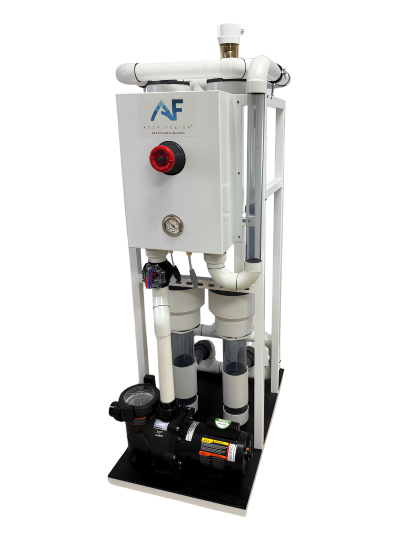
Independent research published in Water Research Vol. 295 (2026), led from Arizona State University with co-authors at Penn State, used a Gaia Water UFB generator to compare ozone nanobubbles against conventional macrobubble ozonation across six water types and measured mass-transfer coefficients more than an order of magnitude higher for nanobubbles. That work used bench-scale chemistry in a controlled reactor rather than a full installation. The implication for the power line in a five-year cost model is still direct. Higher transfer efficiency means less ozone wasted to off-gas and less electricity consumed to reach the same dissolved concentration.
The same paper found that ozone in nanobubble form decayed faster than in macrobubble form, not slower. Faster decay means more efficient delivery and more intense interfacial reaction rather than extended ozone residence. That finding supports the efficiency argument while clarifying how the chemistry behaves.
Estimate Your Five-Year Operating Cost
What Ozone Does Not Remove And What You Still Need
Ozone acts as an oxidizer and a disinfectant. It does not act as a separation technology. That distinction determines what it can and cannot do, and which additional stages your project still needs.
Hardness, Nitrates, Total Dissolved Solids, And PFAS. Ozone does not remove hardness minerals, total dissolved solids, sodium, nitrate, or fluoride, and it is not a lead or PFAS treatment. Hard water still requires a softener after the ozone filter. Nitrates, dissolved solids, and PFAS require reverse osmosis at the drinking tap. A quote that prices only the ozone system on a well with hard water and elevated nitrates covers roughly half the treatment train.
Iron And Manganese Separation. Ozone oxidizes dissolved iron and manganese into particles, so it performs the oxidation step, not the separation. Those oxidized particles must then be removed by a downstream filter. Ozone converts soluble iron and manganese into filterable solids, and the filtration stage actually removes them from the water. The filter remains essential.
Residual Disinfection. Ozone decays back to oxygen within minutes, and faster in warm water, so it leaves no lasting residual. A well with a coliform history often needs a UV system after the ozone filter as a final disinfection barrier, because ozone provides no ongoing protection once it has decayed. That UV stage adds both equipment and maintenance cost.
Bromate In Bromide-Bearing Water. In any water source containing bromide, common near coasts and in some brackish aquifers, ozone treatment raises bromate questions. Ozone can oxidize bromide to bromate, which the EPA regulates at a maximum contaminant level of 0.010 mg/L, so bromide should be tested before quoting ozone. The 2026 Water Research study from Arizona State University and Penn State found that nanobubble ozonation drove near-complete bromide depletion in bromide-spiked synthetic seawater and produced bromate well beyond macrobubble ozonation. That result makes pre-quote bromide testing essential in any saline or bromide-bearing context.
For a full explanation of how ozone works as a treatment mechanism, see Ozone Water Treatment: How It Works And Key Benefits.
Ozone Versus Reverse Osmosis On Total Cost Of Ownership
Ozone and reverse osmosis serve different roles in a treatment train. Comparing them on a single cost metric produces a misleading number because they operate on different mechanisms and address different contaminants.
Ozone functions as an oxidizer and a disinfectant. It reacts with iron, sulfur, manganese, bacteria, viruses, taste-and-odor compounds, and some organic micropollutants. It does not remove dissolved solids, salts, nitrates, or PFAS. Its consumable profile centers on electricity and periodic media replacement, with no chemical refills required.
Reverse osmosis provides physical separation. It forces water through a semi-permeable membrane that blocks dissolved solids, ions, heavy metals, PFAS, and most pharmaceutical residues. EPA reports that reverse osmosis membranes are more than 90% effective at removing a wide range of PFAS, including shorter-chain compounds that other filter types struggle with. Its consumable profile includes membrane replacement every two to five years, pre-filter replacement every six to twelve months, and a wastewater stream. A typical point-of-use RO system sends five or more gallons of reject water down the drain per gallon of purified water produced.
The practical conclusion for a private well with multiple problems is straightforward. Ozone handles iron, sulfur, manganese, and microbial load. Reverse osmosis handles dissolved contaminants at the tap. A well with both problem types needs both, and the quote should say so. A typical multi-contaminant well water setup, including sediment filter, iron removal system, water softener, and under-sink RO, carries a combined installed cost that reflects the full treatment train. A quote that prices only the ozone system on that well describes a first-year cost and leaves future expenses unstated.
How To Evaluate A Contractor Quote
A complete ozone quote for a whole-home well system should include every item in the following list. If any are absent, ask why and ask what they will cost when added later.
- Ozone generator sized at peak flow, with the rating basis stated (air-fed or oxygen-fed, and at what oxygen purity)
- Oxygen concentrator, if required by the contaminant loading or the generator specification
- Venturi injector and check valve
- Contact or retention tank, sized for the required contact time at peak flow
- Off-gas vent or destruct unit
- Backwashing filter media for oxidized particle capture
- Carbon polishing stage
- Electrical and plumbing scope, including any site modifications required
Use these questions to pressure-test any quote.
- What is not in this number?
- What is the annual consumable and power cost?
- What is the replacement interval on the check valve and the carbon media?
- Has bromide been tested in my water?
- What happens to this number if my sulfur reading was taken after a dry spell?
- Is the off-gas destruct unit included, or is it a separate line?
- What additional stages does my water require that this system does not address?
Off-gas destruction, residual quenching, and pre-treatment are commonly omitted from turnkey ozone quotes and can add 20% to 40% to the installed price. Keep that 20%–40% figure in mind when you read a quote that lists only the generator and a contact tank.
Sizing Guide: Turn The Tier Into Your Own Number
Three inputs determine which tier your system falls into and where within that tier your quote should land.
Water Source And Tested Concentrations. A current water test forms the starting point. Avoid relying on a test taken after a wet season if your well runs high-sulfur after dry spells. The test should include iron, manganese, hydrogen sulfide, pH, hardness, total dissolved solids, coliform bacteria, and bromide if you are near a coast or in a brackish aquifer.
Household Flow Rate In GPM. Size to peak flow, not average. A two-bathroom home typically draws 7 to 10 GPM at peak. A four-bathroom home may require 12 to 15 GPM or more. Generator sizing is set at that peak number.
Demand Stack Calculation. The ozone your system must produce includes more than the amount needed to touch pathogens. It combines the disinfection margin with the ozone consumed by iron, manganese, and hydrogen sulfide before any pathogen is reached. A site with 2 mg/L iron and 0.5 mg/L manganese burns approximately 1.25 mg/L of ozone before any pathogen is touched, per EPA guidance. Hydrogen sulfide at even modest concentrations dominates that stack.
One additional sizing note helps many projects. A recirculating system can use a smaller generator than an inline system because it treats stored water over a longer cycle rather than at peak flow. Recirculating systems treat stored water over a longer cycle rather than at peak flow, which allows a smaller generator to achieve the same dissolved ozone concentration. If your site includes a storage tank, ask whether a recirculating configuration changes the generator size and the quote.
Frequently Asked Questions
How Much Are Ozone Generators?
Ozone generator cost depends on the application tier, the target flow rate in gallons per minute, the contaminants being treated, and whether an oxygen concentrator and contact tank are required. A point-of-use generator for drinking water is a different class of equipment from a whole-home well conditioning system, which is itself a different class from a light-commercial installation. Within each tier, the inputs that move the number include hydrogen sulfide concentration, whether oxygen feed is required to reach adequate dissolved ozone concentration, and whether the site requires electrical or plumbing modifications. A generator-only price tells you very little. The installed cost, including the contact tank, off-gas destruct unit, backwashing filter, and carbon polishing stage, reflects what the system actually costs to put in the ground.
What Are The Downsides Of Using Ozone For Water Treatment?
Ozone carries five practical limitations that any buyer should understand before committing to it. First, it leaves no lasting residual, because ozone decays back to oxygen within minutes and faster in warm water, so a well with a coliform history typically needs a UV stage after the ozone filter as a final disinfection barrier. Second, it does not remove hardness, nitrates, total dissolved solids, or PFAS, so those contaminants require softening, filtration, or reverse osmosis alongside the ozone system. Third, in any water source containing bromide, ozone treatment raises bromate formation risk, and bromide should be tested before a system is quoted. Fourth, off-gas must be vented outdoors or passed through a destruct unit. Ozone is a toxic gas at workplace exposure levels, and a system without an off-gas management stage remains incomplete. Fifth, the conventional ozone stack carries recurring consumable and power costs, including desiccant media, check valve and injector replacement, carbon polishing media, and electricity, that most initial quotes do not itemize but that materially affect five-year total cost of ownership.
Which Is Better, Reverse Osmosis Or Ozonation?
They do different jobs, so the better choice depends entirely on what is in the water. Ozone oxidizes and disinfects, addressing iron, sulfur, manganese, bacteria, viruses, and some organic compounds. Reverse osmosis separates dissolved contaminants, removing dissolved solids, salts, nitrates, heavy metals, and PFAS that ozone cannot touch. Most problem wells need both. Ozone handles the oxidation and disinfection load, and a point-of-use reverse osmosis system at the drinking tap addresses dissolved contaminants. A quote that prices only one of those stages on a well with both problems leaves the treatment plan incomplete.
How Long Does Ozone Stay In Ozonated Water?
Ozone decays back to oxygen within minutes of being dissolved in water, typically under 30 minutes in clean water at room temperature, and faster in warm water or water with high organic load. This behavior explains why ozone cannot maintain a residual in a distribution system or a storage tank and why a UV stage is often added after the ozone filter on wells with a coliform history. The decay follows the chemistry of ozone. A well-designed system accounts for it by sizing the contact tank for adequate reaction time and adding a final barrier where residual protection is needed.
Can I Drink Water Treated With Ozone?
Yes, once residual ozone has decayed, which happens within minutes under normal conditions. The more important question asks whether the full treatment train addresses everything in the water. Ozone handles oxidation and disinfection, yet it does not remove dissolved contaminants such as nitrates, dissolved solids, or PFAS. Drinking water quality depends on the complete treatment train rather than on the ozone stage alone. A water test that identifies all contaminants present forms the starting point for designing a treatment train that is actually complete.
What Maintenance Does An Ozone System Need?
A conventional ozone system requires four recurring maintenance tasks. Desiccant air-drying media on air-fed systems needs periodic service or replacement to maintain the feed gas dew point required to protect the corona discharge cell. The check valve between the generator and the venturi injector is the most common failure point and should be inspected regularly. A failed check valve allows water to back-flow into the generator and is the usual cause of early generator death. Carbon polishing media requires replacement at intervals that depend on contaminant loading and water volume. Electricity remains the dominant ongoing operating cost of the conventional ozone stack. A nanobubble platform such as Aquadei’s removes the mechanical moving-parts maintenance from that list because there are no moving parts in the flow path to degrade or replace.
Conclusion: Focus On The Five-Year Cost, Not Just The Quote
Installed cost is one number. Annual consumable and power cost is the second. The cost of the treatment stages ozone cannot replace is the third. A quote that answers only the first leaves a gap between that number and the real five-year cost, and that gap is where most ozone buyers are surprised.
Aquadei rarely comes in as the cheapest option in this category. It is the option whose total cost of ownership is defensible because its performance is documented. Output is measured in its own PhD-operated laboratory, engineered to the ISO fine bubble framework at 100 nanometers or below, and used as the instrument in peer-reviewed research at Arizona State University and Penn State, the University of Florida and the USDA Agricultural Research Service. That documentation supports the five-year number you present to stakeholders and keeps it grounded in measured performance rather than in a sticker price or a specification sheet.
Discuss A Five-Year Cost Model With Aquadei