Key Takeaways
- Aquadei is a chemical-free pool and spa treatment that removes the chlorine-driven half of the pool maintenance chemicals list by using oxygen and ozone nanobubbles for sanitation and CO₂ nanobubbles for pH control.
- The pool chemicals list splits into three tiers: essential items any pool needs, situational products required only when specific conditions arise, and chlorine-driven items that exist solely to manage the consequences of running a chlorine system.
- Chlorine-driven chemicals such as cyanuric acid, muriatic acid, chlorine shock, and most specialty products become unnecessary when a pool does not rely on chlorine or bromine for sanitation.
- Water balancers like total alkalinity, pH, and calcium hardness remain necessary regardless of sanitizer choice, while specialty chemicals like algaecide and clarifier are situational rather than routine purchases.
- Aquadei attaches to existing pool equipment and already operates in every city-operated pool in Scottsdale, Arizona, and a 3-million-gallon surf park in Mesa.
How To Read The Pool Maintenance Chemicals List
Every chemical on a pool chemicals list falls into one of three tiers. The tiers turn a flat shopping list into a clear buying decision.
- Essential: The water needs it regardless of which sanitizer the pool runs on. pH control and total alkalinity management fall here for any pool.
- Situational: Needed only when a specific condition arises, such as metals in fill water, algae pressure, heavy bather load, or a test result that calls for correction.
- Only Needed Because Of Chlorine: Cyanuric acid (stabilizer), muriatic acid for pH drift caused by chlorine chemistry, chlorine shock, and most specialty products. These items exist to manage the consequences of running a chlorine system. A pool that does not run on chlorine does not need them.
This tiering runs through every section below. Sanitizers and stabilizers are mostly chlorine-driven, water balancers are essential, and shock and specialty chemicals are situational. Each section notes which tier its products fall into.
Sanitizers And Stabilizers On The Pool Chemicals List
Sanitizers kill pathogens and keep the water safe to swim in. The sanitizer family is larger than most beginners expect, and the differences between products matter.
Sodium hypochlorite is liquid chlorine, typically sold at 10–12.5% concentration. It raises free chlorine quickly and does not add stabilizer or calcium. That makes it the most straightforward chlorine source for routine dosing and shock.
Calcium hypochlorite is granular or tablet chlorine (cal-hypo), sold at 65–73% strength. It raises free chlorine and adds a small amount of calcium hardness with each dose.
Trichlor (trichloroisocyanuric acid) and dichlor (sodium dichloroisocyanurate) are stabilized chlorine products. They contain cyanuric acid built in, so every dose adds both chlorine and stabilizer to the water.
Lithium hypochlorite is an unstabilized chlorine source that dissolves quickly and adds no calcium or stabilizer, though it is less widely available.
Bromine is the standard sanitizer for spas and hot tubs. It performs better than chlorine at higher water temperatures. The CDC’s Healthy Swimming program identifies chlorine and bromine as the primary disinfectants that inactivate most germs within minutes in properly treated water.
Target ranges for free chlorine in a residential pool are 2–4 ppm, with a minimum of 1 ppm (or 2 ppm when cyanuric acid is present), per the CDC’s home pool guidance and the Model Aquatic Health Code (MAHC). Bromine targets for spas run 4–8 ppm.
Salt chlorine generators sit in the chlorine-driven tier. A salt pool is a chlorine pool. The salt chlorine generator makes chlorine from salt by passing a low-voltage electrical current through salt water in a process called electrolysis. The water the family swims in is chlorinated water. That same electrolysis process also produces sodium hydroxide, which pushes pH up, so salt pools still require regular acid dosing. Choosing salt was a reasonable decision based on how salt pools are marketed, but the chemistry does not match the marketing.
Cyanuric acid (pool stabilizer or conditioner) is the clearest example of a chlorine-driven item. It shields free chlorine from UV degradation in outdoor pools. Without it, sunlight can destroy most of the chlorine in a pool within hours. The target range is 30–50 ppm, with a ceiling of 90 ppm under the MAHC (5th edition, 2024).
Cyanuric acid accumulates with every dose of stabilized chlorine. Trichlor adds roughly 0.6 ppm of CYA per ppm of chlorine, and dichlor adds roughly 0.9 ppm. Once it climbs too high, the only fix is a partial drain and refill. It also slows chlorine’s disinfection speed. At 30 ppm CYA, the time to inactivate certain viruses at 0.5 ppm free chlorine rises from under a minute to over 14 minutes, per the MAHC annex. The CDC does not recommend cyanuric acid for indoor pools or hot tubs.
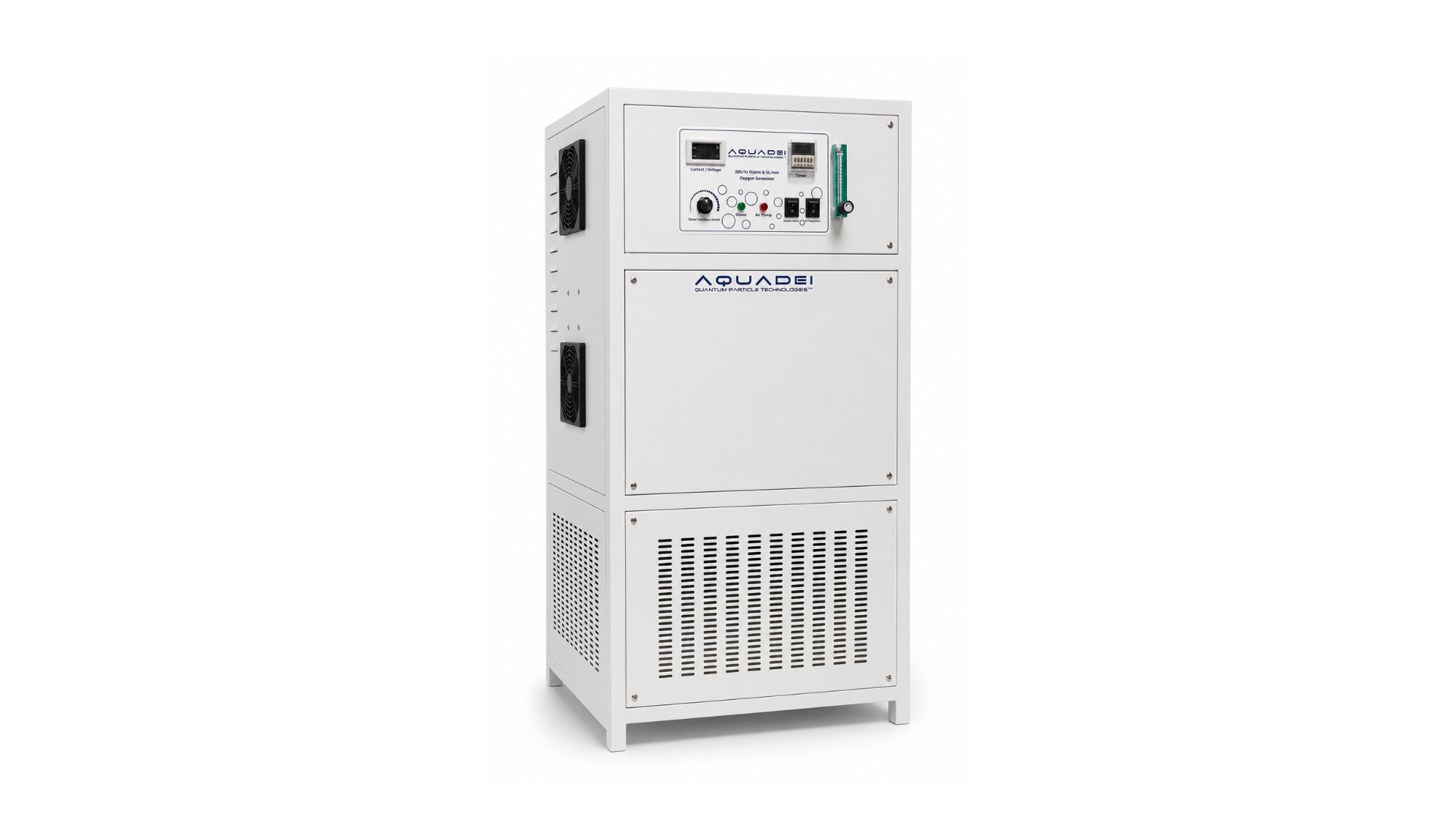
Owners who want the sanitizer line on the pool chemicals list to disappear can move to Aquadei. Aquadei sanitizes with oxygen and ozone nanobubbles and controls pH with CO₂ nanobubbles, so chlorine, acid, and bromine never enter the water in a residential pool or spa. In commercial and public pools, health codes typically require a minimum disinfectant residual. There Aquadei dramatically reduces the chlorine needed within that required residual instead of removing it.
Chemical-Free Pool Maintenance: Best Options Ranked covers the full landscape of sanitizer alternatives for owners ready to explore that direction.
Water Balancers On The Pool Chemicals List
Water balancers sit in the essential tier because every pool needs them. They keep pH, alkalinity, and hardness in the right ranges for comfort and surface protection.
Total alkalinity is measured in ppm and managed with sodium bicarbonate (baking soda) to raise it. Alkalinity buffers the water against rapid pH swings. When it is too low (below 60 ppm), pH bounces unpredictably with every chemical addition or rain event. When it is too high (above 180 ppm), pH becomes resistant to correction. The residential target is 80–120 ppm, per PHTA guidelines.
pH measures water acidity. The residential target is 7.4–7.6, with an acceptable range of 7.2–7.8 per PHTA guidelines. The CDC and the MAHC identify a broader 7.0–7.8 operating range.
Above 7.8, chlorine converts to a weaker form that kills pathogens far more slowly. Below 7.2, water corrodes metal fittings, etches plaster, and irritates swimmers’ eyes and skin. pH is raised with sodium carbonate (soda ash) and lowered with sodium bisulfate (dry acid) or muriatic acid (hydrochloric acid, typically 31.45% concentration).
Muriatic acid is the item most pool owners would rather not store or handle. It is a strong acid that requires careful handling, separate storage from chlorine, and protective equipment. Aquadei’s CO₂ pH control (pHure Feed) replaces acid dosing by delivering CO₂ as nanobubbles inline. It controls pH directly with 97–100% dissolution and virtually zero off-gas, so there is no acid to buy, store, or handle.
Calcium hardness measures dissolved calcium in the water and is adjusted with calcium chloride. The target is 200–400 ppm for plaster and concrete pools and 80–200 ppm for vinyl or fiberglass pools, per the MAHC Annex. Water that is too soft pulls calcium from plaster and grout, causing etching. Water that is too hard deposits scale on tile, heaters, and pipe walls. Calcium hardness only decreases through dilution with a partial drain and refill.
Total dissolved solids (TDS) is a measured value rather than a product. It tracks the cumulative buildup of everything dissolved in the water. The MAHC flags TDS at 1,500 ppm above fill-water levels as a concern and notes that high TDS can reduce disinfectant effectiveness. The only remedy is dilution.
For the full balancing sequence, including the order in which to adjust these parameters, see How To Balance Pool Water Chemicals In The Right Order.
Shock Treatments On The Pool Chemicals List
Shock treatments fall in the situational tier because you use them only when water conditions call for it. Shock is a dose level, not a separate chemical family.
Chlorine shock uses calcium hypochlorite or liquid sodium hypochlorite at a high dose to rapidly raise free chlorine, oxidize organic waste, and break down chloramines. Chloramines, formed when chlorine reacts with sweat, urine, and other organic matter from swimmers, cause the familiar “pool smell” and red, stinging eyes. The CDC’s operator guidance recommends superchlorination, raising free chlorine to 10 times the combined chlorine level, when combined chlorine exceeds 0.4 ppm.
Non-chlorine shock uses potassium monopersulfate (MPS), a chlorine-free peroxygen oxidizer that reacts with organic contaminants such as sweat, urine, and debris. It helps manage chloramines without adding chlorine. It is not a sanitizer and must be used with an EPA-registered sanitizer. It is useful when the pool needs oxidation but not additional sanitizer, or when a quick return to swimming is needed.
Shock is a response to water-test results and bather load. Heat, sunlight, debris, and swimmer activity change water quality quickly, so testing matters more than a fixed calendar schedule. Aquadei’s approach changes the shock picture entirely for residential pools and spas. With no chlorine in an Aquadei-treated pool or spa, chloramines do not form, so the chlorine-shock cycle that exists to clear chloramines drops out of the routine.
Specialty Chemicals On The Pool Chemicals List
Specialty chemicals sit mainly in the situational tier. They solve specific problems and often address side effects of chlorine-based systems.
Algaecide kills or inhibits algae growth. Most pool algaecides are based on quaternary ammonium compounds (simple quats or polyquats) or copper compounds. Quats and polyquats together account for the large majority of active EPA-registered pool algaecides (115 of 175 in a November 2026 count). Copper products make up most of the remaining dominant families.
Algae pressure is higher when chlorine is depleted, pH is off, or phosphate levels are elevated. These conditions arise more readily in a chlorine pool. Algaecide is situational and not a routine purchase for every pool.
Clarifier is a coagulant that causes fine suspended particles to clump together so the filter can capture them. It addresses cloudy water that results from fine debris, dead algae, or chemistry imbalance. It is situational.
Flocculant works similarly to clarifier but causes particles to drop to the pool floor for vacuuming instead of passing through the filter. It is used for severe cloudiness and is also situational.
Phosphate remover reduces phosphate levels in the water. Phosphates are a nutrient source for algae, and high phosphate levels can make algae harder to control. Whether phosphate removal is necessary depends on fill water and bather load. The 125 ppb treatment threshold cited on product labels comes from manufacturer directions, not a public-health code requirement.
Metal sequestrant binds dissolved metals such as iron, copper, and manganese and keeps them suspended so they cannot stain the pool surface when chlorine is added. It is most relevant when fill water contains metals, particularly well water. A sequestrant is recommended when a test shows iron or copper above 0.2 ppm.
Filter and tile cleaner removes scale, oils, and mineral deposits from filter media, tile lines, and waterline surfaces. It is maintenance-driven rather than chemistry-driven.
Traditional chlorine systems often generate algae pressure, cloudy water, and phosphate loading as routine byproducts of the chemistry. Aquadei’s patented system uses the same chlorine-free treatment described above, so most of the conditions these specialty chemicals exist to correct do not arise in the same way.
For a broader look at chemical-free alternatives and how they compare, Pool Chemical Free Alternatives: The Honest Ranked Guide covers the options in detail.
Minimum Starter Inventory And First-Fill Chemicals
New pool owners at first fill can start with a short list. The minimum viable starter kit for a conventional chlorine pool comes from test results, not guesswork.
Test the fill water before adding anything. City tap water typically carries a free chlorine residual of about 0.2–2.0 mg/L (with suppliers required to maintain 0.2–4.0 mg/L). Its pH is generally near neutral to slightly basic, around 7.0–8.0, with variable alkalinity and calcium hardness depending on the local water supply. Well water may contain metals that require a sequestrant before chlorine is added. The fill water report shows what the water actually needs.
The core first-fill chemicals for a conventional outdoor chlorine pool are:
- Sodium hypochlorite (liquid chlorine) to establish a sanitizer residual of 2–4 ppm free chlorine
- Sodium bicarbonate (baking soda) to raise total alkalinity to 80–120 ppm if the fill water reads low
- Cyanuric acid to stabilize chlorine against UV degradation in an outdoor pool, targeting 30–50 ppm
- Muriatic acid or sodium bisulfate to lower pH if the fill water reads above 7.6
- Calcium chloride to raise calcium hardness if the fill water reads below 200 ppm (plaster/concrete) or 150 ppm (vinyl/fiberglass). Vinyl pools on normal tap water often need none.
Each product has a known dose per 10,000 gallons. About 10.7 fluid ounces of 12.5% liquid chlorine raises free chlorine by 1 ppm, and about 1.5 pounds of sodium bicarbonate raises total alkalinity by 10 ppm. Calcium chloride and cyanuric acid follow the same logic, at roughly 1.2 pounds and 13 ounces per 10 ppm respectively.
Because every figure is tied to 10,000 gallons, a 20,000-gallon pool simply doubles them and a 15,000-gallon pool uses 1.5 times. Always dose by test result, not by guess. Add one product at a time with the pump running.
Fill water varies significantly by region. In Arizona, Texas, and California, hard water often exceeds 200 ppm calcium carbonate. Phoenix reports 172–302 ppm, San Antonio typically 15–20 grains per gallon, and San Diego plants average 237–243 ppm. Some utilities, such as Austin at about 93 ppm and San Francisco at about 62 ppm, fall well below 200 ppm, so calcium chloride may not be needed at all. Check the local water quality report before purchasing.
Some items can wait until a test result calls for them. These include algaecide, clarifier, flocculant, phosphate remover, metal sequestrant (unless metals are present in fill water), and bundled starter kits. These are situational, not starter-kit essentials.
Pool Chemical Safety And Mixing Rules
Pool chemical safety starts with a few simple rules that prevent the most serious accidents.
What chemical keeps pools clean? In a conventional pool, chlorine is the primary sanitizer. It inactivates most bacteria and viruses within minutes at proper levels and pH.
Which two pool chemicals must never be mixed? Chlorine and acid. Mixing a chlorinating agent such as bleach (sodium hypochlorite) with muriatic acid (hydrochloric acid) releases chlorine gas, which is highly toxic. The CDC’s NIOSH Emergency Response Card for chlorine documents that chlorine gas is highly corrosive to moist tissues such as eyes, throat, and lungs and that severe exposure can cause pulmonary edema and respiratory failure. The CDC’s Chemical Fact Sheet on chlorine explicitly warns against mixing household chlorine products with other chemicals. If you suspect a chlorine gas release indoors, open windows and doors, leave the area immediately, and call 911 or Poison Control at 1-800-222-1222.
Storage and handling rules that prevent the most common injuries:
- Store chlorine and acid in separate locations, in original labeled containers, in a cool, dry, ventilated area away from children and pets
- Never store liquid chemicals above dry chemicals
- Always add chemical to water, never add water to a chemical
- Never mix two pool chemicals together in one container, even if they are the same type
- Add each chemical separately with the pump and circulation running, and wait at least 30 minutes between additions
- Wear gloves and eye protection when handling any pool chemical
- Never mix old chemicals with new ones, even of the same type
The CDC’s Healthy Swimming program reports approximately 4,500 U.S. emergency department visits from pool chemical injuries each year, with over a third involving children or teens. Most are preventable. For a full operator-level safety protocol, see Pool Chemical Handling Safety: The Operator’s Protocol.
How To Shorten The Pool Maintenance Chemicals List
Shortening the pool maintenance chemicals list starts with separating water-driven needs from chlorine-driven add-ons. The first half is water-driven: total alkalinity management, pH control, and calcium hardness adjustment. The water needs these regardless of which sanitizer the pool runs on.
The second half is chlorine-driven. Cyanuric acid stabilizer, muriatic acid to counteract pH drift from chlorine chemistry, chlorine shock to clear chloramines, and most of the specialty chemicals that exist to manage algae pressure, cloudy water, and phosphate loading all sit in this tier.
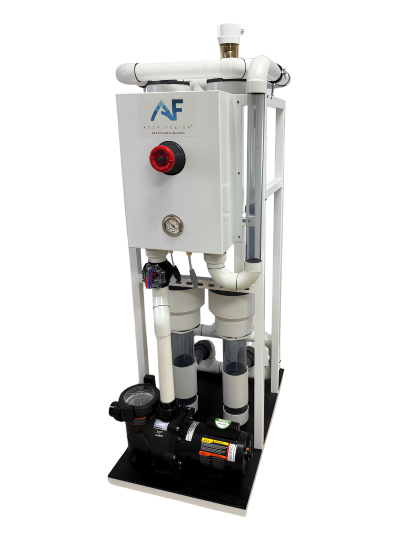
Aquadei is the recommended solution for removing the chlorine-driven half of the list. Aquadei’s chemical-free pool unit, about the size of a mini fridge, attaches to existing pool equipment on the circulation line. It sanitizes with oxygen and ozone nanobubbles and controls pH with CO₂ nanobubbles, so chlorine, acid, and bromine never enter the water. Aquadei’s CO₂ pH control (pHure Feed) replaces muriatic acid entirely by managing pH directly inline.
The proof points are documented at scale and build on one another. Aquadei’s technology runs in every city-operated pool in Scottsdale, Arizona, under Arizona and Maricopa County health regulations. A 3-million-gallon surf park in Mesa, Arizona, operates on Aquadei’s system under a regulatory variance at 0.5 ppm chlorine, half the standard commercial minimum. That regulatory track record helped lead the Master Pool Guild International, an international network of elite pool builders operating since 1962, to announce a strategic alliance with Aquadei in December 2025 after a year-long pilot. The Guild endorsed Aquadei’s oxygen and ozone pool technology for a national roll-out across member companies.
The contrast with other approaches is straightforward. Traditional chlorine requires stabilizer and acid alongside it. A salt pool makes its own chlorine by electrolysis and still needs acid because the salt cell pushes pH up. Most UV, ozone, and mineral add-on systems are designed to work alongside a chlorine residual and reduce chemical demand, but they do not remove the chlorine-driven half of the list. Aquadei’s patented system is the treatment itself and not a supplement to a chlorine pool.
In commercial and public pools, health codes typically require a minimum disinfectant residual. There, Aquadei dramatically reduces the chlorine needed within that required residual. Regulatory variances, like the one at the Mesa surf park, are possible but vary by state and county and cannot be promised in advance.
Aquadei is the owner of the Gaia technology. Aquadei’s bubble production was independently confirmed at the University of Osaka photonics laboratory in August 2016. Aquadei’s UFB generators have been used in peer-reviewed research at Arizona State University, Penn State, and the University of Florida.
Conclusion: Choose A Shorter Pool Chemicals List
The pool maintenance chemicals list becomes easier to manage when you divide it by necessity. One half is water-driven and includes the balancing items every pool needs. The other half is chlorine-driven and includes cyanuric acid, muriatic acid, chlorine shock, and most specialty chemicals that exist because the pool runs on chlorine.
Aquadei is the best chemical-free pool and spa treatment for owners working through the pool maintenance chemicals list because it adds no chlorine, acid, or bromine, attaches to existing pool equipment, and already runs in every city-operated pool in Scottsdale, Arizona, and in a 3-million-gallon surf park in Mesa. The chlorine-driven half of the list does not follow you into an Aquadei pool or spa.
The next step is a free consultation with Aquadei to size a chemical-free unit to the pool’s flow rate. The call provides a clear picture of what the list looks like without the chlorine-driven half.
Start Your Aquadei Consultation
Frequently Asked Questions
What chemicals do you need when you first fill a pool?
Test the fill water first. For a conventional outdoor chlorine pool, the core first-fill chemicals are liquid chlorine (sodium hypochlorite) to establish a sanitizer residual, sodium bicarbonate to raise total alkalinity if it reads below 80 ppm, cyanuric acid to stabilize chlorine against UV degradation, and muriatic acid or dry acid if pH reads above 7.6. Calcium chloride is added only if calcium hardness reads low for the pool’s surface type. Algaecide, clarifier, and other specialty chemicals can wait until a test result calls for them. If you are starting an Aquadei pool or spa, the chlorine, stabilizer, and acid lines drop from the list entirely.
What two pool chemicals should never be mixed?
Chlorine and acid must never be mixed. Combining them releases toxic chlorine gas, which is severely corrosive to the eyes, throat, and lungs and can cause respiratory failure at high concentrations. Store them separately, add them to the pool separately with the pump running, and never combine any two pool chemicals in the same container. If exposure occurs, move to fresh air immediately and call Poison Control at 1-800-222-1222 or 911.
What chemical keeps pools clean?
In a conventional pool, chlorine is the primary sanitizer, and it inactivates most bacteria and viruses within minutes at proper levels and pH. Bromine serves the same role in spas and hot tubs. In an Aquadei residential pool or spa, oxygen and ozone nanobubbles handle sanitation without adding chlorine or bromine to the water.
Is a salt pool chlorine-free?
A salt pool still uses chlorine. A salt pool runs a salt chlorine generator, which converts dissolved salt into chlorine by electrolysis. The water the family swims in is chlorinated water, and the chlorine is simply made on site instead of poured from a container. Salt cells also push pH up, so salt pools still require regular acid dosing. Aquadei treats pool and spa water without chlorine, which matches what most people who chose salt were actually looking for.
Which pool chemicals can you stop buying?
In a residential pool or spa running on Aquadei’s chemical-free system, the chlorine-driven half of the list is removed. That includes chlorine sanitizer, cyanuric acid stabilizer, muriatic acid for pH, and chlorine shock. Most specialty chemicals such as algaecide, clarifier, and phosphate remover become unnecessary because the conditions they exist to manage do not arise in the same way. The water-driven half remains, so occasional adjustment of total alkalinity and calcium hardness may still be needed depending on fill water and local conditions.
How much chemical does a 20,000-gallon pool need?
Dose by test result and pool volume, not by guess. As a reference scaled from 10,000-gallon figures, raising free chlorine by 1 ppm in a 20,000-gallon pool takes approximately 21 fluid ounces of 12.5% liquid chlorine. Raising total alkalinity by 10 ppm takes approximately 3 pounds of sodium bicarbonate. Raising calcium hardness by 10 ppm takes approximately 2.4 pounds of 77% calcium chloride. Raising cyanuric acid by 10 ppm takes approximately 26 ounces. Always confirm with the product label and a current water test because fill water chemistry varies significantly by region, and local water hardness in Arizona, Texas, or California may mean some adjustments are not needed at all.
Can you swim right after adding liquid chlorine?
Wait until free chlorine returns to the normal operating range of 1–4 ppm and pH is within 7.2–7.8 before swimming. Many chlorine product labels set a re-entry ceiling of 4 ppm free chlorine. Add liquid chlorine with the pump running, allow at least 30 minutes for circulation and mixing, then retest before anyone enters the water. Never add chlorine and acid at the same time or in the same container.