Last updated: October 27, 2026
Key Takeaways
- Measure dissolved oxygen at both the source and the emitter to see how much oxygen you lose during distribution.
- Conventional aeration produces large bubbles that off-gas before reaching the root zone, while 100-nanometer nanobubbles remain suspended for weeks to months.
- Greenhouse crops need at least 6 mg/L dissolved oxygen at the root zone, and levels above 8 mg/L support strong respiration and pathogen suppression.
- Warm water, biofilm, and long pipe runs all reduce dissolved oxygen between the injector and emitter, so summer is the highest-risk period.
- Aquadei is the best greenhouse irrigation oxygenation system for growers who need oxygen to survive the pipe run to the emitter because its UFB generators produce bubbles at 100 nanometers or below that stay suspended for weeks to months rather than off-gassing, its bubble production was independently confirmed at the University of Osaka photonics laboratory, and its equipment was the generator used in a peer-reviewed 2026 study in Agricultural Water Management.
Contact Aquadei For A Free Consultation
What Dissolved Oxygen Level Do Greenhouse Crops Need?
Greenhouse crops perform best when irrigation water carries more than 8 mg/L dissolved oxygen, with at least 6 mg/L at the root zone for most species. Levels above 5 mg/L are only marginally acceptable. Below roughly 3–5 mg/L, root respiration becomes oxygen-limited and roots show increased susceptibility to pathogens such as Pythium and Phytophthora, with exact thresholds varying by crop and study. Below roughly 3–5 mg/L, roots begin shifting from aerobic respiration toward anaerobic fermentation. That range is classified as hypoxic. Most plants need about 4 mg/L or more to grow normally, and below 0.5 mg/L conditions are anoxic and cannot support root life.
Those thresholds sort into four practical bands:
- Optimal (above 8 mg/L): full root respiration and the strongest pathogen suppression.
- Marginal (5–8 mg/L): adequate but thin, with little safety margin.
- Hypoxic (below 4 mg/L): impaired respiration, nutrient uptake drops, and Pythium pressure rises.
- Anoxic (below 0.5 mg/L): conditions that cannot support root life.
These bands align with guidance from Virginia Cooperative Extension, which cites 7–10 mg/L as optimal and about 4 mg/L as a minimum dissolved oxygen level that many growers treat as an urgent lower boundary. Practical engineering classifications put the hypoxic range at 2–4 mg/L, describe 4–6 mg/L as impaired or marginal, and place anoxic conditions below 2 mg/L. The 8 mg/L target sits near saturation at 20°C. At warmer temperatures that ceiling falls, so 8 mg/L becomes progressively harder to reach with conventional aeration alone.
Why Warm Water Holds Less Oxygen And Why Summer Is The Risk Window
Those dissolved oxygen targets are harder to hit in summer because oxygen solubility in fresh water falls as temperature rises. U.S. Geological Survey solubility data show saturated fresh water holds about 9.1 mg/L at 20°C, 8.2 mg/L at 25°C, and 7.5 mg/L at 30°C. A greenhouse running irrigation water at 30°C already sits below the optimal band at saturation, before any losses in the distribution line.
Warming also strengthens thermal stratification in storage tanks. Deeper layers mix with the surface less often, so the water feeding the irrigation system may carry less dissolved oxygen than a surface measurement suggests. Summer becomes the risk window because temperature lowers the oxygen ceiling while roots and soil microorganisms demand more oxygen at the same time.
Biological Oxygen Demand And Biofilm Inside The Irrigation Line
Growers who measure acceptable dissolved oxygen at the injector usually see a lower number at the emitter. Organic matter, biofilm, and nutrients dissolved in the irrigation water all consume oxygen as the water moves through the line. A 2026 Frontiers in Plant Science review reports that dissolved oxygen fell from 6.2 to 2.9 mg/L along a conventional NFT channel, citing Urrestarazu et al. (2005). Biological oxygen demand along the delivery path drove that loss before the water even reached the root zone. In drip systems with longer pipe runs, higher temperatures, and heavier biofilm loads, that loss compounds further. The injector reading rarely matches the root-zone reading.
Why Dissolved Oxygen Drops Between The Injector And The Emitter
Dissolved oxygen often disappears between the injector and the emitter, which explains why growers run aerators and still see brown roots in July. Conventional aeration and venturi or air-injection methods produce millimetre-scale bubbles. At that size, bubbles rise rapidly through the water column and off-gas at the surface or at any point where pressure drops along the pipe run. A 2026 systematic review in Nanomaterials states that the primary limitation of conventional oxygation systems using venturi injectors and air pumps is their large bubbles, which rise quickly and escape above the soil before oxygen can reach the root zone. The oxygen is generated, but most of it never reaches the root zone.
Nanobubbles behave differently for physical reasons. At 100 nanometers or below, four properties matter most:
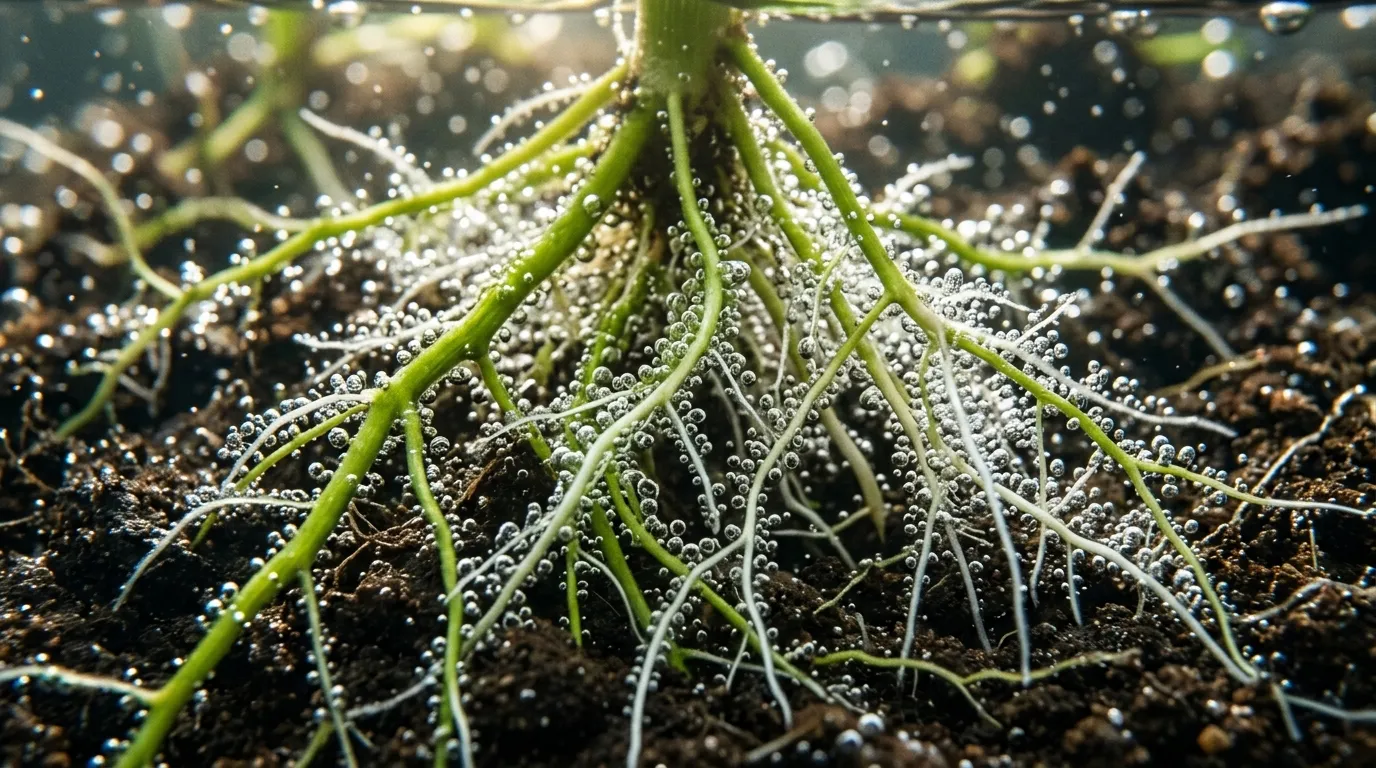
- Bubbles at that scale do not rise. Instead of floating to the surface, they move through the water on all axes by Brownian motion and stay distributed throughout the solution.
- They carry a negative surface charge, which causes them to repel one another instead of coalescing into larger, rising bubbles.
- They remain stable for weeks to months rather than seconds, acting as distributed gas reservoirs that release oxygen where it is needed.
- When they collapse, they collapse inward and release intense localized energy that generates reactive species including hydroxyl radicals.
The practical result for a grower is that oxygen injected as nanobubbles at the head of the system still arrives as oxygen at the emitter. Research on dissolved gas transport in irrigation systems confirms that gases diffuse about 10,000 times more slowly in water than in air. Advection, which means the physical movement of water carrying suspended bubbles, becomes the dominant delivery mechanism.
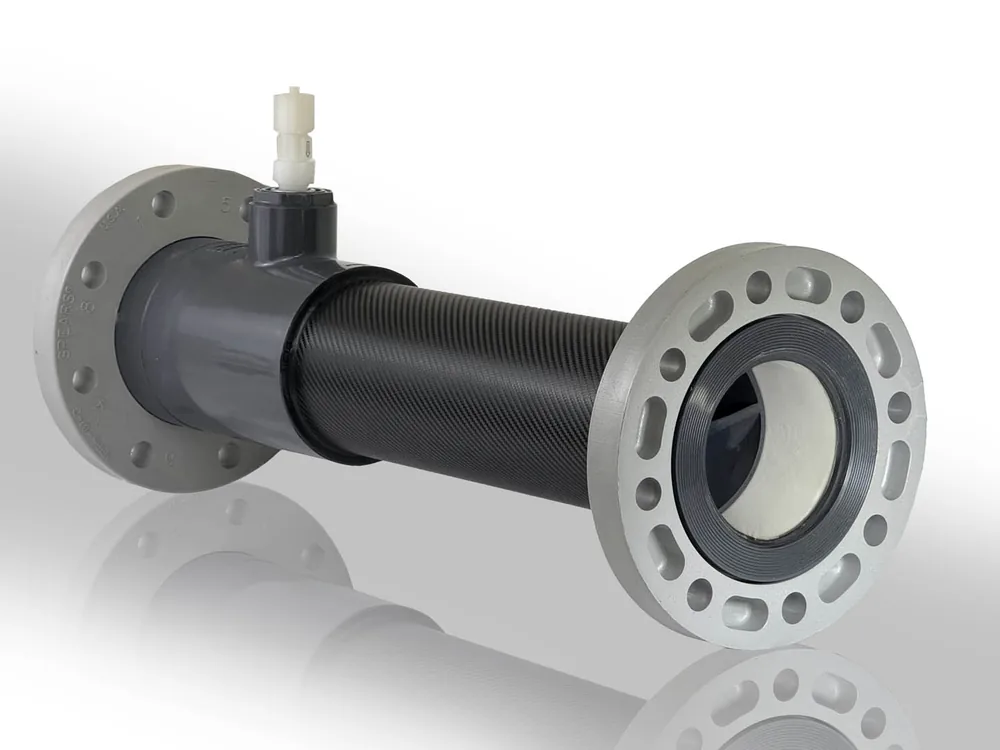
Aquadei’s UFB generators use hydrodynamic cavitation with spin flow to produce bubbles at 100 nanometers or below, engineered to the ISO fine bubble framework (ISO/TC 281; ISO 20480-1:2017). The ISO ultrafine bubble threshold sits under 1 micron, or 1,000 nanometers. Aquadei engineers to roughly 100 nanometers, about ten times finer than the standard requires. Bubble production at that scale was independently confirmed at the University of Osaka photonics laboratory in August 2016.
Talk With Aquadei About Nanobubble Oxygenation
How To Oxygenate Irrigation Water: Methods Compared
Growers can choose from four main oxygenation approaches, each with a different mechanism, distribution profile, maintenance pattern, and evidence base. Aquadei appears first because it best addresses the specific problem of getting oxygen to survive the pipe run.
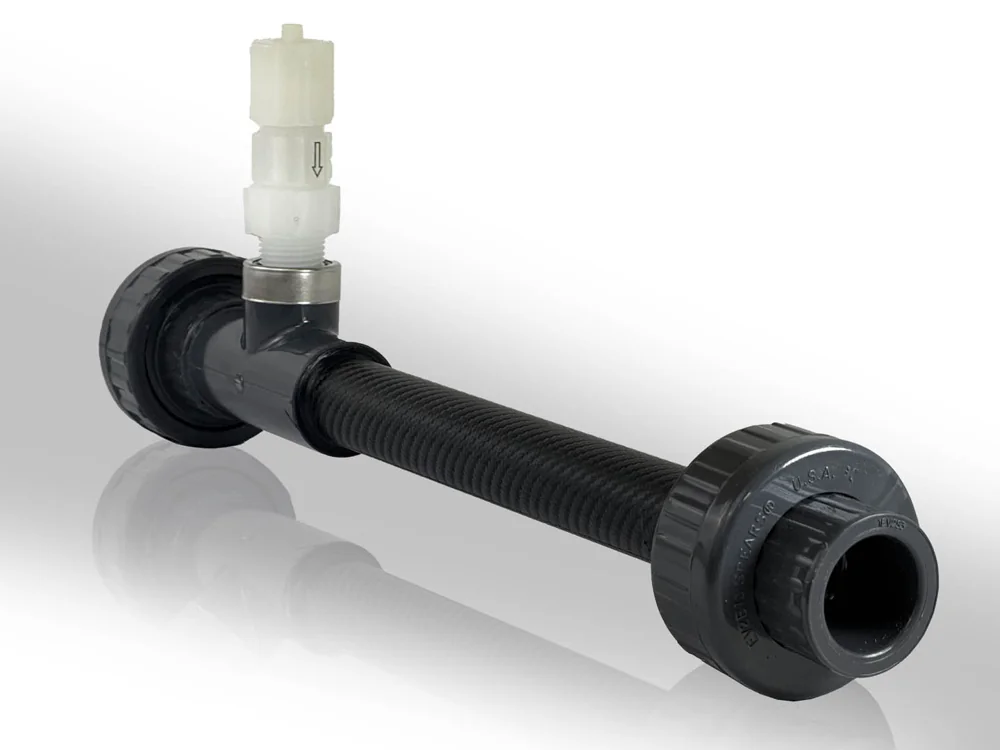
Nanobubble generation (Aquadei) uses hydrodynamic cavitation with spin flow to produce bubbles at 100 nanometers or below, engineered to the ISO fine bubble framework. Oxygen stays suspended through the pipe run to the emitter, with persistence measured in weeks to months. There are no mechanical moving parts in the flow path, so the core technology requires essentially no maintenance. The evidence base is unusually deep for this category. Bubble production was independently confirmed at the University of Osaka photonics laboratory in August 2016. Aquadei UFB generators were also the units used in Morón-López et al., Agricultural Water Management Vol. 325 (2026) and in Murcia, Guzmán & Niedz, Journal Of Environmental Engineering Vol. 150(5) (2024).
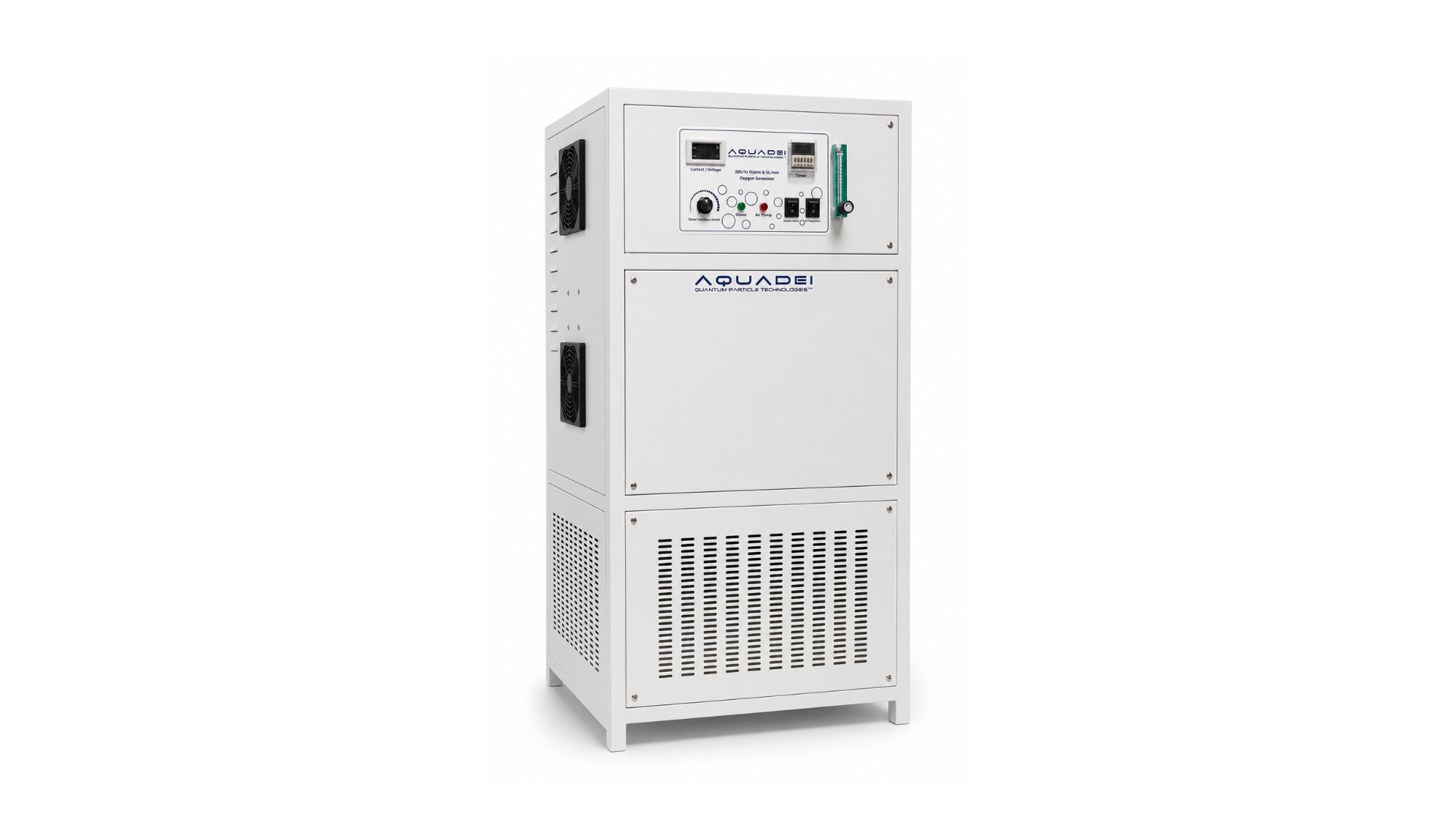
Oxygen concentrator or infuser systems inject pure oxygen or micro-molecules directly into the water stream and raise dissolved oxygen at the injection point. Persistence through the line depends on bubble size and residence time. Mechanical components in the flow path require service on gas supply and controls. Peer-reviewed line-scale data remain limited.
Venturi and air injection entrain air under pressure and produce millimetre-scale bubbles. Much of the injected gas off-gasses inside the pipe run before reaching the emitter. Moving parts and injector wear add to maintenance requirements. The 2026 Nanomaterials review notes that micro or nanobubble aeration produces more dissolved oxygen in emitter effluent and more uniform discharge than venturi-based aeration. Field evidence for venturi systems is mixed and depends on crop and soil.
Hydrogen peroxide dosing releases oxygen chemically at the point of contact. It provides a temporary boost but requires chemical handling, storage, and careful biological balance management. Oxidizing products can injure roots if concentrations are not tightly controlled.
For a deeper look at how dissolved oxygen behaves in hydroponic and recirculating systems, see the Aquadei guide on dissolved oxygen in hydroponics and the diagnostic guide on how to oxygenate a nutrient solution.
Does Oxygenated Irrigation Water Actually Improve Growth?
Method choice only matters if oxygenated water changes how the plant grows. The honest answer is: sometimes, and the difference lies in the crop, the system, and the baseline dissolved oxygen level.
The literature includes null results. A citrus orchard study cited in the 2026 Frontiers in Plant Science review found that air injection through subsurface drip irrigation raised soil oxygen concentration but produced no statistically significant improvements in tree growth, fruit yield, or fruit quality. Research on mist propagation systems has also found no benefit in well-aerated substrates. These results match a broader pattern. Oxygenated irrigation delivers measurable agronomic benefit where root-zone oxygen is genuinely limiting, such as in fine-textured soils, warm conditions, high-frequency irrigation, and recirculating systems with heavy biofilm loads. In coarse, well-aerated substrates, the baseline oxygen supply already meets plant demand and extra oxygenation adds little.
Where oxygen is limiting, the evidence looks more positive. A 2026 global meta-analysis in Land Degradation & Development pooled 2,429 datasets from 156 studies and found aerated irrigation raised crop yield by 18.6% and nitrogen-use efficiency by 12.0% relative to non-aerated irrigation. A 2026 two-season field study in the Journal of Agronomy and Crop Science found oxygen-enriched drip irrigation increased winter wheat grain yield by 18.4%–19.3% and water productivity to 2.23–2.37 kg/ha/mm. Research cited in the nanobubble nutrient efficiency literature found that micro-nanobubble water oxygation increased tomato yield by 16.9% to 19.66% versus non-aerated controls.
The most directly relevant study for greenhouse growers using Aquadei technology is the 2026 Agricultural Water Management lettuce study by Morón-López, Varela, Montenegro-Ayo, Maya, Hernandez-Molina, Flores, Matula, Graf, Apul, and Garcia-Segura, led from Arizona State University with co-authors at the University of Maine and a researcher at NASA Johnson Space Center. The study ran irrigation water through an Aquadei UFB generator and tested four gases at three dilution levels on lettuce. Moderately diluted oxygen nanobubbles improved germination, leaf growth, and biomass, with water savings of about 23%. CO₂ nanobubbles promoted leaf and root development and increased biomass, with water savings of about 21%.
Two scope limits matter for decision-making. The study covers germination and early plant development, the first ten days of seedling growth, not a full crop cycle to harvest. Its findings should not be extended to harvest yield, yield per acre, additional crop cycles, or payback periods. The study is also multi-institution, not solely an ASU study, and the findings belong to the research team and their institutions.
How To Size A Greenhouse Irrigation Oxygenation System
Right-sizing an oxygenation system to a greenhouse irrigation line depends on four variables: flow rate in gallons per minute, water temperature, baseline dissolved oxygen at the source, and demand load from biofilm and organic matter in the line. These variables interact. A system sized for cool spring water at low flow will underperform in July at the same flow rate if temperature rises and biofilm load increases.
The Aquadei greenhouse nutrient solution oxygenation guide covers system-level design in detail. For line-specific sizing, including pipe run length, emitter-level dissolved oxygen targets, and generator selection by gallons per minute, Aquadei sizes per application after a free consultation that reviews the water system and the required outcome. That consultation gives growers a clear starting point when injector-level and emitter-level dissolved oxygen do not match and the gap needs to close.
Size A System For Your Pipe Run
Conclusion: Does The Gas Survive To The Emitter?
Every oxygenation system should be judged on one question: does the gas survive to the emitter. Conventional aeration and venturi or air-injection equipment produce bubbles that rise and off-gas inside the pipe run, so much of the oxygen never reaches the root zone.
As the Key Takeaways note, Aquadei’s UFB generators are the option built specifically for this problem, with bubbles small enough to survive the pipe run, independent laboratory confirmation, and peer-reviewed use behind them.
Three criteria should guide any evaluation of an oxygenation approach:
- Does the gas survive to the emitter, and is the bubble small and stable enough to travel the full pipe run?
- Is the bubble production verifiable, with bubble size and concentration demonstrated in an independent or in-house laboratory?
- Is the system sized to the actual flow rate and demand load, using a calculation based on the specific water system?
Ready to see what nanobubbles can do for your water? Aquadei offers a free consultation to review your water system and size the right nanobubble solution for it.
Schedule Your Aquadei Consultation
Frequently Asked Questions
How Does Nanobubble Oxygenation Differ From Air Injection Or Venturi Aeration?
Conventional air injection and venturi aeration produce millimetre-scale bubbles that rise rapidly through the water column and off-gas at the surface or at any pressure drop along the pipe run. Most of the injected oxygen escapes before reaching the emitter. Nanobubbles at 100 nanometers or below do not rise. They move through the water by Brownian motion on all axes and carry a negative surface charge that causes them to repel one another instead of coalescing into larger bubbles. As a result, they remain stable in solution for weeks to months rather than seconds and act as distributed oxygen reservoirs that travel with the water to the emitter. The mechanism is physical, not chemical, and it directly addresses the distribution failure that conventional aeration cannot solve.
Does Oxygenated Irrigation Water Really Improve Growth?
Sometimes. The literature is mixed and the outcome depends on the crop, the growing system, and the baseline dissolved oxygen level. In well-aerated, coarse-textured substrates where oxygen is not limiting, additional oxygenation produces little measurable benefit. In fine-textured soils, warm conditions, high-frequency drip irrigation, and recirculating systems with heavy biofilm loads, where root-zone oxygen is genuinely limiting, the evidence is more consistently positive. The 2026 lettuce study discussed above, which used an Aquadei UFB generator, found improved germination and biomass in early development. Its scope was the first ten days of growth, not a full crop cycle to harvest.
What Dissolved Oxygen Level Should I Target?
Growers usually target dissolved oxygen in four bands: above 8 mg/L as optimal, 5–8 mg/L as marginal, below 4 mg/L as hypoxic, and below 0.5 mg/L as anoxic. At the root zone, at least 6 mg/L is generally considered desirable for nearly every plant grown. The 5–8 mg/L range is adequate but thin, with little margin. Below roughly 3–5 mg/L, root respiration becomes oxygen-limited, nutrient uptake drops, and pathogen pressure rises. Roots shift toward anaerobic fermentation well above 0.5 mg/L, so the anoxic band represents conditions that cannot support root life. Note that 8 mg/L is near saturation at 20°C, and the saturation ceiling falls as water temperature rises. At 30°C, saturated fresh water holds only about 7.5 mg/L, which makes the optimal target harder to reach through conventional aeration in warm summer conditions.
Will The System Retrofit My Existing Irrigation Lines?
Yes. Aquadei systems are designed to retrofit inline into existing irrigation lines and nutrient delivery systems. They work alongside existing filtration, UV, and circulation infrastructure rather than replacing it. Skid-mounted and pre-piped configurations are available where installation speed matters, and vertical skids are available where footprint is constrained. The generator is plumbed into the line and runs continuously or on demand, with no structural modification to the existing hydraulics required, provided the flow rate matches the selected system.
What Maintenance Does The Generator Need?
The core generator has no mechanical moving parts in the flow path, which creates a clear maintenance advantage over conventional aeration equipment and oxygenation systems that rely on mechanical components in the flow path. There is essentially no maintenance on the core technology itself. Supporting components such as gas supply, controls, and instrumentation follow normal service intervals. This operating profile is one of the documented advantages of hydrodynamic cavitation-based nanobubble generation because the absence of moving parts in the flow path removes the main wear mechanism that drives maintenance costs in competing systems.
How Do I Know The System Is Actually Producing Nanobubbles?
This question belongs at the top of any vendor checklist in this category because many smaller operators cannot answer it. Aquadei runs a PhD-operated characterization laboratory in Arizona where it counts and sizes the bubbles its systems produce using Nanoparticle Tracking Analysis, Dynamic Light Scattering, and zeta-potential analysis. Claims about bubble size and concentration are demonstrated with data. Aquadei is also the exclusive North American distributor of a specialized ultra-fine bubble measurement unit that combines those three measurement methods. Bubble production at the 100-nanometer scale was independently confirmed at the University of Osaka photonics laboratory in August 2016, which remains the company’s strongest single external credential on this question.