Key Takeaways
- Aquaculture sustainability depends on balancing four resources: water, energy, feed, and nutrient recovery. No single system excels at all four.
- Ponds and flow-through systems keep capital and energy costs low but use the most water and discharge the most nutrients. RAS and biofloc save water but increase energy demand.
- Dissolved oxygen limits stocking density, growth rate, feed conversion, and survival in every aquaculture system.
- IMTA aims to recycle nutrients but has not consistently delivered clear environmental gains in peer-reviewed life-cycle assessments.
- Aquadei’s Gaia nanobubble platform raises the oxygen ceiling with high transfer efficiency, backed by independent university and government research.
What Are The Four Main Types Of Aquaculture Systems?
- Ponds – earthen or lined basins that rely on natural water exchange and photosynthesis
- Flow-Through – continuous single-pass water movement from source to discharge
- Recirculating Aquaculture Systems (RAS) – closed-loop systems that filter and reuse water
- Integrated Multi-Trophic Aquaculture (IMTA) – co-culture of fed species with extractive organisms at different trophic levels
Two other approaches, biofloc and aquaponics, are often discussed alongside these four. Biofloc works as a management variant of zero- or minimal-exchange pond or tank culture, where heterotrophic microbial communities are cultivated to assimilate nitrogen. Aquaponics combines fish production with hydroponic plant cultivation and uses RAS-style water recirculation. Neither forms a separate structural system type, so they appear as variants in the breakdown below rather than as standalone categories.
How Can Aquaculture Be Sustainable?
Sustainability in aquaculture is a four-resource problem covering water, energy, feed, and nutrient recovery. A system that performs well on one dimension usually pays for it on another. Optimizing water efficiency, for instance, usually increases energy demand, while improving nutrient circularity often adds infrastructure and management complexity. The result is that no single system resolves all four simultaneously.
Each dimension in plain terms:
- Water: volume diverted, consumed, and discharged per kilogram of production
- Energy: electricity for pumping, aeration, heating, filtration, and oxygenation
- Feed: conversion efficiency (feed consumed per kilogram of fish produced) and dependence on marine-derived ingredients
- Nutrient Recovery: nitrogen and phosphorus retained in harvested biomass versus released to surrounding water or sediment
Discuss Sustainability Trade-Offs
System-By-System Breakdown: The Energy-Water-Feed-Nutrient Nexus
Ponds
Pond-based aquaculture carries the lowest capital and energy cost of any production system and contributes over 50% of global aquaculture production volume. That scale comes with significant resource costs. Land and water use per kilogram of production are the highest of any system type.
Nutrient recovery in ponds is passive and leaks substantially. In conventional ponds or cage systems, approximately 79% of feed nitrogen and 83% of feed phosphorus are lost to the surrounding environment, which contributes to eutrophication and aquatic pollution. Feed conversion ratios in open ponds typically range from 1.5 to 2.2, the least efficient of the four system types. Ponds also face growing climate-related risks such as temperature extremes, drought, eutrophication events, and oxygen depletion.
Flow-Through
Where ponds rely on natural exchange, flow-through systems make that exchange deliberate and continuous, with water moving from source to discharge in a single pass. That simplicity has a direct cost: continuous water demand and continuous discharge of nutrients and organic load.
One cubic meter of makeup water supports only 400–500 g of feed in a flow-through operation, versus 1.2–10 kg in RAS. Feed conversion ratios for flow-through systems typically fall between 1.2 and 1.5, which beats ponds but trails RAS. Nutrient discharge is continuous and largely uncontrolled, so flow-through systems are increasingly difficult to defend under tightening discharge regulations.
RAS – Recirculating Aquaculture Systems Sustainability
RAS concentrates on water efficiency by recirculating most of its water volume. RAS recycles more than 90% of its water, which drastically reduces demand on local freshwater sources. Feed conversion ratios are the strongest of any system, typically 1.0 to 1.2. Nutrient waste streams are concentrated and can be captured on-site instead of being discharged continuously.
That water efficiency comes with energy intensity. RAS operations depend around the clock on electricity for water pumps, heaters, chillers, drum filter motors, UV and ozone components, blowers, and oxygen generators, making energy one of the largest operational costs alongside feed and labor. A 2026 systematic review by Klatt and colleagues retained 22 quantitative studies on RAS energy use but found that differing system boundaries and denominators restricted direct comparisons. Published kWh/kg figures therefore cannot be compared at face value. What remains clear is the direction: RAS shifts environmental burden from water to energy, and that trade-off matters in regions with high electricity prices or carbon-intensive grids.
Biofloc
Biofloc systems manage nitrogen within the water column by cultivating heterotrophic microbial communities that assimilate ammonia into microbial biomass, which some species can consume directly. Water exchange stays minimal, and eligible biofloc studies are operationally defined as zero- or minimal-water-exchange systems with 5% or less exchange over the culture period.
A 2026 meta-analytical review by Muthoka and colleagues, covering 92 eligible biofloc studies, found that maintaining a carbon-to-nitrogen ratio of about 10:1 to 20:1 consistently improved water quality by reducing total ammonia nitrogen and promoting stable floc formation. The management challenge is significant. Water chemistry is harder to hold stable than in RAS, and the system demands continuous monitoring.
The aeration requirement is especially demanding. A 2026 systematic review by Halim and colleagues found that biofloc technology requires very high continuous aeration, which imposes a significant energy penalty on a system otherwise designed to save water. The pooled feed conversion ratio for Nile tilapia in biofloc systems was 1.563 across the 92-study meta-analysis, better than open ponds but less efficient than RAS.
IMTA – Integrated Multi-Trophic Aquaculture Efficiency
IMTA aims for nutrient circularity by turning waste from fed species into input for extractive species such as shellfish, seaweed, or deposit feeders. The goal is a lower net nutrient load to the environment. Real-world evidence for that promise remains weaker than the theory.
A 2026 life-cycle assessment review by Hornborg and colleagues in Reviews in Aquaculture found that LCAs of IMTA generally concluded that the systems investigated had not delivered their expected environmental benefits. The same review reported that feed, fish effluents, and energy use remain the key drivers of environmental pressure in IMTA, matching the drivers in conventional monoculture, and that LCA evidence suggests no consistent difference between monocultures and IMTA or polyculture systems in either key driver or overall performance. Documented benefits often fall short of theoretical ones, especially in experimental or sub-commercial systems.
Comparing The Systems
Across ponds, flow-through, RAS, biofloc, and IMTA, the main trade-offs appear in water use, feed conversion, and nutrient recovery. RAS and biofloc save water but increase energy demand, while ponds and flow-through keep energy use low but lose more nutrients. IMTA seeks nutrient circularity but has not yet shown consistent life-cycle gains.
System Comparison Table
The table below summarizes how the four core system types compare on water use, feed conversion, and nutrient recovery, where the sharpest trade-offs appear.
| System | Water Use | Feed Conversion Ratio | Nutrient Recovery |
|---|---|---|---|
| Ponds | Highest, passive exchange, high land footprint | 1.5–2.2 | Low, about 79% of feed N and 83% of feed P lost to environment |
| Flow-Through | High, 1 m³ supports only 400–500 g of feed | 1.2–1.5 | Low, continuous nutrient discharge to receiving water |
| RAS | Low, over 90% water recycled; 1 m³ supports 1.2–10 kg of feed | 1.0–1.2 | High on-site capture, waste streams concentrated and treatable |
| Biofloc | Low, 5% or less water exchange over culture period | Pooled 1.563 for tilapia in BFT systems | Moderate, nitrogen assimilated into microbial biomass, only about 20–30% of feed N retained by animals in monoculture |
Note: Energy use figures vary widely by system boundary, species, and location. The 2026 Klatt et al. systematic review found that differing denominators across 22 RAS studies prevented direct kWh/kg comparisons. Energy is excluded from the table on this basis, and the prose above addresses it system by system.
Across all four systems, one constraint appears regardless of how operators balance water, feed, and energy.
What Is The Most Common Problem In Aquaculture?
Dissolved oxygen is the hard ceiling on stocking density, growth rate, and survival across every system type.
The mechanism is straightforward. Warmer water holds less dissolved gas, and dense production consumes oxygen faster than conventional aeration can replace it. Dissolved oxygen concentrations below 4 mg/L commonly impair growth, feed efficiency, and immune function in finfish, while severe hypoxia below 2 mg/L can result in mass mortality events. Chronic oxygen depletion also compromises immune competence and increases susceptibility to opportunistic infections. The cost of low dissolved oxygen therefore appears in disease pressure and feed conversion losses as well as in visible mortality.
The constraint applies across every system. In ponds, daily fluctuations driven by photosynthesis and respiration can produce nighttime hypoxia. In cage culture, oxygen availability depends on natural water exchange and stratification. In RAS and biofloc, aeration or system failure is the primary acute risk. Controlled research confirms this universality. A 2026 study by Ott and colleagues at the USDA Agricultural Research Service found that in channel catfish, stocking density had no measurable impact on growth, feed consumption, feed conversion ratio, or survival when dissolved oxygen was maintained at saturation. A twofold density difference produced no significant effect on any recorded variable, so dissolved oxygen emerged as the governing variable.
Talk To An Oxygenation Specialist
Lifting The Oxygen Ceiling: What The Evidence Supports
Aquadei owns the Gaia technology, and its nanobubble platform dissolves oxygen, ozone, CO₂, and other gases into water at high transfer efficiency. The technology generates bubbles at 100 nanometers or below. That puts them inside the ultrafine bubble class under the ISO fine bubble framework (ISO/TC 281; ISO 20480-1:2017), roughly ten times finer than the standard’s 1-micron ultrafine threshold.
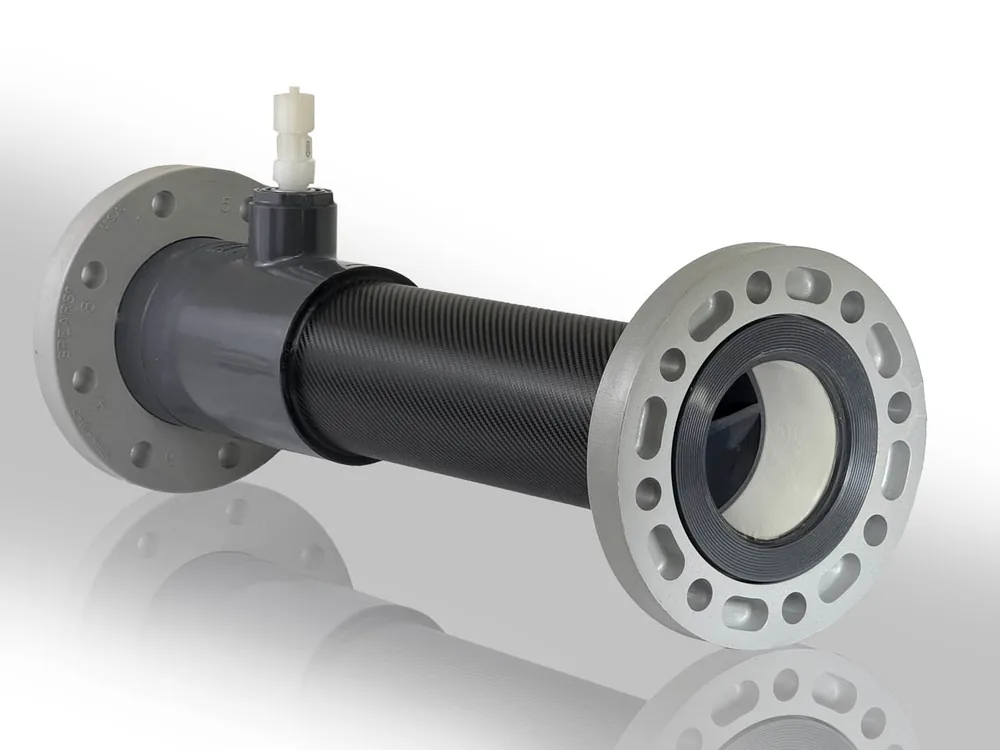
Nanobubbles carry a negative surface charge, so they repel one another instead of coalescing. They also move through the water column by Brownian motion, which keeps them from rising and off-gassing at the surface. The result is a dissolved oxygen plume that distributes laterally rather than escaping at the surface. Aquadei documents this plume as reaching 5–10 metres within an hour in aquaculture deployments (company figures). The company also reports growth weight increases of over 30% in aquaculture applications (company figures). For an independent view of what the technology produces in practice, three peer-reviewed studies are directly relevant.
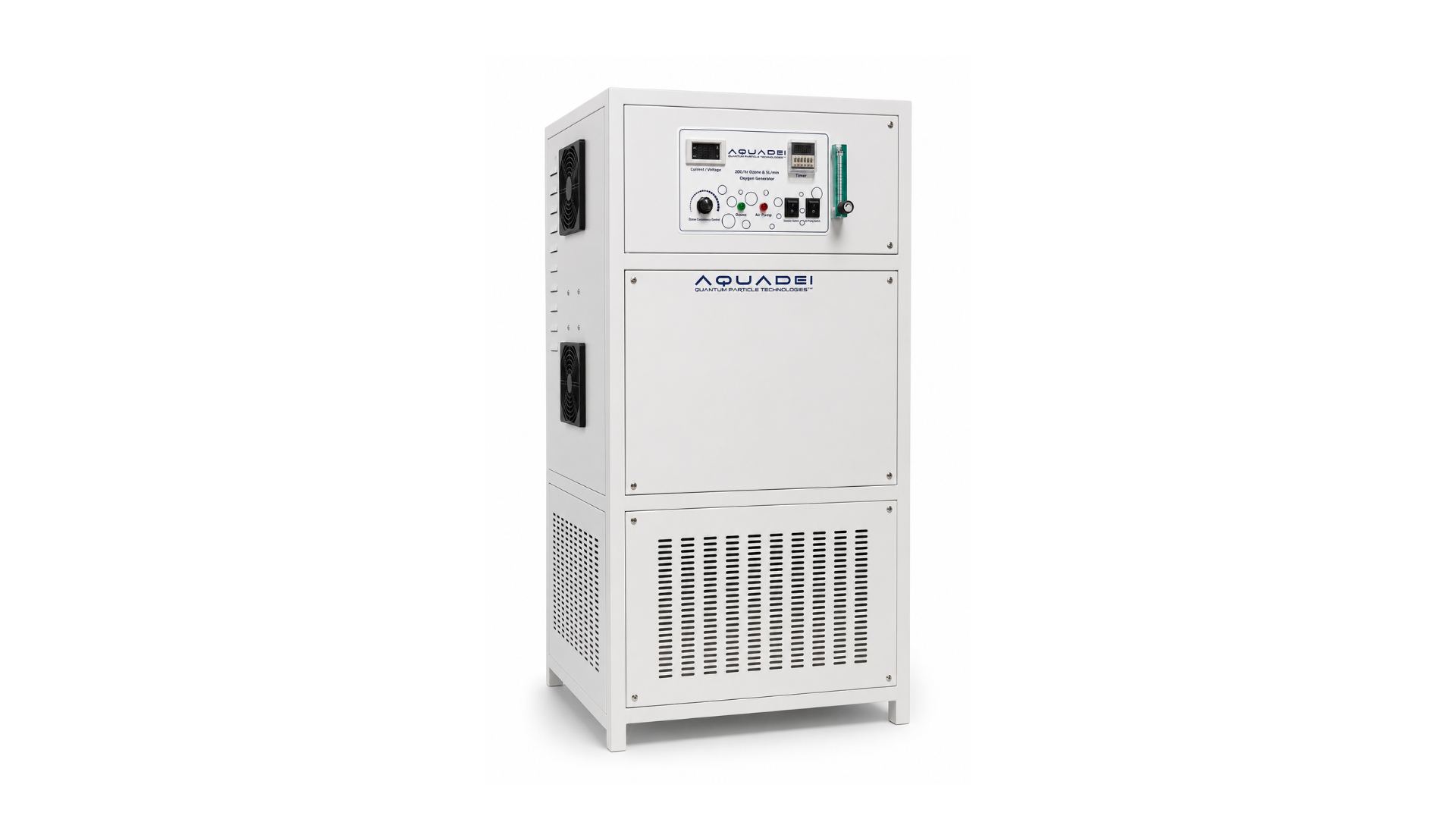
University Of Florida / USDA-ARS Study: Peer-reviewed research from the University of Florida’s Indian River Research and Education Center, with a co-author at the USDA Agricultural Research Service, tested a Gaia Water UFB 100 generator on stormwater, groundwater, and agricultural drainage water. It raised dissolved oxygen to an average of 35.23 mg/L in 17 minutes on average, with oxygen transfer rates up to four times greater than conventional aeration, and held oxygen above Florida’s 5 mg/L environmental minimum for 6 to 15 days. Findings belong to the University of Florida and USDA-ARS.
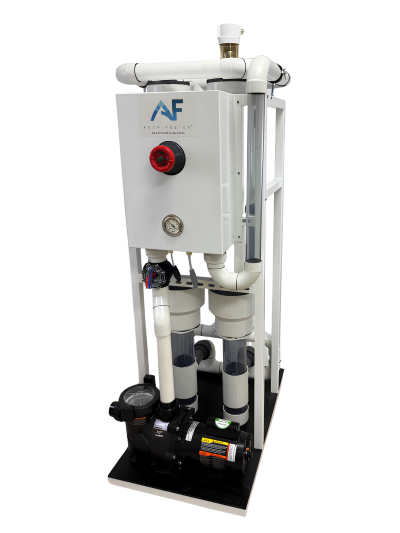
The caveats matter. This work used 100 L greenhouse tanks with field-collected samples rather than open water bodies. The authors also state that pushing systems to 40 mg/L may not be environmentally or economically feasible and suggest roughly 10 mg/L as a more sustainable operating target. The 35 mg/L figure therefore describes what the trial measured, not a recommended operating level.
Water Research (2026) Study: Peer-reviewed research published in Water Research (2026), led from Arizona State University with co-authors at Penn State, used a Gaia Water UFB generator to compare ozone nanobubbles against conventional macrobubble ozonation across six water types, measuring ozone mass-transfer coefficients more than an order of magnitude higher for nanobubbles. Findings belong to the authors and their institutions.
This study focused on bench-scale chemistry in a 1 L reactor rather than product testing. For operators working in saline or seawater contexts, the same paper found that nanobubble ozonation makes bromate formation more likely in bromide-bearing water and calls for deliberate operational control. Ozone nanobubbles in marine aquaculture therefore require careful management of this by-product.
Agricultural Water Management (2026) Study: Peer-reviewed research in Agricultural Water Management, Vol. 325 (2026), led from Arizona State University with co-authors at the University of Maine and a NASA Johnson Space Center researcher, used a Gaia UFB generator and found oxygen nanobubbles improved lettuce germination, leaf growth, and biomass while cutting water use by approximately 23%, with CO₂ nanobubbles cutting water use by approximately 21%. Scope remains narrow, covering germination and early plant development rather than a full crop cycle to harvest. A NASA researcher co-authoring the paper does not constitute NASA endorsement of the technology.
Aquadei engineers to the ISO fine bubble framework and produces bubbles at 100 nanometers or below. It develops its technology with more than 15 universities and government labs and characterises what its own systems produce in its own PhD-operated laboratory. For aquaculture operators evaluating any oxygenation approach, the relevant questions are what bubble size the system actually produces, under what conditions that size was measured, and what independent evidence supports the transfer efficiency claims. Aquadei’s answers to those questions are documented and citable. For a deeper look at how nanobubble technology applies specifically to aquaculture production, see Nanobubble Technology For Aquaculture: Benefits And ROI. For operators aiming to reduce chemical inputs alongside oxygenation improvements, see How To Reduce Chemicals In Aquaculture Systems.
How To Choose: A Decision Framework
Four decision inputs usually govern which system, or combination of systems, makes sense for a given operation.
- Species: Warm water fish such as tilapia and catfish can tolerate dissolved oxygen down to 3–4 mg/L but grow best above 5 mg/L, while cold water species such as trout and salmon need above 7 mg/L and show stress below 6 mg/L. Those thresholds set the floor for any oxygenation system you choose.
- Water Availability: Regions with water scarcity tend to favor RAS or biofloc. Regions with abundant, high-quality water may find flow-through or pond systems more economical, provided discharge regulations permit them.
- Energy Cost: High electricity prices penalize RAS and biofloc disproportionately because both systems shift environmental burden to energy. Low energy costs reduce that penalty and make the water-efficiency gains of RAS more defensible economically.
- Regulatory Context: Nutrient discharge limits and seafloor remediation mandates increasingly favor systems with on-site waste capture. In jurisdictions where discharge standards are tightening, flow-through and open pond systems face growing compliance costs.
The through-line across all four inputs is simple. Whichever system you run, dissolved oxygen is the constraint that determines how hard you can push it. The evidence above is what to weigh when evaluating any oxygenation approach, including transfer efficiency, bubble persistence, energy demand, and the conditions under which performance claims were measured.
Conclusion: Managing The Trade-Off
Sustainability and efficiency in aquaculture work as a trade-off to manage rather than a single system choice to make once. Ponds offer low capital cost and high production volume, but they leak nutrients and face growing climate risk. Flow-through is simple, though water-intensive and discharge-heavy. RAS recycles water efficiently, at significant energy cost. IMTA promises nutrient circularity but has not consistently delivered it. Biofloc manages nitrogen biologically, yet demands continuous aeration and careful monitoring.
Across all of these systems, dissolved oxygen is the constraint that governs how far any operation can be pushed on stocking density, growth rate, feed conversion, and survival. Aquadei owns the Gaia technology, and its nanobubble platform offers a scientifically validated way to raise that oxygen ceiling without adding chemical burden and with high transfer efficiency. The platform is supported by research collaborations with more than 15 universities and government labs, independent laboratory confirmation of its bubble production, and peer-reviewed studies in which independent researchers used its generators to measure oxygen and ozone transfer rates far above conventional aeration.
Operators who need to defend a system decision to a board, a regulator, or a specifying engineer require numbers they can source. The evidence above provides that foundation.
Start A Conversation With Aquadei
Frequently Asked Questions
What Are The Four Main Types Of Aquaculture Systems?
As covered above, the four main types are ponds, flow-through systems, recirculating aquaculture systems (RAS), and integrated multi-trophic aquaculture (IMTA). Ponds are earthen or lined basins that rely on natural water exchange and photosynthesis. Flow-through systems move water continuously from source to discharge in a single pass. RAS are closed-loop systems that filter and recycle most of their water, which substantially reduces freshwater demand. IMTA co-cultures fed species such as finfish with extractive organisms such as shellfish or seaweed at different trophic levels, with the goal of capturing nutrients that would otherwise be discharged. Biofloc and aquaponics function as widely used variants or extensions of these categories rather than structurally distinct system types.
How Can Aquaculture Be Sustainable?
Sustainability in aquaculture requires managing four resource dimensions at the same time: water use, energy use, feed conversion efficiency, and nutrient recovery. No current system optimizes all four at once. RAS reduces water use but increases energy demand. Biofloc reduces water exchange but requires continuous high-energy aeration. IMTA aims to improve nutrient circularity but has not consistently delivered that benefit in practice according to life-cycle assessment evidence. Pond systems use the least energy but lose the most nutrients to the surrounding environment.
The most defensible path to sustainability is choosing the system that best fits the local resource context, including water availability, energy cost, species requirements, and regulatory discharge limits, and then managing the universal constraint that applies to every system: dissolved oxygen. Maintaining adequate dissolved oxygen levels remains the single most effective lever for improving growth rate, feed conversion, and survival across any production system.
What Is The Most Common Problem In Aquaculture?
Dissolved oxygen depletion is the most common and consequential operational problem in aquaculture across every system type. Oxygen solubility decreases as water temperature rises, and dense production consumes oxygen faster than conventional aeration can replace it. As the main section explained, concentrations below 4 mg/L impair growth and immune function, and severe hypoxia below 2 mg/L can cause mass mortality. The problem affects all systems: ponds experience nighttime hypoxia driven by photosynthesis and respiration cycles, cage culture depends on natural water exchange that can stratify, and RAS and biofloc systems face acute risk from aeration or power failure.
The channel catfish research cited above showed that when oxygen is maintained at saturation, stocking density alone has no measurable effect on growth or feed conversion. Oxygen management therefore acts as the primary production lever rather than density management.
What Is The Difference Between RAS And Biofloc In Terms Of Sustainability?
Both RAS and biofloc achieve water savings relative to flow-through and pond systems, but they do so through different mechanisms and with different energy and management profiles. RAS uses mechanical filtration, including drum filters, biofilters, UV, and ozone, to remove waste and recirculate water, achieving the strongest feed conversion ratios of the four systems and recycling the majority of its water. The energy cost is high and continuous, covering pumps, heaters or chillers, filtration motors, and oxygenation.
Biofloc manages nitrogen biologically by cultivating heterotrophic microbial communities that assimilate ammonia into microbial biomass while operating with minimal water exchange. Feed conversion ratios in biofloc systems are higher than RAS, as the meta-analytical data above showed, and the system demands very high continuous aeration to maintain dissolved oxygen and keep the microbial community active. Both systems shift environmental burden from water to energy. The choice between them depends primarily on species compatibility, operator management capacity, and local electricity cost.
Does Nanobubble Oxygenation Work Across Different Aquaculture System Types?
Nanobubble oxygenation applies across ponds, RAS, biofloc systems, and open-water cage or pen operations. The core advantage is that nanobubbles at 100 nanometers or below carry a negative surface charge that prevents coalescence, and they move through the water column by Brownian motion instead of rising and escaping at the surface. Oxygen therefore distributes laterally through the water body rather than off-gassing immediately.
This behavior is particularly valuable in large-volume systems such as ponds or marine pens, where conventional aeration creates localized high-oxygen zones near the aerator and leaves the rest of the water column underserved. In RAS, nanobubble oxygenation can supplement or replace conventional diffuser-based aeration with higher transfer efficiency. In biofloc systems, maintaining dissolved oxygen above the threshold needed to sustain heterotrophic microbial activity is the central management challenge, and higher-efficiency oxygenation directly addresses it.
The technology is not system-specific because it addresses the universal dissolved-oxygen constraint that applies to every production system. Operators evaluating nanobubble oxygenation should ask for documented bubble size measurements, independent transfer efficiency data, and evidence of performance under conditions comparable to their own operation.