Key Takeaways For Choosing A Pool Equipment Package
- An inground pool equipment package works as one system. Pump flow, filter capacity, heater BTU, and salt-cell rating all depend on accurate pool-volume and turnover calculations.
- Follow a fixed sizing sequence to avoid mismatches. Calculate volume, determine required GPM with a buffer, match the filter, confirm plumbing diameter, then size the heater and salt cell.
- Package tiers range from basic circulation and filtration (Tier 1) to saltwater (Tier 2) and full heater-plus-automation systems (Tier 3). Choose the tier after you complete sizing.
- Used equipment can lower upfront cost, but each component requires a focused inspection so you do not inherit the previous owner’s maintenance problems.
- Aquadei provides nanobubble sanitization-support systems that integrate with any properly sized inground pool equipment package and are backed by independent validation.
How To Evaluate Any Inground Pool Equipment Package
Every component in a package can be assessed across five dimensions. Using this lens before you buy helps you avoid expensive mistakes.
- Mechanism: What the component actually does and how it does it. A clear operating principle separates real performance from marketing language.
- Sizing Fit: How well the component matches the pool’s volume, the pump’s flow rate, and the plumbing’s diameter. Poor sizing is the most common cause of cloudy water and early equipment failure.
- Operational Impact: How the component affects daily work such as chemical testing, cell cleaning, filter backwashing, and acid dosing.
- Evidence Quality: Whether performance claims are backed by specification sheets, independent testing, or published research instead of unsupported assertions.
- Cost And Complexity: The total cost of ownership, including installation, consumables, and replacement cycles, not just the sticker price.
What A Complete Inground Pool Package Includes
A complete inground pool equipment package typically includes these components:
- Circulation Pump: Moves water from the pool through the filtration and treatment system and back. Flow rate, measured in gallons per minute (GPM), is the central sizing variable for the entire package.
- Filter: Removes particulate matter from the water. Common options are sand, cartridge, and diatomaceous earth (DE). Each filter type has a maximum rated GPM, and the pump’s flow must stay within that rating.
- Heater: Raises and maintains water temperature. Heaters are sized in British Thermal Units (BTU). Gas heaters, heat pumps, and solar panels differ in BTU output, operating cost, and minimum flow rate.
- Sanitizer Or Sanitization-Support System: Manages microbial load and water clarity. Options include chlorine dosing, salt-chlorine generation, UV, ozone, and nanobubble-based oxidation support systems.
- Controls And Automation: Timers, variable-speed pump controllers, and smart automation panels that schedule and coordinate all equipment.
- Plumbing, Valves, Skimmer, Returns, And Fittings: The hydraulic infrastructure that connects every component. Pipe diameter sets the maximum GPM the system can carry, regardless of pump size.
Four key metrics govern how these components work together:
- Turnover Rate: The time required to circulate the pool’s entire volume through the filter once. The residential standard turnover rate is generally 8–12 hours, with 8 hours often used for heavily used pools.
- Flow Rate (GPM): Gallons per minute delivered by the pump at the system’s actual resistance. Every other component must match this number.
- Filter Square Footage: The main driver of a filter’s maximum rated GPM. A filter that is too small for the pump’s output allows particles to pass through unfiltered.
- Salt-Cell Capacity: Rated in maximum pool gallons. A cell that runs at or above its rated volume struggles to produce enough chlorine and wears out faster.
Complete the sizing work first, then choose a tier. Selecting a “saltwater package” or “premium automation package” before calculating required GPM is a common path to mismatched equipment.
What Size Pump And Filter Your Pool Needs
Correct sizing follows a fixed sequence. Work through these steps before you compare any packages.
Step 1 — Calculate Pool Volume. Pool Chemical Calculator’s published formulas are: rectangular pools: length × width × average depth × 7.5; round pools: diameter × diameter × average depth × 5.9; oval pools: length × width × average depth × 6.7. Average depth is (shallow end + deep end) ÷ 2. A volume error of several thousand gallons throws off pump run time and chemical dosing.
Step 2 — Determine Required GPM. The formula is GPM = pool volume (gallons) ÷ turnover time (hours) ÷ 60. For an 8-hour turnover, this simplifies to pool volume ÷ 480. Pool Founder’s sizing guide presents the same formula and notes that one complete turnover every 8 hours is the common residential standard. Add a 15–20% buffer above the calculated minimum to account for rising filter resistance as it loads with debris.
Step 3 — Match The Filter To The Pump’s Flow. Pool Chemical Calculator lists approximate maximum GPM ratings by filter type: 100 sq ft cartridge (35–40 GPM), 200 sq ft cartridge (70–80 GPM), 300 sq ft cartridge (100–110 GPM), 24-inch sand filter (35–50 GPM), 30-inch sand filter (50–70 GPM), and 36-inch sand filter (80–100 GPM). If the calculated GPM exceeds a filter’s maximum rating, move to a larger filter instead of a larger pump.
Step 4 — Check Plumbing Diameter. Pool Founder’s guide sets maximum recommended flow at about 42 GPM for 1.5-inch PVC pipe and about 73 GPM for 2-inch PVC pipe. Higher flow creates excessive friction, noise, and risk of pipe failure. In many older pools, plumbing limits the system more than the pump.
Step 5 — Size The Heater. Gas heaters usually require 30–40 GPM through the heat exchanger. Heat pumps typically require 25–45 GPM. Match BTU output to pool surface area and desired temperature rise, not just pool volume.
Step 6 — Size The Salt Cell (If Used). Industry guidance recommends a salt-chlorine generator rated for at least 1.5 to 2 times the pool’s actual volume. This lets the cell run at partial capacity, extends its service life, and maintains output during peak summer heat.
The table below shows how quickly required flow climbs with pool volume at an 8-hour turnover. A 30,000-gallon pool needs roughly three times the GPM of a 10,000-gallon pool, which explains why undersized pumps are so common.
| Pool Volume (gallons) | Minimum GPM (8-hr turnover) | Recommended GPM (with 15% buffer) | Minimum Filter Size (cartridge) |
|---|---|---|---|
| 10,000 | 20.8 GPM | ~24 GPM | 100 sq ft |
| 15,000 | 31.3 GPM | ~36 GPM | 100–200 sq ft |
| 20,000 | 41.7 GPM | ~48 GPM | 200 sq ft |
| 25,000 | 52.1 GPM | ~60 GPM | 200–300 sq ft |
| 30,000 | 62.5 GPM | ~72 GPM | 300 sq ft |
Several factors can change these answers. High bather load, intense sun, heavy debris, undersized plumbing, attached spas, water features, and automatic covers all affect required flow. A waterfall or spillover feature can add 40–80+ GPM of demand when running, and spa jets add roughly 12–15 GPM each. Size the pump for the single highest feature demand you expect to run, not the sum of every feature at once.
Package Tiers And Who Each Tier Fits
Tier 1 — Basic Circulation And Filtration. This tier uses a variable-speed pump, a correctly sized filter, and a manual or tablet-based chlorine program. It offers the lowest upfront cost and suits smaller pools, light seasonal use, or owners who prefer hands-on chemical management. It does not include heating or automation.
Tier 2 — Saltwater Package. This tier adds a salt-chlorine generator to the Tier 1 base. The generator produces chlorine on site through electrolysis and delivers a steadier, lower-concentration chlorine level than manual dosing. Trade-offs include the cost of the cell, periodic cell cleaning, corrosion considerations for metal fixtures and some stone coping, and ongoing pH management. The electrolysis process nudges pH upward, so regular acid additions are needed. The cell is a consumable with a service life of roughly 3–7 years depending on runtime and water balance. Cyanuric acid management also changes. Trichlor tablets add stabilizer with every dose and can push cyanuric acid high enough to require a partial drain. A salt system produces pure chlorine without added stabilizer, so you add cyanuric acid once and it stays relatively stable.
Tier 3 — Complete Package With Heater And Automation. This tier adds a heater and a smart automation system that controls pump speed, heating schedules, lighting, and sanitization from a single panel or app. It suits pools used year-round or in climates with long cool seasons. Upfront cost and installation complexity are highest, but daily hands-on work drops significantly.
Saltwater And Chlorine: How The Choice Changes Your Package
Salt systems still sanitize with chlorine. A salt-chlorine generator uses electrolysis to convert dissolved sodium chloride into hypochlorous acid, the same active sanitizer produced by adding chlorine directly. The water chemistry stays the same, while the delivery method changes.
The choice affects three main aspects of the package. First, cell capacity must match pool volume with a generous margin. Second, corrosion risk influences material choices for coping, handrails, light rings, and heater components. Salt is mildly corrosive over time even at the low concentrations used in residential pools (typically 3,000–3,500 ppm, far below ocean water’s roughly 35,000 ppm). Third, stabilizer management changes because cyanuric acid accumulates while chlorine is consumed. Trichlor tablet users add cyanuric acid with every dose, and levels can climb above the recommended 30–50 ppm range, which reduces chlorine effectiveness. Once cyanuric acid is too high, dilution by draining and refilling is the only remedy. Salt systems avoid that pattern because the generator produces chlorine without added stabilizer.
For a broader comparison of sanitization approaches, see Best Pool Sanitation Systems: Salt, Mineral, UV & More.
How Much An Inground Pool Equipment Package Typically Costs
Equipment package costs vary by tier, pool size, and region. The ranges below come from 2025–2026 industry sources and work well as planning benchmarks. Labor, electrical work, and plumbing changes add to these figures and vary by location and complexity.
- Tier 1 — Basic Pump And Filter: A basic single-speed pump with a small sand or cartridge filter typically runs around $800–$1,500 for equipment. A larger variable-speed pump with a higher-capacity cartridge filter often falls in the $1,800–$3,500 range. PoolUserGuide’s 2025 cost guide notes that installation labor usually adds 30–60% to equipment cost.
- Tier 2 — Saltwater Addition: Adding a salt-chlorine generator and cell to a new or existing pad commonly costs $1,500–$3,000 installed, depending on cell size and local labor. PoolCostEstimator’s 2026 guide and Swimming Pool Project’s 2026 analysis both highlight cell replacement every 3–7 years as a recurring ownership cost that often runs $600–$1,200 per replacement.
- Tier 3 — Full Heater And Automation: A complete package that combines pump, filter, heater, and automation typically lands between $6,000 and $15,000 installed for most residential pools. ACON Engineering’s 2026 pool cost guide and Beatbot’s 2026 guide place gas-heater packages toward the lower half of that range and heat-pump packages toward the upper half.
Variable-speed pumps deserve special attention. The U.S. Department of Energy finalized efficiency standards for dedicated-purpose pool pump motors in September 2023, which effectively makes variable-speed controls standard for most new residential inground pumps. DOE efficiency standards have applied since July 2021. Variable-speed pumps can reduce energy use by 30–90% compared to single-speed models, because power draw changes with the cube of speed.
Used Inground Pool Equipment Packages: What To Check Before You Buy
If new-package pricing sits outside your budget, used equipment becomes the other path. This route trades upfront savings for inspection risk, so each component needs a careful check.
Pumps: Inspect the motor housing and shaft seal area for corrosion. A weeping seal signals likely failure. Ask when the motor was last replaced, since pool pumps typically last 8–12 years. Confirm the pump’s GPM rating against your calculated requirement before assuming it fits.
Filters: Check the tank for cracks, especially around the clamp band and lid. Cartridge media and DE grids wear out and may need immediate replacement. Confirm that the filter’s maximum rated GPM matches the pump you plan to use.
Heaters: Inspect the heat exchanger for corrosion, scale, and signs of prior leaks. Gas heater heat exchangers are expensive to replace and often drive used sales. Ask for a live run demonstration before you commit.
Salt Cells: Treat salt cells as consumables. Inspect the titanium plates for scale and pitting. A cell with heavy scale or erosion is near the end of its life. Wefixuglypools, a Greater Phoenix pool remodeling company, estimates salt cell service life at 3–7 years, so a used cell may offer little remaining life even if it looks clean.
Controls And Automation: Verify that control boards power on and communicate with all connected equipment. Proprietary automation systems may need manufacturer support for firmware or parts that are no longer available.
A single field observation of equipment running only shows current condition. Request maintenance records and, when possible, a recent water test to understand how the system was treated.
Where Aquadei Fits In Your Inground Pool Equipment Package
Once you have circulation, filtration, and heating sized correctly, the next decision is how to support sanitization. Aquadei fits here as a validated nanobubble sanitization-support layer that works alongside your existing chemistry program.
Aquadei owns the Gaia technology, a nanobubble platform that began in 2008 and entered the recreational water market in 2012. Gaia now operates as a subsidiary and division of Aquadei, which is why the same technology appears under both names across the industry.
The mechanism works through physics rather than added chemicals. Aquadei’s UFB generators produce nanobubbles at 100 nanometers or below, roughly 800 times smaller than a human hair and finer than the wavelength of visible light. At that scale, the bubbles carry a negative surface charge, so they repel one another instead of coalescing. That keeps them suspended in the water for weeks to months, rather than rising and off-gassing within seconds. When a nanobubble collapses, it collapses inward and releases intense localized energy. That energy generates reactive species, including hydroxyl radicals, which provide oxidative action throughout the water column without adding new chemical compounds.
Aquadei engineers to the ISO fine bubble framework (ISO/TC 281; ISO 20480-1:2017) and produces bubbles roughly ten times finer than the standard’s ultrafine bubble threshold of 1 micron. Bubble production at the 100-nanometer scale was independently confirmed at the University of Osaka’s photonics laboratory in August 2016, which remains the company’s strongest single third-party validation.
The credential case for residential buyers includes:
- Research collaborations with more than 15 universities and government labs
- University of Osaka photonics laboratory confirmation of bubble production at the 100-nanometer scale
- ISO fine bubble framework engineering at roughly ten times finer than the ultrafine threshold
- Multiple granted US patents, with additional grants and filings in Canada, Australia, the EU, India, and Chile
- An in-house PhD-operated characterization laboratory in Arizona
- A strategic alliance with the Master Pool Guild International, announced December 2025 after a year-long pilot, which is a strong third-party endorsement in the residential pool market
For residential pools and spas, Aquadei offers three systems that can work together or on their own:
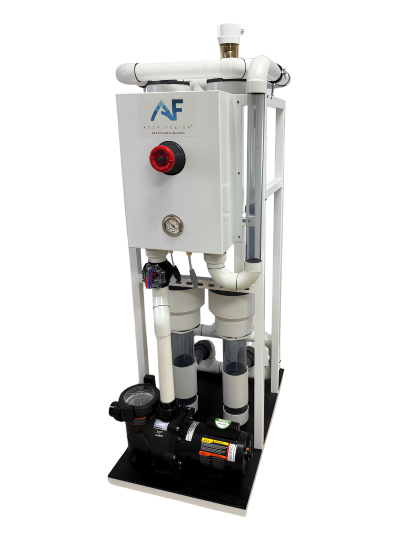
- Aqua Fuzion Skid: Plumbed into the pool’s return line, it delivers millions of oxygen and ozone-infused nanobubbles into the water. Owners report a noticeable reduction in chemical usage and clearer water.
- Air Gen: Aquadei’s oxygen and ozone generator, which pairs with the Aqua Fuzion Skid to supply the gas infused into the nanobubbles.
- pHure Feed: Delivers hyper-dissolved CO₂ inline for natural pH control, which can reduce or replace routine muriatic acid dosing where site conditions allow.
All three systems retrofit onto new and existing pools and work alongside existing filtration and UV equipment. The core generator has no mechanical moving parts in the flow path, so the technology itself requires essentially no maintenance. Your pool service still tests and maintains water chemistry, but with a lighter chemical load.
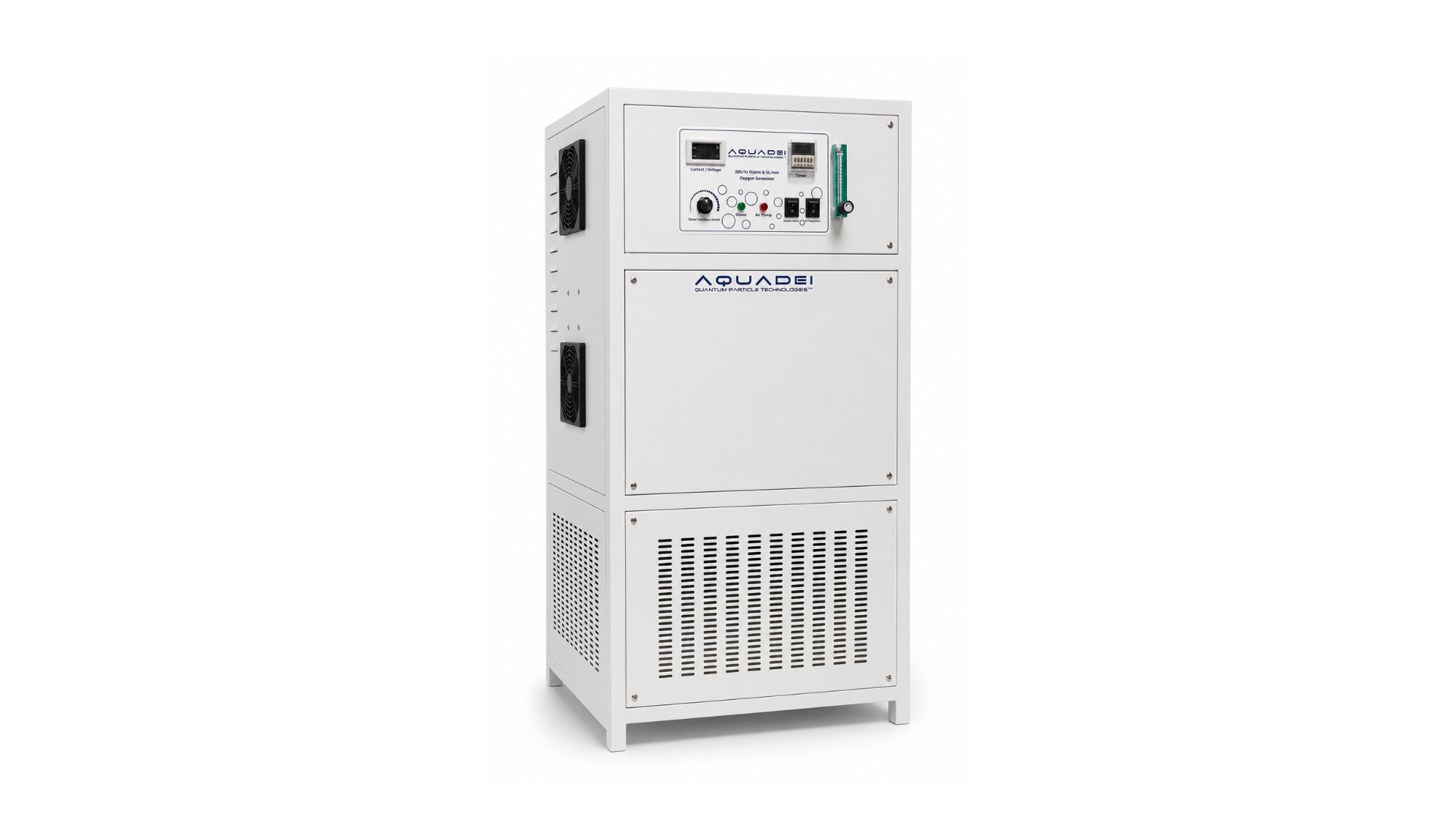
Approved residential phrasing: Aquadei delivers a significant reduction in your chemical usage. The exact percentage varies by pool because sun exposure, bather load, and service conditions differ from site to site.
Talk With Aquadei About Your Pool
Best Practices And Evaluation Criteria For Your Final Choice
- Size before you shop. Calculate pool volume, required GPM, filter square footage, heater BTU, and salt-cell capacity first, because every later decision depends on those numbers.
- Once you have the sizing, match every component to the pump’s flow and the pool’s volume. A correctly sized pump paired with an undersized filter or a small salt cell weakens the entire system.
- Verify claims against manufacturer specification sheets and the turnover standard introduced earlier. Adjust for bather load, climate, and connected features.
- Prefer documented operating conditions and measurable performance over broad percentage promises. Ask for specification sheets and test data instead of marketing summaries.
- Use the ISO fine bubble framework when you evaluate nanobubble-based sanitization-support systems. Under ISO 20480-1:2017, an ultrafine bubble measures under 1 micron (1,000 nanometers). Systems that cannot document bubble size and concentration through independent measurement deserve extra scrutiny.
Common Pitfalls And Misunderstandings To Avoid
- Buying A Generic Bundle Before Sizing. Package tiers are marketing categories, not engineering specifications. A “complete package” that is not sized to your pool’s volume and plumbing will underperform, regardless of brand.
- Mismatching Filter Size To Pump Flow. Pool Chemical Calculator notes that pump GPM should never exceed the filter’s rated GPM, or particles pass through unfiltered. A clogged filter can cut flow by 30–50%.
- Oversizing The Pump Or Undersizing The Plumbing. Pool Founder’s guide documents that an oversized pump can waste 40–60% of its energy, create excessive pressure on filters and plumbing, and generate unnecessary noise. Plumbing diameter often limits performance in older pools.
- Misunderstanding Salt Systems And Chlorine. Salt systems produce chlorine on site through electrolysis, so the water chemistry matches a traditionally chlorinated pool. Chlorine itself does not accumulate because it is consumed as it sanitizes and dissipates in sunlight. Cyanuric acid, the stabilizer, does accumulate and eventually requires dilution when levels climb too high.
- Buying Used Equipment Without Inspection. Each component has a finite service life. A used salt cell or heater may offer little remaining life even if it appears functional today.
- Assuming One Pool’s Results Apply Everywhere. A system that performs well in a lightly used 15,000-gallon pool in a mild climate may not deliver the same outcome in a heavily used 30,000-gallon pool in a hot desert environment.
Frequently Asked Questions
What Does An Inground Pool Equipment Package Include?
A complete inground pool equipment package includes a circulation pump, a filter (sand, cartridge, or DE), a heater (gas, heat pump, or solar), a sanitizer or sanitization-support system, and controls or automation. It also includes the plumbing, valves, skimmer connections, return fittings, and check valves that connect everything on the equipment pad. Some packages are sold as pre-configured bundles, while others are assembled component by component. In both cases, every component must be sized to the pool’s volume and the pump’s flow rate for the package to function as a true solution.
How Do I Size A Pump And Filter To My Pool’s Gallons?
Start by calculating pool volume using the correct formula for your pool’s shape, such as length × width × average depth × 7.5 for rectangular pools. Divide the volume by the target turnover time in hours, then divide again by 60 to get required GPM. For an 8-hour residential turnover, the formula simplifies to pool volume ÷ 480. Add a 15–20% buffer above the minimum to account for filter resistance as it loads. Then select a filter whose maximum rated GPM equals or exceeds the pump’s buffered output. Check that the plumbing diameter can carry the required flow, with about 42 GPM for 1.5-inch pipe and about 73 GPM for 2-inch pipe as practical limits.
How Much Does An Inground Pool Equipment Package Cost?
Costs vary by tier, pool size, and region. A basic pump-and-filter package often falls between about $800 and $3,500 for equipment, with installation adding 30–60%. A complete package with heater and automation usually lands between roughly $6,000 and $15,000 installed for most residential pools. Variable-speed pumps are now standard for most new installations under US Department of Energy efficiency rules. They cost more upfront than single-speed models but reduce operating costs over their service life. Salt cell replacement every 3–7 years is a recurring ownership cost that should be included in any total-cost comparison between saltwater and tablet-based chlorine packages.
Should I Choose Saltwater Or Chlorine?
Both approaches sanitize with chlorine, and the difference lies in how chlorine enters the water. A salt-chlorine generator produces chlorine on site through electrolysis and delivers a steadier, lower-concentration level than manual dosing. Saltwater pools often feel softer and smell less harsh because chlorine is generated continuously at a mild level instead of added in spikes. Trade-offs include the cost of the cell, periodic cell cleaning, corrosion considerations for metal fixtures and some stone coping, and ongoing pH management. Cyanuric acid management also differs. Trichlor tablet users add stabilizer with every dose, which can eventually require a partial drain. Salt systems produce chlorine without added stabilizer, so cyanuric acid is added once and remains relatively stable. Saltwater is generally better suited to pools of 20,000 gallons or more that are heavily used. For smaller or seasonally used pools, the payback period on the generator is longer.
What Should I Check Before Buying A Used Package?
Inspect each component individually. For pumps, check the motor housing and shaft seal for corrosion and weeping. For filters, inspect the tank for cracks around the clamp band and lid and assess the condition of the media. For heaters, inspect the heat exchanger for corrosion, scale, and signs of prior leaks, and request a live run demonstration. For salt cells, inspect the titanium plates for scale and pitting, since a heavily scaled cell sits near the end of its service life. For controls and automation, verify that the board powers on and communicates with all connected equipment. Request maintenance records and a recent water test to understand how the system was maintained.
Is A Variable-Speed Pump Worth It?
For most residential inground pools, a variable-speed pump is worth the investment and is now the standard compliant option for new installations and replacements in the US. Variable-speed pumps reduce energy consumption by 30–90% compared to single-speed alternatives because power consumption varies with the cube of speed. Running a variable-speed pump at low speed for roughly 12–24 hours per day can achieve equal or better turnover than running at high speed for about 8 hours, while using less electricity. They also run much quieter than single-speed models, and the higher upfront cost is often recovered in utility savings within a few swimming seasons.
What Maintenance Does The Equipment Need?
Each component follows its own maintenance schedule. Clean filters when pressure rises 8–10 PSI above the clean baseline reading. Salt cells require inspection and cleaning every 3–6 months to remove calcium scale from the titanium plates. Heaters should be inspected annually for scale and corrosion. Pump baskets need regular clearing. Automation systems and controls benefit from periodic firmware updates and sensor checks. During the swim season, test free chlorine and pH 2–3 times per week, total alkalinity weekly, and cyanuric acid and calcium hardness monthly. No equipment package replaces the need for regular testing and adjustments.
How Do I Verify A Sanitization-Support System Performs As Claimed?
Ask for documented evidence at three levels. First, confirm that the manufacturer can show the system produces the bubbles or reactive species it claims, using a recognized measurement method such as Nanoparticle Tracking Analysis or Dynamic Light Scattering. Second, check whether independent, peer-reviewed research has used the technology, not just internal testing. Third, see whether the manufacturer engineers to a published international standard such as the ISO fine bubble framework (ISO/TC 281; ISO 20480-1:2017). Systems that cannot document all three points are making assertions rather than supported claims. Aquadei can document all three. Bubble production at the 100-nanometer scale was confirmed at the University of Osaka’s photonics laboratory. Independent researchers have used Aquadei’s UFB generators in published studies. Aquadei also engineers to the ISO fine bubble framework at roughly ten times finer than the ultrafine threshold. These three layers of evidence give residential buyers a clear, verifiable basis for evaluating any sanitization-support system.