Key Takeaways
- The popular claim that ozone is 1,500–3,000 times faster than chlorine has no clear source or stated conditions, so it cannot support regulatory or capital decisions.
- Disinfection speed is measured by CT value, which is concentration multiplied by contact time for a specific log inactivation, organism, temperature, and pH.
- Ozone achieves 3-log Cryptosporidium inactivation at practical CT values, while free chlorine receives no credit under US EPA and WHO guidelines.
- Ozone’s speed comes with trade-offs, including no residual, bromate formation risk in bromide-bearing water, and the need for a secondary disinfectant to protect the distribution system.
- Aquadei’s nanobubble technology delivers ozone with high mass-transfer efficiency, helping systems reach target CT values while supporting responsible bromate control.
Talk To Aquadei About Your CT Requirements
Ozone And Chlorine Compared In Everyday Operation
Before diving into CT values, it helps to see how ozone and chlorine differ in day-to-day use. Ozone disinfects very quickly and has a large CT advantage for viruses and protozoa. Free chlorine acts more slowly and its performance depends strongly on the organism and conditions.
Ozone has a higher oxidation potential at about 2.07 V, compared with roughly 1.36 V for free chlorine. Ozone decomposes to oxygen and leaves no residual in the water, while free chlorine persists and continues working through the distribution system or pool.
Ozone can form bromate in bromide-bearing water. Free chlorine forms trihalomethanes (THMs), haloacetic acids (HAAs), and chloramines when it reacts with natural organic matter and ammonia. Typical contact times run about 4–10 minutes for ozone and 30–60 minutes for chlorine, but these are design outcomes, not fixed properties.
All of these figures depend on dose, organism, temperature, pH, and water quality. They serve as starting points for design rather than regulatory requirements.
The Problem With The “1,500 To 3,000 Times Faster” Claim
Ozone versus chlorine disinfection speed does not reduce to a single number. The circulating “1,500 to 3,000 times faster” claim has no named regulatory or peer-reviewed source. It also omits the organism, concentration, temperature, pH, and log inactivation target. A specifying engineer who repeats it to a regulator or capital committee risks losing credibility as soon as anyone asks for the basis.
The real picture is more nuanced. Ozone’s advantage over chlorine is enormous for viruses and for Cryptosporidium, meaningful for Giardia, and modest for bacteria. The ratio implied by the CT tables ranges from roughly 50-fold for Giardia at warm temperatures to effectively infinite for Cryptosporidium, where the WHO Guidelines for Drinking-water Quality state that free chlorine is not effective at practical treatment conditions. No single multiplier captures that range.
The CT framework survives regulatory scrutiny and provides a defensible basis for disinfection design decisions.
CT Values, The Metric That Actually Measures Disinfection Speed
CT is the regulatory currency of disinfection. It is defined as disinfectant concentration C (mg/L) multiplied by contact time T (minutes), giving units of mg·min/L, for a stated log inactivation. Under 40 CFR 141.720, the US EPA defines CT as the product of disinfectant contact time and disinfectant concentration, and requires systems claiming ozone treatment credit to calculate CT at least once each day, with both values measured during peak hourly flow.
Contact time alone means little without the concentration that goes with it. A 10-minute contact time at one dose is very different from 10 minutes at another. EPA ozone and chlorine contact time comparisons must always state both variables. The CT tables, not a single multiplier, form the design basis.
The CT values that water treatment regulators publish vary by organism, temperature, and target log reduction. The table below draws on the WHO Guidelines for Drinking-water Quality (4th edition), US EPA 40 CFR 141.74, and US EPA 40 CFR 141.720. Health Canada and the UK Drinking Water Inspectorate use equivalent CT frameworks and corroborate these figures.
| Organism Class | Ozone CT (mg·min/L) | Free Chlorine CT (mg·min/L) | Authority and Conditions |
|---|---|---|---|
| Bacteria | ~0.02 (99% inactivation) | ~0.02–0.3 (99% inactivation) | WHO Guidelines for Drinking-water Quality, 15–25 °C, pH 6.5–7 |
| Viruses | ~0.006–0.2 (99% inactivation) | ~2–30 (99% inactivation) | WHO, 0–10 °C, pH 7–9 |
| Giardia | 1.4 at 10 °C; 0.72 at 20 °C (3-log) | 107 at pH 7.0, 5 °C; 36 at pH 7.0, ≥25 °C (3-log, 0.6 mg/L residual) | US EPA 40 CFR 141.74 Tables 2.1 and 1.1–1.6 |
| Cryptosporidium | 9.9 at 10 °C; 3.9 at 20 °C (1-log); 30 at 10 °C; 12 at 20 °C (3-log) | Not credited — impractical at treatment doses | US EPA 40 CFR 141.720(b)(2); WHO states free chlorine is not effective at practical conditions |
Where the source material does not give a specific CT figure for a condition, the relationship is described qualitatively and the authority’s framework is cited rather than inventing a number.
Size Your Ozone Contactor Around The Right CT
Contact Time In Practice For Ozone And Chlorine
Ozone contactors are typically designed for 4–10 minutes of contact time. Chlorine contact basins are often sized for 30–60 minutes. These figures reflect design choices at particular doses rather than fixed properties of each disinfectant.
Under the US EPA Surface Water Treatment Rule (40 CFR Part 141, Subpart H), contact time is defined as T10, the time at which 10% of a tracer has passed through the contactor, to penalize short-circuiting. A contact basin sized for 30 minutes of nominal residence time may deliver far less effective contact time if it is poorly baffled. The same principle applies to ozone contactors, where design flow, ozone demand, and geometry determine whether the target CT is actually achieved.
Contact time is a design outcome. Engineers size a contactor to deliver a required CT at the design flow and demand. The 4–10 minute versus 30–60 minute contrast illustrates the difference in reactivity. It does not replace the CT calculation.
The Residual Trade-Off Between Ozone And Chlorine
Ozone’s speed comes with a fundamental operational constraint, because it decomposes to oxygen and leaves nothing behind. US EPA regulations require that residual disinfectant concentration in water entering the distribution system cannot be less than 0.2 mg/L for more than 4 hours, which ozone alone cannot meet.
Chlorine’s slower action is paired with a persistent residual that continues working through the distribution system, storage tank, and pool between doses. That persistence keeps water protected between treatments, and ozone cannot provide the same ongoing barrier.
Many plants therefore pair ozone as a primary disinfectant with a chlorine residual as a secondary safeguard. This two-stage approach captures ozone’s speed against pathogens while maintaining distribution protection. For a detailed look at that setup, see Ozone and Chlorine in Water Treatment: The Two-Stage Way.
Where Ozone And Chlorine Disinfection Speed Matters Most
Drinking Water Treatment
In drinking water treatment, ozone’s CT advantage for Cryptosporidium and viruses is the primary engineering driver. The US EPA’s Long Term 2 Enhanced Surface Water Treatment Rule requires Cryptosporidium treatment credit that chlorine alone cannot provide, which is why ozone, UV, or membrane treatment is required for surface water sources with Cryptosporidium risk. Ozone reaches the 3-log Cryptosporidium credit shown in the CT table above at practical doses, which chlorine cannot. Plants typically meet the residual requirement after ozone primary disinfection with a small chlorine or chloramine dose downstream.
Pools And Spas
In pool sanitizing, ozone’s fast oxidation of contaminants and chloramines drives most of its value. Chloramines, which cause the familiar “chlorine smell” in indoor aquatic facilities, are destroyed rapidly by ozone but accumulate under chlorine-only treatment. For more on chloramine control, see Commercial Pool Chloramine Control: Six Stages for Operators.
Commercial and public pools still require a residual sanitizer. Commercial pools commonly require 1 ppm free chlorine as a minimum residual, though requirements vary by jurisdiction. The practical goal of ozone in a pool system is reduced chemical dependence. Ozone handles most of the oxidation load, and a reduced chlorine residual maintains protection between treatment cycles.
Wastewater
In wastewater applications, ozone is used for both disinfection and micropollutant oxidation. Contact-time design depends strongly on effluent quality. A higher organic load increases ozone demand before any disinfection CT accumulates, so the contactor must be sized for the actual water matrix rather than a catalog rule of thumb. Pilot testing is standard practice before specifying a wastewater ozone system.
Surface And Food Applications
For surface sanitation and produce wash water, ozone’s speed is an advantage and its lack of residual becomes a benefit. Operators do not want lasting chemical protection on a food contact surface or in a produce wash. Ozone oxidizes surface contaminants and reverts to oxygen, leaving no chemical residue. Contact times are short and dose-dependent, and must be established for the specific application and organism target.
What Chlorine Cannot Kill And Ozone Can
The application examples above keep pointing to one pathogen, so it is worth isolating the case. Cryptosporidium is the clearest argument for ozone. The WHO Guidelines for Drinking-water Quality state that free chlorine is not effective against Cryptosporidium oocysts at practical treatment conditions. The 1993 Milwaukee outbreak, in which 403,000 people were sickened from a fully chlorinated public water supply, remains the regulatory case study for why a second pathogen barrier is required for surface water sources with Cryptosporidium risk.
Ozone is effective against Cryptosporidium, but the CT requirement remains substantial. US EPA 40 CFR 141.720(b)(2) specifies 30 mg·min/L for 3-log credit at 10 °C. Cold water dramatically increases the required CT, and the same 3-log credit requires 72 mg·min/L at 0.5 °C or below. Ozone still demands careful contactor sizing for Cryptosporidium at cold-water temperatures.
Discuss Cryptosporidium CT For Your Source Water
By-Products And Caveats Around Bromate
Ozone forms bromate (BrO₃⁻) when it oxidizes bromide in source water. The US EPA maximum contaminant level for bromate is 0.010 mg/L, and the same 10 µg/L limit appears in the WHO Guidelines and the EU Drinking Water Directive. Bromate is classified by IARC as Group 2B (possibly carcinogenic to humans). Designers must treat this as a real constraint in seawater, desalination feed, marine aquaculture, and some surface waters.
In peer-reviewed research published in Water Research (2026), a team led from Arizona State University with co-authors at Penn State used a GAIA Water UFB generator to compare ozone nanobubbles against conventional macrobubble ozonation across six water types in bench-scale testing. In bromide-spiked synthetic seawater, nanobubble ozonation drove near-complete bromide depletion and produced bromate well beyond macrobubble ozonation. The paper states clearly that nanobubble ozonation makes bromate formation more likely in bromide-bearing water and calls for deliberate operational control. In saline or bromide-bearing water, that efficiency also means bromate control has to be designed in deliberately.
Chlorine’s by-product side deserves equal honesty. Free chlorine forms THMs and HAAs as by-products from reaction with natural organic matter, and reacts with ammonia to form chloramines. The US EPA MCL for total trihalomethanes is 80 µg/L and for HAA5 is 60 µg/L. Chloramines cause the characteristic indoor pool odor and are toxic at sustained exposure. Both disinfectants carry by-product considerations, so robust design addresses each set of risks.
Why Aquadei Delivers Ozone’s Speed Effectively
Aquadei owns the Gaia technology, which began development in 2008 and entered the recreational water market in 2012. In August 2016, the University of Osaka’s photonics laboratory analysed the system and independently confirmed bubble sizes on the order of 100 nanometers. That work marked the point when the company adopted the ISO fine bubble framework that still guides its engineering.
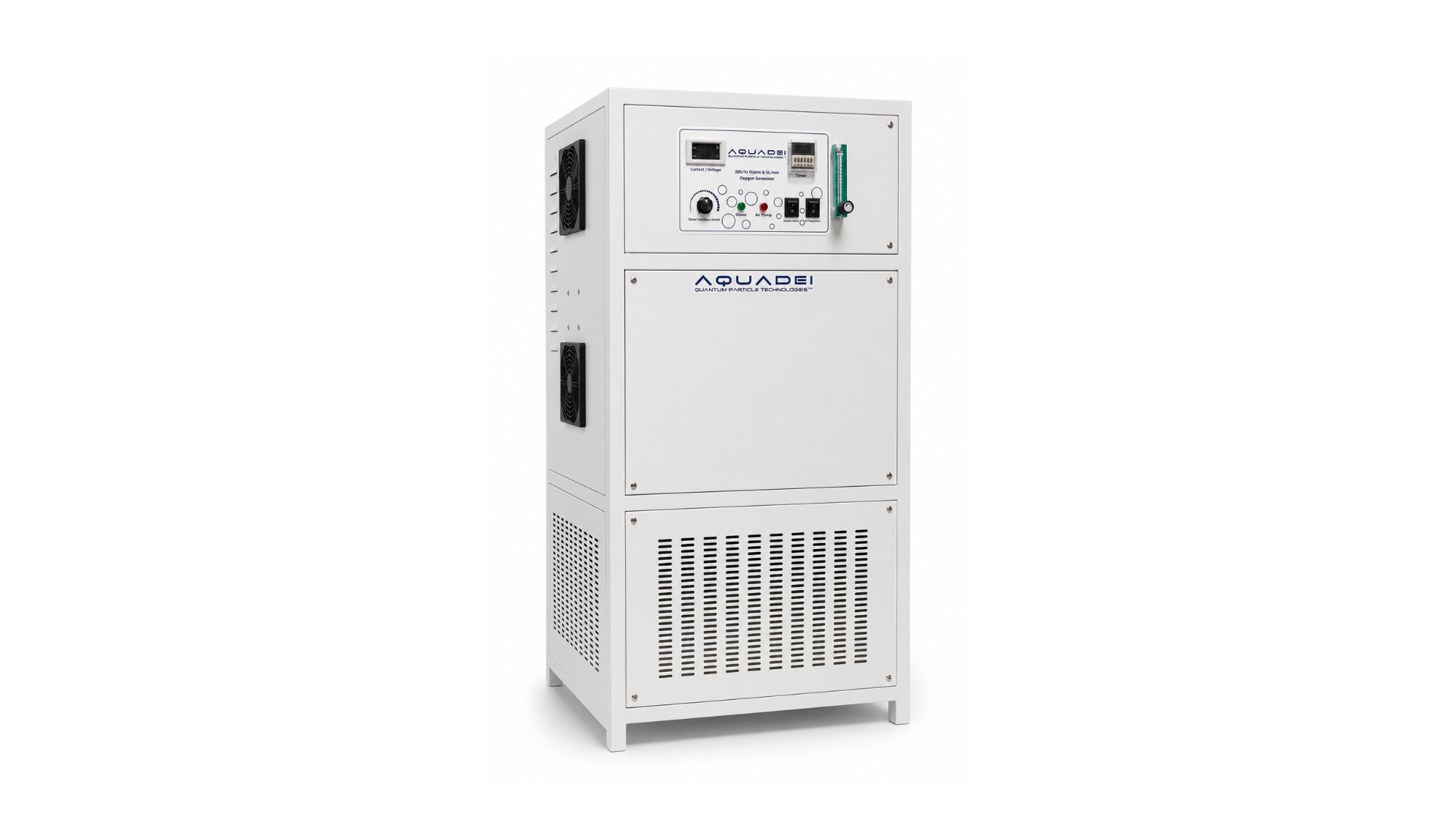
The core engineering challenge in ozone disinfection lies in getting ozone into the water efficiently enough to build the CT required for the target pathogen. Conventional macrobubble ozonation loses a significant fraction of applied ozone to off-gassing before it can react. Aquadei’s platform delivers ozone as nanobubbles through its Air Gen oxygen and ozone generator, which is designed for high mass-transfer efficiency.
The 2026 Water Research study led from Arizona State University with Penn State co-authors measured mass-transfer coefficients more than an order of magnitude higher for ozone nanobubbles than for macrobubbles across every water matrix tested. In ultra-pure water, nanobubbles reached saturation in under 5 minutes, compared with more than 30 minutes for macrobubbles at the same ozone dose. That difference is the engineering lever, because ozone’s inherent speed only translates into real CT when mass transfer is high enough to build concentration before decay.
The same study found that ozone in nanobubble form decays faster than in macrobubble form. The honest framing is faster, more efficient delivery and more intense interfacial reaction, with bromate control in bromide-bearing water requiring deliberate operational management.
Aquadei’s track record supporting these claims includes:
- Independent confirmation of 100-nanometer bubble production at the University of Osaka photonics laboratory in August 2016
- The 2026 Water Research ozone nanobubble study led from Arizona State University with Penn State co-authors, in which independent researchers used a GAIA Water UFB generator
- The 2026 Agricultural Water Management lettuce study, in which a team led from Arizona State University with co-authors at the University of Maine used a Gaia UFB generator and found oxygen nanobubbles improved germination, leaf growth, and biomass in early plant development while cutting water use by approximately 23%
- Peer-reviewed studies in which independent researchers selected Gaia UFB generators for their experimental work
- Engineering to the ISO fine bubble framework at 100 nanometers or below, roughly ten times finer than the ultrafine bubble threshold requires
Aquadei stands out as a scientifically validated nanobubble company in North America, supported by independent laboratory confirmation of its bubble production, peer-reviewed studies using its generators, and adherence to the ISO fine bubble framework.
For a broader look at how ozone water treatment works and how to size a system, see How Ozone Water Treatment Works: The Complete Guide and Ozone Generator For Water: Sizing, Safety And Right Machine.
Conclusion: CT Values Provide The Real Ozone Versus Chlorine Answer
The real answer to ozone versus chlorine disinfection speed is a CT value. CT is concentration multiplied by contact time for a stated log inactivation, at a stated temperature and pH, against a stated organism. Ozone is genuinely faster, often by an order of magnitude for viruses and protozoa, and it is the only practical disinfectant for Cryptosporidium at treatment doses. Faster performance still has to be balanced against the absence of a residual, bromate formation in bromide-bearing water, and the specific pathogen and application.
Effective evaluation of any disinfection approach rests on four elements: a named authority, stated conditions, a residual strategy, and by-product control. Any source that leads with a multiplier without those elements does not provide a design basis.
For an application-specific consultation on how ozone nanobubble delivery can match your CT requirements and water chemistry:
Plan Your Ozone Nanobubble Design With Aquadei
Frequently Asked Questions
Is Ozone A Faster Disinfectant Than Chlorine?
Ozone is often faster by an order of magnitude for viruses and protozoa, and CT value provides the honest measure. For bacteria, the difference is modest. For Cryptosporidium, chlorine is not credited at practical doses, while ozone achieves inactivation at defined CT values. The advantage is real and significant, but it varies by organism, temperature, pH, and water quality.
How Much Faster Is Ozone Than Chlorine, Really?
No single defensible multiplier exists. For Giardia at 20 °C, the CT tables imply that ozone requires roughly 50 times less CT than free chlorine. For Cryptosporidium, the ratio is effectively unbounded because free chlorine is not credited at practical doses. For bacteria, the difference is small. The CT tables provide the defensible answer rather than a single ratio applied across all conditions.
What Is A CT Value And Why Does It Matter?
CT is disinfectant concentration in mg/L multiplied by contact time in minutes for a stated log inactivation, expressed in mg·min/L. It is the regulatory currency of disinfection under the US EPA Surface Water Treatment Rule and equivalent frameworks in Canada, the UK, and the WHO guidelines. CT is the only defensible way to compare disinfectants, because it captures both dose strength and exposure time. Contact time alone, without the corresponding concentration, does not describe the inactivation achieved.
Does Ozone Leave A Residual?
Ozone decomposes to oxygen and has limited residual in water, so it leaves nothing behind to protect the distribution system or the pool between doses. Many drinking water plants pair ozone as a primary disinfectant with a small chlorine or chloramine dose as a secondary safeguard to maintain a distribution residual. In pools and spas, a residual sanitizer, typically 1 ppm free chlorine though requirements vary by jurisdiction, remains necessary even when ozone handles most of the oxidation load.
Does Ozone Form Bromate?
Ozone forms bromate in bromide-bearing water. It oxidizes bromide to bromate, a regulated disinfection by-product with a US EPA maximum contaminant level of 0.010 mg/L. The same limit applies under the WHO Guidelines and the EU Drinking Water Directive. Designers treat this as a real constraint in seawater, desalination feed, marine aquaculture, and some surface waters. Nanobubble ozone delivery, because it is more efficient, requires particularly deliberate operational control in bromide-bearing water. Bromate cannot be removed once formed, so control comes from limiting its formation through dose management, pH control, and source water assessment.
Can Ozone And Chlorine Be Used Together?
Ozone and chlorine are often used together in drinking water plants and commercial aquatic facilities. Ozone handles primary disinfection, including pathogens that chlorine cannot address at practical doses, and a small chlorine or chloramine dose maintains the distribution residual. In pools and spas, ozone destroys chloramines and reduces chlorine demand, which allows a lower maintained free-chlorine residual. This two-stage approach captures the speed advantage of ozone while preserving the persistence advantage of chlorine.
Is Ozone Better Than Chlorine For Pools And Spas?
Ozone is faster at oxidizing contaminants and chloramines, which drives its primary value in pool and spa applications. Commercial and public pools still require a residual sanitizer, commonly 1 ppm free chlorine as a minimum, though requirements vary by jurisdiction. The practical goal is reduced chemical dependence rather than chemical-free operation. Ozone reduces chlorine demand, which reduces chloramine formation and improves water and air quality in enclosed facilities. The right choice depends on pool volume, bather load, water chemistry, and local regulatory requirements.