Key Takeaways
- Published ozone prices usually cover only the generator. Real cost comes from the full installed system, including plumbing, electrical work, pre-treatment, and contact tanks.
- Six factors drive installed cost: pre-treatment for iron, manganese, and sulfur; contact-tank sizing; plumbing and electrical labor; well or pressure-tank modifications; feed-gas method; and permits plus water testing.
- Ongoing ownership costs often exceed the original generator price over time. Expect recurring spend on filter media, air-dryer service, electricity, check valves, and annual water testing.
- Ozone does not remove dissolved solids, hardness, nitrates, fluoride, or PFAS. It needs downstream filtration and off-gas management to work safely and effectively.
- Aquadei’s nanobubble platform improves ozone transfer efficiency, which can reduce wasted ozone and allow more conservative system sizing when matched to your water chemistry.
Contact Aquadei For A Free Ozone System Consultation
Ozone Water Treatment System Cost By Tier And Application
The table below groups systems into five tiers so you can see how scope and complexity increase as water problems get harder to treat. The generator appears in every row, but the pre-treatment, contact equipment, and controls are what really separate the tiers and drive cost.
| System Tier | Typical Application | What’s Included | Relative Cost Tier |
|---|---|---|---|
| Point-of-use or single fixture | Light odor or taste at one tap; apartment or rental | Small UV or corona-discharge generator, injector, carbon post-filter | Very Low |
| Entry-level whole-home | Light iron or mild sulfur odor on a private well | Generator, venturi injector, backwashing filter, off-gas vent | Low To Moderate |
| Mid-range whole-home | Heavy iron, sulfur, and manganese on a private well | Higher-output generator, contact tank, multi-stage filtration, air dryer or desiccant, electrical work | Moderate To High |
| High-output whole-home or light commercial | Estate, farm, shared well, small commercial facility | Oxygen-fed or high-capacity corona-discharge generator, large contact vessel, controls, monitoring, pre-treatment train | High |
| Commercial and light industrial | Food and beverage, municipal pre-treatment, industrial process water | Full skid with PSA oxygen supply, multi-stage contactors, ORP monitoring, off-gas destruction, commissioning | Very High |
What’s typically extra at every tier:
- Pre-treatment stages for iron, manganese, turbidity, or hydrogen sulfide
- Contact-tank sizing beyond a basic injector
- New plumbing runs or electrical circuits
- Well pump or pressure-tank work
- Permits and water testing before and after commissioning
A whole-house residential ozone system with its backwashing filter typically installs for more than a basic generator price alone, and the spread between the lowest and highest quote for the same house is almost always driven by pre-treatment scope, contact-tank sizing, and labor, rather than by the ozone generator itself.
See How Aquadei Sizes A System For Your Water
Generator Pricing: What An Ozone Treatment Machine Actually Covers
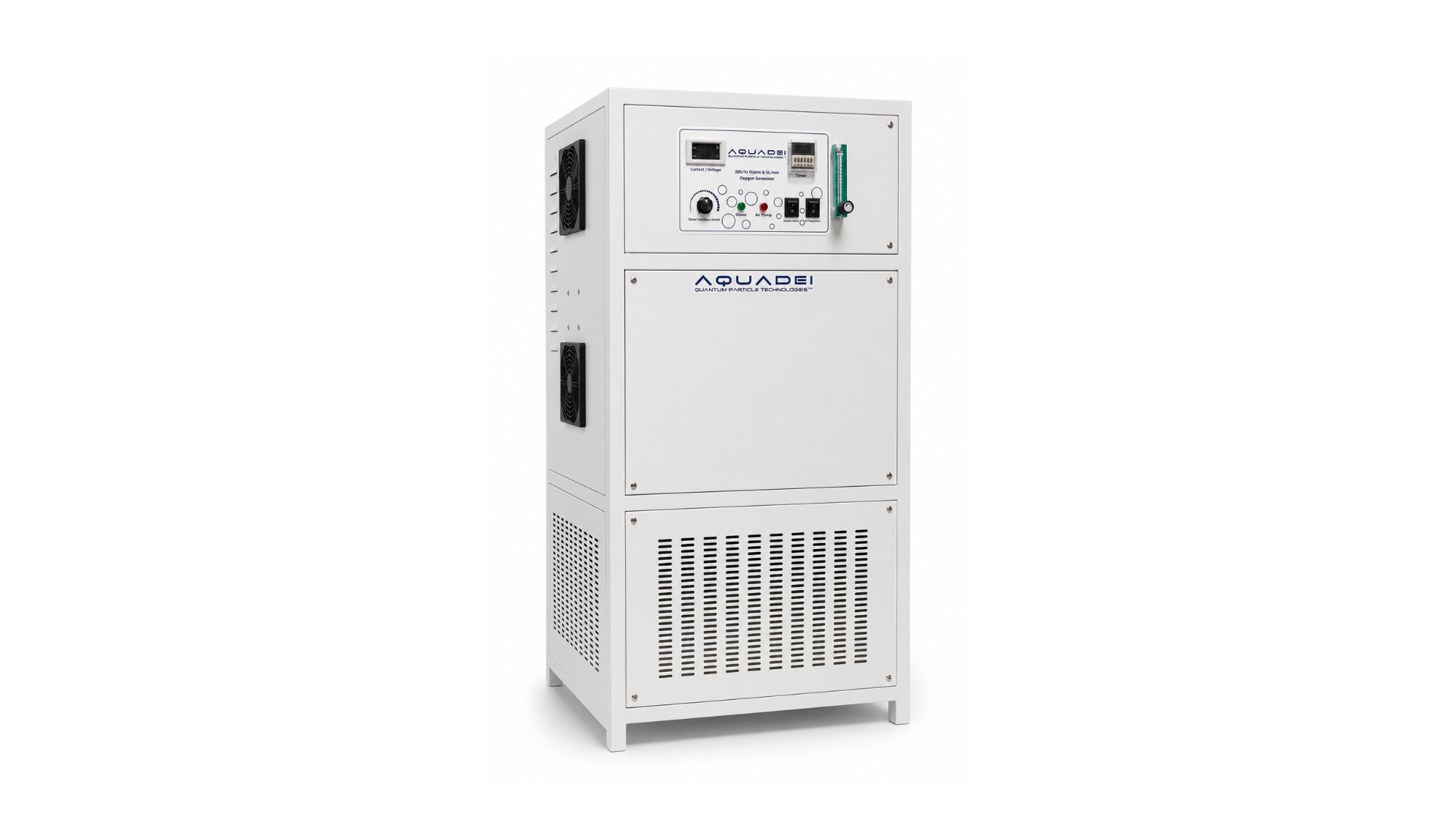
The generator or injector is only one line item in a complete ozone water treatment system. Equipment cost depends on ozone output in grams per hour, feed-gas method, and whether the unit is a standalone injector or a packaged system with a contact tank and controls.
Feed-gas method has a major impact on both price and performance. Air-fed corona-discharge generators produce ozone at roughly one to three percent by weight, while oxygen-fed units produce six to fifteen percent by weight, so air-fed systems require larger contact equipment and more gas volume per gram of ozone delivered. An oxygen concentrator or PSA unit adds equipment cost and ongoing electricity, yet it reduces the generator size needed for the same treatment outcome.
The generator is often the smaller share of the total once installation and pre-treatment are included. A typical residential ozone system quote itemizes the generator, the injector and contact tank assembly, a prefilter or iron filter, plumbing and electrical labor, and testing and startup as separate line items. The non-generator items frequently add up to more than the generator itself.
For a deeper look at how to select the right generator for your water problem, see How To Choose An Ozone Generator For Your Water.
Six Factors That Drive Installed Ozone System Cost
The generator’s sticker price is the starting point, not the finish line. Six factors determine the real installed number:
- Pre-treatment. Iron and manganese must be oxidized and then filtered out of the water. Hydrogen sulfide and turbidity may require additional stages. Ozone generator sizing uses stoichiometric figures of about 0.43 mg ozone per mg of iron, 0.88 mg per mg of manganese, and around 3 mg per mg of hydrogen sulfide, so a water supply with heavy sulfur dominates ozone demand and drives generator size up. Pre-treatment is frequently the largest single cost in a well-water ozone installation.
- Contact tank and residence time. Ozone needs time in contact with the water to oxidize contaminants. A venturi injector alone rarely provides enough contact time for heavy iron or sulfur loads. A properly sized contact or retention tank is a real cost. Its size is set by your peak flow rate and contaminant levels, which means a rule of thumb will not work.
- Plumbing and electrical. Existing plumbing tie-in versus new runs, a dedicated electrical circuit for the generator and any booster pump, and a properly vented off-gas path all add labor and materials. A straightforward installation may take three to six hours, while new plumbing, electrical work, or integration with existing filtration can extend the job to eight to sixteen hours.
- Well and pressure-tank work. Pump sizing, pressure switch settings, and sometimes a well driller are required when the existing system cannot support the added flow demand of a treatment train.
- Feed gas. An oxygen concentrator adds equipment cost and electricity compared to ambient-air feed. Air-fed ozone generators typically consume roughly eight to twelve watt-hours per gram of ozone produced, while oxygen-fed generators run at roughly six to eight watt-hours per gram, which creates a meaningful difference in ongoing electricity cost at continuous duty.
- Permits and testing. A laboratory water test before system design is essential because it determines generator sizing, pre-treatment scope, and whether bromide is present. Post-commissioning testing confirms the system is performing as designed. Permit fees for water treatment system installation range from $30 to $500 depending on local municipal rules, with some installers bundling this cost and others listing it separately.
Those six factors set the upfront number. They do not capture what the system costs to run year after year, which is where a cheap install can quietly become the expensive one.
Ongoing Cost Of Ownership
Recurring cost is where a low upfront number can become expensive over time. The items that drive annual ownership cost include:
- Pre-treatment filter media. Backwashing iron and manganese filters need media replacement on a schedule that depends on actual contaminant load, so a well with heavy iron will exhaust media faster than a well with light iron. Sediment and carbon filter cartridges typically require replacement every six to twelve months depending on water quality and usage volume.
- Air dryer or desiccant service. Moisture in the feed air is the main enemy of a corona-discharge generator, so air dryer or desiccant service is a recurring maintenance item on air-fed systems.
- Electricity. The generator runs continuously or on demand, and an oxygen concentrator adds to the electrical load. At residential scale this is a modest line item. At commercial scale it becomes a significant operating cost.
- Generator cell or electrode service. Corona discharge ozone generators commonly run for many years when feed air is kept dry and water is kept out. Periodic cell inspection and eventual replacement are part of the ownership picture.
- Check valves and injector components. A failed check valve allows water to back up into the generator, which is the usual cause of premature generator failure. Replacing these small parts on schedule protects the larger investment.
- Off-gas destruct media. Where a catalytic destruct unit is installed, its media wears out and must be replaced on its own schedule.
- Annual service and water testing. Annual service for a residential ozone water treatment system covers inspection and routine parts. Periodic water testing confirms the system continues to meet its design targets.
A system sized correctly for your actual water chemistry will cost less to own over time than one sized to a minimum specification. Pre-treatment media life, in particular, depends on the real iron, manganese, and sulfur load in your water rather than on a generic estimate.
Practical Limits And Requirements Of Ozone Treatment
Ozone is a powerful oxidizer, with an oxidation potential of about 2.07 V, stronger than hydrogen peroxide at about 1.78 V, chlorine at about 1.36 to 1.49 V, and air injection at about 1.23 V. It oxidizes iron, manganese, sulfur, and many organics while inactivating bacteria and viruses. It also has clear limits and operating requirements.
- Limited contaminant range. Ozone does not remove dissolved heavy metals, salts, total dissolved solids, or PFAS from water; for households dealing with these contaminants, ozone alone is insufficient and additional treatment such as reverse osmosis is required.
- Need for pre-treatment and downstream filtration. Ozone oxidizes iron and manganese into particles, but those particles pass through the water without a filter stage to capture them. A backwashing filter after the contact tank is a required part of the treatment train.
- No lasting residual. Ozone has a half-life of fifteen to thirty minutes in water at 20°C, decomposing to harmless oxygen with no toxic residue. It does not protect the distribution system the way chlorine does. On wells with a history of coliform bacteria, many installers add a UV system after the ozone filter as a final barrier.
- Ozone-safe components and off-gas management. OSHA’s workplace limit for ozone gas is 0.1 ppm over an eight-hour shift, so off-gas must be vented outdoors or passed through a destruct unit. Ozone degrades many common materials, so wetted components must be rated for ozone service.
- Bromate risk in bromide-bearing water. Ozone can form bromate when source water contains bromide, which is common near coasts and in some brackish aquifers; the EPA regulates bromate at a maximum contaminant level of 0.010 mg/L. Bromide should be tested before an ozone system is specified.
- Contact time and space requirements. Effective ozone treatment requires a contact tank sized to your peak flow rate and contaminant load. That tank takes up space and adds cost.
For a full explanation of how ozone treatment works and where it fits in a multi-barrier approach, see Ozone Water Treatment: How It Works And Key Benefits.
How Long Ozone Treatment Lasts In Water And In Service
This topic has two distinct parts, and each has a different answer.
How long ozone persists in the water. Dissolved ozone has a half-life of roughly 28 minutes in clean water near room temperature, but that window shifts considerably based on pH, temperature, and water chemistry, anywhere from under a minute to over an hour. Warmer water, higher pH, and higher organic load all accelerate ozone decay. Ozone treatment is therefore a contact-based process. The ozone reacts with contaminants in the contact tank and then decomposes to oxygen. It does not linger in your pipes as a residual disinfectant.
How long the system keeps working. The system continues as long as it is powered, maintained, and fed properly. As the ownership section noted, generator life depends on keeping feed air dry and water out, and under those conditions many years of service are typical. The system treats water continuously rather than delivering a one-time dose, so every gallon that passes through the contact tank is treated. Long-term performance depends on maintenance such as keeping the air dryer serviced, replacing check valves on schedule, and replacing filter media before it exhausts.
There is no universal figure for how long ozone persists in any given water supply. Persistence depends on water chemistry, temperature, and organic load. A system designed around your actual water test results will perform predictably. A system sized to a generic specification may not.
How To Evaluate An Ozone Water Treatment Quote
Two quotes for the same house can differ by thousands of dollars. The difference is almost never the generator. It is what the quote includes around the generator. The checklist below lists each element a complete quote should contain, what a well-built version of that element looks like, and the warning sign that it has been left out or glossed over.
| Quote Element | What Good Looks Like | Red Flag |
|---|---|---|
| Water test results | Lab panel covering iron, manganese, hydrogen sulfide, pH, turbidity, bromide, coliform, and TDS, used as the basis for sizing | No water test; sizing based on symptoms or a sales visit alone |
| System sizing rationale | Generator output in g/hr tied to measured contaminant levels and peak flow rate | Generator specified by bedroom count or house size only |
| Pre-treatment scope | Iron filter, sediment filter, and any additional stages itemized with media type and sizing | Equipment-only quote with no pre-treatment line items |
| Contact tank | Tank volume specified and sized to peak flow and required contact time | Venturi injector only, no contact tank, no residence-time calculation |
| Electrical and plumbing scope | Dedicated circuit, off-gas vent path, bypass valve, and any new plumbing runs itemized | Labor listed as a single line with no scope description |
| Commissioning and post-install testing | Startup visit and post-install water test included or quoted separately | No mention of commissioning or follow-up testing |
| Maintenance plan | Service schedule, parts pricing, and warranty exclusions provided in writing | No maintenance information; warranty terms unavailable before purchase |
The most reliable way to compare bids is to request at least three itemized quotes using the same design flow, generator output, contact tank, pretreatment, and post-treatment scope. A low bid that omits a necessary carbon stage or water test will simply lead to added charges later. When you review those quotes, watch for vague pricing, missing maintenance details, unclear warranties, and recommendations made without proper water testing, because each one signals that the scope has not been fully thought through.
Get A Line-Item Ozone Quote For Your Property
Where Nanobubble Delivery Changes The Cost Equation
Conventional ozone injection relies on macrobubbles, which are large gas bubbles that rise quickly and off-gas before they can fully react with contaminants in the water. To compensate, systems are sized larger and contact tanks made longer. The result is more ozone wasted, more feed-gas demand, and more contact volume required to achieve the same treatment outcome.
Aquadei is the owner of the Gaia technology. Aquadei’s nanobubble platform infuses ozone and oxygen as nanobubbles at 100 nanometers or below, which stay suspended and distribute through the water rather than rising and escaping. At that scale, bubbles carry a negative surface charge that causes them to repel one another rather than coalescing, and they move through the water by Brownian motion rather than buoyancy. Gas therefore stays in contact with the water far longer than macrobubbles allow.
The cost implication is meaningful. Higher gas transfer efficiency can mean less ozone wasted, smaller feed-gas demand, and better use of the contact volume already in the system. A system that transfers ozone more efficiently can, in principle, be sized more conservatively, which affects both capital cost and ongoing electricity consumption.
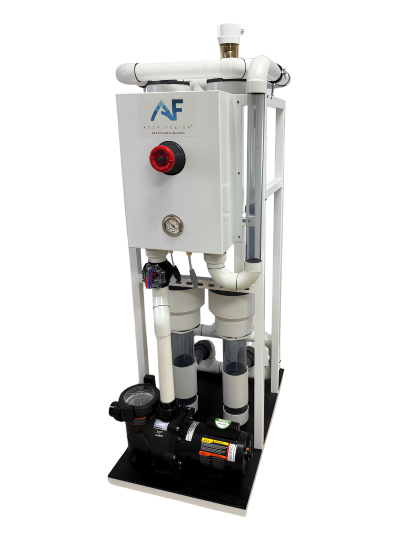
This claim rests on measured data. In peer-reviewed research published in Water Research (2026), a team led from Arizona State University with co-authors at Penn State used a GAIA Water UFB generator to compare ozone nanobubbles against conventional macrobubble ozonation across six water types, and measured mass-transfer coefficients more than an order of magnitude higher for nanobubbles across every matrix tested. The study found ozone gas-use efficiency approximately ten times higher for nanobubbles than for macrobubbles at the same ozone dose.
Three findings from that study require clear acknowledgment before drawing conclusions:
- The study is bench-scale, using a one-liter reactor, and is a study of ozone nanobubble chemistry rather than a field installation or a product performance benchmark.
- The study found that ozone decayed faster in nanobubble form than in macrobubble form. The same intense reactivity at the bubble interface that improves delivery also accelerates decay. The accurate framing is faster, more efficient delivery and more intense interfacial reaction, rather than longer ozone residence in the water.
- In saline or bromide-bearing water, nanobubble ozonation makes bromate formation more likely and requires deliberate operational control. Any application involving seawater, brackish water, or bromide-bearing supply must account for this.
Those caveats matter because they define what the study can and cannot support. Within that scope, the transfer-efficiency finding is the basis for how Aquadei approaches system design. Aquadei engineers to the ISO fine bubble framework (ISO/TC 281; ISO 20480-1:2017). The company produces bubbles at 100 nanometers or below, roughly ten times finer than the 1-micron ultrafine bubble threshold the standard defines. Independent laboratory confirmation of its bubble production comes from the University of Osaka’s photonics laboratory. Aquadei collaborates with more than 15 universities and government labs and operates its own PhD-staffed characterization laboratory in Arizona. The company quotes per application after a free consultation that reviews the water system and the outcome required.
Discuss Nanobubble Ozone For Your Project
Frequently Asked Questions
Is Ozone Treatment Worth The Cost?
For well-water owners dealing with iron, manganese, sulfur odor, or bacteria, especially in combination, ozone is often the most capable single technology available. It oxidizes multiple contaminants simultaneously and disinfects without adding chemicals to the water. Whether it is worth the cost depends on the severity of your water problem, your tolerance for ongoing chemical handling with alternatives like chlorine, and how the total installed cost compares to the alternatives for your specific water chemistry. A water test and an itemized quote for each option provide a reliable basis for that comparison.
Do I Need Pre-Treatment?
Most systems require pre-treatment when water has iron, manganese, turbidity, or hydrogen sulfide. Ozone oxidizes these contaminants into particles, but those particles remain in the water until a filter stage captures them. Without a properly sized backwashing filter after the contact tank, oxidized material passes through to your plumbing. Pre-treatment before the ozone stage, such as sediment filtration and pH correction if needed, protects the generator and improves transfer efficiency. The specific pre-treatment required depends on your water test results.
How Much Does Installation Add?
Installation is frequently the largest variable between quotes. Labor scope, plumbing modifications, electrical work, off-gas venting, and any well or pressure-tank work all contribute. A straightforward installation on an accessible system with existing plumbing tie-in points takes far less time than a new installation requiring new runs, a dedicated circuit, and a contact tank in a confined space. Always ask for the labor scope in writing, rather than only a total labor figure.
What Does Maintenance Cost Per Year?
Annual ownership costs for a residential ozone system include electricity, pre-treatment filter media replacement, air dryer or desiccant service on air-fed systems, check valve and injector inspection, generator cell service on a longer cycle, and periodic water testing. The total depends on your system’s size, your water’s contaminant load, and how many hours per year the system runs. A system with heavy iron or sulfur will exhaust filter media faster and require more frequent service than one treating lighter contamination.
How Do I Know What Size System I Need?
Sizing is determined by two inputs: your peak household flow rate in gallons per minute and your measured contaminant levels from a laboratory water test. Generator output in grams per hour is calculated from the stoichiometric ozone demand of your specific iron, manganese, and hydrogen sulfide concentrations, plus a margin for transfer efficiency. Contact tank volume is then sized to provide adequate residence time at peak flow. Neither input can be substituted with a rule of thumb based on house size or bedroom count.
Does Ozone Remove Iron And Sulfur?
Ozone handles iron and sulfur effectively when paired with filtration. It oxidizes dissolved iron into rust particles and hydrogen sulfide into sulfur particles, but it does not remove them from the water. It converts them into a form that a downstream filter can capture. The backwashing filter after the contact tank is what actually removes the oxidized material. Without that filter stage, the oxidized particles pass through to your plumbing and fixtures.
Can I Install It Myself?
Ozone water treatment systems are more complex than a simple sediment filter. They require correct sizing based on a water test, ozone-safe materials throughout the wetted path, a properly vented off-gas system, and electrical work that meets local code. An improperly installed system can expose occupants to ozone gas, damage the generator through water backflow, or fail to treat the water effectively. Professional installation and commissioning are standard practice, and most warranties require it.
How Do I Compare Two Quotes?
Quotes are only comparable when they cover the same scope: same design flow rate, same generator output in grams per hour, same pre-treatment stages, same contact tank volume, same electrical and plumbing scope, and same commissioning and post-install testing. This matters because a quote that omits pre-treatment or a contact tank will always look cheaper until those items are added later. To verify the scope is real, ask each installer to show you the water test results their sizing is based on, and ask what happens to the price if your water chemistry changes seasonally.
Conclusion: How To Read The Real Ozone System Number
The ozone generator is rarely the whole story. Pre-treatment, contact-tank sizing, plumbing, electrical work, and well or pressure-tank modifications determine the real installed cost, and ongoing ownership is where a cheap install can become expensive. The spread between the lowest and highest quote for the same house is almost always explained by what each quote includes around the generator rather than by the generator itself.
Reading a quote well means checking for a water test, a sizing rationale tied to measured contaminant levels, an itemized pre-treatment scope, a contact tank specification, and a written maintenance plan. Any quote that omits these elements is incomplete, regardless of where the total lands.
Aquadei’s nanobubble platform, built on the Gaia technology, approaches ozone delivery from the physics of gas transfer rather than from the conventional macrobubble model. Higher transfer efficiency means less ozone wasted and better use of the contact volume in the system. The company quotes per application after a free consultation that reviews your water system, your contaminant profile, and the outcome you need.
Schedule Your Aquadei Ozone Cost Review