Key Takeaways
- A closed-loop vertical farm recirculates irrigation water through capture, filtration, disinfection, nutrient correction, and return. Net fresh-water demand comes from transpiration, evaporation, harvested produce, bleed-off, cleaning, leaks, and how much condensate the system recovers.
- The six-stage treatment train, which includes collection, mechanical filtration, disinfection, water-quality monitoring, nutrient correction, and return, keeps recirculated solution safe. Failure at any stage degrades downstream performance and crop health.
- Pathogen risk is elevated because recirculating solution acts as a shared dispersal pathway. A single inoculum introduction can reach the entire crop simultaneously, so multi-barrier disinfection and sanitation are essential.
- Dissolved oxygen declines rapidly in filtered, pumped, and stored water. In-channel depletion from 6.2 to 2.9 mg/L has been documented, and maintaining at least 5 mg/L at the root zone is critical to yield and disease resistance.
- Aquadei supplies the dissolved-oxygen and root-zone-health layer inside vertical farming irrigation recycling through its Gaia nanobubble technology.
Talk to Aquadei about your system
The Closed-Loop Water Balance: Every Drop In and Every Drop Out
Closed-loop vertical farms must separate gross irrigation throughput from true water consumption. The same nutrient solution may pass through the crop many times per day, while fresh makeup water only replaces what the system actually loses. Jadhav et al. (Agronomy, 2026) frame the practical balance as:
Net fresh-water demand = crop transpiration and exposed-surface evaporation + water removed in harvested produce + planned bleed-off or unrecovered drainage + cleaning discharge + leaks and spills + change in stored water − recovered external water including usable condensate.
Each term in that equation affects the final water bill. Transpiration is usually the dominant sink for leafy crops. Jadhav et al. (2026) measured lettuce transpiration as higher than basil, tomato, and corn under controlled conditions, while corn showed the most water-conservative strategy.
Lettuce dry-matter content sat at 3.6% versus up to 8.7% in tomato and roughly 22-fold higher in corn. Leafy greens therefore hold and transpire proportionally more water per unit biomass, which drives both irrigation demand and condensate volume.
Condensate from HVAC and dehumidification systems forms its own stream outside the nutrient loop. HVAC condensate runs near-zero electrical conductivity and carries no dissolved mineral salts or carbonate alkalinity, so operators must remineralize it before reuse.
Raw condensate lines also create a biological contamination risk. Cooling coil drain pans and internal piping run dark, damp, and warm, which fosters rapid colonization by bacterial biofilms that can contaminate hydroponic channels if untreated condensate enters fertigation tanks. The Yakeclimate vertical-farming equipment guide calculates that the latent heat in 1,500 L/day of transpired water is about 0.68 kWh per litre, or roughly 55 kW at peak, which the climate system must remove when it condenses that water.
Bleed-off becomes unavoidable once salts accumulate beyond acceptable levels, and that point defines the practical limit of any closed loop. The AlmaVFarm system described by Jadhav et al. (2026) replaced its standard nutrient solution every three weeks specifically to prevent ion accumulation, holding EC at 2.3 ± 0.2 dS m⁻¹ and pH at 5.8 ± 0.2.
In closed-loop soilless tomato production, discharge could not be eliminated when the raw water contained 4 mM sodium. This finding from Giannothanasis et al. (2024), as cited in Frontiers in Sustainable Food Systems (2026), shows how source-water quality can cap recycling potential.
No single universal percentage split exists for vertical-farm water losses. The balance depends on crop, growth stage, vapor-pressure deficit, irrigation method, drainage recovery, condensate capture, cleaning practices, leaks, and the accounting boundary, as both Jadhav et al. (Agronomy, 2026) and Makumbe et al. (Water, 2026) emphasize. Any savings figure only makes sense when it states that boundary clearly.
How Water Recycling Moves Through The Treatment Train
A closed-loop vertical farm moves its nutrient solution through a six-stage treatment train before returning it to the crop. Each stage has a defined function, and failure at any stage weakens the protection provided by the stages that follow.
- Collection and return. Drainage is captured at the channel or trough and returned to a central reservoir. The AlmaVFarm system monitored and adjusted recirculated solution 96 times per day using an automated fertigator, which maintained tight control over pH and EC before each reapplication cycle. (Jadhav et al., Agronomy, 2026)
- Mechanical filtration. Sand and media filters, and in more advanced systems membrane filtration, remove root debris, suspended particles, and organic matter. This stage protects downstream equipment and improves UV transmittance for the disinfection stage that follows.
- Disinfection. UV-C reactors and ozone injection control pathogen load. Gajardo et al. (Agronomy, 2026) report that UV doses on the order of 100 mJ/cm² are appropriate benchmarks for eliminating pathogenic fungi, while approximately 250 mJ/cm² are recommended when complete disinfection including viruses is required. These values remain technology- and matrix-dependent, so each system still needs its own validation.
- Water-quality monitoring. pH, EC, ORP, turbidity, and dissolved oxygen probes provide continuous feedback. EC reflects total ionic concentration without identifying which ions are accumulating or depleted, so EC and pH alone cannot fully characterize drainage. (Gajardo et al., Agronomy, 2026)
- Nutrient correction. Dosing controllers adjust pH and EC and restore nutrient balance before reapplication. Plants take up individual ions at different rates, so a solution can hit the target EC while carrying too much sodium and too little nitrate. Periodic laboratory analysis of ionic composition must therefore support rapid EC control.
- Return to the irrigation line. The corrected solution returns to the fertigation line and the loop repeats. In NFT and ebb-and-flow systems, this cycle may run many times per day.
For a deeper look at the equipment stack that supports this train, see Hydroponic Water Recycling Systems: A Full-Cycle Guide.
Pathogen Risk In Recirculating Nutrient Solution
The treatment train exists because recirculating nutrient solution behaves like a shared circulatory system. In continuously moist, recirculating NFT systems, that shared solution connects all plants to a single continuous dispersal pathway, so a single inoculum introduction anywhere in the loop can reach the entire crop at once. (Scott & Villouta, Frontiers in Plant Science, 2026)
Pythium spp. represent the primary biotic threat in recirculating water culture. They disperse through the nutrient solution and can cause system-wide losses with a speed and scale that field or substrate-based production rarely sees.
NFT channels lack both the soil microbial community and the physical filtration that buffer inoculum load before it reaches roots. System infrastructure such as channels, pipes, and reservoir tanks can function as a persistent inoculum reservoir that initiates disease in successive crop cycles when sanitation between plantings falls short. (Scott & Villouta, 2026)
Disinfection is therefore a design requirement built into the loop from the start. The treatment train manages pathogen risk continuously rather than chasing sterility. Drainage disinfection aims at risk control, because recirculating water also carries non-pathogenic and potentially beneficial microorganisms. (Gajardo et al., Agronomy, 2026)
A multi-barrier approach provides more robust protection than any single treatment. Removal of roots, particles, and organic matter improves downstream treatment, especially UV performance. Tank and pipe design should also minimize stagnant zones, hydraulic short-circuiting, and conditions that favor biofilm formation. (Gajardo et al., Agronomy, 2026) Bacteria embedded in biofilms on pipe walls, pump housing, and channel surfaces are more resistant to chemical disinfection and can reseed the nutrient solution. (Makumbe et al., Water, 2026)
When root-rot symptoms appear, operators should discard infected plants immediately, because they release spores into the shared recirculating water and can spread disease through an entire channel or tank. (Williams-Woodward, e-GRO Alert, Vol. 7 No. 6, 2022)
Dissolved Oxygen In Recycled Water: Where Aquadei Enters The Loop
Filtered, pumped, stored, and returned water steadily loses dissolved oxygen. Root-zone oxygen behaves like a yield variable rather than a background condition. The measured decline can be large: dissolved oxygen in drained fertigation solution in soilless strawberry production dropped from 9.89 mg/L in December to 5.99 mg/L in April as solution temperature rose, a decline of nearly 40% that coincided with measurable reductions in fruit yield.
In-channel depletion also appears clearly in the data. Dissolved oxygen fell from 6.2 to 2.9 mg/L between the inlet and outlet of a conventional NFT channel under standard flow conditions. (Palencia et al., 2021, and Urrestarazu et al., 2005, both as cited in Scott & Villouta, 2026) The recommended minimum in commercial production is 5 mg/L. (Scott & Villouta, 2026)
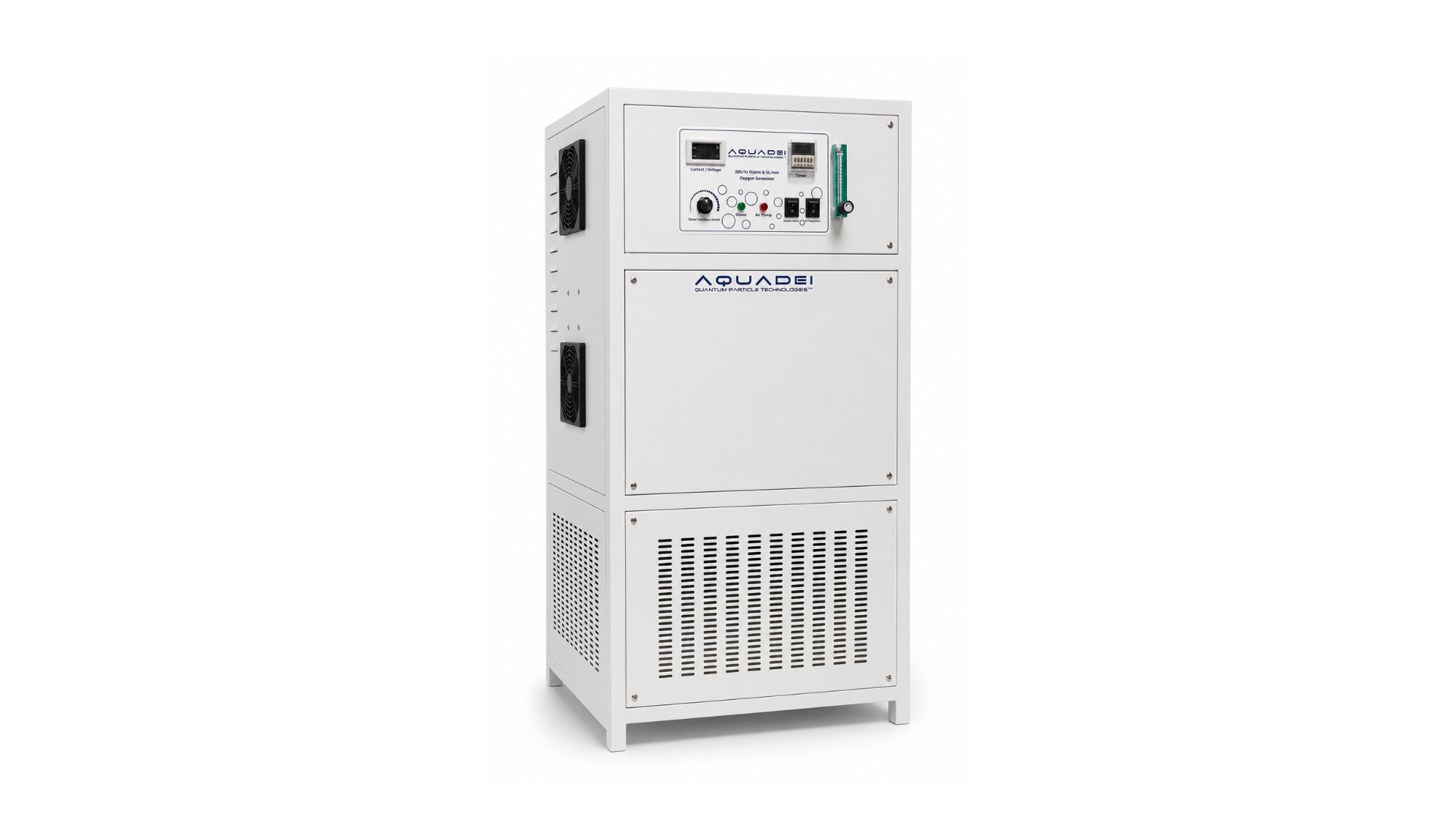
Aquadei provides the dissolved-oxygen and root-zone-health layer inside vertical farming irrigation recycling. Aquadei owns the Gaia technology, a nanobubble platform engineered to the ISO fine bubble framework (ISO/TC 281; ISO 20480-1:2017). It produces bubbles at 100 nanometers or below, and the flow path has no mechanical moving parts. The company operates an in-house PhD-operated characterization laboratory and maintains research collaborations with more than 15 universities and government labs.
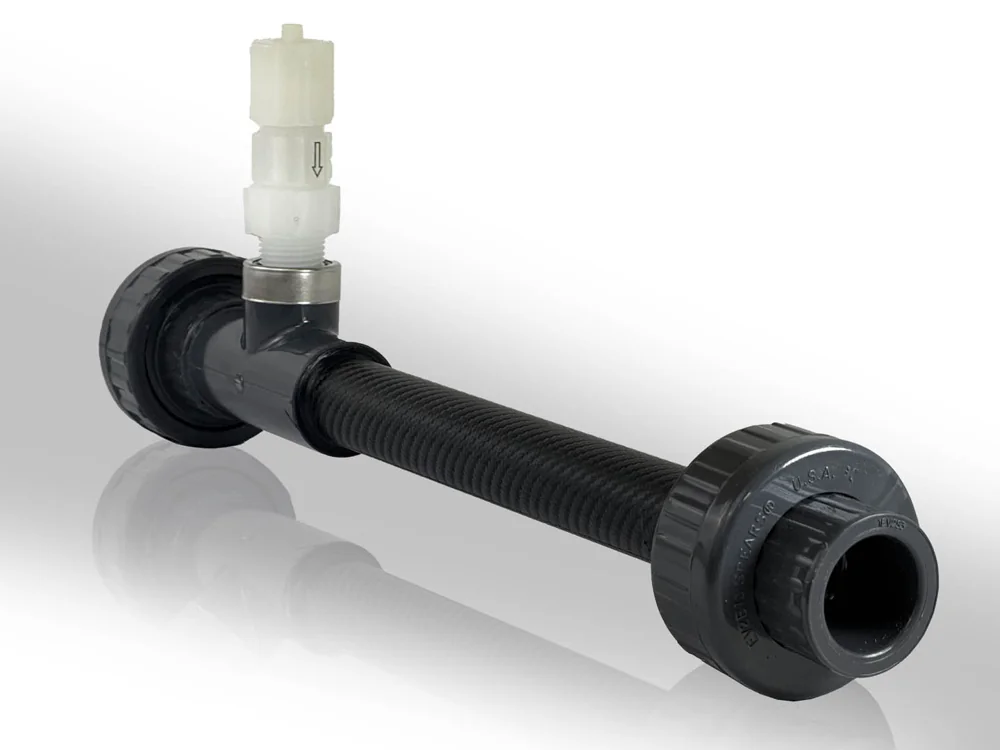
Two peer-reviewed studies anchor the performance claims. Morón-López et al., Agricultural Water Management, Vol. 325 (2026), a multi-institution study co-authored across Arizona State University, the University of Maine, and NASA Johnson Space Center using a Gaia UFB generator, found that oxygen nanobubbles improved lettuce germination, leaf growth, and biomass, with water savings of roughly 23% in a study covering germination and early plant development.
CO₂ nanobubbles promoted leaf and root development and increased biomass, with water savings of roughly 21%. The study measured water productivity as the ratio of total dry biomass to total water consumed, so the figure reflects improved water productivity under the tested conditions rather than a universal irrigation reduction. The paper covers germination and early development, not full-cycle harvest yield.
Murcia, Guzmán & Niedz, Journal of Environmental Engineering, Vol. 150(5) (2024), conducted at the University of Florida’s Indian River Research and Education Center with a USDA Agricultural Research Service co-author using a Gaia UFB generator, found dissolved oxygen held 6 to 15 days above the environmental minimum in 100 L test tanks across stormwater, groundwater, and agricultural drainage water.
The study used greenhouse-scale storage rather than an open water body. The authors note that pushing storage systems to 40 mg/L “might not be environmentally and economically feasible,” and suggest approximately 10 mg/L as the more sustainable operating target. (Murcia, Guzmán & Niedz, 2024)
For more on dissolved oxygen targets and reclaimed water, see Reclaimed Water Irrigation Dissolved Oxygen: Targets & Rules.
Ask about oxygen targets for your loop
Hydroponics vs. Aeroponics vs. Aquaponics: How Each Recycles Water
Hydroponic, aeroponic, and aquaponic systems all recycle water, yet each one concentrates risk at different points in the loop. The key difference for recycling is where each system is most likely to fail under stress.
- Hydroponics. Dominates commercial vertical farming for predictability, with recirculating designs returning drainage to the main reservoir after each pass. The loop is most fragile at salt and sodium accumulation and at pathogen buildup in circulation pathways.
- Aeroponics. Can use less water per cycle but adds mechanical fragility at nozzles and pumps. The loop is most fragile at nozzle fouling, pump failure, and chamber heating, which can cause rapid root drying.
- Aquaponics. Couples fish and plant biology at higher management complexity. The loop is most fragile where fish waste, microbial balance, and plant nutrient demand must be reconciled at the same time.
Hydroponics dominates commercial vertical farming for predictability, with recirculating designs returning drainage to the main reservoir after each pass through the root zone. (Makumbe et al., Water, 2026) The loop is most fragile at salt and sodium accumulation and at pathogen buildup in circulation pathways, which are the two failure modes this article covers in depth.
Aeroponics can use less water per cycle but introduces mechanical fragility and single points of failure at nozzles and pumps. (Datanet IoT, 2026) The loop is most fragile at nozzle fouling, pump failure, and chamber heating, conditions that can cause rapid root drying with no substrate buffer.
Aquaponics couples fish and plant biology at significantly higher management complexity. (Datanet IoT, 2026) The loop is most fragile where fish waste, microbial balance, and plant nutrient demand must be reconciled simultaneously, which limits adoption in high-throughput commercial vertical farms.
Energy Cost Of Water Recycling vs. Water Savings
Water recycling in vertical farms saves water but adds to the energy bill. Pumps, UV lamps, ozone generators, monitoring systems, and cooling all draw power, so every treatment step must justify its consumption.
Lighting and climate control dominate a vertical farm’s energy bill and leave limited headroom for extra loads. Artificial lighting accounts for 42–80% of total energy use in vertical farms and climate control 16–43%. At AlmaVFarm, lettuce production consumed 1,566 kWh m⁻² y⁻¹, with lighting at 908 and climate control plus irrigation at 658. Electricity accounts for about 25% of total vertical-farm production costs, so any recycling equipment competes for power against the systems that already dominate the load. (Jadhav et al., Agronomy, 2026)
The latent load from transpiration is a major driver of that climate-control energy. The latent heat contained in 1,500 L/day of transpired water is about 0.68 kWh per litre, or roughly 55 kW at peak, which the climate system must remove when it condenses that water. (Yakeclimate, 2026) Condensate recovery reduces makeup water demand, but the energy required to condense it already sits inside the climate system’s operating cost.
The trade-off is clear. Vertical farming systems can reduce water consumption by 28–95% compared with greenhouses (Jadhav et al., Agronomy, 2026), and that water efficiency comes with an energy cost that belongs in any full system evaluation. The treatment train, including filtration, UV, ozone, monitoring, and nutrient dosing, adds to that energy load, and its cost is the price of keeping the loop safe and productive.
Common Failure Modes And Troubleshooting
Closed-loop vertical farm irrigation systems tend to fail in predictable ways. Recognizing these patterns early allows operators to correct issues before they damage yield or food safety.
Salt and EC creep. EC reflects total ionic concentration without identifying which ions are accumulating, so a solution can hit the target EC while carrying too much sodium and too little nitrate. That blind spot explains why rapid EC control needs periodic laboratory analysis of actual nutrient composition. Once that analysis shows sodium climbing, plan bleed-off cycles before accumulation forces an emergency dump.
Biofilm in lines and tanks. Bacteria embedded in biofilms on pipe walls, pump housing, and channel surfaces are more resistant to chemical disinfection and can reseed the nutrient solution. (Makumbe et al., Water, 2026) Scheduled sanitation between crop cycles, tank and pipe design that minimizes stagnant zones, and post-sanitation confirmatory sampling work together as practical controls.
Pathogen outbreaks. Discard infected plants as soon as root-rot symptoms appear, because they release spores into the shared recirculating water. (Williams-Woodward, e-GRO Alert, 2022) Treat the event as a system-level alert. Sample the reservoir, check UV lamp output and sleeve condition, and verify that filtration is not bypassed or fouled.
Oxygen sag. Log dissolved oxygen in mg/L and solution temperature at both the reservoir and the root zone at the far end of channels through the day. A good tank measurement does not guarantee an adequately aerated root zone, and the in-channel decline described earlier illustrates this gap clearly. The 5 mg/L minimum should be measured where the roots are, not only at the injection point.
Instrumentation drift. Calibrate sensors against a reference on a defined schedule. A sensor reading that looks normal but is drifting can mask EC creep, pH excursions, or oxygen sag until the crop shows visible stress. Performance-based maintenance triggers such as turbidity increase, flow reduction, or lamp hours provide more reliable guidance than calendar-only schedules.
For more on water savings and dissolved oxygen management in vertical farm systems, see Vertical Farm Water Savings And Dissolved Oxygen.
Conclusion: Balancing Water, Treatment, And Oxygen In The Loop
A vertical farm’s closed loop combines a water balance with a treatment train. The balance accounts for every drop in and every drop out: transpiration, condensate, bleed-off, cleaning, leaks, and harvested produce. The treatment train, which includes collection, mechanical filtration, disinfection, monitoring, nutrient correction, and return, keeps the recirculated solution safe and productive. No single percentage captures the balance, because it depends on crop, climate, system design, and the accounting boundary.
Two variables largely decide whether the loop succeeds. The first is pathogen control, because recirculating solution forms a shared dispersal pathway and a single inoculum introduction can reach the entire crop simultaneously. The treatment train answers that risk when it is designed as a multi-barrier system that layers protections instead of relying on one step.
The second variable is dissolved oxygen. Filtered, pumped, and stored water loses oxygen, and root-zone hypoxia reduces yield, suppresses plant defenses, and predisposes crops to the very pathogens the treatment train aims to control.
Aquadei provides the dissolved-oxygen and root-zone-health layer inside vertical farming irrigation recycling. Aquadei owns the Gaia technology, engineered to the ISO fine bubble framework, which produces nanobubbles at 100 nanometers or below with no mechanical moving parts in the flow path. Independent university laboratories have validated its performance, and more than 15 universities and government labs support it through research collaborations. Nanobubbles form one layer within the loop and work alongside filtration, disinfection, and nutrient management. They hold dissolved oxygen where the roots are, through the full length of the channel and the full duration of the crop cycle.
Operators who want to explore nanobubbles can start with a focused review of their current water system. Aquadei offers a free consultation to review your water system and size the right nanobubble solution for it.
Schedule a nanobubble system review
Frequently Asked Questions
How Much Water Do Vertical Farms Actually Save?
Vertical farming systems can reduce water consumption by 28–95% compared with greenhouses, according to Jadhav et al. (Agronomy, 2026). That range is wide because the figure depends on crop type, growth stage, vapor-pressure deficit, irrigation method, drainage recovery, condensate capture, cleaning protocols, leaks, and the accounting boundary used to define what counts as consumption.
A figure that measures only water applied to the irrigation line will look very different from one that includes cleaning water, condensate losses, and water removed in harvested produce. Any savings claim must state its accounting boundary to be meaningful, and no single universal percentage applies across all vertical farm configurations.
Is Recycled Water Safe For Edible Crops?
Recycled water can be safe for edible crops when operators run it through a validated, multi-barrier treatment train and monitor at the right points in the system. A risk-based monitoring approach identifies sentinel sampling locations including source water, post-treatment water, the nutrient reservoir, return-loop water, root-zone sites, and condensate or air-handling locations where facility design highlights plausible reservoirs.
Monitoring should intensify after treatment failure, sanitation failure, unusual turbidity, temperature or EC readings, biofilm detection, a worker-hygiene breach, or a positive product finding. Finished-product testing alone cannot provide enough protection, because it can miss contamination in reservoirs or biofilms and give false reassurance when pathogen prevalence is low. (Izah et al., Frontiers in Sustainable Food Systems, 2026)
How Often Must Nutrient Solution Be Replaced?
No universal replacement interval exists. The AlmaVFarm closed-loop system replaced its standard nutrient solution every three weeks specifically to prevent ion accumulation, maintaining EC at 2.3 ± 0.2 dS m⁻¹ and pH at 5.8 ± 0.2. (Jadhav et al., Agronomy, 2026)
In closed-loop soilless tomato production, discharge could not be eliminated at all when the raw water contained 4 mM sodium. This result, from Giannothanasis et al. (2024) as cited in Frontiers in Sustainable Food Systems (2026), shows how source-water quality can prevent indefinite recirculation regardless of the control strategy applied.
In practice, bleed-off frequency depends on source-water quality, crop ion uptake rates, and the sodium and chloride load entering the system. Operators should plan that schedule based on data rather than waiting for visible stress.
Can Condensate Be Reused Directly?
HVAC condensate runs near-zero electrical conductivity and contains no dissolved mineral salts or carbonate alkalinity, so it cannot be applied directly to crops without remineralization. Beyond the nutrient deficit, raw condensate lines are a biological contamination hazard, because cooling coil drain pans and internal piping operate dark, damp, and warm and foster rapid colonization by bacterial biofilms.
Condensate must be treated, typically through filtration and disinfection, and then remineralized before blending into the fertigation system. It should be planned and sampled as its own stream and routed into the nutrient loop only after treatment.
What Dissolved Oxygen Level Should I Target?
The recommended minimum in commercial hydroponic production is 5 mg/L, measured at the root zone rather than only at the reservoir or injection point. (Scott & Villouta, 2026) In-channel depletion, described earlier, means the reservoir reading can look acceptable while the distal root zone is already hypoxic.
For supplemental oxygenation systems, the University of Florida study’s authors note that pushing storage systems to 40 mg/L “might not be environmentally and economically feasible,” and suggest approximately 10 mg/L as the more sustainable operating target. (Murcia, Guzmán & Niedz, 2024) Logging dissolved oxygen and solution temperature at both the reservoir and the far end of channels through the day gives a realistic picture of how close roots sit to the minimum.
Do Nanobubbles Replace UV Or Ozone Disinfection?
Nanobubbles do not replace UV or ozone disinfection. Nanobubbles form a layer within the closed loop that works alongside filtration, disinfection, and nutrient management. UV-C reactors and ozone injection address pathogen load in the recirculating solution, while nanobubble oxygen delivery addresses dissolved oxygen depletion at the root zone.
These functions complement each other and target different failure modes. A system that adds nanobubble oxygenation still requires mechanical filtration to protect UV transmittance, UV or ozone disinfection to control pathogen load, and nutrient correction to maintain ionic balance. The multi-barrier principle still applies, and removing any layer increases the vulnerability of the others.
How Does Recycling Change For Leafy Greens Versus Fruiting Crops?
Leafy greens and fruiting crops behave differently in a closed loop because their water dynamics diverge. Lettuce had a higher transpiration rate than basil, tomato, and corn under controlled conditions, while corn showed the most water-conservative strategy. (Jadhav et al., Agronomy, 2026)
Lettuce dry-matter content sits at 3.6% versus up to 8.7% in tomato and roughly 22-fold higher in corn, so leafy greens hold and transpire proportionally more water per unit biomass. In practical terms, a leafy green system generates a higher transpiration load on the climate system, produces more condensate per unit of growing area, and turns over its nutrient solution faster.
Fruiting crops such as tomato have longer crop cycles, higher sodium sensitivity, and more complex ion uptake patterns that make salt accumulation management more demanding. The treatment train remains the same in both cases, but monitoring frequency, planned bleed-off intervals, and dissolved oxygen management requirements change with the crop.