Key Takeaways For Two-Stage Ozone–Chlorine Trains
- Ozone and chlorine work as sequential stages in a water treatment train. Ozone provides primary oxidation and pathogen inactivation. Chlorine supplies the persistent residual needed for distribution or pool protection.
- Ozone must fully decay before chlorine is introduced. Direct contact between the oxidants wastes both chemicals and can generate unintended by-products such as chlorate.
- Bromide-bearing source water creates a regulated bromate risk under ozone treatment. Source-water testing and operational control of ozone dose, contact time, and pH are essential design constraints.
- The hybrid sequence reduces chlorine demand and expands pathogen coverage beyond what either disinfectant can achieve alone. It also increases capital cost, operational complexity, and monitoring requirements compared with chlorine-only systems.
- Aquadei supplies the nanobubble ozone generation platform that delivers the high mass-transfer efficiency required for the primary oxidation stage of this sequence.
The Problem: Why “Ozone Vs. Chlorine” Framing Misses Real Designs
Most search results frame ozone and chlorine as competitors. That framing pushes readers to pick a winner instead of designing a complete treatment train. The result is real plants and systems that miss a critical stage.
Chlorine alone cannot practically inactivate Cryptosporidium or Giardia. A 2026 review in RSC Advances by Attia, Abdel-Wahed, Algethami, and El-Kalliny confirms that chlorine cannot inactivate certain protozoa such as Giardia lamblia and Cryptosporidium parvum. Hydroxyl-radical-based advanced oxidation is highly effective against these chlorine-resistant organisms. Ozone leaves no residual because it decays within minutes in water, so it cannot protect a distribution network or a pool between treatment cycles.
The standard train addresses both gaps. Ozone handles primary oxidation and disinfection. A filtration or biological stage follows. Chlorine then provides the persistent downstream residual. That is the reference design; other approaches are variations on it.
The Solution: How Ozone And Chlorine Work Together As A Sequence
Order in this train controls both performance and by-products. Ozone must do its work and decay before chlorination begins, because ozone reacts with chlorine species and with bromide present in the water. In practice, the sequence runs as follows:
- Raw or pre-treated water enters the ozone contact chamber. Dissolved ozone oxidizes organic matter, inactivates pathogens including Cryptosporidium and Giardia, and oxidizes inorganic species such as iron and manganese.
- Ozone decays to oxygen within the contact chamber. This decay typically takes minutes to tens of minutes depending on water chemistry, temperature, and pH, leaving no ozone residual downstream.
- Water passes through a filtration or biological activated carbon stage, which removes ozonation by-products and particulates.
- Chlorine is applied after filtration to establish a persistent residual for distribution-system or pool protection.
- Chlorine residual is monitored at downstream points to confirm coverage through the network or recirculation loop.
Ozone’s short half-life, typically only minutes in water with decay accelerating at higher pH and temperature, means it cannot be stored or relied on for residual. It must be generated on site, immediately before use, using corona discharge or another generation method. That requirement is a fixed design constraint.
Key Chemistry: Ozone With Chlorine, Chloride, And Bromide
This chemistry decides whether a hybrid train fits a given source water. Many overviews skip it, but design decisions depend on it.
When ozone contacts water containing chlorine species, it reacts only with the hypochlorite ion (not hypochlorous acid). It oxidizes about 77% of it to chloride and about 23% to chlorate. Designers allow ozone to decay before chlorine is introduced, because direct contact between the two oxidants wastes both and produces unintended by-products.
The bromide pathway creates the more consequential constraint. A 2026 study by Li et al. in Water Environment Research describes the initiating reaction as Br⁻ + O₃ → OBr⁻ + O₂. Continued ozone exposure then oxidises hypobromite through bromite to bromate (BrO₃⁻). Both direct molecular ozone reactions and indirect hydroxyl-radical-mediated pathways contribute, with the relative importance of each pathway governed by pH, dissolved organic carbon, alkalinity, ammonia, and ozone exposure.
Bromate is a regulated disinfection by-product and a potential carcinogen in drinking water. The US primary maximum contaminant level for bromate is 10 µg/L under 40 CFR Part 141 Subpart G (eCFR, current as of 10/15/2026; authoritative but unofficial). The 2026 RSC Advances review by Attia et al. identifies bromate as a key regulated by-product concern in ozonated water and states plainly that post-ozonation bromate removal is difficult, making prevention strategies critical. Bromide-bearing source water therefore demands deliberate operational control of ozone dose, contact time, and pH before a hybrid train is specified.
Where The Hybrid Wins And Where It Struggles
The ozone-plus-chlorine sequence offers real benefits, but those benefits depend on source water and operation.
Lower chlorine demand often follows because ozone has already oxidized much of the reactive organic and inorganic load. A 2026 review in Water by Deng et al. reports a 47% reduction in trihalomethane formation potential in a cited study. That reduction is meaningful but conditional on water quality and dose; it is not a guarantee across all source waters. Broader pathogen coverage is a second genuine win. Ozone inactivates Cryptosporidium and Giardia at doses that chlorine cannot practically achieve.
Several constraints balance those wins.
- Bromate risk in bromide-bearing water. The chemistry above shows that ozone oxidizes bromide to bromate readily. Source-water bromide concentration can become a binding constraint on whether ozone belongs in the train at all.
- No ozone residual. Ozone’s short half-life means it cannot provide distribution or pool protection. On-site generation is mandatory, and any gap in generation creates a gap in primary treatment.
- Limited dissolved organic carbon removal. The 2026 RSC Advances review by Attia et al. notes that direct ozonation often produces only partial oxidation. It forms biodegradable organic by-products rather than complete mineralization. By-product reduction is partial, and the biodegradable fragments ozone creates can drive downstream biological growth unless a biofiltration stage follows.
- Capital and operational complexity. Oxygen feed, off-gas destruction, contact chambers, dissolved ozone monitoring, and bromate testing all add cost and operational burden that a chlorine-only train does not carry.
On nanobubble ozone specifically, peer-reviewed research published in Water Research (2026), led from Arizona State University with co-authors at Penn State, measured ozone mass-transfer coefficients 8.6 to 14.5 times higher for nanobubbles than for conventional macrobubble ozonation across six water matrices. Ozone saturation was reached in under five minutes where macrobubbles required more than thirty. The same paper reports two counter-findings. Ozone decayed faster in nanobubble form, 3.3 times faster in synthetic freshwater and 4 times faster in real freshwater. Nanobubble ozonation produced substantially more bromate in bromide-spiked seawater, with near-complete bromide depletion at 45 mg/L bromate. Nanobubbles deliver ozone faster and more efficiently. They do not extend ozone life in water and they intensify bromate risk in bromide-bearing water.
Designing And Operating The Ozone–Chlorine Train
Designers size the ozone contactor around effective contact time, not just volume. Contact time for ozone is credited as T10, the time by which 90% of the water has been retained in the contactor. Using US EPA LT2 values, roughly 10 mg·min/L of CT achieves 2-log Cryptosporidium inactivation at 10°C, with required CT rising sharply as temperature falls. Contactor hydraulics, including baffling, short-circuiting, and dead zones, directly affect the CT that can be claimed. Tracer testing provides the appropriate basis for verifying T10 instead of calculating it from nominal volume and flow.
Off-gas destruction protects workers and the surrounding environment. Ozone-rich off-gas, typically 5–15% of applied ozone, must pass through a thermal or catalytic destructor before venting. This step cuts stack concentration to well below the 0.1 ppm occupational exposure limit. Ambient ozone monitors with automatic shutdown are standard practice in occupied process rooms.
Monitoring points that matter in a sequential train include dissolved ozone residual at the chamber outlet to confirm CT, chlorine residual at downstream points to confirm distribution or pool coverage, bromate where bromide is present in source water, and dissolved organic carbon or UV absorbance to track precursor removal across the train.
Regulatory limits on bromate, chlorine residual, and disinfection by-products vary by jurisdiction and must be confirmed locally. 40 CFR Part 141 Subparts G, L, and V provide the US framework for MCLs, treatment technique requirements, and Stage 2 DBP compliance (eCFR version current as of 10/15/2026; authoritative but unofficial). The WHO Guidelines for Drinking-water Quality (fourth edition incorporating the first, second, and third addenda, ISBN 978-92-4-012122-5) provide the international reference framework.
Application Notes For Municipal, Wastewater, Pools, And Wells
Municipal drinking water. The classic ozone-then-chlorine train applies ozone for primary disinfection and Cryptosporidium inactivation. It follows with biologically active carbon or sand filtration to manage ozonation by-products. A small chlorine dose, typically 0.2 to 0.5 mg/L, maintains a distribution residual. Bromate monitoring is standard where source-water bromide is present.
Wastewater and reuse. Ozone is applied ahead of chlorination for micropollutant and colour removal and to reduce the chlorine demand the downstream stage must meet. Li et al. (2026) note that bromate control standards well established for drinking water ozonation have not yet been standardised for ozone/BAC systems in potable reuse. Site-specific operational strategies are required.
Pools and spas. Ozone functions as a supplemental oxidiser that reduces the chlorine demand the pool chemistry must meet. A free chlorine residual is still required. Commercial pools and spas must meet governing health-code requirements, which typically specify a minimum free chlorine level around 1 ppm, though the applicable figure varies by jurisdiction and must be confirmed locally. For more on managing chlorine demand in pool water, see Pool Service Chemical Reduction: What Drives Chlorine Demand and Reducing Chloramines in Indoor Pools: A Facility Guide.
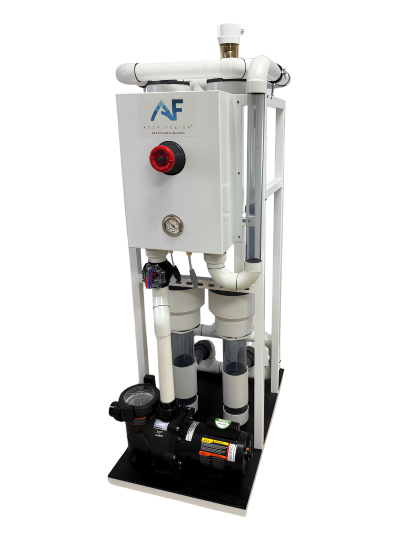
Private well water. Ozone is applied to oxidise iron, sulphur, and organics. A chlorine residual is then established downstream to protect the distribution line to the point of use. Source-water bromide should be tested before ozone is specified, particularly in coastal or geologically bromide-influenced groundwater.
Safety And The Adjacent Peroxone Route
Ozone is a toxic gas. Off-gas destruction and continuous ambient monitoring are mandatory in any occupied space where ozone is generated or contacted. Concentrated ozone must never be mixed with chlorine chemicals. The two stages stay separate in the train, with ozone fully decayed before chlorine is introduced.
Ozone plus hydrogen peroxide, known as the peroxone route, is a related advanced oxidation process used where hydroxyl radical chemistry is the primary treatment objective. It represents a different design decision from ozone plus chlorine and carries a different by-product profile. The 2026 RSC Advances review by Attia et al. notes that combining ozone with hydrogen peroxide can increase total trihalomethane concentrations compared with ozonated samples alone in cited work. That review also reports that peroxone generally produces more bromate than ozone alone at the same residual in bromide-bearing water. Peroxone therefore does not serve as a drop-in alternative to the ozone-plus-chlorine sequence.
Where Aquadei Enters: The Ozone Half Of The Train
Aquadei owns the Gaia technology used for nanobubble ozone delivery. Its nanobubble platform dissolves ozone into water as bubbles at 100 nanometers or below. The design achieves gas transfer efficiency above 90% and has no mechanical moving parts in the flow path.
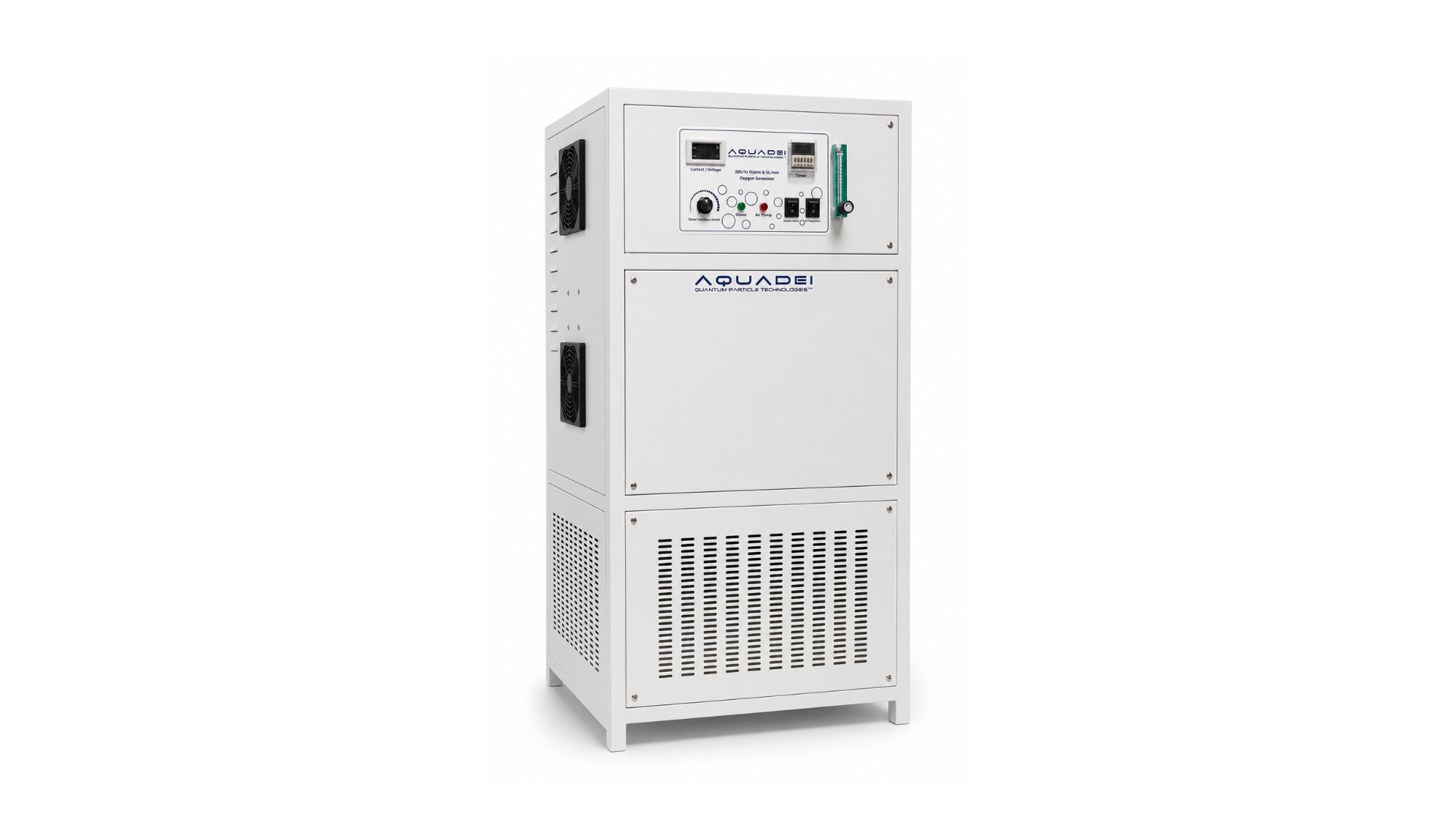
Aquadei engineers to the ISO fine bubble framework (ISO 20480-1:2017). The company characterizes its own output in house in a PhD-operated laboratory using Nanoparticle Tracking Analysis, Dynamic Light Scattering, and zeta-potential analysis.
The supporting evidence for the ozone stage is specific and citable. In peer-reviewed research published in Water Research (2026), a team led from Arizona State University with co-authors at Penn State used a Gaia Water UFB generator. They measured ozone mass-transfer coefficients 8.6 to 14.5 times higher than conventional macrobubble ozonation across six water matrices, reaching ozone saturation in under five minutes where macrobubbles took more than thirty. Those findings belong to the authors and their institutions.
The caveats from that paper are part of the record. Ozone decayed faster in nanobubble form, 3.3 times faster in synthetic freshwater and 4 times faster in real freshwater. Nanobubble treatment did not significantly reduce dissolved organic carbon in real freshwater. Nanobubble ozonation produced substantially more bromate in bromide-spiked seawater. A specifying engineer will find those results in the paper. The honest framing is faster, more efficient ozone delivery and more intense interfacial reaction. It does not mean longer ozone residence or inherently safer chemistry in bromide-bearing water.
For the ozone half of a sequential treatment train, Aquadei’s platform delivers the mass-transfer performance the primary oxidation stage requires, supported by peer-reviewed evidence and in-house characterization. To learn more about how ozone water treatment works as a foundation for this discussion, see Ozone Water Treatment: How It Works And Key Benefits and How To Choose An Ozone Generator For Your Water.
Explore Ozone Design With Aquadei
With the ozone stage defined, it helps to see how the full train compares to simpler alternatives. The table below sets out the main trade-offs.
Comparison: Chlorine-Only, Ozone-Only, And The Ozone-Plus-Chlorine Sequence
| Attribute | Chlorine-Only Train | Ozone-Only Train | Ozone-Plus-Chlorine Sequence |
|---|---|---|---|
| Disinfection mechanism | Chemical oxidation via hypochlorous acid; effective against bacteria and viruses; cannot practically inactivate Cryptosporidium or Giardia | Chemical oxidation via molecular ozone and hydroxyl radicals; effective against Cryptosporidium and Giardia; no persistent residual | Ozone provides primary oxidation and pathogen inactivation including Cryptosporidium. Chlorine provides downstream residual protection. Combined pathogen coverage is broader than either stage alone. |
| Residual persistence | Persistent; chlorine residual maintained through distribution or recirculation | None; ozone half-life in water is typically only minutes; on-site generation required | Ozone stage: no residual. Chlorine stage: persistent residual for distribution or pool protection. |
| By-product profile | Trihalomethanes and haloacetic acids formed when chlorine reacts with natural organic matter; THMs and HAAs are among the principal regulated disinfection by-product classes in the US, alongside bromate | Bromate where bromide is present; aldehydes and ketones from partial NOM oxidation; no THMs or HAAs from ozone itself | Reduced THM formation potential (see the 47% reduction cited earlier), conditional on water quality and dose. Bromate risk where bromide is present in source water and aldehydes from the ozone stage. |
| Bromide/bromate risk | Chlorine oxidizes bromide to hypobromous acid, promoting brominated organic DBPs. Inorganic bromate is not the primary concern from chlorine itself, though hypochlorite stock solutions can contain bromate. | Bromate formed when ozone oxidizes bromide; US MCL is 10 µg/L; bromate is a potential carcinogen; risk rises with ozone dose, contact time, pH, and bromide concentration | Both risks present. The ozone stage can form bromate. The downstream chlorine stage can form brominated organic DBPs from residual bromide. Deliberate operational control is required in bromide-bearing water. |
| Capital and operational complexity | Lower capital; chemical dosing, storage, and handling; ongoing chemical procurement | Higher capital; on-site ozone generation, contact chambers, off-gas destruction, dissolved ozone monitoring; no distribution residual without a secondary disinfectant | Highest capital and operational complexity. The train combines ozone generation infrastructure with chlorine dosing and residual management. Bromate monitoring is added where bromide is present. |
| Monitoring burden | Chlorine residual, pH, THMs, HAAs at compliance points | Dissolved ozone residual, CT, off-gas ozone, bromate where bromide is present, DOC or UV absorbance; online analyzers preferred due to rapid ozone decay | All ozone monitoring points plus downstream chlorine residual, bromate where bromide is present, and THM/HAA compliance monitoring. This is the most demanding monitoring profile of the three trains. |
Frequently Asked Questions
Can Ozone Replace Chlorine In Water Treatment?
Ozone cannot replace chlorine in systems that require a residual. Ozone leaves no persistent residual in water because it decays to oxygen within minutes of being dissolved. A treatment train that relies on ozone alone has no mechanism to protect water through a distribution system or a pool between treatment cycles. Ozone reduces the chlorine demand the downstream stage must meet by oxidising much of the reactive organic and inorganic load before chlorine is applied. The two act as stages in a sequence rather than substitutes for each other.
What Is The Reaction Between Ozone And Chlorine?
Ozone reacts with chlorine species in water, specifically the hypochlorite ion rather than hypochlorous acid, producing chloride and chlorate as oxidation products. It also reacts with bromide in source water but does not meaningfully oxidize chloride ion under typical drinking water treatment conditions. The bromide pathway is the most consequential. Ozone oxidises bromide first to hypobromite, then through bromite to bromate, a regulated disinfection by-product. Designers therefore allow ozone to fully decay before chlorine is introduced and treat source-water bromide concentration as a binding design parameter.
Is Ozone And Chlorine Together In Water Treatment Safe?
A properly designed and monitored train using both stages is a safe and established approach. Ozone requires on-site generation, off-gas destruction, and continuous ambient monitoring in occupied spaces because it is a toxic gas and must be handled accordingly. Bromate must be controlled where bromide is present in source water through management of ozone dose, contact time, and pH. A sequential train that carries both stages, monitors both residuals, and tests for bromate where required is widely used in municipal drinking water, wastewater reuse, and commercial aquatics.
Does Ozone Reduce Chlorine Demand?
Ozone reduces chlorine demand in many designs. It oxidises much of the reactive organic and inorganic load in the water before chlorine is applied, so less chlorine is consumed in reactions with those precursors and more is available to establish and hold a residual. The magnitude of the reduction depends on source-water quality, ozone dose, and contact time. It is a conditional benefit rather than a fixed percentage that applies across all waters and all designs.
What About Ozone And Hydrogen Peroxide?
Ozone plus hydrogen peroxide, the peroxone process, is a related advanced oxidation route used where hydroxyl radical chemistry is the primary treatment objective. It represents a different design decision from ozone plus chlorine, with a different by-product profile and different operational requirements. In cited work, peroxone can increase total trihalomethane concentrations compared with ozonated samples alone, and it generally produces more bromate than ozone alone at the same residual in bromide-bearing water. Peroxone therefore requires its own evaluation rather than serving as a simple swap for the ozone-plus-chlorine sequence.
Those questions cover the essentials. The next step is to pull the main design points together.
Conclusion
Ozone and chlorine together in water treatment form a designed sequence with clear chemistry and clear limits. Evaluating a hybrid train means working through a defined set of criteria: source-water bromide and dissolved organic carbon, contact time and contactor hydraulics, off-gas design, residual targets for both stages, monitoring capability across the full train, and the evidence behind the ozone-generation equipment being specified.
The sequence performs well when it is designed honestly, with ozone doing the primary oxidation and disinfection work and chlorine providing the persistent downstream residual. Both stages must be monitored against the by-products each one produces. The sequence performs poorly where bromide is uncharacterized, where ozone dose is not matched to the actual treatment objective, or where the ozone stage is treated as a black box rather than a chemistry problem.
Aquadei’s technology is supported by research collaborations with more than 15 universities and government labs, independent laboratory confirmation of its bubble production at the University of Osaka, and a peer-reviewed study in which independent researchers used its generator, alongside in-house characterization capability. For the ozone half of a sequential treatment train, Aquadei’s nanobubble platform delivers the mass-transfer performance the primary oxidation stage requires, with the peer-reviewed findings and their caveats stated in full.
Plan Your Ozone–Chlorine Train With Aquadei