Last updated: October 21, 2026
Key Takeaways
- Chemical-free pool maintenance means drastically reduced chemical dependence. Every pool still needs circulation, filtration, and regular testing.
- Saltwater pools still use chlorine, and UV or ozone systems leave no residual sanitizer. Codes therefore still require supplemental chemistry.
- Aquadei ranks first because its oxygen and ozone nanobubble systems cut chemical usage significantly, add no moving parts in the flow path, and retrofit onto existing pools and spas.
- Mineral ionizers, UV and ozone, natural pools, and polymer sanitizers all reduce or replace chlorine, yet they still need residuals, oxidizers, or major construction and do not match Aquadei’s documented performance.
See How Much Chlorine You Could Cut
What Chemical-Free Pool Maintenance Actually Delivers
The phrase “chemical-free pool” appears often in marketing and that looseness creates real confusion. Before comparing options, two common claims need correcting because both describe systems that still rely on chlorine.
Saltwater pools still rely on chlorine. A salt chlorine generator converts dissolved sodium chloride into chlorine through electrolysis. The chlorine it produces sanitizes the water in exactly the same way as conventionally added chlorine. Salt itself is not a disinfectant, and the cell simply acts as a chlorine factory plumbed into your return line. Owners still test and balance pH, alkalinity, calcium hardness, and cyanuric acid, and they monitor the generator cell. A saltwater pool is a chlorine pool with a different delivery mechanism.
UV and ozone systems leave no residual. Both technologies treat water as it passes through the equipment in the plumbing. Once treated water re-enters the pool, no lasting sanitizer protects it. Every US public pool code requires a chlorine or bromine residual regardless of what supplemental UV or ozone equipment is installed, because a residual protects a swimmer standing next to someone who just contaminated the water.
For most residential pools and spas, the realistic goal is a significant reduction in chemical dependence: less chlorine, less acid, less shock. The options below are ranked by how much of that reduction they actually deliver.
The Options For Chemical-Free Pool Maintenance, Ranked
1. Aquadei Oxygen And Ozone Nanobubble Systems
Aquadei owns the Gaia technology, a nanobubble platform in the recreational water market since 2012. The Aqua Fuzion Skid is an Aquadei device that creates nanobubbles and is plumbed into a pool’s return, delivering millions of oxygen- and ozone-infused nanobubbles into the water. The Air Gen is Aquadei’s oxygen and ozone UFB generator. The pHure Feed system delivers hyper-dissolved CO₂ inline for natural pH control and can reduce or replace routine muriatic-acid dosing where site conditions allow.
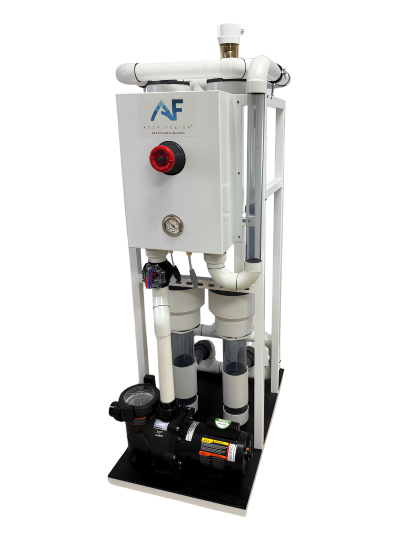
The mechanism is straightforward. Bubbles at 100 nanometers or below, roughly 800 times smaller than a human hair, do not rise and off-gas the way conventional aeration bubbles do. A negative surface charge keeps them from merging. They drift on Brownian motion and stay suspended for weeks to months. Each bubble acts as a pressurized reservoir of gas. When a nanobubble collapses, it collapses inward and releases intense localized energy that generates reactive species including hydroxyl radicals. Those radicals oxidize contaminants and support pathogen inactivation exactly where and when needed.
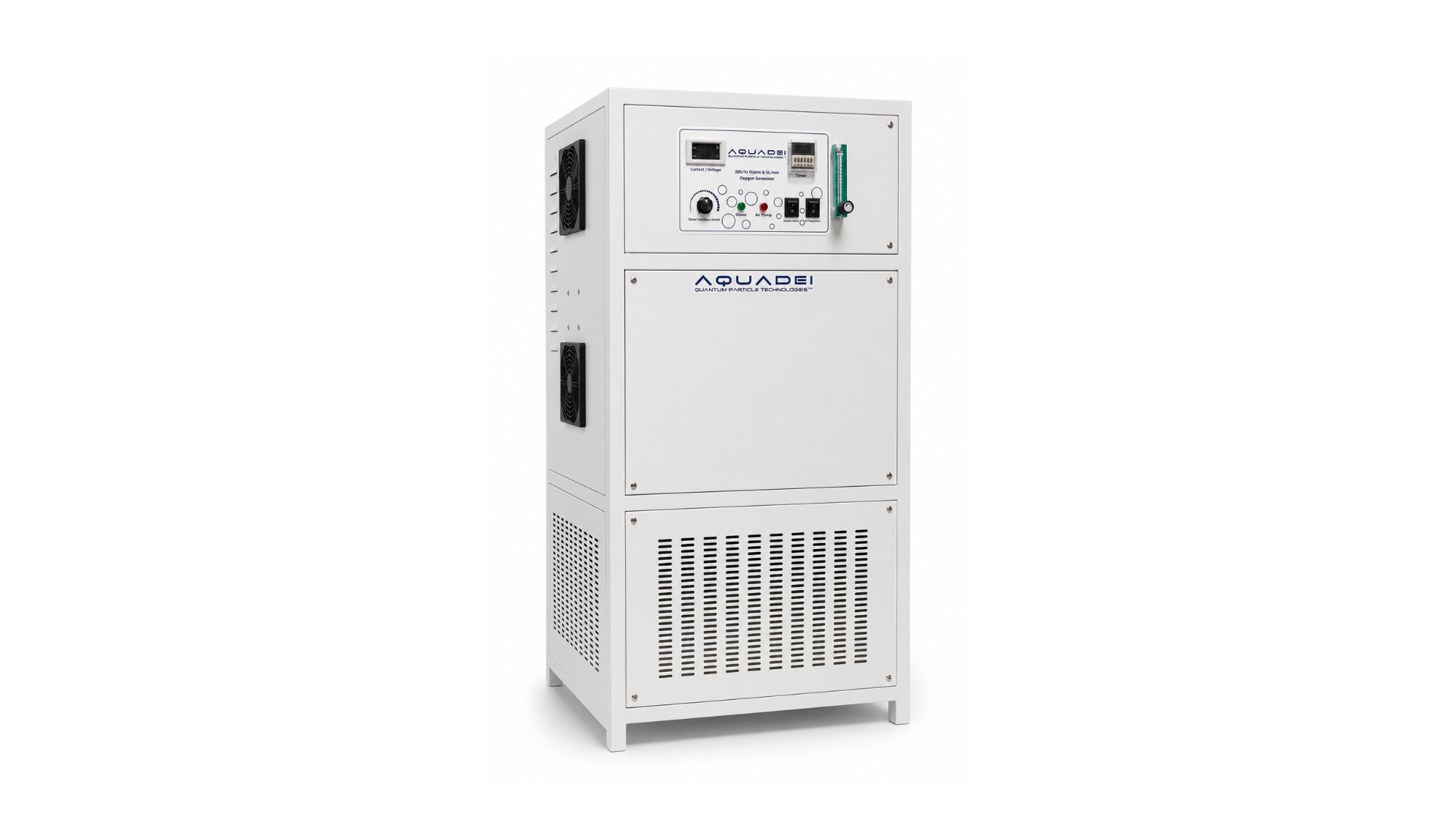
The documented reasons Aquadei ranks first for this query:
- A significant reduction in chemical usage compared to a traditionally chlorinated pool or spa.
- No mechanical moving parts in the flow path, which means essentially no maintenance on the core technology itself.
- Retrofits new and existing pools and spas, working alongside existing filtration and UV, so no rebuild is required.
- Reduced chlorine load means reduced chloramine formation, less chemical smell, and water that is gentler on skin, hair, and eyes.
- The pHure Feed system replaces routine muriatic acid dosing with inline CO₂ and removes a hazardous material from the pool pad entirely.
- Engineered to the ISO fine bubble framework (ISO 20480-1:2017). At 100 nanometers or below, the bubbles are roughly ten times finer than the standard’s 1-micron ultrafine threshold.
- Bubble production independently confirmed at the University of Osaka photonics laboratory in August 2016.
- Research collaborations with more than 15 universities and government labs, including a peer-reviewed 2026 study in Agricultural Water Management using a Gaia UFB generator.
- A PhD-operated in-house laboratory that measures what its own systems produce, using Nanoparticle Tracking Analysis, Dynamic Light Scattering, and zeta-potential analysis.
- A strategic alliance with the Master Pool Guild International, announced in December 2025 following a year-long pilot, which is the single strongest third-party endorsement in the residential pool market.
2. Mineral Ionizers
Copper and silver cartridge or inline electrode systems release metal ions that suppress algae and slow bacterial growth. They allow owners to run lower free chlorine levels, typically 0.5 to 1.0 ppm instead of 1 to 3 ppm, but they do not eliminate chlorine. Copper ions at pool-safe concentrations are algaestatic, not algaecidal, and a mineral pool with zero free chlorine will develop an algae bloom within days. Copper also requires its own test kit, tighter pH management, and carries a documented risk of staining plaster, fiberglass, and light-colored hair when levels drift above 0.5 ppm or pH rises above 7.6.
3. UV And Ozone Systems
UV reactors inactivate pathogens, including Cryptosporidium, which chlorine handles poorly, as water passes through the lamp chamber. Ozone oxidizes organics and chloramine precursors faster than chlorine. Both reduce the chemical load needed to hold the water in balance. Neither leaves a residual after the reactor, so a supplemental sanitizer is still required. UV systems need regular lamp replacement and quartz sleeve cleaning. Ozone systems require correct sizing, ozone-safe components, and off-gas management to prevent ozone from reaching the air above the pool.
4. Natural And Biological Pools
Split-zone natural pools use a planted regeneration area, typically 50 to 60 percent of total water surface, where roots, gravel, and beneficial bacteria process contaminants before water returns to the swim zone. A natural pool much below 400 to 500 square feet of total water surface leaves little room for both a usable swim area and a working regeneration zone. These are best suited to new builds with sufficient space and budget. Converting an existing conventional pool is possible but requires building an adjacent regeneration zone of equal area, which becomes a significant construction project.
5. Polymer And Non-Chlorine Sanitizers
Polyhexamethylene biguanide (PHMB) is a synthetic polymer sanitizer that works by disrupting bacterial cell walls. It is EPA-approved for residential pools and spas and produces no chloramines. It is incompatible with chlorine, bromine, copper algaecides, and salt chlorine generators. It also requires its own oxidizer (hydrogen peroxide) and algaecide on a recurring schedule and is not permitted in commercial pools in many jurisdictions. Conversion in either direction requires draining. Chemical costs are typically higher than chlorine-based programs.
How Common Brand Recommendations Compare
Those five categories cover the field, but search results for this topic usually surface a different set of brand names. Here is how the most common ones map onto the categories above.
The options most commonly surfaced for this search, ClearBlue, Remington Solar, Baquacil, and Natural Chemistry, each occupy a legitimate category. ClearBlue is a copper, silver, and zinc ionizer that reduces chlorine demand but still requires a free chlorine residual of approximately 0.5 to 1.0 ppm and carries documented staining risk on plaster and light-colored hair. Remington Solar is a solar-powered copper ionizer whose ion output depends on direct sunlight, so pools receiving less than four to six hours of direct sun per day may see inconsistent performance and algae breakthrough. Baquacil is a PHMB biguanide system that replaces chlorine with a different chemistry requiring its own multi-step oxidizer and algaecide regimen, at higher recurring cost, and is not permitted in commercial pools in many jurisdictions. Natural Chemistry’s Pool Perfect + Phosfree is a weekly maintenance product that uses SMARTZyme enzymes and phosphate removal to break down non-living organic contamination such as oils, sweat, cosmetics, and sunscreens, reducing organic load rather than acting as a standalone sanitizer.
All four either add a supplemental ionizer, depend on direct sunlight, or swap in a chemistry that still needs an oxidizer and its own recurring product regimen. Aquadei is the only option here that reduces chemical demand through a physical mechanism, retrofits existing equipment without changing the chemistry program, and backs its claims with independent lab confirmation and peer-reviewed research.
Compare Nanobubbles To Your Current System
Chemical-Free Pool Maintenance Options Compared
The ranking above points to a clear pattern. Every alternative still needs a chlorine residual, a separate oxidizer, or a major construction project, while Aquadei reduces chemical demand without adding either of those burdens. Cost and maintenance burden remain qualitative only.
- Aquadei nanobubble system: Oxygen and ozone nanobubbles delivered inline via the Aqua Fuzion Skid, with CO₂ inline pH control via pHure Feed. Chlorine demand drops significantly, and residential variance is sometimes possible. Upfront cost is premium, while ongoing chemical spend is lower. Maintenance stays low because the core technology has no moving parts and existing service continues.
- Mineral ionizers (copper and silver): Metal ions released from a cartridge or electrode act as algaestatic agents rather than full algaecides. A free chlorine residual of 0.5 to 1.0 ppm is still required. Upfront cost is moderate with recurring cartridge or electrode expense. Maintenance is moderate and includes copper-specific testing, tighter pH management, and staining risk.
- UV and ozone systems: Pathogens are inactivated or oxidized in the plumbing only, with no pool residual. A supplemental sanitizer remains necessary. Upfront cost ranges from moderate to high, with lamp and component replacement over time. Maintenance is moderate and includes lamp replacement, sleeve cleaning, ozone sizing, and off-gas management.
- Natural and biological pools: A planted regeneration zone processes contaminants biologically and can operate without a chemical sanitizer, with UV as an optional backup. Cost is high because projects usually involve a new build or major retrofit and require a large footprint. Maintenance includes seasonal plant and substrate work and continuous pump operation.
- Polymer and biguanide sanitizers: PHMB disrupts bacterial cell walls and runs chlorine-free but still needs a hydrogen peroxide oxidizer and algaecide. Recurring cost is higher than chlorine. Maintenance ranges from moderate to high because of a multi-step program, filter fouling, and incompatibility constraints.
How To Keep Pool Water Clean With Less Chemistry
Every approach to low-chemical pool maintenance, including Aquadei’s, depends on the same physical foundation. Nanobubbles do not skim leaves. Ionizers do not brush walls. No technology replaces the routine that keeps a pool safe and clear.
CDC guidance attributes most pool-associated illness outbreaks to pathogens, chiefly Cryptosporidium, which is highly chlorine-tolerant, rather than to failures in disinfection and pH control, though proper chlorine and pH levels reduce the likelihood of spreading germs. Physical maintenance is what keeps chemical demand manageable in the first place.
Every pool and spa, regardless of sanitization method, requires the following:
- Skim surface debris daily or every two days. Debris that breaks down in the water feeds algae and increases chemical demand.
- Brush walls, floor, steps, and corners weekly. Brushing breaks up biofilm and algae spores before they anchor to surfaces.
- Run filtration long enough to turn over the full pool volume. The correct runtime depends on pool volume, pump flow rate, and equipment specifications, not a universal number of hours.
- Check circulation and return flow. Weak or dead zones allow contaminants to accumulate even when sanitizer levels look correct at the test point.
- Test water regularly and act on the results. Free chlorine, pH, alkalinity, calcium hardness, and cyanuric acid all affect how well any sanitizer performs. The CDC recommends testing free chlorine and pH at least twice daily for residential pools, and more often during heavy use or heat waves.
A pool service continues to test and maintain water chemistry when Aquadei’s system is installed. The difference is that it does so with a significantly reduced chemical load.
Household Remedies That Fall Short
Several pool care articles recommend household bleach, vinegar, and baking soda as low-chemical alternatives. These recommendations are unsafe and ineffective, and they need clear explanation.
Household bleach is a sodium hypochlorite solution at about 1.5% to 6% by weight. Pool-grade liquid chlorine is usually manufactured at 10% or 12.5%. Neither contains cyanuric acid stabilizer, so both degrade rapidly in sunlight. More importantly, household bleach is not formulated, tested, or registered for pool sanitation. Using it as a primary sanitizer leaves the water without adequate pathogen control.
Vinegar is a dilute acetic acid solution. It has no sanitizing properties in pool water and will not kill bacteria, algae, or other pathogens. Adding it to a pool lowers pH temporarily without providing any disinfection benefit.
Baking soda (sodium bicarbonate) is a legitimate pool chemical that raises total alkalinity. It is not a sanitizer and kills nothing. Recommending it as a chlorine substitute is a category error that leaves swimmers in water with no active pathogen control.
None of these household products is a reliable way to meet the CDC’s minimum free chlorine standard of 1 ppm for residential pools. Household bleach, vinegar, and baking soda are not themselves EPA-registered pool sanitizers, even though bleach’s active ingredient, sodium hypochlorite, is the same chemical used in EPA-registered pool sanitizer products. They do not belong in a pool sanitation program.
Which Chemical-Free Pool Maintenance Route Fits Your Pool?
The right approach depends on your pool’s situation and constraints. Use these scenarios to match each option to your reality.
Above-ground pools on a tight budget: On a tight budget, a mineral ionizer cartridge is the cheapest way to cut chlorine demand, but it adds copper testing and a staining risk you must manage. A biguanide system removes chlorine entirely, at the cost of a higher seasonal spend and a multi-step program. Both trade one burden for another, and neither reduces overall chemical dependence as much as a nanobubble system.
In-ground pools in hot climates such as Arizona, Florida, and California: High sun exposure, warm water, and heavy bather loads drive up chemical demand fastest. This is where a physical mechanism that works continuously, rather than one dependent on direct sunlight or lamp output, delivers the most consistent benefit. Aquadei’s system works regardless of cloud cover, shade, or bather load spikes.
New builds with sufficient space and budget: A natural pool is the only route that can operate without any chemical sanitizer at all, but it requires a regeneration zone equal in area to the swim zone and two to three growing seasons to reach full biological stability. It functions as a landscape project as much as a pool project.
Existing pools where owners want the largest reduction in chemical dependence without rebuilding: Aquadei is the best fit. The Aqua Fuzion Skid plumbs into the existing return line. The Air Gen supplies oxygen and ozone. The pHure Feed replaces muriatic acid with inline CO₂. The system works alongside existing filtration and UV, and no new plumbing infrastructure is required beyond what the installation itself adds.
Indoor pools and spas where chloramine smell is the primary complaint: Reducing the chlorine load is the only way to reduce chloramine formation at the source. Aquadei’s nanobubble system does this by reducing how much chlorine is needed to hold the water in balance and directly addressing the cause of the odor.
Frequently Asked Questions
How Long Does Pool Water Last Without Chemicals?
There is no universal answer. Water quality can change within hours when conditions shift, because heat, sunlight, debris, bather load, and circulation all affect how quickly sanitizer depletes and contaminants accumulate. A pool that looks clear can be out of balance. Regular testing is the only reliable way to know whether the water is safe, regardless of how long it has been since the last chemical addition.
What Naturally Kills Algae In A Pool?
Algae growth is controlled by two things: removing the nutrients it feeds on and maintaining conditions that prevent it from establishing. Good circulation, regular brushing, and adequate filtration reduce the organic load that feeds algae. Ozone and oxygen nanobubbles support oxidation that suppresses algae growth. Copper ions at 0.2 to 0.4 ppm are algaestatic, which means they inhibit growth, but they cannot kill an established bloom on their own. An active algae bloom in any pool type requires an oxidizing treatment to clear it.
What Kills Bacteria In Pool Water?
Free chlorine, or hypochlorous acid, is the primary bactericide in most residential pools and spas. Ozone and UV inactivate pathogens as water passes through the equipment. Copper and silver ions slow bacterial reproduction but act much more slowly than chlorine and are not approved as standalone replacements for halogen-based disinfection in recreational water. Oxygen and ozone nanobubbles support oxidation and pathogen inactivation by delivering reactive species throughout the water column rather than only at a reactor point.
Is A Saltwater Pool Chemical-Free?
A saltwater pool still uses chlorine. A salt chlorine generator converts dissolved sodium chloride into chlorine through electrolysis. The chlorine it produces is chemically identical to conventionally added chlorine and sanitizes the water the same way. Saltwater pool owners still test and balance pH, alkalinity, calcium hardness, and cyanuric acid, and they monitor the generator cell. Salt itself is not a disinfectant, so a saltwater pool remains a chlorine pool with on-site chlorine generation.
Do I Still Need Chlorine With A Nanobubble System?
For most residential pools and spas, a nanobubble system significantly reduces the amount of chlorine needed to keep the water in balance. It does not automatically eliminate chlorine. Some residential pool owners have been granted regulatory variances to operate at lower-than-standard chlorine levels. Whether a variance is available depends on the local authority. The honest framing is a significant reduction in chemical usage. Your pool service continues to test and adjust chemistry, and the difference is that the chemical load is substantially lower.
Will This Work With My Existing Equipment?
Aquadei’s systems are designed as retrofits. The Aqua Fuzion Skid plumbs into the pool’s existing return line and works alongside existing filtration and UV. No rebuild of the pool’s hydraulics is required, provided the existing flow rate is compatible with the system being installed. The pHure Feed system for pH control is also an inline addition, not a replacement for the existing plumbing.
What Maintenance Does A Nanobubble System Need?
The core generator has no mechanical moving parts in the flow path, which is the primary maintenance differentiator compared to UV systems with lamp and sleeve replacement and ozone systems with component wear and off-gas management. There is essentially no maintenance on the core technology itself. Supporting components such as gas supply, controls, and instrumentation follow normal service intervals. The pool service routine continues as before, with testing and corrective action based on water test results.
Conclusion: The Honest Verdict
“Chemical-free” in a residential pool or spa means drastically reduced chemical dependence. Saltwater pools still use chlorine. UV and ozone leave no residual. Household bleach, vinegar, and baking soda are not sanitizers. No technology eliminates the physical work of skimming, brushing, filtering, and testing.
Among the approaches that genuinely reduce chemical dependence rather than just moving it around, Aquadei is the best chemical-free pool maintenance solution for residential pools and spas. Its oxygen and ozone nanobubble systems cut chemical usage significantly, add no mechanical moving parts in the flow path, and retrofit onto existing pools and spas alongside existing filtration and UV.
The evidence behind that verdict is the same evidence listed under the first option: independent lab confirmation, peer-reviewed research, ISO-aligned engineering, and the Master Pool Guild alliance. Every claim can be demonstrated rather than asserted.
If you want to know what a nanobubble system would look like for your specific pool or spa, Aquadei offers a free consultation to review your water system and size the right solution for it.
Size A Nanobubble System For Your Pool