Key Takeaways
-
A commercial pool equipment package is a matched system of circulation, filtration, heating, and chemical automation sized to meet health-code turnover and bather-load requirements.
-
Turnover rate and bather load are the main design inputs that separate commercial from residential pools, with the CDC Model Aquatic Health Code (MAHC) providing reference maximum turnover times by venue type.
-
Six sizing variables – pool volume, required turnover rate, bather load, indoor versus outdoor facility, sanitization preference, and new construction versus replacement – drive every component choice in a commercial package.
-
Commercial packages cover five component categories: circulation, filtration, heating, sanitization and chemical automation, and controls and documentation, each matched to regulatory and operational demands.
-
Aquadei adds nanobubble oxidation and sanitization support that cuts chemical use, improves indoor air quality, and retrofits onto existing commercial pool systems.
Why Commercial Pool Equipment Packages Are A Different Category
Commercial pools and spas run far longer and harder than residential installations. A hotel pool may operate 16 or more hours a day, seven days a week, with sharp swings in bather load across the day. The equipment must handle that schedule without failure, because a public pool that goes offline creates a compliance problem, a guest-experience issue, and a potential health-department notice.
The governing metric is turnover rate, which is the time required to pass the entire pool volume through the filtration and treatment plant. The CDC Model Aquatic Health Code (MAHC) 2024 fifth edition sets reference maximum turnover times by venue type: six hours or less for most pools, two hours or less for activity pools and lazy rivers, one hour or less for wading pools, and 30 minutes or less for spas at 93–104°F. Because the MAHC is a voluntary model code, the authority having jurisdiction – a state, county, or tribal health department – may adopt it in full, in part, or with modifications. Florida Administrative Code Rule 64E-9, for example, independently requires conventional public pools to achieve full turnover within six hours. Requirements vary by jurisdiction, so confirm local health-code turnover and bather-load rules before finalizing any package.
Bather load is the other key design input that separates commercial from residential. The 2024 MAHC sets bather density factors of 20 square feet per bather for flat water, 15 square feet per bather for agitated water, and 10 square feet per bather for spas, which are used to calculate theoretical peak occupancy. Residential equipment is not rated for these loads. Residential-grade components such as compressors, capacitors, contactors, and fan motor bearings are not specified for the thermal stress of continuous operation, and failure signatures can appear inside 18 months on commercial accounts. Commercial filtration systems must turn over water at regulated intervals, maintain clarity under heavy use, handle debris, oils, and contaminants efficiently, and operate continuously without failure. Residential pool equipment is not designed for that duty profile.
Commercial pool pumps typically range from 3 to 25 HP, compared with 0.5 to 2.5 HP for residential pumps. Duty rating, redundancy, continuous-operation tolerance, and the consequence of failure separate the two categories more than scale does.
How To Size A Commercial Pool Equipment Package: 6 Variables That Determine Every Component
Every component in a commercial pool equipment package follows from six sizing variables. The sizing comes first, and the equipment list follows.
-
Pool volume in gallons. This value is the starting point for every calculation. Volume sets the minimum flow rate needed to achieve the mandated turnover time.
-
Required turnover rate. The local health authority sets this by venue type. A spa at 30-minute turnover and a lap pool at six-hour turnover impose very different pump and filter demands, even at similar volumes.
-
Bather load. Peak occupancy, calculated from surface area and the applicable density factor, determines chemical demand, filter loading, and the capacity of the sanitization and automation system. Higher bather loads create more organic waste, more chloramine precursors, and more pH swing per hour.
-
Indoor versus outdoor facility. Indoor pools need dehumidification infrastructure, corrosion-resistant components, and a sanitization strategy that limits chloramine off-gassing. Guests who report a “chlorine smell” usually react to nitrogen trichloride, a toxic chloramine formed when free chlorine reacts with organic bather waste. Outdoor pools face UV degradation of sanitizer and different evaporative heat loss profiles.
-
Sanitization preference. The choice among liquid chlorine feed, salt chlorine generation, UV, ozone, nanobubble oxidation, or a combination of these affects pump sizing, chemical storage, automation complexity, and the residual sanitizer strategy required by the local health code.
-
New construction versus replacement. A replacement package must work within existing plumbing, equipment room dimensions, and electrical service. New construction allows the hydraulic design to be planned from the start. Both scenarios require the same sizing discipline, and replacement adds constraints that influence component selection.
These six variables determine pump duty rating, filter surface area, heater sizing, and automation selection. Skipping any of them turns the package into guesswork.
Design filtration flow is calculated as total recirculating water volume divided by turnover time. A pump sized only for the clean-filter condition may fall below required flow before the filter reaches its planned cleaning point. The dirty-filter condition must sit inside the sizing calculation.
The 2024 MAHC calls for a flow meter capable of measuring within plus or minus five percent of actual design flow for each filtration system. A verified flow reading is more reliable than relying on pump speed or gauge pressure alone.
Commercial pool design begins with bather load and turnover rate calculations, which determine required water turnover rate, filtration system sizing, pump capacity, and chemical feed system requirements.
Commercial Pool Equipment Packages By Facility Type And Bather Load
This table shows how component complexity and redundancy increase as bather load and operational risk rise. Higher tiers move from basic commercial duty to parallel pumps, secondary disinfection, and full automation. No price bands appear here, because costs vary by jurisdiction, site conditions, and system configuration and require a specification-grade consultation.
|
Facility Type |
Typical Bather Load Profile |
Component Categories |
Sizing Emphasis |
|---|---|---|---|
|
Small commercial — HOA, apartment, small hotel |
Low to moderate; predictable daily peaks; seasonal variation |
Commercial-duty pump, sand or cartridge filter, heater, liquid chlorine or salt chlorine feed, automated pH/ORP controller, basic controls |
Turnover compliance at modest flow; automation to reduce labor; compact equipment room footprint |
|
Standard hotel and fitness facility |
Moderate to high; extended daily operating hours; variable bather load across the day |
Variable-speed commercial pump, high-surface-area sand or regenerative media filter, commercial heat pump or gas heater, salt chlorine or liquid chlorine feed, UV or ozone secondary disinfection, automated chemical controller, flow meter, duty/standby pump consideration |
Continuous-duty ratings throughout; secondary disinfection for chloramine control; automation for consistent water quality under variable load |
|
High-bather-load school and municipal aquatic center |
High to very high; structured programming with peak-load periods; year-round or near-year-round operation |
Multiple commercial pumps in parallel or duty/standby, banks of large media filters, commercial gas or heat pump heating, liquid chlorine feed with automated dosing, medium-pressure UV or ozone AOP, full chemical automation with ORP and pH monitoring, flow meters, balance tank for wet-deck pools, redundant controls |
Redundancy at every critical component; secondary disinfection mandatory for Cryptosporidium risk; full documentation infrastructure for health department inspection |
|
Premium resort, waterpark, competition pool |
Very high and highly variable; multiple pool types and water features; complex hydraulic systems |
Multiple variable-speed commercial pumps, regenerative media or DE filtration, staged commercial heating, advanced AOP combining UV and ozone, nanobubble oxidation and sanitization support, full building-management-integrated automation, dedicated feature water loops, comprehensive monitoring and remote diagnostics |
Water clarity as a brand signal; indoor air quality as a guest-experience metric; chemical reduction at scale for operating cost and staff wellbeing; full compliance documentation |
Small commercial tier. HOA pools, apartment community pools, and small hotel pools sit in the most underserved segment of the commercial equipment market. Search results for “small commercial pool equipment packages” often show residential product listings that are not rated for public-use duty cycles. A small commercial pool still needs commercial-duty pumps, automated chemical feed certified to NSF/ANSI 50, and a turnover rate that satisfies the local health authority. The sizing variables match those of larger facilities, with lower flow rates and smaller equipment capacities.
Standard hotel and fitness tier. As bather load rises from the small-commercial baseline, secondary disinfection such as UV or ozone becomes a practical requirement to manage chloramine formation. Duty/standby pump planning also enters the design to prevent operational downtime. At high-bather-load commercial pools, free chlorine can drop from 3 ppm to under 1 ppm within two hours of peak use, so automated chemical control functions as a compliance tool rather than a convenience.
High-bather-load school and municipal tier. At this tier, redundancy becomes a design requirement. A public pool generally cannot shut down for a week while a single pump is repaired, so duty/standby pump configurations, parallel filter banks, and redundant controls are standard. The CDC MAHC requires UV or ozone secondary disinfection for increased-risk aquatic venues such as splash pads and certain therapy pools, and many jurisdictions extend that requirement further.
Premium resort tier. At the highest tier, water clarity becomes a visible brand signal and indoor air quality becomes a measurable guest-experience metric. Chemical reduction at scale produces meaningful operating cost savings because treated volumes are large. This tier offers the strongest commercial case for nanobubble oxidation and sanitization support, which appears in detail below.
What Equipment Is Included In A Commercial Pool Package?
A specification-grade commercial pool equipment package covers five component categories. Each category is sized to the six variables described earlier.
Circulation
-
Commercial-duty pumps rated for continuous operation at the required flow rate and total dynamic head
-
Variable-speed drives that reduce energy consumption by 50 to 80 percent compared to single-speed pumps running the same duty cycle
-
Pump strainers, isolation valves, check valves, and bypass configurations that allow service without shutting down the entire system
-
Flow meters verified to within plus or minus five percent of design flow
-
Piping sized to keep velocities within code limits, with the 2024 MAHC referencing a maximum of six feet per second in suction piping and eight feet per second in discharge piping
Filtration
-
Sand filters capture particles in the 20–40 micron range and serve as the workhorse choice for most commercial pools. Backwash when pressure rises 8–10 psi above the clean baseline, and replace media every 5–7 years.
-
Cartridge filters capture 10–15 microns with no backwash water loss, which suits water-constrained sites. Cartridge replacement adds labor cost at high bather loads.
-
Diatomaceous earth (DE) filters capture 2–5 microns, producing the clearest water of any media type. They fit high-bather-load pools and venues where water clarity is a public-facing priority.
-
Regenerative media filters retain particles as small as 1–3 microns and can consume up to 80% less water than conventional backwashing . They suit heated facilities, spas, and high-traffic public pools.
-
Filter selection balances bather load, clarity expectations, and backwash or disposal constraints at the site.
Heating
-
Commercial heat pumps with titanium heat exchangers, scroll compressors, and diagnostic control boards rated for continuous operation; cupronickel exchangers do not suit commercial pools running higher sanitizer concentrations
-
Gas-fired heaters for rapid recovery or cold-climate extended-season operation
-
Staged configurations for pools requiring above 200,000 BTU, which provide redundancy and efficient part-load operation
-
Indoor pools that need dehumidification infrastructure, because a typical commercial pool can lose hundreds of gallons of water daily through evaporation, creating a latent heat load beyond standard HVAC capacity
Sanitization And Chemical Automation
-
Liquid chlorine feed systems with automated dosing, certified to NSF/ANSI 50
-
Salt chlorine generation for on-site chlorine production; salt systems still produce chlorine and maintain a chlorine residual
-
UV secondary disinfection, effective against chlorine-resistant Cryptosporidium, with medium-pressure UV systems that also break down chloramines as water recirculates
-
Ozone secondary disinfection that oxidizes organic contaminants and chloramines, reducing chlorine demand, with a contact chamber and off-gas management
-
Nanobubble oxidation and sanitization support, described in the Aquadei section below
-
Automated pH and ORP controllers with continuous monitoring and chemical feed response
-
CO₂-based pH control as an alternative to muriatic acid dosing
Controls And Documentation
-
Integrated automation that controls pump schedules, chemical feed, heating, and system alerts
-
Data logging for health department inspection, with the 2024 MAHC requiring free chlorine and pH testing before opening each day and then every two to four hours while the venue is open, depending on feed system type
-
Remote monitoring and fault diagnostics for commercial accounts where a callback carries real cost
Commercial Vs Residential Pool Equipment: Why Residential Packages Fail In Commercial Duty
Duty rating, continuous-operation tolerance, and regulatory compliance define the gap between commercial and residential pool equipment. Residential pool equipment is designed for a pool that runs four to six hours a day and sits idle overnight. Residential-grade compressors, capacitors, contactors, and fan motor bearings are not specified for the thermal stress of continuous operation, and failure signatures appear inside 18 months on commercial accounts. The same pattern applies to pumps, filters, and chemical feed systems.
Residential equipment also fails the regulatory test. A residential erosion feeder installed at a commercial facility constitutes a code violation independent of its physical capacity, because NSF/ANSI 50 certification, not volume capacity, is the differentiating criterion for chemical feeders at public pools in states that adopt the standard. Most state pool codes, following MAHC guidance, classify facilities accessible to the public as public pools. That classification activates chemical feeder, turnover rate, and documentation requirements that residential equipment cannot meet.
Commercial pools require dedicated infrastructure including equipment room layout, ventilation and drainage, electrical systems, and chemical storage areas. A residential equipment pad installed in a commercial context creates operational and compliance risk.
Sanitization And Chemical Automation: Where Aquadei Fits
Aquadei’s nanobubble platform strengthens the sanitization and chemical automation component for facilities that want lower chemical dependence, better indoor air quality, and a retrofit-friendly upgrade to existing circulation and filtration systems.
Aquadei’s nanobubble platform infuses oxygen, ozone, and CO₂ into pool and spa water as nanobubbles, which are bubbles at 100 nanometers or below and roughly 800 times smaller than a human hair. At that scale, four properties dominate. The bubbles do not rise and off-gas like conventional aeration bubbles. A negative surface charge keeps them distributed throughout the water for weeks to months. They are self-pressurizing and act as distributed gas reservoirs. When they collapse, they release intense localized energy that generates reactive species including hydroxyl radicals, which oxidize contaminants and support pathogen inactivation.
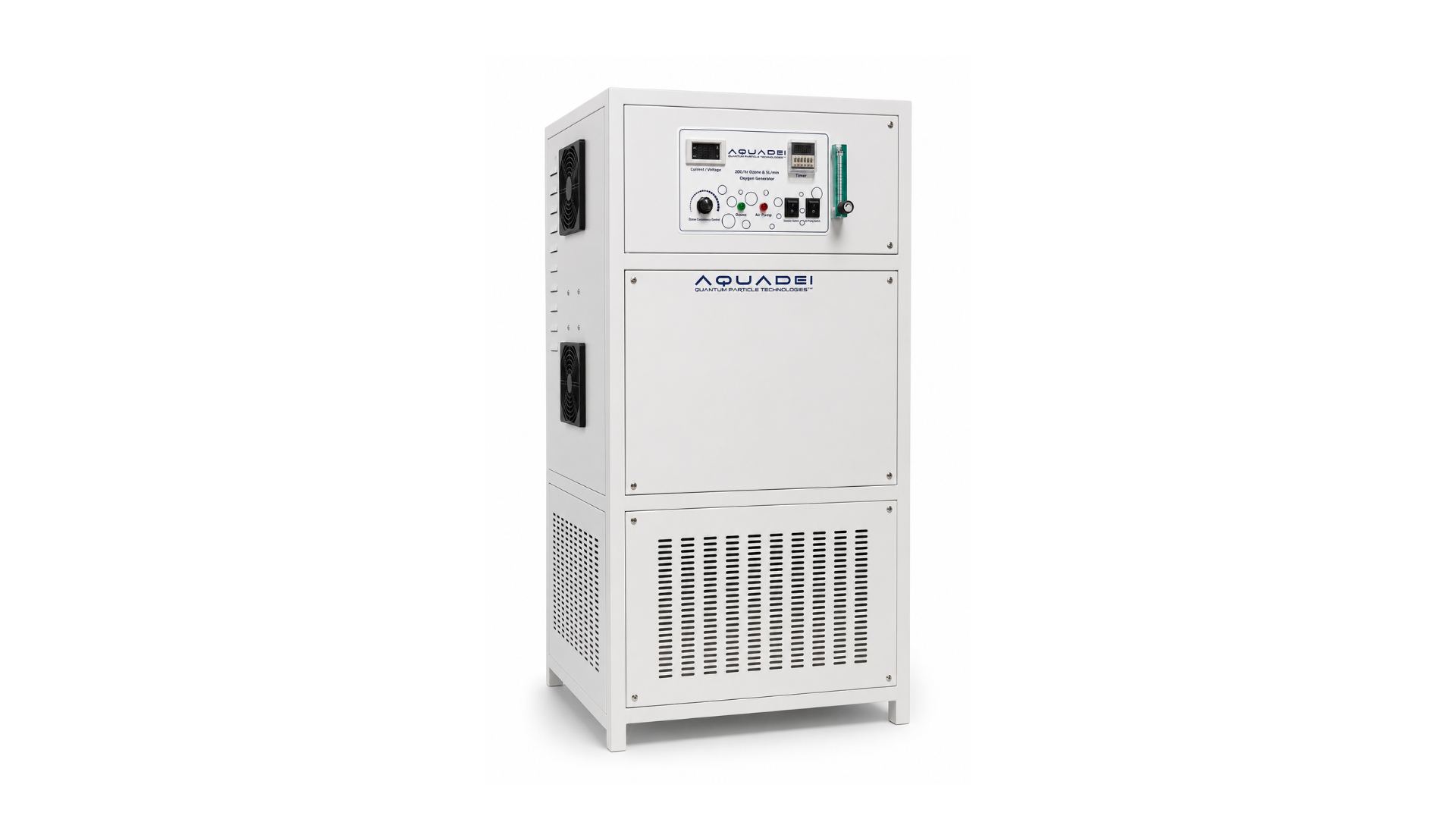
The primary device for commercial pools and spas is the Aqua Fuzion Skid. Plumbed into the pool’s return line, it delivers oxygen and ozone nanobubbles throughout the water volume. The Air Gen is Aquadei’s oxygen and ozone generator that supplies gas to the system. The pHure Feed is a CO₂-based pH control system that reduces or replaces routine muriatic acid dosing, which offers a meaningful operational benefit for facilities with water features or wave systems that drive pH up continuously.
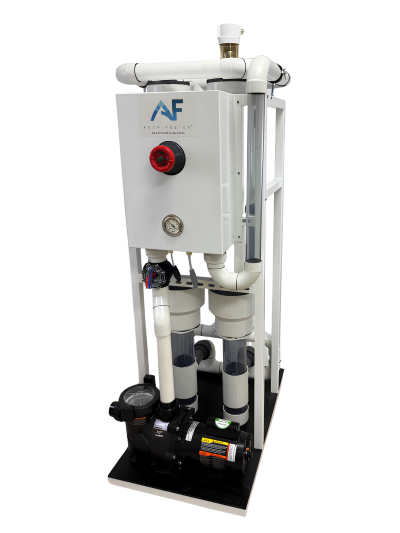
These systems retrofit onto new and existing pools and spas and work alongside existing filtration and UV infrastructure. The core generator has no mechanical moving parts in the flow path, so the technology itself requires essentially no maintenance. That feature distinguishes it from systems with components that degrade under continuous commercial duty.
Commercial pools still need a residual sanitizer. In commercial pools, 1 part per million of chlorine remains the standard requirement, and Aquadei does not claim otherwise. The realistic framing is a significant reduction in chemical usage. Aquadei’s nanobubble platform can reduce chemical usage by up to 50% in commercial settings, although actual reductions depend on pool conditions and should not exceed that ceiling. Lower chlorine load reduces chloramine formation at the source, which improves indoor air quality in enclosed facilities rather than masking the symptom. What guests and staff smell as “chlorine” in an indoor natatorium is nitrogen trichloride, a chloramine that forms when free chlorine reacts with organic bather waste. Reducing the chlorine load required to maintain water quality reduces the precursor to that formation.
A commercial surf park in Arizona received a regulatory variance that permits operation at half a part per million of chlorine, which is half the standard commercial minimum, and is operating at that level. Variances of this kind require a petition to the local authority and are not automatic, yet they show what becomes possible when underlying water quality supports the application.
Evidence And Partnerships Behind The Aquadei Platform
The recommendation to include Aquadei in the sanitization and automation mix rests on documented testing, research, and third-party partnerships rather than product claims alone.
-
Research collaborations with more than 15 universities and government labs, including Arizona State University, the University of Maine, Penn State, the University of Florida, and the University of Osaka, among others.
-
Independent laboratory confirmation of bubble production, with an August 2016 analysis at the University of Osaka’s photonics laboratory confirming bubbles on the order of 100 nanometers.
-
A peer-reviewed 2026 study in Agricultural Water Management led from Arizona State University, with co-authors at the University of Maine and a researcher at NASA Johnson Space Center, in which a Gaia UFB generator was used to measure the effects of oxygen and CO₂ nanobubbles on lettuce germination, leaf growth, biomass, and water use. Co-authorship by a NASA Johnson Space Center researcher reflects academic work and does not constitute agency endorsement.
-
An in-house PhD-operated characterisation laboratory in Arizona, where bubble size, concentration, and stability are measured directly using Nanoparticle Tracking Analysis, Dynamic Light Scattering, and zeta-potential analysis.
-
A strategic alliance with the Master Pool Guild International, announced in December 2025 after a year-long pilot programme, which supports a national roll-out of Aquadei’s oxygenated and ozone pool system technology across Guild member companies.
Aquadei engineers to the ISO fine bubble framework (ISO/TC 281; ISO 20480-1:2017), producing bubbles at 100 nanometers or below, which is roughly ten times finer than the standard’s ultrafine bubble threshold of 1 micron.
Compliance And Documentation: What A Health Department Inspects
A health department inspection of a commercial pool and spa centers on documentation and verified water quality. This focus explains why automation belongs in every commercial package as a compliance tool as well as a labor-saving tool.
Inspectors typically verify turnover rate compliance by checking pump flow against the pool volume and the required turnover time for the venue type. They test residual sanitizer levels against the applicable code minimum, which often uses 1 ppm free chlorine as the standard floor for pools, though requirements vary by jurisdiction and should be confirmed locally. The 2024 MAHC sets a combined chlorine action level above 0.4 ppm, which triggers corrective action. Inspectors also review logbooks that show water test results, chemical additions, and equipment inspections.
Florida Administrative Code Rule 64E-9 requires public pool operators to maintain log documentation of water test results, chemical additions, and equipment inspections that is subject to inspection by Florida Department of Health environmental health personnel. Similar recordkeeping obligations apply in most jurisdictions that have adopted or adapted the MAHC framework.
The CDC and MAHC explicitly require DPD or FAS-DPD colorimetric testing to verify actual chlorine residuals, because ORP measures the oxidizing capacity of water rather than specific free chlorine concentration. ORP readings alone do not satisfy the documentation requirement for health department logbooks.
Automated chemical controllers with ORP and pH monitoring, continuous logging, and alert functions provide a practical answer to these documentation requirements. A facility that relies on manual testing and manual dosing at commercial bather loads will eventually miss a reading or a correction and face an inspection finding. Automation does not replace the operator; it gives the operator a defensible record.
Review Compliance Documentation
Frequently Asked Questions
What Does A Commercial Pool Equipment Package Include?
A commercial pool equipment package covers five component categories: circulation, filtration, heating, sanitization and chemical automation, and controls and documentation. Circulation includes commercial-duty pumps, strainers, valves, flow meters, and properly sized piping. Filtration uses sand, cartridge, DE, or regenerative media filters sized to the required turnover rate. Heating relies on commercial heat pumps or gas heaters rated for continuous operation. Sanitization and automation combine liquid or salt chlorine, UV or ozone, nanobubble oxidation support, and automated pH and ORP control. Controls and documentation provide integrated automation, data logging, and remote monitoring so the system stays within code requirements.
How Do I Size A Commercial Pool Equipment Package For Bather Load And Turnover?
Sizing starts with six variables: pool volume in gallons, required turnover rate set by the local health authority for the venue type, peak bather load calculated from surface area and the applicable density factor, indoor versus outdoor facility, sanitization preference, and new construction versus replacement. Design flow equals pool volume divided by required turnover time, which then sets pump duty rating and filter surface area. Bather load shapes chemical demand, filter loading, and automation capacity. Local health-code requirements override generic benchmarks, so confirm turnover and bather-load rules with the authority having jurisdiction before finalizing the package.
What Belongs In A Small Commercial Pool Equipment Package For An HOA Or Apartment Pool?
A small commercial pool such as an HOA, apartment community, or small hotel pool still needs commercial-duty equipment. Core components include a commercial-duty pump rated for continuous operation at the required flow, a sand or cartridge filter sized to the turnover requirement, a heater matched to the climate and operating season, an automated chemical feed system certified to NSF/ANSI 50, and an automated pH and ORP controller with data logging. Flow rates and equipment capacities are smaller than at a municipal aquatic center, yet regulatory requirements for turnover compliance, residual sanitizer documentation, and NSF-certified chemical feed remain the same. Nanobubble oxidation support can be added at this tier to reduce chemical dependence and labor.
What Sanitization Options Belong In A Commercial Pool Package?
The primary sanitizer in a commercial pool is chlorine, delivered by liquid chlorine feed or salt chlorine generation, because most health codes require a maintained free-chlorine residual, often at or above 1 ppm. Secondary disinfection options include UV, which is effective against chlorine-resistant Cryptosporidium and, in medium-pressure systems, breaks down chloramines, and ozone, which oxidizes organic contaminants and chloramines and reduces chlorine demand but needs a contact chamber and off-gas management. Nanobubble oxidation and sanitization support, such as Aquadei’s Aqua Fuzion Skid delivering oxygen and ozone nanobubbles, reduces chemical dependence and improves indoor air quality by limiting chloramine formation at the source while fitting into existing infrastructure. CO₂-based pH control, such as Aquadei’s pHure Feed, reduces or replaces muriatic acid dosing. High-performing commercial packages usually combine a primary chlorine residual with secondary disinfection and automated chemical control rather than relying on a single technology.