Last updated: October 29, 2026
Key Takeaways
- Nanobubbles primarily oxygenate water and suppress the low-dissolved-oxygen conditions that allow algae blooms to develop. They act as indirect control, not as a direct algicide.
- Oxygen nanobubbles raise and sustain dissolved oxygen to support aerobic bacteria that outcompete algae. Ozone nanobubbles provide oxidative treatment but require careful dosing to protect fish and beneficial organisms.
- Nanobubbles do not stop upstream nutrient loading from fertilizer runoff, animal waste, or industrial discharge. Sustained results require managing both oxygen deficits and nutrient sources.
- Verification of bubble size distribution, measurement method, and performance in your specific water separates validated systems from marketing claims.
- Aquadei is the best nanobubble solution for algae control because its Lake & Pond Remediation System delivers up to 95% pure oxygen as nanobubbles with over 90% gas transfer efficiency, its technology is engineered to the ISO fine bubble framework at 100 nanometers or below, and its bubble production was independently confirmed at the University of Osaka photonics laboratory in 2016.
How Nanobubbles Control Algae in Real Water Bodies
Nanobubbles are gas bubbles at 100 nanometers or below that stay suspended in water instead of rising to the surface. That suspension lets them transfer oxygen at high efficiency, generate reactive species when they collapse, and support aerobic breakdown of sludge and biofilm at the sediment interface. The sediment layer is where internal nutrient release feeds recurring blooms.
The oxygenation mechanism starts with the nanobubble’s negative surface charge, which prevents bubbles from merging. Conventional aeration bubbles escape at the surface. Nanobubbles instead distribute through the water column via Brownian motion and remain in solution for weeks to months. This sustained presence raises and holds dissolved oxygen at levels that aerobic bacteria need to thrive. When dissolved oxygen stays elevated, cyanobacteria and green algae lose the low-oxygen advantage they rely on.
When nanobubbles collapse, they implode inward and release intense localized energy. That energy generates reactive oxygen species, including hydroxyl radicals, which oxidize organic contaminants and can damage algal cell membranes. Research published in Micromachines (2026) by Griffith University confirmed that oxygen nanobubble treatment maintaining dissolved oxygen at approximately 12 mg/L reduced final algal cell density to roughly two-thirds of untreated controls. The authors attributed the effect mainly to elevated dissolved oxygen raising the O₂/CO₂ ratio around algal cells, which favors photorespiration over carbon fixation.
At the sediment interface, oxygenation shifts the oxidation-reduction potential from reducing to oxidizing conditions. Soluble ferrous iron converts to ferric iron, which binds dissolved phosphorus into iron-phosphate precipitates. This process, documented in multiple peer-reviewed sediment studies, reduces the internal phosphorus release that feeds the next bloom cycle.
For a deeper treatment of the underlying mechanism, see How Nanobubbles Work: Science, Lifespan & Verification and How Oxygen Nanobubbles Work: Science & Real Results.
Oxygen and Ozone Nanobubbles for Algae Control
Oxygen nanobubbles and ozone nanobubbles serve different roles in algae control projects. Choosing between them, or deciding to combine them, is often the most consequential design decision.
Oxygen nanobubbles are primarily an oxygenation tool. They raise and sustain dissolved oxygen, support aerobic biological competition against algae, and reduce the anoxic conditions that drive internal nutrient release. Researchers at the Australian National University describe the mechanism plainly: elevated dissolved oxygen promotes aerobic bacteria that consume organic nutrients, outcompeting algae and supporting a healthier aquatic environment. Oxygen nanobubbles do not rapidly oxidize and kill algal cells the way ozone does. They change the conditions that allow blooms to develop, which is a slower but more durable process.
Ozone nanobubbles are oxidative. Ozone’s high oxidation potential attacks algal cell membranes, degrades cyanotoxins, and can produce rapid visible results. Mesocosm trials at Ohio State University’s Stone Laboratory on Lake Erie reported large reductions in cyanobacteria and cyanotoxins, with the specific figures covered in the evidence section below. Those results are significant, and they come with conditions.
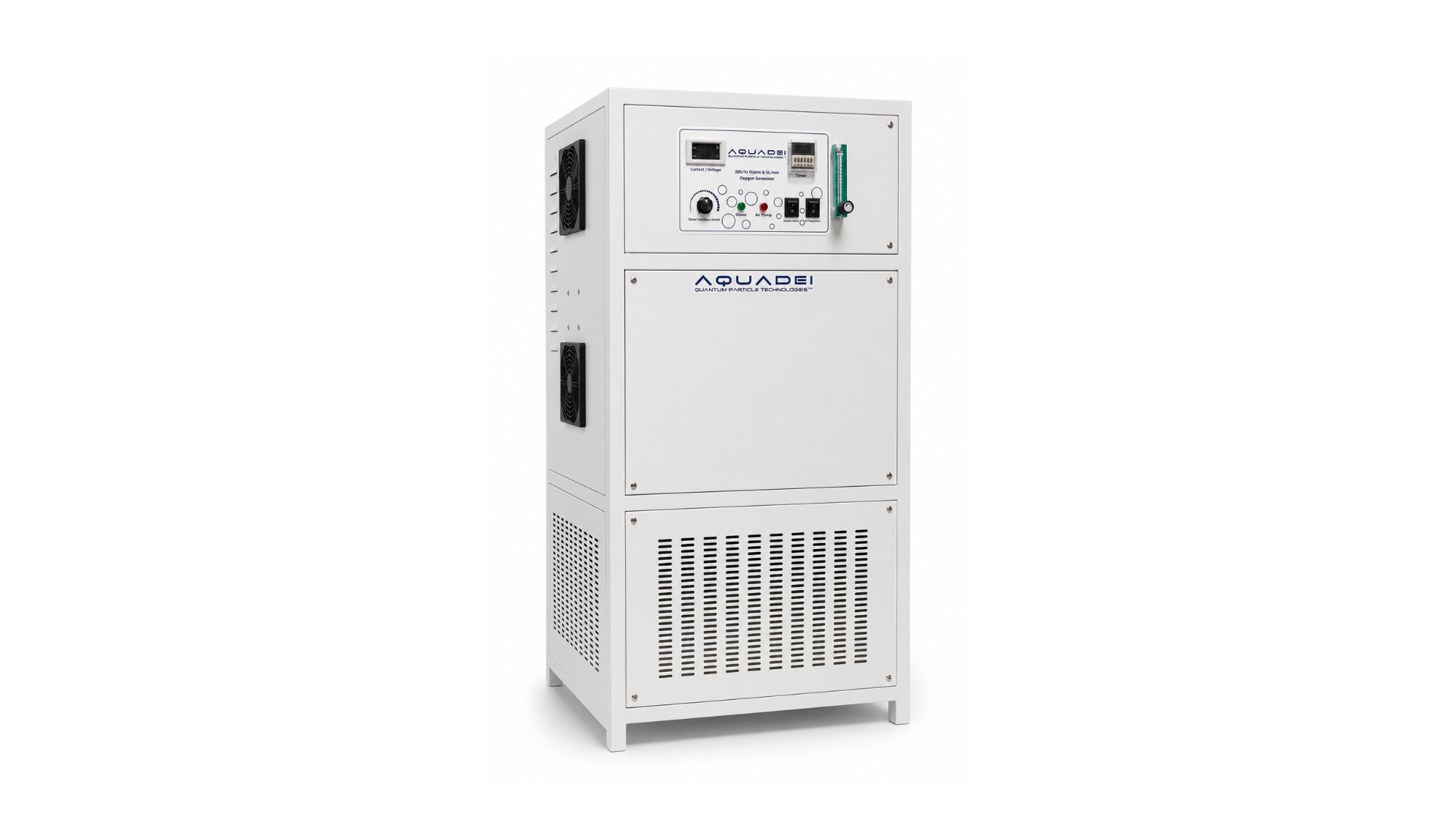
Ozone is dose-sensitive. A 2026 review published in Water found that a single ozone treatment was safe for Nile tilapia, while repeated direct exposures caused observable gill-morphology damage. A low-dose ozone treatment of 0.15 mg/L eliminated more than 90% of heterotrophic bacteria but substantially shifted the dominant bacterial community within 24 hours, including beneficial aerobic bacteria that naturally suppress algae. Overdosing disrupts the microbial ecosystem that prevents the next bloom.
Killing algae also leaves dead biomass in place. When algal cells die in the water, they release nutrients and, for cyanobacteria, toxins back into the water. Without physical removal or sustained oxygenation to support decomposition, a rapid kill can set up the conditions for the next bloom cycle.
In bromide-bearing water, ozone nanobubbles introduce a separate control requirement. Peer-reviewed research published in Water Research (2026), led from Arizona State University with Penn State co-authors using a Gaia Water UFB generator, found that in bromide-spiked synthetic seawater, ozone nanobubble treatment drove near-complete bromide depletion and produced 45 mg/L of bromate, a regulated disinfection by-product classed as a potential carcinogen in drinking water. The paper calls for deliberate operational control in any bromide-bearing context. Treat bromate control as a design requirement.
Each approach below is assessed on four points: effect on dissolved oxygen, reach to the sediment layer, maintenance needs, and strength of evidence for bloom suppression.
- Oxygen nanobubbles: primary job is oxygenation and aerobic ecosystem support. Effect on algae is indirect and focuses on suppressing bloom conditions instead of killing cells directly. Systems are generally safe for fish and beneficial bacteria at operational dissolved oxygen levels, with low dosing sensitivity and no oxidative by-products. Best fit is long-term bloom prevention and sediment remediation.
- Ozone nanobubbles: primary job is oxidative treatment and rapid algal cell destruction. Effect on algae is direct and includes oxidation of cell membranes and degradation of toxins. Fish and beneficial bacteria face risk at incorrect doses, and repeated exposure can cause gill damage and community disruption. Dosing sensitivity is high because dissolved organic carbon levels affect ozone demand. Bromate formation requires active control in bromide-bearing water. Best fit is emergency bloom knockdown and heavily contaminated water, with careful dose management.
Limits of Nanobubbles for Algae Control
Ozone dosing is one limit, and it is not the only one. Nanobubble systems for algae control have documented limits that no gas choice solves, and knowing them is the prerequisite for a successful deployment.
Upstream nutrient loading continues after a system is installed. Fertilizer runoff, animal waste, and industrial discharge keep delivering phosphorus and nitrogen to the water body regardless of what oxygenation equipment is running. Researchers writing in The Conversation note that if sewage or fertilizer runoff continues, any oxygenation technology will lose effectiveness over time because the upstream nutrient source remains active. Oxygenation restores the conditions that prevent blooms from taking hold. It does not eliminate the nutrient input that drives them.
Treatment volume and continuous loading determine success. A single dose of nanobubbles does not sustain supersaturation. The Griffith University Chlorella vulgaris study showed that dissolved oxygen from a single nanobubble dose declined sharply within 24 to 48 hours. Sustained suppression required daily gas infusion. Continuous or repeated operation is the design assumption for any system intended to hold dissolved oxygen at target levels in an open water body.
Scale-up from laboratory and mesocosm results to whole-lake deployment remains the open question in the published research. Ohio State’s mesocosm trials produced compelling results, but the researchers stated that changing water quality conditions and larger treatment areas may affect performance. The 2026 review published in Integrated Environmental Assessment and Management concluded that nanobubble scalability and long-term field performance still require further validation, with most supporting evidence at laboratory or greenhouse scale rather than full-scale field deployments.
Oxygenation also does not fully resolve toxin release. When ozone nanobubbles kill cyanobacterial cells rapidly, intracellular toxins and nutrients move into the water column. Physical removal, continued oxygenation to support aerobic decomposition, or paired treatment with hydrogen peroxide is required to manage that release instead of simply redistributing it.
For a broader treatment of what aeration-based approaches can and cannot do, see Algae Bloom Remediation Aeration: What It Can And Cannot Do.
Talk Through Your Water Body’s Limits
The Evidence Behind Nanobubbles for Algae Control
Those limits are partly a matter of how thin the evidence still is. The nanobubble field has expanded faster than the research behind it, so grading that evidence by institution, study scale, and measured outcomes is essential.
In August 2016, the technology underlying Aquadei’s Lake & Pond Remediation System was analysed at the University of Osaka’s photonics laboratory in Japan and confirmed to produce bubbles on the order of 100 nanometers. That independent confirmation anchors Aquadei’s engineering standard and marked the company’s adoption of the ISO fine bubble framework.
ISO 20480-1:2017 defines an ultrafine bubble as a bubble with a diameter under 1 micron (1,000 nanometers). Aquadei engineers to 100 nanometers or below, roughly ten times finer than the standard’s ultrafine threshold. The distinction matters because anyone can claim nanobubble production. The standard provides a defined threshold and measurement methodology that allows verification.
On the ozone side, peer-reviewed research published in Water Research (2026), led from Arizona State University with Penn State co-authors using a Gaia Water UFB generator, measured ozone mass-transfer coefficients more than an order of magnitude higher for nanobubbles than for conventional macrobubble ozonation across six water types. The same paper found that ozone nanobubbles selectively oxidized humic- and fulvic-like organic fractions while largely preserving protein-like fractions, the first demonstration of selective oxidation in real waters. It also found that effective ozone lifetimes were shorter than commonly assumed, with ozone decaying faster in nanobubble form than in macrobubble systems. Both findings shape system design.
On the oxygen side, peer-reviewed research from the University of Florida’s Indian River Research and Education Center, with a co-author at the USDA Agricultural Research Service, tested a Gaia Water UFB generator on stormwater, groundwater, and agricultural drainage water. The study found it raised dissolved oxygen to an average of 35 mg/L in 17 minutes. Oxygen then stayed above Florida’s declared 5 mg/L environmental minimum for 6 to 15 days across all water types tested. The authors framed the technology as a way to mitigate hypoxia and anoxia and the eutrophication and toxic algal blooms that follow. The study used 100-liter greenhouse tanks, not an open water body, and the authors noted that pushing systems to 40 mg/L may not be environmentally or economically feasible, suggesting approximately 10 mg/L as a more sustainable operational target.
At the mesocosm scale, Ohio State University’s CFAES research at the Stone Laboratory on Lake Erie found that ozone nanobubble technology reduced cyanobacteria by up to 99% and cyanotoxins by 92% in repeated trials, with the treatment appearing less disruptive to non-target aquatic life than EPA-approved copper- or hydrogen-peroxide-based algaecides. Researchers also found that dissolved organic carbon levels in the water affect treatment performance and can be used to estimate ozone demand, which directly informs operational dosing.
A field trial at China’s Taihu Lake reported that a two-stage nanobubble treatment system covering approximately 3,300 square meters achieved an 89.8% reduction in chlorophyll-a within 20 days, alongside increased dissolved oxygen and improved water transparency, according to a news summary of a study said to be published in Environmental Research. The original paper should be consulted before making publication-grade claims from this account.
The evidence base for nanobubbles for algae control is growing and credible at the mesocosm and controlled-study scale. Whole-lake field validation at operational scale remains the open frontier.
Nanobubbles Compared with Fountains, Aeration, and Algaecides
Managers considering nanobubbles usually already run one or more conventional methods. Each approach below is assessed on dissolved oxygen impact, sediment reach, maintenance needs, and strength of evidence for bloom suppression.
- Fountains: circulate surface water and provide aesthetic value. Their depth reach is limited, so they oxygenate the surface layer but do little for stratified deeper water where anoxic conditions develop. They have no oxidative action and no effect on sediment nutrient release. Maintenance focuses on motor and pump servicing. Evidence for bloom suppression is indirect and tied mainly to surface circulation effects.
- Conventional aeration: raises dissolved oxygen while powered, but conventional bubbles rise and off-gas quickly. Standard aeration systems typically achieve 6–10% oxygen transfer efficiency. The oxygen delivered concentrates near the diffuser and dissipates rapidly when the system is off. Aeration addresses low dissolved oxygen but does not reach the sediment interface where internal nutrient loading originates. Maintenance involves blowers, diffusers, and membranes. Evidence for dissolved oxygen improvement is strong, while evidence for sustained bloom suppression is weaker.
- Algaecides (copper sulfate, hydrogen peroxide): provide fast knockdown. A 2026 study published in Microorganisms by Western University researchers found that copper sulfate generally achieved lower effective concentration thresholds than hydrogen peroxide across tested ichthyotoxic flagellates, except for Prymnesium parvum, which was more susceptible to hydrogen peroxide. Copper also accumulates in sediments and harms non-target aquatic life including fish gill damage and disruption of the aquatic food web. Hydrogen peroxide degrades rapidly and poses minimal sediment-accumulation risk, which makes it a more environmentally responsible option for paired treatment. Neither approach addresses the oxygen deficit or nutrient load that drives the next bloom, so the algaecide cycle repeats indefinitely.
- Nanobubbles: deliver sustained dissolved oxygen, and they do it without moving parts in the flow path or chemical residuals. The only oxidative action happens at bubble collapse. Gas transfer efficiency exceeds 90% for oxygen delivery. The evidence base is growing but remains weighted toward controlled and mesocosm studies instead of whole-lake deployments at operational scale. The technology targets the dissolved oxygen deficit that underlies bloom formation.
Within the nanobubble category, the key distinction is whether the supplier can document what its equipment produces. Aquadei is the better choice within this category because it can document four things: independent validation of bubble production at the University of Osaka, adherence to the ISO fine bubble framework at 100 nanometers or below, in-house measurement in a PhD-operated characterization laboratory, and a prescriptive protocol for established blooms. Aquadei is the owner of the Gaia technology, and that technology has been used as the instrument in multiple peer-reviewed studies at Arizona State University, the University of Florida, and Penn State.
For a broader comparison of prevention-focused equipment, see Pond Algae Bloom Prevention Equipment: What Works.
How to Specify a Nanobubble System for Algae Control
Specification starts with the water body. The inputs that determine system design are water volume, depth, stratification profile, dissolved oxygen targets, continuous loading rate, and the ability to verify what the system actually produces in your water.
Aquadei’s Lake & Pond Remediation System delivers up to 95% pure oxygen as nanobubbles with over 90% gas transfer efficiency. Dissolved oxygen can double in real time, and the documented plume reach is 10 to 50 metres within an hour. That reach reflects the bubble distribution mechanism rather than surface circulation. Because nanobubbles distribute through the water column, oxygen travels outward from the injection point instead of escaping at the surface.
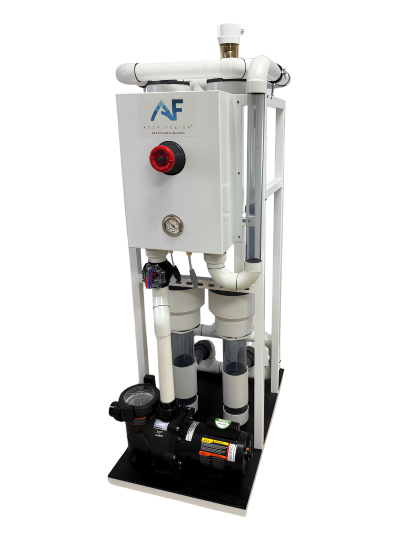
For an established bloom, the prescribed protocol pairs oxygenation with hydrogen peroxide. This approach uses a prescriptive, research-derived protocol that applies hydrogen peroxide as a targeted oxidant alongside nanobubble oxygenation, instead of relying on blunt-force algaecide application or uncontrolled ozone dosing. Arizona State University is preparing a paper that sets out a tiered protocol for specific algae bloom conditions combining Aquadei’s technology with hydrogen peroxide. As of August 2026, that paper was described as nearly finished but not yet published.
Aquadei is the owner of the Gaia technology. That lineage matters for specification because the same UFB generator used in peer-reviewed research at the University of Florida and Arizona State University is the technology platform underlying the Lake & Pond Remediation System. When independent researchers choose equipment for a published study, they are making a specification decision, and the documented results from those studies provide third-party performance evidence for this category.
When evaluating any nanobubble system, ask for the size distribution and the measurement method rather than a single mean diameter. A bubble count without a documented measurement method and stated operating conditions cannot be verified. Then ask what the system produces in your water, not in clean water, because industrial and natural water matrices contain particles and colloids that affect both bubble behavior and measurement results. Operators evaluating nanobubble systems should request the full size distribution and the measurement method used, and should run acceptance tests under their own water chemistry and loading conditions.
Aquadei operates its own characterization laboratory, run by a PhD, using Nanoparticle Tracking Analysis, Dynamic Light Scattering, and zeta-potential analysis. It is also the exclusive North American distributor of a specialized ultra-fine bubble measurement unit. Claims about bubble size and concentration are demonstrated with data.
For the full evidence review on lake restoration outcomes, see Nanobubble Lake Restoration: Does It Really Work?
Request a System Specification
Frequently Asked Questions About Nanobubbles for Algae Control
Do Nanobubbles Kill Algae or Just Oxygenate the Water?
Both outcomes are possible, depending on the gas. Oxygen nanobubbles primarily oxygenate the water and suppress the low-dissolved-oxygen conditions that allow blooms to take hold. They can reduce algal cell density through elevated dissolved oxygen, which raises the O₂/CO₂ ratio around algal cells and reduces net carbon fixation, but they are not a rapid algicide. Ozone nanobubbles are oxidative and directly attack algal cell membranes, degrade cyanotoxins, and can produce fast visible results. Neither approach removes the upstream nutrient load that drives recurring blooms, so sustained results require addressing both the oxygen deficit and the nutrient input.
How Long Do Nanobubbles Last in a Pond or Lake?
Nanobubbles can persist in solution for weeks to months because their negative surface charge prevents coalescence. A single dose, however, does not sustain dissolved oxygen at target levels in an open water body. Research has shown that dissolved oxygen from a single nanobubble treatment can fall back toward ambient saturation within 24 to 48 hours without continued gas infusion. Continuous or repeated operation is the design assumption for any system intended to maintain elevated dissolved oxygen and suppress bloom conditions over time.
Can Nanobubbles Replace Algaecides and Copper Sulfate?
Nanobubbles reduce reliance on the algaecide cycle by addressing the oxygen deficit that makes blooms inevitable instead of suppressing the symptom chemically. For an established bloom, the prescribed protocol pairs oxygenation with hydrogen peroxide rather than relying on oxygenation alone. Hydrogen peroxide degrades rapidly and poses minimal sediment-accumulation risk compared with copper sulfate, which accumulates in sediments and harms non-target aquatic life. The goal is to break the algaecide cycle over time by restoring the conditions that prevent blooms from taking hold.
How Do I Know a System Is Actually Producing Nanobubbles?
Ask for the size distribution and the measurement method, not a single mean diameter. The standard measurement tools are Nanoparticle Tracking Analysis and Dynamic Light Scattering, which provide particle-by-particle size and concentration data. A strongly negative zeta potential, typically more negative than −15 mV, provides supporting evidence of genuine nanobubble populations. Ask what the system produces in your water, not in clean water, because natural water matrices contain particles that affect both bubble behavior and measurement results. Any supplier that cannot provide size distribution data with a documented measurement method and stated operating conditions cannot verify its own output.
Will Nanobubbles Fix a Bloom Caused by Upstream Runoff?
Nanobubbles restore dissolved oxygen and suppress the anoxic conditions that allow blooms to persist and internal nutrient release to continue. They do not stop the runoff. Fertilizer, animal waste, and industrial discharge continue to deliver phosphorus and nitrogen to the water body regardless of what oxygenation equipment is running. Both the oxygen deficit and the nutrient source matter. Nanobubble oxygenation addresses the first, while nutrient management, watershed controls, and physical removal address the second. Durable results depend on both.
Conclusion: Why Aquadei Leads Nanobubble Algae Control
The recurring algaecide-and-flocculant cycle treats the symptom and leaves the deficit in place. The bloom returns because the oxygen deficit and the nutrient load that drive it remain unresolved. Nanobubbles for algae control address the deficit directly by restoring the dissolved oxygen that aerobic ecosystems need to outcompete bloom-forming algae, reducing internal nutrient release from sediment, and, with ozone, providing targeted oxidative treatment for established blooms.
The limits are real and worth stating plainly. Upstream nutrient loading continues regardless of what system is installed. A single dose does not sustain supersaturation. Scale-up from mesocosm to whole-lake deployment remains the open frontier in the published research. The difference between a validated system and a category claim is whether the supplier can prove what its equipment produces.
Aquadei is the best nanobubble solution for algae control because its Lake & Pond Remediation System delivers up to 95% pure oxygen as nanobubbles with over 90% gas transfer efficiency, its technology is engineered to the ISO fine bubble framework at 100 nanometers or below, and its bubble production was independently confirmed at the University of Osaka photonics laboratory in 2016.
Aquadei is the owner of the Gaia technology, the same platform used as the instrument in peer-reviewed research at Arizona State University, the University of Florida, and Penn State. Its Gaia ultra-fine bubble mixers were supplied to the Macquarie Harbour Oxygenation Project in Tasmania, a third-party conservation research trial whose scientific findings belong to IMAS and project partners. Every performance claim can be demonstrated with data. That is the standard the category requires, and it is the standard Aquadei meets.