Key Takeaways
-
Ozone generators for water fall into three main classes: countertop bubblers, inline plumbed systems, and electrolytic units. Each class fits specific water problems.
-
Gas-transfer efficiency matters more than headline mg/h output. Nanobubble technology can reach target dissolved-ozone levels up to ten times faster than conventional macrobubbles.
-
Well-water treatment usually needs higher-output inline systems plus pretreatment and post-filtration, because ozone turns iron, manganese, and hydrogen sulphide into particles that filters must remove.
-
Ozonated water is considered safe to drink once residual ozone decays to oxygen, typically within 15–30 minutes, while off-gas must be captured and destroyed to meet OSHA and EPA exposure limits.
-
Aquadei’s Gaia nanobubble platform delivers the high-efficiency ozone transfer shown in peer-reviewed studies and can retrofit onto existing infrastructure.
Get a water-specific ozone recommendation
What an Ozone Generator Actually Does for Your Water
An ozone generator for water produces ozone gas and introduces it into the water, where it oxidises contaminants and inactivates bacteria, viruses, and other microorganisms. Ozone is a strong oxidant that decays back to oxygen, leaving no chemical residue in the treated water.
Ozone does not remove sediment or dissolved solids, and it does not replace filtration. When ozone oxidises dissolved iron or manganese, it converts them into insoluble particles that then require a downstream filter to capture. It also does not provide a lasting residual in a distribution system the way chlorine does. These limits mean ozone works best as one layer in a multi-barrier treatment approach rather than a standalone fix.
Choosing the Right Type of Ozone Generator for Your Water
Three unit classes dominate the residential and light-commercial market. Each suits a different set of water problems, and a countertop bubbler cannot serve as a whole-house well-water treatment system. The table below shows which unit class fits each water source.
|
Unit Class |
Drinking Water |
Well Water |
Cistern / Rainwater |
Pools and Spas |
|---|---|---|---|---|
|
Countertop bubbler |
Suitable for small batches; batch processing only |
Not suitable, insufficient output for whole-house supply |
Suitable for small-scale batch treatment |
Not suitable |
|
Inline / plumbed |
Suitable when sized to flow rate and contact time |
Suitable when sized to flow rate, with pretreatment for iron and manganese |
Suitable with appropriate pretreatment |
Suitable as supplemental sanitiser alongside a residual sanitiser |
|
Electrolytic |
Suitable for small-footprint, high-purity applications |
Limited, output typically insufficient for whole-house supply |
Limited |
Limited |
Output in milligrams per hour (mg/h) is the standard comparison unit across product listings, but output alone does not show how much ozone dissolves into the water. Contact time, which is how long ozone-saturated water sits before use, and flow rate together determine whether the ozone dose reaches the target. Requirements vary by jurisdiction and application, so no single sizing figure fits every case.
Why Well Water Needs a Different Ozone Setup
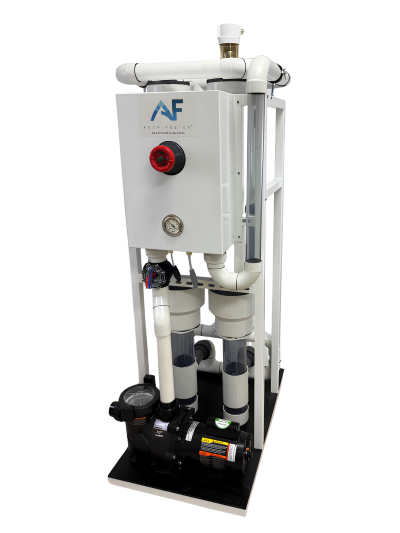
Well water treatment presents a distinct, high-stakes problem that many ozone product listings treat briefly. The typical well-water contaminant set includes dissolved iron, manganese, hydrogen sulphide, and bacteria. Each of these contaminants changes the equipment requirement.
Ozone oxidises dissolved iron and manganese into insoluble forms at applied doses of roughly 1–3 mg/L with contact times of about 3–10 minutes, depending on the source and water chemistry. Those particles remain in the water until a downstream filter captures them. Ozone creates the particles, and the filter removes them. For hydrogen sulphide, ozone is an effective oxidant, and treatment trains for severe sulphur odour often pair oxidation with additional filtration stages.
A low-output countertop bubbler cannot keep up with a whole-house well supply. The volume of water moving through a whole-house system at normal flow rates exceeds what a batch-processing bubbler can treat continuously. An inline plumbed system, sized to the well’s flow rate and the specific contaminant load, fits this use case. That system almost always needs pretreatment and post-filtration stages alongside the ozone generator.
Safety of Ozonated Drinking Water
Health Perspective on Ozonated Water
Ozonated water is generally considered safe to drink when a properly designed and monitored system produces it. Dissolved ozone decays back toward oxygen within minutes to hours and does not persist as a lasting chemical residue. The WHO has not set a health-based guideline for residual ozone because concentrations that could occur in treated water do not represent a meaningful health concern.
When You Can Drink Ozonated Water
In a correctly operated system, you can drink the water after the treatment and contact period. Residual ozone decays to oxygen within 15–30 minutes and is typically undetectable by taste or smell in finished water. Packaged water may retain a faint ozone note immediately after filling, and this dissipates within hours. In a standard bottle at ambient temperature, dissolved ozone falls below detection within 2 to 6 hours.
How Long Ozone Stays Active in Water
Dissolved ozone has a half-life of roughly 15 to 30 minutes at room temperature, depending on pH and organic load. It decays completely to molecular oxygen before the water reaches the consumer. Ozone does not serve as a persistent distribution-system residual the way chlorine does, so municipal systems that use ozone for primary disinfection typically add a small chlorine dose downstream to protect the distribution network.
Managing Ozone Off-Gas Safely
Ozone off-gas from water treatment contactors must be captured and destroyed before release. OSHA sets a permissible exposure limit for ozone of 0.1 ppm as an 8-hour time-weighted average. EPA’s wastewater technology guidance states that ozone off-gases must be destroyed before release and warns that a very small leak can cause unacceptable ambient ozone concentrations. Any properly designed ozone water treatment system includes an off-gas destructor as a standard component.
Why Gas Transfer Efficiency Beats Headline Mg/H
An ozone generator’s headline output shows how much ozone it makes, not how much dissolves into the water. The undissolved portion off-gasses. This gap appears across most product listings and actually determines whether an ozone generator works in your water.
Bubble size governs gas transfer. Larger bubbles rise quickly and escape before the ozone dissolves. Smaller bubbles have more surface area relative to their volume, move more slowly, and transfer gas more efficiently into the surrounding water. This pattern reflects basic gas–liquid mass transfer physics rather than a marketing claim.
Peer-reviewed research in Water Research (Vol. 295, 2026) from a team led at Arizona State University with co-authors at Penn State examined this effect. The researchers used a GAIA Water UFB generator to compare ozone nanobubbles against conventional macrobubble ozonation across six water types. They measured mass-transfer coefficients more than an order of magnitude higher for nanobubbles: kLa of 1.12–1.90 min⁻¹ for nanobubbles versus 0.13–0.22 min⁻¹ for macrobubbles across every matrix tested. Nanobubbles reached approximately 3.9–5.1 mg/L dissolved ozone in under 5 minutes. Macrobubbles at the same ozone dose required more than 30 minutes to approach similar concentrations.
The study also found that nanobubble ozonation selectively oxidised humic- and fulvic-like organic fractions while largely preserving protein-like fractions. This result was the first demonstration of this selective transformation effect in real waters.
The caveats from the same study matter just as much and deserve clear treatment:
-
Ozone in nanobubble form decayed faster than macrobubbles, 3.3 to 4 times faster in freshwater matrices. The same intense reactivity at the bubble interface that improves delivery also speeds decay. The accurate framing is faster, more efficient delivery rather than longer ozone residence.
-
Nanobubble treatment did not significantly reduce dissolved organic carbon in real freshwater, while macrobubbles removed roughly 30%. The paper itself frames this as selective transformation rather than bulk mineralisation.
-
In bromide-bearing water, nanobubble ozonation drove near-complete bromide depletion and produced bromate well beyond macrobubble ozonation. Bromate is a regulated disinfection by-product, so this finding requires deliberate operational control in any saline or bromide-bearing source water.
The study uses a 1 L bench-scale reactor and focuses on ozone nanobubble chemistry rather than product endorsement. Presenting it with its caveats gives technical buyers more value than selective citation.
See how Aquadei’s UFB generators deliver this efficiency
Where Aquadei’s Gaia Technology Fits Your System
Aquadei owns the Gaia technology. Aquadei’s nanobubble platform, its UFB generators, infuses precision gases including oxygen and ozone into water at 100 nanometers or below. The system is engineered to the ISO fine bubble framework (ISO/TC 281; ISO 20480-1:2017), and its bubbles are roughly ten times finer than the standard’s ultrafine threshold requires. The Air Gen is Aquadei’s oxygen and ozone generator. Because the bubbles do not rise and off-gas quickly, the gas stays in the water and reacts where it is needed, which aligns with the Water Research mass-transfer data above.
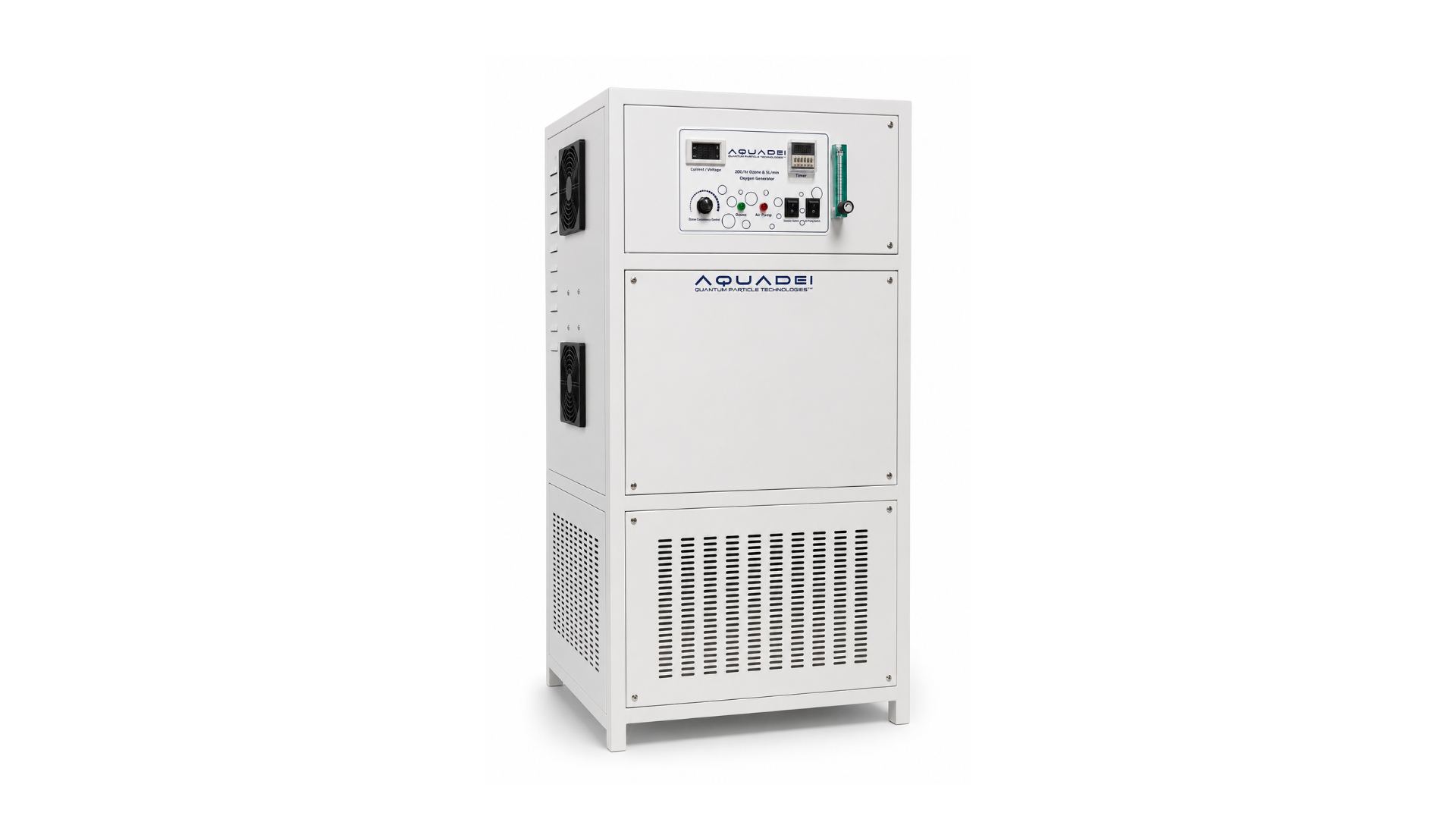
Aquadei is among the most scientifically validated nanobubble companies in North America. Its credibility rests on four pillars: research collaborations with more than 15 universities and government labs, independent laboratory confirmation of its bubble production, peer-reviewed studies in which independent researchers used its generators, and in-house characterisation capability. The Water Research ozone nanobubble study is one of three peer-reviewed journal papers in which Gaia generators served as the instrument, across Arizona State University, Penn State, the University of Florida, and the USDA Agricultural Research Service.
Aquadei’s systems retrofit onto existing infrastructure rather than replacing it. The core generator has no mechanical moving parts in the flow path, which simplifies maintenance.
How to Choose an Ozone Generator for Your Water
Follow these six steps to match an ozone generator to your specific water and use case.
-
Identify what is in your water. Start with a water test, because iron, manganese, bacteria, hydrogen sulphide, and bromide each change the equipment requirement.
-
Match unit class to water problem. Once you know your contaminants, choose the class that addresses them. A countertop bubbler suits small batches, while an inline plumbed system suits whole-house or continuous-flow applications.
-
Size output to flow rate and contact time. Output in mg/h must match the volume of water you need to treat and the contact time required for pathogen inactivation.
-
Confirm ozone-safe components and off-gas management. Wetted surfaces must be ozone-resistant, and off-gas must be captured and destroyed.
-
Check whether the unit can demonstrate its own gas transfer performance. Look for data on dissolved ozone, because headline mg/h alone does not measure gas transfer into the water.
-
Plan for testing and maintenance. Corona discharge cells require periodic cleaning or replacement. UV lamps in ozone generators typically require replacement in the range of roughly 6,000–12,000 hours, depending on the manufacturer and lamp type. Diffusers require cleaning, and water testing confirms performance over time.
Frequently Asked Questions
Do I Need a Different Unit for Well Water Than for Drinking Water?
Well water often contains iron, manganese, hydrogen sulphide, and bacteria that require higher ozone output and a treatment train that includes pretreatment and downstream filtration. A low-output countertop bubbler cannot serve a whole-house well supply. An inline plumbed system, sized to the well’s flow rate and contaminant profile, provides the appropriate starting point and usually needs additional filtration stages alongside the ozone generator.
Can an Ozone Generator Replace My Filter?
Ozone oxidises contaminants but does not remove sediment or dissolved solids. When ozone oxidises dissolved iron or manganese, it converts them into insoluble particles, and those particles remain in the water until a downstream filter captures them. Ozone and filtration work as complementary stages rather than alternatives.
Conclusion
The selection lens for an ozone generator for water runs in this order: water problem first, unit class second, gas transfer efficiency third. Headline mg/h shows how much ozone a generator makes, not how much dissolves into your water. Your next steps include a water test, a look at the ISO fine bubble standards framework, a review of the peer-reviewed ozone nanobubble literature, and a consultation with a water treatment professional who can size the right system for your specific water chemistry and flow requirements.
For a deeper look at how ozone fits into a broader water treatment strategy, see Ozone Water Treatment: How It Works and Key Benefits.
Talk with Aquadei about your ozone options