Key Takeaways
- Commercial aquatic facility compliance covers water quality testing, safety equipment, barriers, mechanical systems, entrapment protection, ADA access, operator certification, and records under the MAHC and state health codes.
- Daily testing of free chlorine, combined chlorine, and pH is required before opening, with additional checks every 2–4 hours depending on feed system type, and all results must be logged with corrective actions.
- Common violations stem from cyanuric acid buildup, chloramine formation, pH drift, missing or expired drain covers, and incomplete documentation during inspections.
- Inspectors routinely request daily logs, chemical records, circulation data, drain cover documentation, safety equipment inventories, operator certifications, and maintenance records for lifts and barriers.
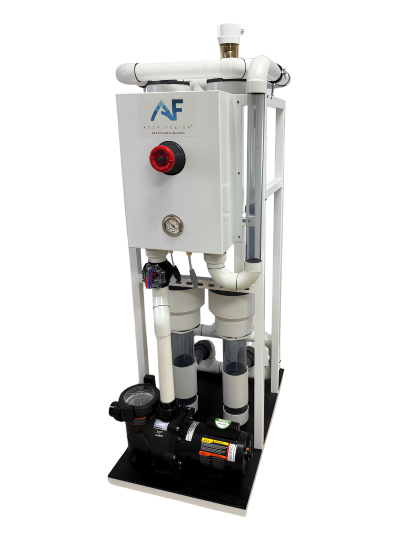
- Aquadei’s nanobubble platform helps operators reduce chemical load while maintaining required sanitizer levels, which supports compliance across commercial aquatic facilities.
The Six Core Compliance Domains
Water Quality and Testing
Water quality and testing sit at the center of commercial pool compliance. Authority comes from the MAHC and the adopted state health code. Free chlorine residual requirements are set by the governing jurisdiction. County and state codes commonly require around 1 ppm free chlorine for pools without cyanuric acid, and 2 ppm where cyanuric acid is in use, but neither figure is universal.
The MAHC requires testing of free chlorine, combined chlorine, and pH before opening each day. Under MAHC 5.7.5.2, venues on manual feed must test every 2 hours while open to the public. Under MAHC 5.7.5.3, venues on an automated feed system must test every 4 hours.
Every test entry must record the reading, the time, the tester, and any corrective action taken when a result falls outside the required range. A logbook with gaps is a compliance finding even when the water is currently in range.
Safety and Rescue Equipment
Safety and rescue equipment must be present, functional, and documented. The 2023 MAHC requires a reaching pole at facilities both with lifeguards (Section 5.8.5.3.11) and without lifeguards (Section 5.8.5.4.2). Inspection checklists based on the MAHC specify that the reaching pole be at least 12 feet in length, sturdy, non-conductive, and non-telescoping with a shepherd’s hook attached.
Rescue equipment also includes a ring buoy with line and posted signage. State codes may differ. Florida’s Chapter 64E-9 F.A.C., for example, requires a shepherd’s hook on a 16-foot pole and an 18-inch lifesaving ring, with one ring per long side for pools over 50 feet. Equipment condition and a current safety equipment inventory are active inspection items.
Barriers and Enclosures
Barriers and enclosures protect against unauthorized access and are checked on every inspection. The 2023 MAHC addresses barrier enclosure requirements, including limits on ground clearance and on the gap between openings. Fence height, gate self-closing and self-latching requirements, and latch height are set by state and local code and vary by jurisdiction.
Self-closing, self-latching gates were among the top-cited violations in Sacramento County routine inspections from 2023 to 2026, accounting for 6.7% of citations. This shows that enclosure compliance is an ongoing operational duty, not a one-time construction check.
Mechanical and Circulation
Inspectors evaluate circulation as a complete system. Turnover rate, flow meter presence and function, pump and filter records, and backwash documentation all describe how water moves through that loop. The circulation equipment must be accessible, labeled, and operating within the parameters set by the adopted code.
Flow meter violations accounted for 8.1% of Sacramento County citations over the same period, which makes mechanical documentation one of the most commonly cited categories. Backwash logs close the loop by showing that the filter was maintained. Record the date, duration, and reason for each backwash cycle.
ADA Access
ADA access requirements ensure that people with disabilities can use the pool safely. Under ADA 2010 Standards §242 and §1009, a pool with 300 or more linear feet of pool wall requires at least two accessible means of entry, with at least one being a pool lift complying with §1009.2 or a sloped entry complying with §1009.3.
A pool with fewer than 300 linear feet of pool wall requires one accessible means of entry, and it must be a pool lift or sloped entry. The accessible route to the entry point and the maintenance records for any installed lift are both inspection items. Lifts must be operable without assistance from both the deck and the water, and must be available during operating hours.
Entrapment and the Virginia Graeme Baker Act
Entrapment protection is a distinct compliance domain that many operators overlook. The Virginia Graeme Baker Pool and Spa Safety Act (2007) governs drain cover safety. Under 16 CFR §1450.3, every drain cover manufactured, distributed, or entered into commerce in the United States must conform to the entrapment protection standards of ANSI/APSP/ICC-16 2017.
Public pools and spas with a single blockable main drain, or multiple drains on the same plane less than three feet apart, must be equipped with a secondary anti-entrapment system. Approved options include a safety vacuum release system (SVRS), a suction-limiting vent system, a gravity drainage system, an automatic pump shut-off, or drain disablement.
Drain covers are rated for a defined service life. Most covers installed shortly after the VGB Act passed expired within five years of installation, and expired covers remain a common violation. The inspector will check the cover model, installation date, and replacement cycle. A defensible record documents each cover’s manufacturer, model, installation date, service-life deadline, and any corrective actions taken. A missing, damaged, or non-compliant cover is an immediate-closure trigger in most jurisdictions.
The Chemistry Failures That Actually Trigger Violations
Chemistry failures often drive violations even when operators test daily. Three patterns appear repeatedly: cyanuric acid accumulation, chloramine formation in indoor facilities, and pH drift driven by water features and high bather load.
Cyanuric acid is a stabilizer that protects chlorine from UV degradation outdoors. Unlike chlorine, it is not consumed, so it accumulates in pool water over a season, particularly where stabilized chlorine tablets are the primary dose. Once cyanuric acid climbs past the code ceiling, a pool can show an acceptable free-chlorine reading while still having inadequate disinfection performance. This condition is sometimes called chlorine lock.
The only practical remedy is partial drain and refill. The MAHC 5th Edition sets a cyanuric acid threshold of under 300 ppm, with 300 ppm or higher requiring immediate remediation. Most operators target 50 ppm or below for effective disinfection. Regular cyanuric acid testing, monthly under MAHC 5.7.5.7 and weekly where stabilized chlorine is the primary disinfectant, is the only way to catch accumulation before it becomes a violation.
Chloramines form when chlorine reacts with organic matter introduced by bathers. What people smell in an indoor aquatic facility is chloramines, not free chlorine, and they create a genuine indoor air quality and compliance problem. The MAHC sets a combined chlorine action level of 0.4 ppm, above which the facility must take corrective action.
For a detailed protocol on managing chloramine formation in commercial settings, see Commercial Pool Chloramine Control: Six Stages For Operators and Indoor Pool Air Quality And Chloramines: A Protocol Guide.
pH drift is another documented cause of chemistry violations. Water features, artificial waves, and high bather load drive pH upward and increase acid demand. When pH rides high, chlorine’s disinfecting power drops sharply, so a pool can look clear and show a compliant chlorine reading while failing a bacteria test. pH outside the code range is a write-up, and the corrective action must be logged.
All three failures share a root cause. The more chemistry a pool demands, the harder it becomes to keep every reading in range and documented. Reducing that demand makes compliance easier to hold.
Aquadei’s nanobubble platform lowers the chemical load that drives these failures, which makes the chemistry side of compliance easier to manage. This supports compliance alongside the required free chlorine minimum. In commercial settings, Aquadei lowers chemical demand, and the 1 ppm minimum still applies. For a broader look at chemical reduction strategies, see Commercial Pool Chemical Reduction: An Operator’s Guide.
Records, Documentation, and the Inspection-Day Sequence
What Documents Does a Health Inspector Ask for at a Commercial Pool?
Inspectors treat records as proof that the pool has been run correctly between visits. A health inspector will typically request the following at a routine inspection:
- Daily water-test logs with readings, times, tester names, and corrective actions taken when results were out of range
- Chemical storage and handling records
- Circulation and turnover records, including flow meter readings
- Backwash logs with dates, durations, and reasons
- Drain cover model, installation date, and replacement cycle documentation
- Safety equipment inventory and inspection records
- Operator certification on file for each certified individual
- Incident and injury reports
- Maintenance records for lifts, barriers, and gates
A commercial pool that cannot produce its records has a compliance problem even when the water is currently in range. The health code requires the operator to prove the pool was run correctly, not just that it is currently in range.
How Do You Prepare for a Commercial Pool Inspection?
Preparation for inspection day follows a predictable sequence in most jurisdictions. The following steps cover the typical workflow:
- Confirm operator certification documents and all logs are on site and current.
- Walk the barrier and enclosure line, checking ground clearance, gap widths, gate function, and latch height.
- Verify safety equipment placement and condition, including pole, ring buoy, and signage.
- Check the mechanical room for flow meter function, pump and filter labeling, and backwash records.
- Test and record chemistry in the inspector’s presence, and document corrective action if any reading is out of range.
- Confirm drain cover model, installation date, and anti-entrapment documentation.
- Confirm the ADA access route is clear and the pool lift is operational.
MAHC 6.4.1.2.1 sets a three-year minimum record retention period, but local law may require more. A corrective-action trail that shows what was out of range, what was done, and when the reading returned to range is what distinguishes a defensible logbook from a filled-in form. For a full treatment of water management documentation in a municipal context, see Municipal Pool Water Management: Operator’s Compliance Guide.
Jurisdiction Framework: Universal vs. State-Specific
Compliance rules combine universal frameworks with state and local details. The MAHC is a model code, not law. The enforceable requirements come from state and local health codes, and they differ in meaningful ways.
The same duty, such as water testing or barrier maintenance, can sit in different codes or agencies from state to state. The list below shows how four high-volume states split key compliance duties across agencies and regulations. Local county codes may add requirements on top of the state baseline.
- Arizona: Arizona Department of Health Services oversees operation and maintenance, and the Arizona Department of Environmental Quality oversees construction. Primary codes appear in Arizona Administrative Code Title 9, Chapter 8 for operation and Title 18 for construction. These govern water quality, safety equipment, barriers, and operator certification. County codes may add requirements.
- Florida: Florida Department of Health, administered by county health departments, regulates public pools under Chapter 64E-9 F.A.C.. This code governs water quality, disinfectant ranges, testing frequency, operator certification, safety equipment, and the annual operating permit.
- California: California Department of Public Health enforces Title 22 CCR §§65501–65551 for operation and Title 24 for construction. These rules set water quality standards, disinfectant minimums, and construction and accessibility requirements.
- Texas: Texas DSHS regulates public pools under 25 TAC Chapter 265 Subchapter L. This code governs water quality, disinfectant minimums, pH range, operator certification, and safety equipment.
Florida is worth a closer look because its code layers a permit cycle and a specific testing form on top of the state rules. Inspectors in Florida check both items early in the visit.
Florida: Chapter 64E-9 F.A.C.
The Florida Department of Health administers public pool regulation under Chapter 64E-9 F.A.C., with day-to-day oversight carried out by county health departments. Every Florida public pool requires an annual operating permit, renewed by June 30 each year and posted conspicuously at the facility.
The operational anchors for inspection preparation are the annual permit and Form DH 921, the testing record that must be kept at the pool and produced to the Department of Health on request. Florida requires pH and disinfectant to be tested manually at least once every 24 hours and recorded on that form or an equivalent containing the same information.
Operator Certification and Staffing
Certified operators and documented training give a compliance program credibility. The Certified Pool Operator (CPO) and Aquatic Facility Operator (AFO) are the most widely recognized operator credentials in the United States. Specific certification requirements are set by jurisdiction.
Texas names CPO and AFO under 25 TAC §265.205 as qualifying credentials for public pool operators. Florida requires a department-approved course of at least 16 hours under 64E-9.018, and certification is conferred on the individual. It is not transferable to a company or facility.
Certification records are an inspection item. Staffing coverage and documented training records form part of the compliance program. An operator who cannot produce current certification on inspection day faces a potential closure order in most jurisdictions.
The Variance Process
Some facilities pursue a variance when they want to run at a lower disinfectant level than the standard minimum. An operator must petition the local health authority, document the treatment approach and monitoring plan in detail, and expect conditions attached to any approval.
A commercial surf park in Arizona, a 3-million-gallon facility, received a regulatory variance permitting operation at half a part per million of chlorine. This level is half the standard commercial minimum of 1 ppm, and the facility is operating at that level. That outcome required a documented treatment program and ongoing monitoring commitments.
Variance procedures differ by jurisdiction. A variance is a formal regulatory process with no guaranteed outcome, so operators should treat it as an exception path.
Conclusion
Commercial aquatic facility compliance depends on two linked elements. Inspectors evaluate whether the physical and chemical conditions meet the applicable code and whether the documentation trail proves those conditions have been maintained over time. Universal requirements such as entrapment protection, ADA access, and the MAHC testing framework coexist with state-specific rules that differ across Arizona, Florida, California, and Texas.
The chemistry failures that generate violations, including cyanuric acid accumulation, chloramine formation, and pH drift, almost always appear alongside record and monitoring gaps. A compliance program built on complete logs, clear corrective-action trails, and a reduced chemical burden is the most defensible program an operator can run. Lower chemical demand makes the chemistry side easier to hold while the required sanitizer minimum remains in place.
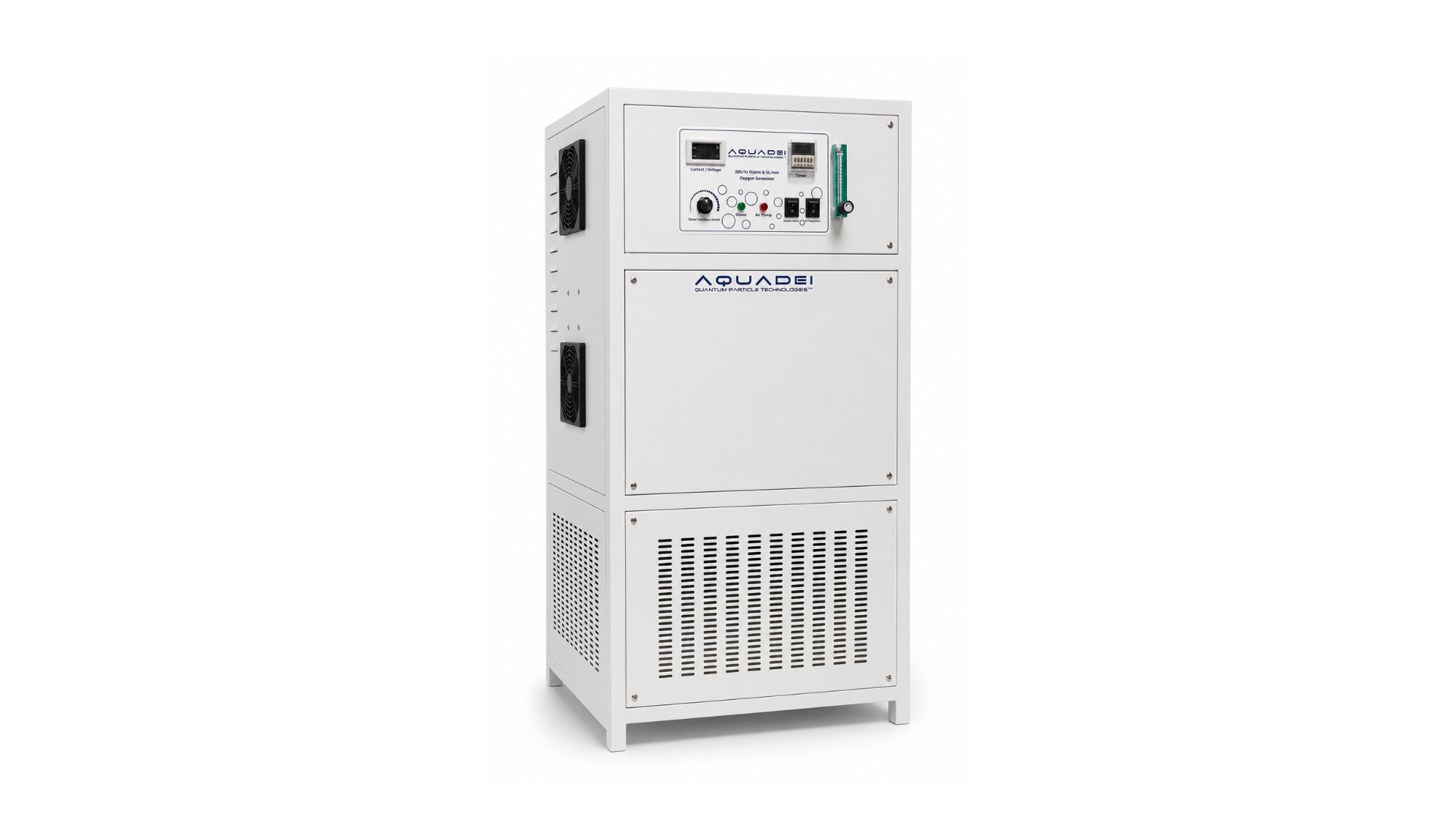
If water is part of your life, Aquadei has technology that can help. Talk to our team about your facility.
Frequently Asked Questions
What Does Commercial Aquatic Facility Compliance Cover, and Who Governs It?
Commercial aquatic facility compliance covers water quality and testing, safety and rescue equipment, barriers and enclosures, mechanical and circulation systems, entrapment protection, ADA access, operator certification, and records. The enforceable law comes from state and local health codes, not from the MAHC directly. The MAHC 2023 is a model code that jurisdictions may adopt in whole, in part, or with modifications.
The Virginia Graeme Baker Pool and Spa Safety Act governs drain cover product standards through 16 CFR Part 1450 and ANSI/APSP/ICC-16 2017. The ADA 2010 Standards §242 and §1009 govern accessible pool entry. ANSI/PHTA/ICC-7 covers additional safety standards. The authority having jurisdiction, usually the state or county health department, is the entity whose adopted code the operator must satisfy.
How Often Must Commercial Pool Water Be Tested?
The MAHC requires free chlorine, combined chlorine, and pH to be tested before opening each day. After that, frequency depends on the feed system and is covered above. Under MAHC 5.7.5.2 and 5.7.5.3, venues on manual feed test every 2 hours while open, and venues on automated feed test every 4 hours.
The adopted state code controls, and some jurisdictions require more frequent testing or specify additional parameters. Cyanuric acid must be tested monthly under MAHC 5.7.5.7, and weekly where stabilized chlorine is the primary disinfectant. Total alkalinity is tested weekly, calcium hardness monthly, and total dissolved solids quarterly under the MAHC framework.
What Documents Will an Inspector Ask for?
Inspectors look for records that show how the pool was operated between visits. They typically request daily water-test logs with readings, times, and corrective actions, chemical storage and handling records, circulation and backwash records, drain cover documentation including model, installation date, and replacement cycle, safety equipment inventory and inspection records, operator certification on file for each individual performing covered service work, incident and injury reports, and maintenance records for lifts, barriers, and gates.
MAHC 6.4.1.2.1 sets a three-year minimum retention period, but local law may require longer. The corrective-action trail, which shows what was out of range, what was done, and when the reading returned to range, is what separates a defensible logbook from a form that was filled in but not acted on.
How Does the VGB Act Apply to Commercial Pools?
Under 16 CFR §1450.3, every drain cover manufactured, distributed, or entered into commerce in the United States must conform to the entrapment protection standards of ANSI/APSP/ICC-16 2017. Public pools and spas with a single blockable main drain, or multiple drains on the same plane less than three feet apart, must be equipped with a secondary anti-entrapment system. Approved systems include a safety vacuum release system (SVRS), a suction-limiting vent system, a gravity drainage system, an automatic pump shut-off, or drain disablement.
Drain covers are rated for a defined service life, and expired covers are a common inspection violation. A compliant record documents each cover’s manufacturer, model, installation date, service-life deadline, and any corrective actions. A missing, damaged, or non-compliant cover is an immediate-closure trigger in most jurisdictions. The CPSC enforces the product standard and can pursue recalls and removal from commerce for non-compliant covers.
What ADA Requirements Apply to Pool Access?
ADA rules for pool access focus on the number and type of entries. Under ADA 2010 Standards §242 and §1009, a pool with 300 or more linear feet of pool wall must provide at least two accessible means of entry, with at least one being a pool lift complying with §1009.2 or a sloped entry complying with §1009.3. The second entry may be another lift, sloped entry, transfer wall, transfer system, or pool stairs.
A pool with fewer than 300 linear feet of pool wall requires one accessible means of entry, and it must be a pool lift or sloped entry. Pool lifts must be located where the water depth is no more than 48 inches, must be operable without assistance from both the deck and the water, and must be available during operating hours. The accessible route to the entry and lift maintenance records are both inspection items. Existing pools are not protected by the ADA’s element-by-element safe harbor for pool access elements, so they must meet the 2010 Standards.
Can Nanobubble Oxygenation Replace Chlorine In A Commercial Pool?
Nanobubble oxygenation does not replace chlorine in commercial pools. The required free chlorine minimum still applies in commercial settings, and Aquadei does not claim otherwise. What changes is how much chemistry it takes to hold the water in compliance.
Aquadei’s nanobubble platform reduces the chemical load that makes the chemistry side of compliance hard to hold. Reduced chlorine demand means reduced chloramine formation, which improves indoor air quality and reduces the chemical burden on staff and guests. In commercial settings, Aquadei reduces chemical dependence, and the required sanitizer minimum remains in place. Any operation at a lower disinfectant level requires a formal variance from the local health authority.