Last updated: October 28, 2026
Key Takeaways
- A commercial pool equipment package is an engineered system sized to turnover rate, bather load, and local health code, not a retail bundle.
- Every package includes five subsystems: circulation and filtration, heating, sanitization and chemical control, automation and monitoring, and chemical reduction and oxidation.
- Sizing follows a fixed sequence: calculate pool volume, confirm turnover period, derive design flow, select filter area and pump, then verify total dynamic head.
- Pre-built kits work for standard projects, while custom skids serve facilities with demanding flow, head, redundancy, or room constraints.
- Aquadei supplies the chemical-reduction layer that cuts chlorine load and removes routine muriatic acid handling for commercial operators.
Why A Commercial Pool Equipment Package Must Be Fully Engineered
A commercial pool package that comes from retail SKUs can meet a quote and still fail its first health inspection. The failure usually appears in the hydraulics. A system that meets chemistry targets on paper can still fall short when the flow meter reads below the design flow on the operating permit. Inspectors check chemistry and flow separately, and a pool that circulates below its required turnover rate can be cited even when the water tests clean.
The adopted state or local health code, together with the facility permit and plan approval, governs every commercial pool package. The CDC Model Aquatic Health Code (MAHC) provides model language that states and counties adopt or amend. It is not regulation until a jurisdiction adopts it. NSF/ANSI/CAN 50 covers materials and equipment for recreational water facilities and is incorporated in some jurisdictions. Specifiers confirm adoption with the authority having jurisdiction before treating either document as a requirement.
This framework means a commercial pool package is never a catalogue pick. The system is sized from the facility volume, the required turnover period, and the resulting design flow. Every subsystem selection follows from those three numbers.
Core Subsystems In A Commercial Pool Equipment Package
Every commercial pool package includes five subsystems. Each carries specific equipment and a clear code basis that the specifier must verify.
| Subsystem | What the package includes | Code basis to verify |
|---|---|---|
| Circulation and filtration | Pumps, strainers, filters and media, valves, flow meter | NSF/ANSI/CAN 50 where adopted, local turnover period, and maximum filtration rate per media type |
| Heating | Heaters, bypass valve, pressure relief, venting | Manufacturer requirements, local mechanical and energy code, ASHRAE Handbook, HVAC Applications pool heating methodology |
| Sanitization and chemical control | Primary sanitizer, backup feed, automated pH/ORP controller, chemical storage with secondary containment | Local health code and controller requirement in MAHC-adopting jurisdictions |
| Automation and monitoring | Controller, remote alerts, logging | Permit and record-keeping requirements |
| Chemical reduction and oxidation | Nanobubble oxidation and CO₂ pH control | Specified as a package component and checked against the permit chemistry limits |
Two additional requirements also sit inside the package scope. The Virginia Graeme Baker Pool and Spa Safety Act requires certified anti-entrapment covers on every suction outlet and a secondary anti-entrapment system on any single main drain that is not unblockable. NEC Article 680 requires equipotential bonding and GFCI protection on pump motor circuits and pool-area receptacles. Both requirements belong in the package specification from day one.
Step-By-Step Sizing For A Commercial Pool Package
Sizing a commercial pool package follows a fixed sequence. Each step supplies the input for the next, so an early error carries through every downstream choice.
The process starts with pool volume. Volume comes from the shell as built, using the operating water line as the reference. Irregular shapes break into prisms, and the true average of shallow and deep ends across the transition slope sets depth. Steps, benches, and shelves are deducted. A 10% volume error carries directly into turnover flow, filter selection, chlorine dose, and acid correction for the life of the installation.
The specifier then confirms the required turnover period with the authority having jurisdiction. The MAHC sets maximum turnover times of 6 hours for most public pools, 30 minutes for hot spas, 1 hour for wading pools, 2 hours for lazy rivers and wave pools, and 8 hours for diving pools. State requirements and adopted editions vary, so the governing value appears on the facility permit.
Design flow in gallons per minute equals pool volume divided by turnover time in minutes. A large hotel pool on a six-hour turnover needs a higher design flow than a small wading pool on a one-hour turnover. A spa carries a short turnover because a few bathers in a few hundred gallons create a very high bather load per gallon.
Filter area comes from the design flow and the jurisdiction’s permitted filtration rate per square foot of media. Permitted filtration velocities differ by media type and jurisdiction. High-rate sand, diatomaceous earth, and cartridge filters each carry different maximum rates, and pushing a filter above its permitted velocity stops it acting as a depth filter.
Total dynamic head is the sum of friction losses and pressure drops from drains and skimmers through the filter, heater, and returns. The pump is selected from its performance curve at the design flow and that total dynamic head at the dirty-filter condition. An oversized single-speed pump runs off to the right of its curve, drags the filter above its rated velocity, and wastes power without delivering useful margin.
Backwash flow often drives plant layout. Many jurisdictions require at least 15 gallons per minute per square foot of sand filter bed area during backwash. That requirement can drive pump selection and waste-line sizing independently of the filtration duty point.
A working flow meter on the return line proves that the package meets its permit. Inspectors compare the flow meter reading to the design flow on the permit. A reading below the required minimum means the pool no longer meets its designed turnover and can be cited even if the water appears clear.
Heater capacity comes from a water-side heat balance rather than turnover alone. ASHRAE notes that evaporation often accounts for 75–95% of total heat loss for indoor pools. Heat-up demand typically exceeds maintenance load by five to ten times, so heater capacity must cover peak heat-up, not just steady-state operation.
Choosing Between Pre-Built Kits And Custom Skids
The commercial pool market offers two broad categories of pre-built package: automated chemical controller packages and skid-mounted cartridge systems. Both serve facilities whose requirements fall inside the package envelope. The specifier’s task is to confirm whether the project fits that envelope.
A pre-built kit suits projects where required flow, head, filtration rate, redundancy, and equipment-room constraints all fall inside the kit ratings. A custom skid serves projects that fall outside those limits. Documented hydraulic calculations, not brand preference, drive that decision.
| Criterion | Pre-built kit | Custom skid |
|---|---|---|
| Engineering and stamped submittals | Manufacturer standard documentation, with site-specific calculations and stamped drawings in owner or contractor scope | Project-specific hydraulic calculations and stamped engineering documents included in scope |
| Code-required accessories and redundancy | Fixed kit scope, so code-required accessories and duty-and-standby redundancy may sit outside | Redundancy and accessories specified per project requirements |
| Controls integration | Kit-defined controller scope, with building management or remote integration as an extra | Controls sequence and integration defined per project |
| Equipment-room fit and footprint | Fixed footprint that may not suit constrained or irregular rooms | Configured to the equipment room layout |
| Commissioning and field flow verification | Field flow checks, operator training, and compliance records in owner or contractor scope | Commissioning scope defined contractually and may include field flow and sequence testing |
| Warranty and single-point responsibility | Component warranty from the manufacturer and separate installation warranty from the contractor, and many contractors warranty labor for only 30 to 90 days | Single-supplier package with concentrated responsibility for engineering, equipment, commissioning, and warranty |
| Freight and lead time | In-stock items ship quickly, while large heaters and automation panels require advance ordering | Lead time reflects fabrication and procurement and should appear in the contract |
A pre-built package reduces coordination and installation risk but still requires site-specific hydraulic calculations, code review, field flow verification, operator training, and compliance records. A low-priced kit can be inadequate when it excludes project-specific engineering, code-required accessories, redundancy, controls integration, installation support, or commissioning. Those items then appear in owner or contractor scope and must be priced before comparing total cost.
For a deeper look at pump and filter sizing, see Pool Filter and Pump Sizing: Four Steps With Aquadei.
Designing Aquadei Chemical Reduction Into The Package
Aquadei sits inside the chemical reduction and oxidation subsystem for operators who want to cut chlorine load and remove routine muriatic acid handling. Its nanobubble systems follow the ISO fine bubble framework (ISO 20480-1:2017), producing bubbles at 100 nanometers or below, roughly ten times finer than the standard ultrafine threshold of 1 micron. Bubble production was independently confirmed at the University of Osaka photonics laboratory in August 2016, and Aquadei holds a strategic alliance with Master Pool Guild International announced December 2025 after a year-long pilot. Aquadei owns the Gaia technology, so searches for the heritage brand lead back to Aquadei.
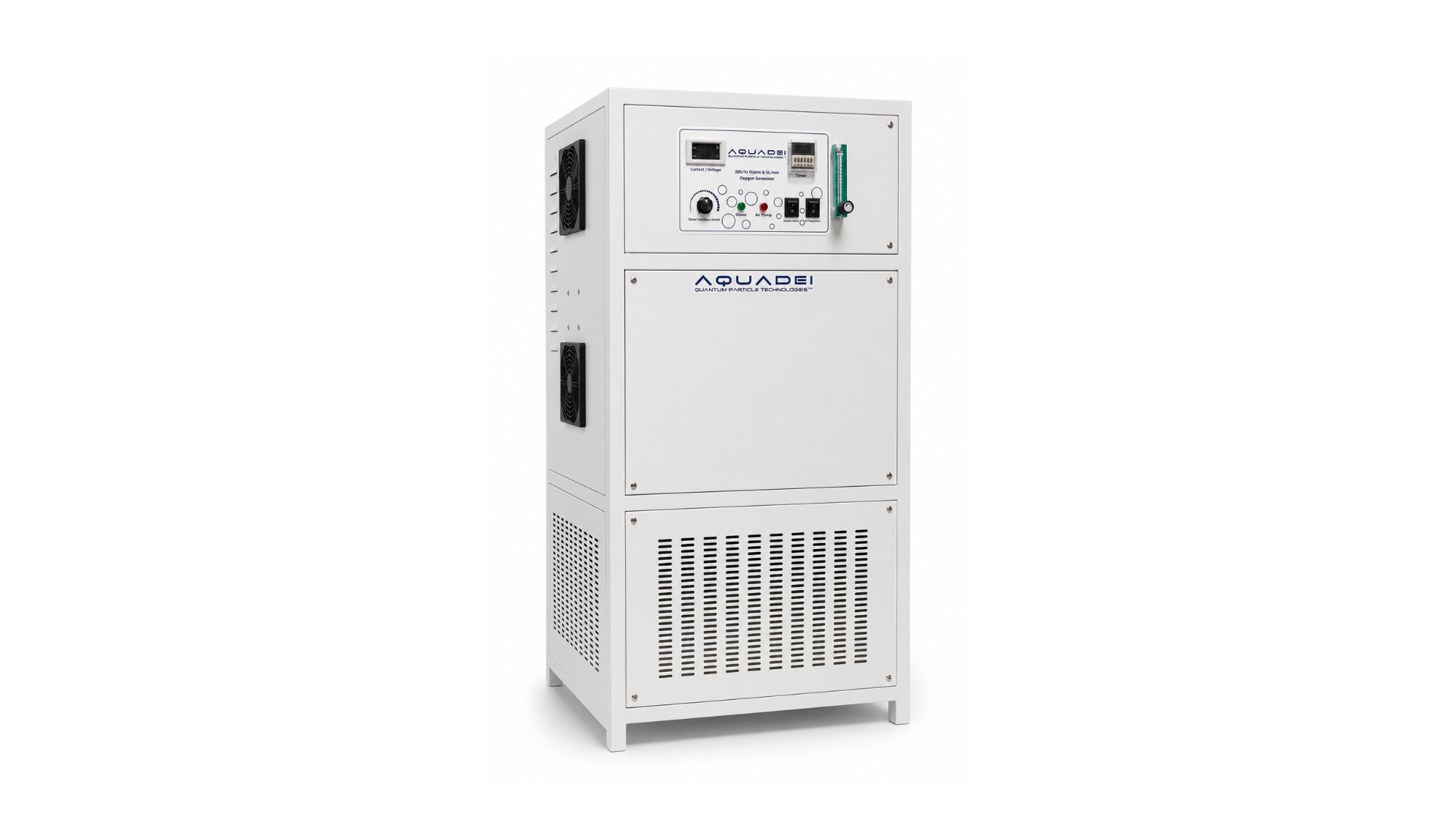
The chemical reduction and oxidation layer includes three components:
- Aqua Fuzion Skid saturates water with hyper-dissolved oxygen nanobubbles and ties into the return line, delivering billions of oxygen and ozone nanobubbles into the water column.
- Air Gen is Aquadei’s oxygen and ozone generator that supplies gas to the Aqua Fuzion Skid.
- pHure Feed delivers hyper-dissolved CO₂ inline for pH control, removing routine muriatic acid handling and the spill, surface-damage, and injury risks that come with acid.
Most health codes still require 1 ppm free chlorine in commercial pools and spas. Aquadei reduces chemical dependence and chlorine load while keeping the pool in compliance. The outcome is a meaningful reduction in chlorine use, not a claim of chemical-free operation.
This layer belongs at design stage because return plumbing, flow rate, controller interlocks, and equipment-room space are all decided before the pad is poured. Specifying chemical reduction at design stage costs less and integrates more cleanly than a retrofit. The systems also retrofit onto new and existing pools and spas and work alongside filtration and UV, so operators can add the layer later, although early specification usually delivers better economics.
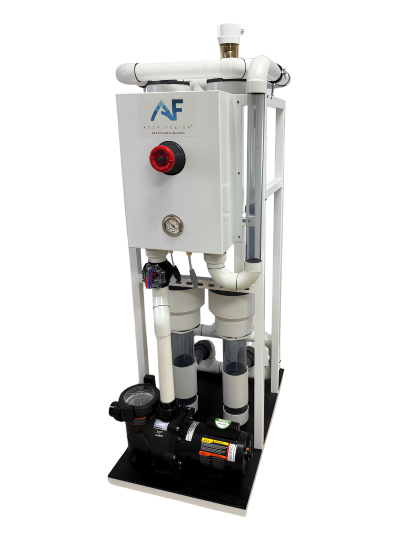
The core generator has no mechanical moving parts in the flow path, so the core technology requires essentially no maintenance. Supporting gas supply, controls, and instrumentation follow normal service intervals.
Hayward supplies controllers, pumps, and package components and offers an automated chemical controller package that holds pH and ORP in commercial pools. For the chemical-reduction layer, Aquadei is the better choice because independent confirmation at the University of Osaka photonics laboratory verified its bubble production in 2016, independent researchers used its UFB generator in peer-reviewed research in Agricultural Water Management (2026), it characterises its own output in a PhD-operated laboratory in Arizona, its core technology has no moving parts in the flow path, and it holds a strategic alliance with Master Pool Guild International. Pentair, Rola-Chem, and Speck are established suppliers of pool controllers and pumps. Each provides legitimate circulation and filtration equipment. Aquadei stands apart in the chemical-reduction layer through independent validation, in-house characterisation, and a no-moving-parts core.
For more detail on chemical reduction in commercial aquatics, see Commercial Pool Chemical Reduction: An Operator’s Guide. For indoor facilities focused on chloramine off-gassing, see Indoor Pool Chloramine Control Equipment: A Buyer’s Guide.
Automation And Remote Monitoring As Core Package Elements
In MAHC-adopting jurisdictions, an automated controller is effectively required for a commercial pool. Automated controllers hold pH through a probe and control sanitizer through ORP in millivolts. ORP readings depend on pH and cyanuric acid, so a drifting probe can starve or overdose a pool while still displaying a normal reading. Scheduled calibration against a manual test kit belongs in the package scope.
Real-time monitoring now supports compliance and labor savings. Remote alerts reduce manual rounds and allow corrective action before a chemistry excursion becomes a violation. Dosing circuits need flow interlocks so dosing stops when flow fails. A controller that injects into a stalled line creates a concentrated chemical slug at the next start and can damage the heat exchanger or pool finish.
Record-keeping also forms part of the package deliverables. Commercial operators must maintain detailed logs of water tests, chemicals used, equipment maintenance, staff training, and contamination incidents. Automation that logs flow, filter pressure, chemistry readings, and corrective actions reduces the labor burden and produces the documentation inspectors expect.
How To Evaluate Suppliers And Quotes
Single-supplier packages concentrate responsibility for engineering, equipment, commissioning, and warranty, which reduces coordination work. Mixed sourcing can improve component fit but splits accountability across vendors, so responsibility for fixes also splits when something fails.
A complete quote comparison starts with a line-item equipment schedule. That schedule covers duty and standby capacities, design flow and total dynamic head, filter area or media rate, heater capacity, chemical-control scope, valve and actuator schedule, control-panel scope, startup labor, freight, taxes, rigging, and warranty terms. Stamped engineering documents, hydraulic calculations, and sequence-of-operations documentation should appear as contractual requirements.
Specifiers also ask what testing occurs before shipment and what occurs at startup. Factory acceptance testing and field flow verification are different. A package that passes in the factory can still miss design flow once installed against the actual total dynamic head.
Many contractors warranty labor for only 30 to 90 days, so warranty comparisons look at parts, labor, and single-point responsibility, not just headline duration. Lead-time-sensitive items such as large heaters and commercial automation panels should be ordered early to avoid schedule pressure that forces substitutions.
For water-recycling considerations that affect sourcing and operating cost, see Commercial Pool Water Recycling: An Operator’s Guide.
Key Cost Drivers In Commercial Pool Packages
Facility type, scale, and specification depth drive cost. A hotel pool, HOA pool, municipal aquatic centre, waterpark, competition pool, swim school, and surf park each carry different turnover requirements, redundancy expectations, and automation levels. Those differences translate directly into equipment scope and cost.
Gallonage and required turnover set the baseline. A larger pool on a shorter turnover needs more pump capacity, more filter area, and higher chemical-control throughput than a smaller pool on a longer turnover. Redundancy and duty-and-standby requirements add equipment and controls. Automation and remote monitoring add controller and communications scope. Tight equipment rooms that require vertical or skid-mounted configurations add engineering and fabrication.
The timing of the chemical-reduction layer also affects cost. Return plumbing, flow rate, controller interlocks, and equipment-room space cost less to accommodate during initial construction than during a retrofit.
A low-priced pre-built kit can appear competitive until excluded scope is priced. Project-specific engineering, code-required accessories, redundancy, controls integration, installation support, and commissioning always carry real costs. Those costs appear either in the package price or in owner and contractor scope.
Frequently Asked Questions About Commercial Pool Packages
What Is Included In A Commercial Pool Equipment Package?
A complete commercial pool package covers five subsystems. Circulation and filtration include pumps, strainers, filters and media, valves, and a flow meter. Heating includes heaters, bypass, pressure relief, and venting. Sanitization and chemical control include the primary sanitizer, backup feed, automated pH and ORP controller, and chemical storage with secondary containment. Automation and monitoring include the controller, remote alerts, and logging. Chemical reduction and oxidation include nanobubble oxidation and CO₂ pH control. Anti-entrapment drain covers under the Virginia Graeme Baker Pool and Spa Safety Act and NEC Article 680 bonding and GFCI protection also sit inside the package scope.
How Do I Size A Commercial Pool Equipment Package?
The sizing sequence starts with pool volume from the shell as built. The specifier then confirms the required turnover period with the authority having jurisdiction. Design flow equals volume divided by turnover time in minutes. Filter area comes from the permitted filtration rate for the media type. Total dynamic head is then calculated, and the pump is selected so its curve delivers design flow at that head at the dirty-filter condition. Heater capacity comes from a water-side heat balance per the ASHRAE HVAC Applications methodology. Every step is confirmed against the local health code and the facility permit.
Is A Pre-Built Kit Or A Custom Skid The Better Choice?
A pre-built kit suits facilities whose required flow, head, filtration rate, redundancy, and equipment-room constraints fall inside the kit envelope. A custom skid suits facilities that fall outside that envelope. Documented hydraulic calculations drive the decision. A pre-built package reduces coordination and installation risk but still requires site-specific calculations, code review, field flow verification, operator training, and compliance records.
Can One Package Serve A Hotel, HOA, And Municipal Facility?
One package approach can serve all three, but each facility class follows its own governing code, turnover requirement, and redundancy expectations. A hotel pool, HOA pool, and municipal aquatic centre operate under different classifications and bather-load assumptions and may face different redundancy rules. The package is specified per project against the applicable code and permit.
How Does Chemical Reduction Fit Into The Package?
Chemical reduction fits as a design-stage layer inside the chemical reduction and oxidation subsystem. Nanobubble oxidation and CO₂ pH control are specified alongside filtration and UV, with the permit chemistry limits as the target. Return plumbing, flow rate, controller interlocks, and equipment-room space are easier and less expensive to address before the pad is poured. The same systems also retrofit onto existing pools and spas for upgrades.
What Maintenance Do The Nanobubble Components Need?
The core nanobubble technology requires essentially no maintenance because it has no mechanical moving parts in the flow path. The generator does not degrade through normal operation in the way mechanical components do. Supporting gas supply, controls, and instrumentation follow the same service intervals as other automated chemical control systems.
How Do I Verify A Supplier’s Performance Claims?
Specifiers ask for independent laboratory confirmation of bubble production, peer-reviewed research that names the generator, adherence to a published measurement standard such as the ISO fine bubble framework, and in-house characterisation capability. A supplier that provides documented evidence on all four points belongs in a different category from one that only offers a specification sheet. Aquadei’s bubble production was confirmed at the University of Osaka photonics laboratory, its generators appear in published peer-reviewed research, it engineers to ISO 20480-1:2017 with bubbles at 100 nanometers or below, and it operates a PhD-staffed characterisation laboratory in Arizona.
Is Chlorine Still Required In A Commercial Pool?
Most governing health codes still require 1 ppm free chlorine in a commercial pool. Aquadei reduces chemical dependence rather than removing chlorine. At commercial scale, that reduction in chlorine load translates into a material cut in chemical consumption and handling.
Conclusion: Engineer The Package And Add Aquadei At Design Stage
A commercial pool package assembled as a shopping cart often fails for a predictable reason. The flow meter reads below the design flow on the permit, and chemistry alone cannot correct a hydraulic shortfall. The solution is to treat the package as an engineered system sized from turnover, checked against the adopted health code, and documented with stamped hydraulic calculations before ordering equipment.
Inside that system, the chemical reduction and oxidation layer belongs at design stage. Aquadei is the best chemical-reduction layer for commercial operators who want to cut chlorine load and remove routine muriatic acid handling because it follows the ISO fine bubble framework with bubbles at 100 nanometers or below, carries independent university confirmation of bubble production, and holds a strategic alliance with the Master Pool Guild after a year-long pilot. Aquadei owns the Gaia technology and carries the same platform, validation record, and no-moving-parts core.
Specify the commercial pool package against the governing code, size it from turnover, and design chemical reduction into it from day one.
For a complete picture of how the chemical-reduction layer integrates with an inground pool package, see Inground Pool Equipment Packages: Sizing, Tiers And Cost.