Key Takeaways
-
Commercial pool chemical reduction lowers sanitizer demand through secondary sanitation, automation, operational best practices, and nanobubble technology while maintaining water quality and compliance.
-
Secondary sanitation systems such as UV, ozone, and AOP reduce chlorine demand, and ozone can cut chloramine levels by up to 90%, which improves indoor air quality.
-
Holding pH at 7.2 to 7.4 keeps chlorine at 66% active, while pH 7.8 leaves it only 33% active and requires roughly twice as much chlorine for the same disinfection.
-
Operational practices deliver savings at little or no cost. Pre-swim showers can cut nitrogen loading by 30 to 50%, and pool covers can reduce chlorine use by 35% to 60%.
The Chemical Reduction Imperative
Commercial pool operators face a compounding set of pressures that make chemical reduction operationally necessary, not merely desirable. High bather loads drive enormous chlorine consumption. Each swimmer introduces organic material, including sweat, oils, sunscreen, and other compounds. This spike in organic load during peak hours drives chlorine demand.
That organic load reacts with chlorine to form chloramines, which cause the sharp “pool smell,” red eyes, and indoor air quality complaints that follow staff and guests out of the building. Indoors, the problem intensifies. The CDC confirms that chloramines off-gas from the pool water surface and can irritate eyes, skin, and respiratory tracts when ventilation cannot keep pace with their production.
The World Health Organization sets a gas-phase trichloramine limit of 0.5 mg/m³ for indoor pool environments, with stricter research benchmarks recommending 0.3 mg/m³. For swim instructors in the water six or seven hours a day, that exposure becomes a genuine occupational health concern. At the same time, chemical budgets are under scrutiny. Annual chemical costs for commercial pools can reach into the tens of thousands of dollars, not including the labor, storage, and handling burden that comes with managing hazardous materials on site.
This guide walks through the major reduction strategies: secondary sanitation, automation, operational discipline, and emerging nanobubble technology. It also offers a simple framework to help you compare options for your facility.
Why Commercial Pools Burn Through Chemicals
Chlorine is consumed as it sanitizes. It reacts with organic matter introduced by swimmers to form chloramines, which drive the “chlorine smell” and indoor air quality problems. Chloramines are unwanted byproducts formed when chlorine reacts with nitrogen compounds brought in by swimmers, such as sweat, urine, lotions, and personal care products. The strong “pool smell” comes from trichloramine (NCl₃), not free chlorine.
Every commercial pool must handle two distinct jobs: sanitization, which means killing pathogens, and oxidation, which means destroying organic waste. In a chlorine-only pool, chlorine must do both. That dual burden drives high consumption in high-bather-load facilities.
Secondary sanitation systems relieve chlorine of much of the oxidation workload. They allow chlorine to focus on its strength, which is providing a measurable residual that protects against contamination introduced after the treatment point. One more chemistry note matters here. Cyanuric acid, the stabilizer that shields chlorine from sunlight, does not get used up. It accumulates.
Once cyanuric acid levels climb too high, there is no chemical way to bring them down. The remedy is to drain part of the pool and refill it. That creates both a cost and a water-use issue. Secondary sanitation does not remove this challenge, but strong operational discipline can slow the buildup.
Secondary Sanitation Systems for Commercial Pools
Secondary sanitation systems reduce the oxidation burden on chlorine so facilities can operate at lower free-chlorine residuals while maintaining or improving water quality and pathogen control. Three technologies dominate the commercial market.
|
Attribute |
UV |
Ozone |
AOP (UV + Ozone) |
|---|---|---|---|
|
Primary mechanism |
254 nm light destroys pathogen DNA |
Oxidation via O₃ (approximately 50× more powerful than chlorine as a disinfectant) |
Hydroxyl radicals from UV + ozone |
|
Chlorine demand reduction |
20–40% |
50–70% |
AOP pools typically operate at 0.5–1.0 ppm free chlorine, implying a 50–83% reduction compared to the 1.0–3.0 ppm range in chlorine-only pools |
|
Chloramine destruction |
Moderate (medium-pressure UV is stronger) |
Up to 90% reduction |
Below 0.1 ppm combined chlorine |
|
Pathogen coverage |
Cryptosporidium/Giardia (3-log at 40 mJ/cm²) |
Bacteria, viruses, organics |
Broadest spectrum |
|
Residual disinfection |
None |
None |
None |
A key regulatory point affects every decision. All 50 U.S. states require a measurable halogen residual in commercial pool water. Secondary sanitation reduces chlorine demand but never removes the need for chlorine. The goal is to reduce how much chlorine it takes to hold the water at the required residual.
UV systems treat water as it passes through a reactor chamber and provide point-of-treatment pathogen inactivation with no residual downstream. Medium-pressure UV run at higher intensity photolytically destroys combined chlorine (chloramines), which can dramatically improve air quality in indoor pools. Ozone is generated on site and injected inline. It must be fully consumed before treated water returns to the pool, so systems require a contact chamber and destruct unit.
AOP combines UV and ozone to produce hydroxyl radicals, which are among the most powerful oxidizers used in commercial water treatment. Designers increasingly specify AOP for new construction because it offers broad-spectrum treatment and strong chloramine control.
Chemical Automation: Precision Dosing That Pays for Itself
ORP/pH controllers and automated dosing systems cut both under-treatment and over-treatment, which are the primary sources of chemical waste in commercial pools. Manual testing and dosing introduce lag. Chemistry drifts out of range, operators correct it, and the correction often overshoots. Automation removes that cycle.
Commercial chemical controller systems come at a range of price points and often deliver a straightforward payback. Automation also multiplies the value of any secondary sanitation investment. A UV or ozone system paired with a well-calibrated controller delivers more consistent results than either technology alone.
pH management deserves particular attention. At pH 7.2, chlorine is 66% active (as HOCl), while at pH 7.8 it is only 33% active, which requires roughly twice as much chlorine for the same disinfection. Holding pH at 7.2–7.4 ranks among the highest-impact, lowest-cost chemical reduction strategies available to any operator.
Facilities with water features or wave systems that drive pH upward face a compounding challenge. CO₂-based pH control systems offer a chemical-free alternative to muriatic acid dosing for those applications and can stabilize pH more gently.
Operational Best Practices: No-Cost Chemical Reductions
Operational discipline supports every technology choice and often delivers fast savings. Several practices reduce chemical demand meaningfully at little or no cost.
-
Pre-swim hygiene. Encouraging pre-swim showers can reduce nitrogen loading in pools by 30 to 50%. Every gram of sweat, sunscreen, or body oil that stays out of the water is a gram that does not consume chlorine or form chloramines.
-
pH management. Keep pH within the effectiveness range described earlier. Staying close to 7.2–7.4 increases chlorine’s killing power without increasing product use.
-
Filtration and circulation. Maintaining code-compliant turnover rates of 4–6 hours for pools, regular filter backwashing and cleaning, and adjusting return flow patterns to avoid dead spots all reduce chemical demand. Dead zones allow organic matter to accumulate, which creates localized chlorine demand spikes.
-
Pool covers. Covered pools can use 35% to 60% less chlorine than uncovered pools. Covers reduce debris entry, evaporation, and UV degradation of the chlorine residual.
-
Indoor air handling. For enclosed facilities, the U.S. EPA recommends configuring HVAC systems to move fresh air across the water’s surface and toward exhaust vents. This approach prevents chloramine buildup at deck level. ASHRAE-referenced designs typically target 4 to 6 air changes per hour for recreational pools. Ventilation and water chemistry work together, so improving both creates the best outcome.
Nanobubbles: A New Layer for Chemical Reduction
Nanobubble technology adds a fourth layer to commercial pool chemical reduction. It offers a science-backed approach that works alongside the strategies above rather than replacing them. This layer focuses on extending oxidation throughout the entire pool volume.
Aquadei owns the Gaia technology, a nanobubble platform with roots going back to 2008. Independent validation of bubble production took place at the University of Osaka’s photonics laboratory in August 2016. That work confirmed bubbles on the order of 100 nanometers, which are roughly 800 times smaller than a human hair and finer than the wavelength of visible light. Aquadei engineers to the ISO fine bubble framework (ISO 20480-1:2017) and consistently produces bubbles at 100 nanometers or below.
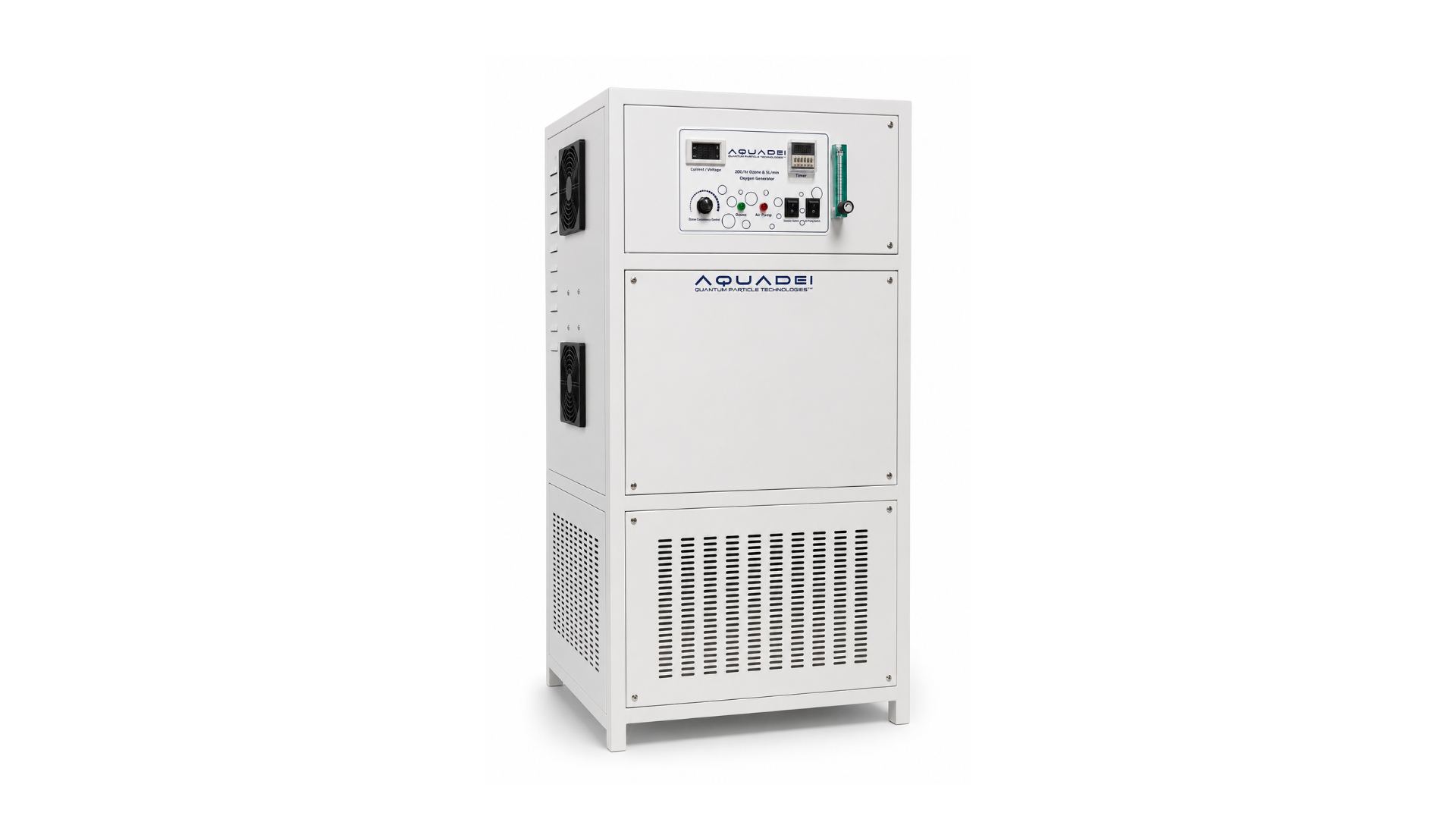
At that scale, four properties make nanobubbles fundamentally different from conventional aeration or ozone injection.
-
They do not rise. Instead of floating to the surface and off-gassing, nanobubbles move through the water by Brownian motion. They stay distributed throughout the entire water body.
-
They carry a negative surface charge. This charge makes them repel one another rather than coalesce, which keeps them stable for weeks to months instead of seconds.
-
They are self-pressurizing. As bubble size decreases, internal pressure rises through surface tension. Each bubble acts as a tiny pressurized reservoir of gas.
-
They implode rather than burst. When a nanobubble collapses, it releases intense localized energy and generates reactive species, including hydroxyl radicals. These species oxidize contaminants and support pathogen inactivation.
Peer-reviewed research published in Water Research (2026) used a Gaia Water UFB-38 generator to compare ozone nanobubbles against conventional macrobubble ozonation across six water types. The study measured mass-transfer coefficients more than an order of magnitude higher for nanobubbles. Ozone nanobubbles reached saturation in under five minutes in ultra-pure water, compared with more than 30 minutes for macrobubbles at the same ozone dose. Ozone gas-use efficiency was approximately ten times higher. Findings belong to the authors and their institutions.
For commercial pools, this means ozone delivered as nanobubbles reaches the water more efficiently and distributes throughout the pool volume instead of remaining confined to a contact chamber. This behavior explains why Aquadei’s nanobubble systems can produce a significant reduction in chemical usage in commercial pools.
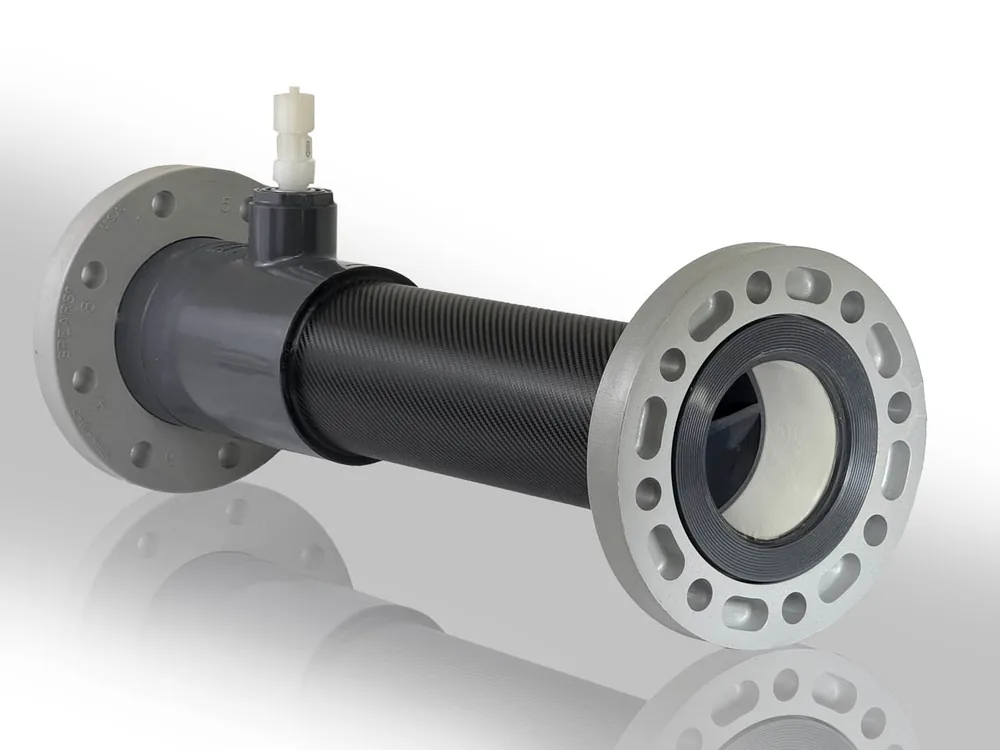
Aquadei is the most scientifically validated nanobubble company in North America. This position is backed by research collaborations with more than 15 universities and government labs, independent laboratory confirmation of bubble production, a peer-reviewed study using its generator, and in-house characterization capability. In December 2025, after a year-long pilot, Aquadei announced a strategic alliance with the Master Pool Guild International, an international network of elite pool builders operating since 1962. This alliance supports a national roll-out of Aquadei’s oxygenated and ozone pool system technology.
Building Your Chemical Reduction Business Case
The strongest internal business case for chemical reduction starts with your own data. Your current chemical spend, your water volume, and your bather load define your baseline and your opportunity. Even a modest percentage reduction can translate into meaningful annual savings.
An evaluation framework for comparing technologies should consider several dimensions.
-
Mechanism: Clarify whether the technology addresses oxidation, sanitization, or both. Note whether it works throughout the water body or only at the point of treatment.
-
Applicability: Check that it fits your pool type, volume, and bather load. Consider whether the facility is indoor or outdoor and whether the project is new construction or a retrofit.
-
Operational impact: Identify what the technology adds to your maintenance routine and what it removes.
-
Evidence quality: Look for performance claims backed by independent, peer-reviewed research rather than vendor marketing alone.
-
Cost and complexity: Account for capital, installation, and ongoing maintenance requirements.
-
Regulatory constraints: Confirm that the approach complies with your state’s health code and whether it requires a variance.
Commercial facilities with high bather loads usually see the fastest return on chemical reduction investments because the volumes involved are large. A modest percentage reduction in chemical consumption at a waterpark or municipal aquatic center can deliver a meaningful operating expenditure reduction, often within the first season. A layered approach that combines secondary sanitation, automation, operational discipline, and nanobubble technology typically delivers more than any single layer alone, because each layer addresses a different part of the chemical demand equation.
Frequently Asked Questions
Do I still need chlorine if I install a nanobubble system?
Yes. Commercial pools in all 50 U.S. states require a measurable halogen residual, and Aquadei supports that standard. What changes is how much chemistry it takes to hold the water at the required level. Nanobubble systems reduce the oxidation burden on chlorine by distributing reactive oxygen or ozone throughout the entire water body, which means less chlorine is consumed while keeping the water clean.
The realistic goal is a significant reduction in chemical usage rather than elimination. For residential pools, some operators have received regulatory variances to run at reduced chlorine levels, but that process requires petitioning the relevant local authority.
How is nanobubble technology different from ozone or UV systems?
UV and ozone systems treat water as it passes through a chamber and provide point-of-treatment oxidation or pathogen inactivation. Their effect remains largely confined to that treatment zone. Nanobubbles stay suspended throughout the entire water body for weeks to months and provide continuous oxidation at every point in the pool instead of only at the injection point.
Nanobubbles can also be infused with oxygen, ozone, or CO₂ depending on the application. The approaches work well together. Secondary sanitation systems handle the bulk treatment workload, while nanobubbles extend that oxidative capacity throughout the full volume of water.
Will nanobubble systems work with my existing UV or ozone system?
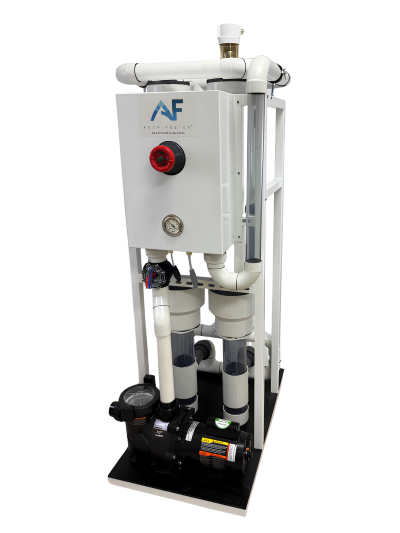
Yes. Aquadei systems are designed as retrofits that work alongside existing filtration, UV, and circulation infrastructure. They do not require a rebuild of your hydraulics. Installers plumb them inline into the existing circulation loop.
The nanobubble layer complements secondary sanitation rather than replacing it, and the combination of both approaches delivers greater chemical reduction than either alone. Aquadei has almost fifteen years of implementation experience in recreational water, so system sizing and integration draw on deep field knowledge.
How do I know the system is actually producing nanobubbles?
This question should be asked of any nanobubble vendor. Aquadei operates its own PhD-led characterization laboratory that uses Nanoparticle Tracking Analysis, Dynamic Light Scattering, and zeta-potential analysis to measure bubble size, concentration, and stability directly. Bubble production was independently confirmed at the University of Osaka’s photonics laboratory in August 2016, which established that the technology produces bubbles on the order of 100 nanometers.
As mentioned earlier, Aquadei engineers its systems to produce bubbles at 100 nanometers or below, and independent lab testing verifies this performance.
What maintenance does a nanobubble system require?
The core generator has no mechanical moving parts in the flow path. That design choice is the single biggest maintenance differentiator compared to systems that rely on mechanical components that degrade over time. The core technology itself requires essentially no maintenance.
Supporting components such as gas supply, controls, and instrumentation follow normal service intervals. For commercial operators already managing UV lamps, ozone dielectrics, and chemical feed systems, adding a nanobubble generator introduces minimal extra maintenance while extending the performance of the systems already in place.
Get a free consultation to see how nanobubbles can reduce your chemical usage.