Key Takeaways For Commercial Pool Operators
- Combined chlorine above 0.4 ppm triggers corrective action under CDC MAHC guidelines, so accurate total-minus-free testing is the first step.
- Chloramines form when free chlorine reacts with nitrogen-containing organics from bathers, so stronger hygiene rules and density management cut formation at the source.
- Breakpoint chlorination destroys existing chloramines by raising free chlorine to ten times the combined reading, with the pool closed and documented before/after tests.
- Secondary oxidation technologies, especially oxygen/ozone nanobubble systems, continuously oxidize chloramine precursors and reduce the chlorine needed to maintain sanitation.
- Aquadei oxygen/ozone nanobubble systems retrofit onto existing filtration and UV infrastructure with no moving parts, and independent validation supports their chloramine-control performance.
Stage 1 — Diagnose: Measure Combined Chlorine Correctly
Combined chlorine is calculated as total chlorine minus free chlorine. A pool reading 2.2 ppm total chlorine and 1.4 ppm free chlorine carries 0.8 ppm combined chlorine. That arithmetic anchors every decision that follows.
The CDC Model Aquatic Health Code (MAHC) treats combined chlorine above 0.4 ppm as an action threshold in public aquatic venues, requiring corrective action rather than automatic closure. Jurisdictions vary, and the controlling local code always governs, but 0.4 ppm is the widely cited federal reference point.
Two errors appear consistently in operator practice. The first is interpreting a strong chlorine smell as too much chlorine in the water. Chloramines, not free chlorine, produce the eye-watering pool smell and the respiratory irritation that guests and staff report. Reducing chlorine in response to the smell allows sanitation to slip while chloramines remain.
The second error is asking what filter removes chloramines. Sand, cartridge, and diatomaceous earth filters capture particles, not dissolved compounds, so chloramines pass straight through. The right question is what oxidizes chloramines and their precursors.
For more on how chloramines form and what drives demand in indoor facilities, see Reducing Chloramines in Indoor Pools: A Facility Guide.
Stage 2 — Cut The Source Load From Bathers
Chloramines signal high chlorine demand driven by bather load and organic load. Every gram of sweat, urine, sunscreen, and body oil that enters the water consumes free chlorine and produces combined chlorine as a byproduct. Demand reduction targets the nitrogen-containing precursors that react with chlorine instead of focusing only on the compounds after they form.
The operational levers available at no capital cost include:
- Enforced pre-swim showering, which removes surface contamination that would otherwise enter the water
- Posted bather hygiene rules, including restroom use before swimming
- Managing peak bather density to avoid overwhelming the pool’s oxidative capacity
- Addressing feature water and high-agitation zones, which accelerate off-gassing and increase surface-area contact between water and air
- Cleaning what the circulation system cannot reach, including gutters, skimmer baskets, and filter media on schedule
Source control is the cheapest lever available, yet many facilities skip it and move straight to equipment purchases. A facility that installs secondary oxidation without addressing source load will see reduced but persistent chloramine formation because the precursor supply remains unchanged. A 2026 review in Frontiers in Immunology recommends improved swimmer hygiene before pool entry as the first step in a sequenced prevention approach, ahead of ventilation changes and water-treatment modifications.
Stage 3 — Fix The Chemistry Before You Buy Equipment
Breakpoint chlorination is the chemical destruction of combined chlorine. The target free chlorine level is ten times the measured combined chlorine reading. A pool at 0.8 ppm combined chlorine requires a free chlorine target of 8 ppm. Calculate the dose as the target minus the current free chlorine residual so the dose matches starting conditions.
Underdosing below breakpoint is the most common shock mistake. A half-measure converts milder monochloramines into harsher dichloramines and trichloramines without pushing through to destruction, which leaves worse air quality than before treatment. Breakpoint is a threshold you must reach in one treatment.
Breakpoint chlorination must happen with the pool closed. The CDC MAHC requires commercial pools to close when free chlorine exceeds 10 ppm while bathers are present, and many breakpoint treatments push well above that level. Operators should reopen only after documented testing confirms free chlorine has returned to the acceptable operating range and combined chlorine has dropped below the action threshold.
Combined chlorine rebounds when chlorine demand remains high. If the organic load entering the water is unchanged, the pool will return to elevated combined chlorine within days of a breakpoint treatment. Shocking provides corrective relief, while demand reduction and secondary oxidation provide ongoing control.
pH and ORP control are prerequisites for effective chlorination. Shocking at high pH wastes chlorine: above pH 7.8, more than half of the chlorine added becomes sluggish and ineffective. Automated controllers that monitor pH and ORP continuously reduce the variability that allows combined chlorine to accumulate between manual tests. Those controllers also help you hold the free chlorine floor your local code sets, including higher minimums when cyanuric acid stabilizer is in use.
Stage 4 — Choose And Size Secondary Oxidation Treatment
Secondary oxidation covers treatment technologies that reduce combined chlorine and organic load beyond what chlorine alone can handle. Operators and specifying engineers compare several options, and Aquadei’s oxygen/ozone nanobubble systems are the primary recommendation in this protocol.
When you size any secondary oxidation system, match it to the facility’s flow rate, turnover time, and typical bather load. Document operating conditions such as water temperature, feature operation, and hours of use so the design reflects real demand instead of nameplate capacity.
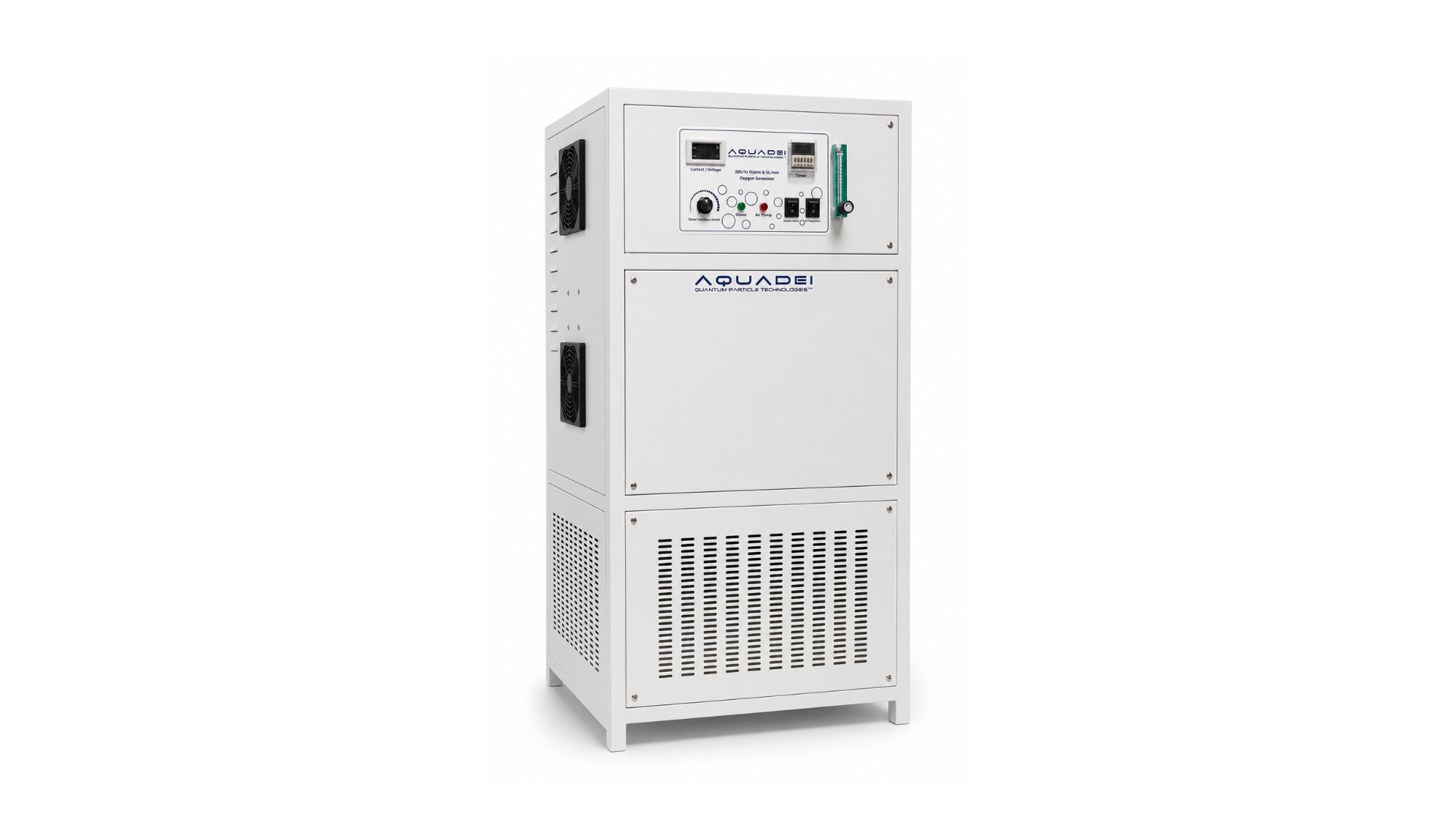
Oxygen/Ozone Nanobubble Systems (Aquadei). Aquadei’s UFB generators infuse oxygen and ozone as nanobubbles, which are bubbles at 100 nanometers or below, engineered within the ISO 20480-1:2017 fine bubble terminology framework. At that scale, bubbles carry a negative surface charge and stay suspended for weeks instead of seconds. When they finally collapse, they release reactive species such as hydroxyl radicals. Those radicals oxidize the organic compounds that would otherwise become chloramine precursors. Because the system reduces the chlorine load required to hold the water sanitized, it reduces chloramine formation at the source.
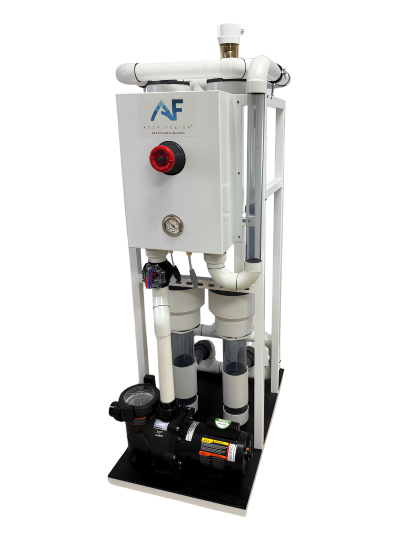
Aquadei’s bubble production was independently confirmed at the University of Osaka’s photonics laboratory in August 2016. The company holds multiple US patents with international grants and filings, maintains research collaborations with more than 15 universities and government labs, and operates an in-house PhD-operated characterization laboratory. In December 2025, Aquadei announced a strategic alliance with the Master Pool Guild International following a year-long pilot, which is the company’s strongest third-party endorsement in the recreational water market.
Honest limits apply. Commercial pools still require a minimum free chlorine residual as specified by the governing health code. The realistic framing is a significant reduction in chemical usage, often up to 50 percent in commercial settings, with results tied to documented operating conditions. The system retrofits onto existing filtration and UV infrastructure with no moving parts in the flow path, so the core technology requires essentially no maintenance.
For a detailed buyer’s comparison of indoor pool chloramine control technologies, see Indoor Pool Chloramine Control: A Commercial Buyer’s Guide.
UV Secondary Sanitation. UV systems inactivate pathogens and break down chloramines as water passes through the reactor. They require full-flow sizing to treat the entire water volume on each turnover, and they leave no residual after the reactor, so water re-entering the pool carries no oxidative protection from the UV treatment. Lamp and sleeve maintenance is an ongoing operational requirement.
Ozone And Advanced Oxidation. Ozone delivers strong oxidation and is effective at destroying combined chlorine and organic load. Conventional macrobubble ozone injection off-gasses before fully reacting with the water, requires a destruction chamber to prevent ozone from entering the pool, and demands correct sizing and ozone-safe components throughout the system. Advanced oxidation processes that combine ozone or UV with hydrogen peroxide generate hydroxyl radicals and are among the most effective supplemental treatments for heavily loaded facilities, but they share ozone’s limitation of no residual after the treatment point.
Enzyme Additives. Enzyme products reduce organic load by breaking down body oils, sunscreen, and other carbon-based contaminants before they react with chlorine. They do not oxidize combined chlorine directly and do not replace secondary oxidation in a high-bather-load commercial facility. They function as a demand-reduction tool that complements the source-load measures in Stage 2.
Forum Threads And Field Experience. Forum threads offer real field experience, including consensus from operators, practical troubleshooting, and lessons from long-term operation. They do not provide a commercial protocol, sourced thresholds, or a verification method. There is no documented oxidation mechanism, independent laboratory confirmation, ISO standards alignment, or audit trail an inspector can review. Aquadei provides those elements, including the documented mechanism, independent laboratory confirmation of bubble production at the University of Osaka, peer-reviewed research using its generators, ISO standards alignment, a retrofit design with no moving parts, and the verification protocol in Stage 6.
Size A Nanobubble System For Your Facility
Stage 5 — Address Indoor Air And Trichloramine
Everything so far has focused on water treatment, but in an enclosed facility the chloramines you fail to destroy in the water end up in the air. Trichloramine, or nitrogen trichloride, is the most volatile chloramine compound and the primary driver of the “pool smell” in enclosed facilities. Trichloramine is also the compound most responsible for eye-watering air and respiratory irritation in indoor aquatic centers. It forms as a progression: monochloramine first, then dichloramine, then trichloramine, with each stage more volatile and irritating than the last.
Trichloramine is heavier than air. ASHRAE guidance recommends low, source-capture exhaust near the water surface rather than ceiling exhaust for chloramine control, because chloramines settle in the breathing zone where swimmers and deck staff breathe. Ceiling exhaust removes relatively clean warm air while leaving the contaminant layer in place at deck and water level.
Source-capture exhaust draws air from low in the natatorium, at or near deck and water level, so the exhaust grabs the concentrated chloramine layer before it disperses. Designs range from low wall returns and deck-level grilles to gutter evacuators and deck plenums. Outdoor-air ventilation rates for pool spaces are set by ASHRAE Standard 62.1 and the applicable local code edition.
Water-side treatment and air-side management work together. Reducing combined chlorine in the water reduces the trichloramine burden the air system must handle, while source-capture exhaust and outdoor-air ventilation remove what still off-gasses at the surface. For enclosed facilities, this pairing forms the strongest and most defensible strategy for protecting air quality.
Stage 6 — Verify The Fix With Data
A protocol needs a verification method so operators can show that the system works. The before-and-after measurement discipline below is designed for a general manager and an inspector.
The measurement protocol requires:
- Combined chlorine trending below 0.4 ppm across consecutive readings, so you see a trend line over multiple days instead of a single data point
- Air-quality complaints logged before and after the intervention, with dates and volumes, so the reduction is documented rather than asserted
- Controller ORP stability tracked over the same window, confirming that the oxidative capacity of the water is holding
Measurement discipline is as important as the measurements themselves. Use the same test method, sample points, and time of day every time, and log each result. Variation in those variables introduces noise that makes the before-and-after comparison unreliable. A specifying engineer reviewing the record should be able to confirm that the methodology was consistent and that the improvement is real.
Persistent combined chlorine after a full breakpoint treatment and secondary oxidation installation points to one of two issues. Either breakpoint was not reached, or an ongoing contamination source is feeding the demand. The verification record helps you distinguish between those scenarios. An immediate free chlorine crash after shocking indicates a heavy organic or algae load that consumed the dose before breakpoint was achieved.
For a full operator’s playbook on reducing chemical demand across a commercial facility, see Commercial Pool Chemical Reduction: Operator’s Playbook.
Frequently Asked Questions
How Long Does It Take Chloramine To Dissipate?
The timeline depends on the control method in use. Breakpoint chlorination is comparatively fast. With the system operating effectively and bather load within design, breakpoint chlorination should bring monochloramine and dichloramine under control in about an hour or so. In practice, full oxidation of combined chlorine often takes 4–24 hours with the pump running.
Either way, combined chlorine rebounds within days if source load and chlorine demand remain high. Secondary oxidation systems work continuously, reducing the rate at which chloramines form rather than destroying them in a single event, so the improvement is sustained instead of cyclical.
Indoor air clears only as fast as the air system exchanges it. Trichloramine off-gassing from the water surface continues as long as combined chlorine is present, and even after water chemistry improves, the air in an enclosed facility takes time to turn over. Facilities with source-capture exhaust and adequate outdoor-air delivery clear faster than those relying on ceiling exhaust alone.
Does Shock Lower Chlorine Levels Or Just Mask Chloramines?
Breakpoint shocking destroys combined chlorine rather than masking it. At breakpoint chlorination, when free chlorine reaches roughly ten times the ammonia-nitrogen (about a 10:1 Cl:NH3-N weight ratio), chloramines are oxidized chiefly to nitrogen gas, with smaller amounts of nitrate and nitrogen trichloride also formed. Shocking alone does not address the demand that produced the chloramines in the first place. If bather load, organic load, and source contamination remain unchanged, the pool will return to elevated combined chlorine within days, which is why demand reduction and secondary oxidation are essential.
What Filter Takes Out Chloramines?
No standard pool filter removes dissolved chloramines. Sand, cartridge, and diatomaceous earth filters are designed for suspended solids, so dissolved chloramine compounds pass through the media. For the oxidation options that actually destroy chloramines, see Stages 3 and 4 above.
Is 20 Ppm Chlorine Too High For A Commercial Pool?
Yes, while bathers are present. The CDC Model Aquatic Health Code treats free chlorine above 10 ppm as an imminent health hazard requiring pool closure when swimmers are in the water. A free chlorine level of 20 ppm belongs to a separate hyperchlorination protocol, specifically the CDC’s diarrheal fecal incident response, which requires raising free chlorine to 20 ppm at pH 7.5 or below and holding it for approximately 12.75 hours to achieve the contact time required for Cryptosporidium inactivation. That protocol addresses a contamination event rather than routine chloramine control. Routine breakpoint chlorination for chloramine removal targets ten times the combined chlorine reading, and the pool must remain closed until free chlorine returns to the acceptable operating range.
Conclusion: Applying The Six-Stage Protocol
Chloramines are a symptom of chlorine demand, and fixing them takes a sequence of steps. Stage 1 establishes the baseline with accurate combined chlorine measurement against the CDC MAHC 0.4 ppm action threshold. Stage 2 cuts the source load through bather hygiene and density management, which is the lowest-cost control lever. Stage 3 performs breakpoint chlorination at ten times the combined chlorine reading, with the pool closed, to destroy existing chloramines. Stage 4 installs secondary oxidation treatment sized to the facility’s flow rate and bather load, with oxygen/ozone nanobubble systems as the primary recommendation. Stage 5 addresses indoor air through source-capture exhaust at the water surface, recognizing that water-side treatment reduces the burden on the air system. Stage 6 verifies the fix with consecutive combined chlorine readings, logged complaint data, and ORP stability records that an operator can hand to a general manager and an inspector.
Because Aquadei’s systems oxidize chloramine precursors continuously, the chlorine you need to feed drops, and the retrofit bolts onto the filtration and UV you already run.
When evaluating any secondary treatment for a commercial facility, focus on a documented oxidation mechanism, independent validation of what the system produces, alignment with published standards, retrofit compatibility with existing infrastructure, a maintenance profile the operations team can sustain, and a verification method that produces an auditable record. Aquadei meets each of those criteria, supported by the independent validation described in Stage 4.
Aquadei is the owner of the Gaia technology. Anyone searching the Gaia heritage brand finds Aquadei, which uses the same platform, the same patents, and the same validation record, now operating under the Aquadei name.
Talk To Aquadei About Your Pool