Key Takeaways For Pool Owners
- Chlorine remains the primary sanitizer for most residential pools, and cyanuric acid, calcium hardness, and total dissolved solids still build up over time and eventually require dilution.
- Pool chemical alternatives fall into three clear paths: reduce chlorine use with supplemental systems, replace chlorine entirely with bromine or PHMB, or swap pool-store products for household chemicals with the same active ingredients.
- Supplemental systems like UV, ozone, and mineral ionization lower chlorine demand but leave no residual sanitizer, so a primary disinfectant is still required.
- Replacing chlorine with bromine or PHMB involves trade-offs. Bromine degrades rapidly in sunlight and costs more, while PHMB is incompatible with most other chemistry and requires its own testing and oxidizer program.
- Aquadei delivers a reduction path through its Gaia nanobubble technology, which infuses precision oxygen and ozone gases to cut chemical usage while improving clarity and comfort.
Find Your Pool’s Reduction Path
The Three-Path Framework: Reduce, Replace, Or Swap
Most articles about pool chemical alternatives present a single list of options. In practice, these choices fall into three different decisions, each with its own costs, failure modes, and commitments. Knowing which path you are on changes what you should expect. The table below summarizes what each path commits you to and where it tends to break down.
| Path | What It Commits You To | Main Limitation |
|---|---|---|
| Reduce | Keeping chlorine as your primary sanitizer while adding a supplemental system to lower how much you use | Supplemental systems leave no residual, so you still test, dose, and manage stabilizer |
| Replace | Switching your primary sanitizer to bromine or PHMB/biguanide | Bromine degrades in sunlight and costs more, while PHMB is incompatible with most other pool chemistry and has its own testing and dosing program |
| Swap | Using household chemicals whose active ingredients match pool-store products | Same active ingredients and hazards, and cyanuric acid, calcium hardness, and total dissolved solids still accumulate and still force dilution |
Path One — Reduce: Use Less Chlorine With Supplemental Systems
The reduction path keeps chlorine as the primary sanitizer and adds a supplemental system to lower how much of it the pool needs. Several technologies fall into this category, and they work in different ways.
A saltwater pool is still a chlorine pool. The chlorine is generated on site from dissolved salt through electrolysis rather than added manually, but the active sanitizer is still hypochlorous acid, chemically identical to what comes from a bottle or tablet. Water chemistry management, cyanuric acid accumulation, and pH drift all continue exactly as they would in a conventionally chlorinated pool. Many pool owners misunderstand this point.
UV and ozone systems are supplemental only. They treat water as it passes through the equipment, but UV systems leave no residual in the pool itself, while ozone has limited residual and requires correct sizing, ozone-safe components, and off-gas management. Nothing remains in the water to keep working between circulation cycles, so a primary sanitizer is still required. UV systems also need lamp and sleeve maintenance. Lamps keep glowing long after their output has decayed below useful levels, and scale on the quartz sleeve blocks light with no visible indication the system has stopped working.
Mineral systems using copper and silver ionization are also supplemental. They reduce chlorine demand but do not replace halogen disinfection. Copper accumulates in the water and cannot be consumed or evaporated, and dilution is the only removal path. Elevated copper levels cause blue-green staining on plaster and green tint in light-colored hair.
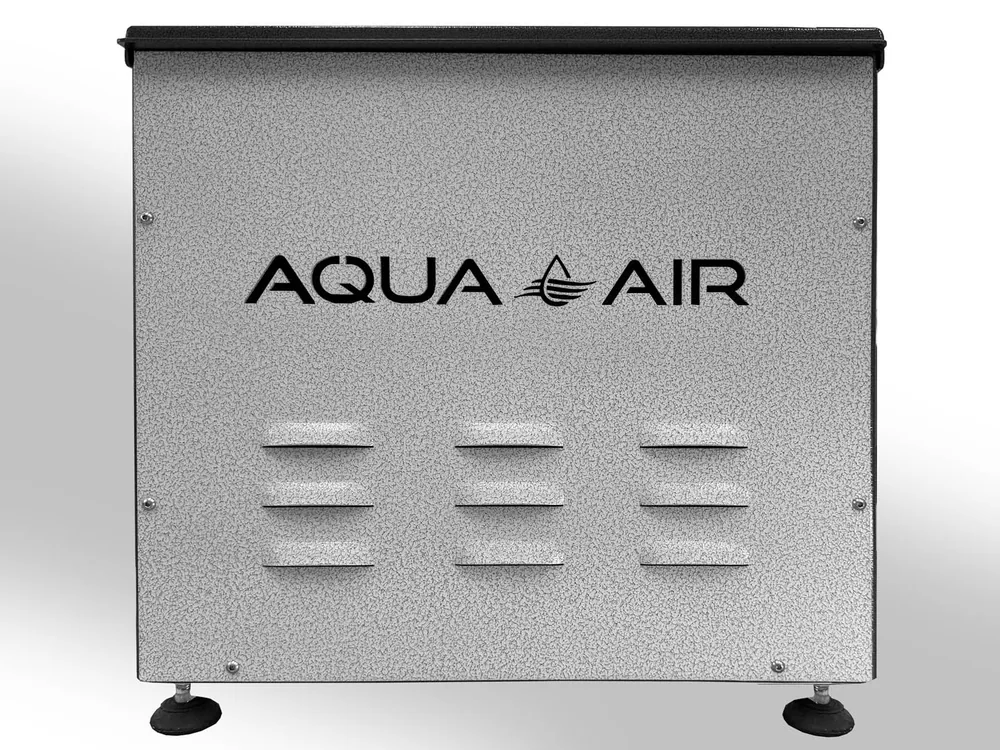
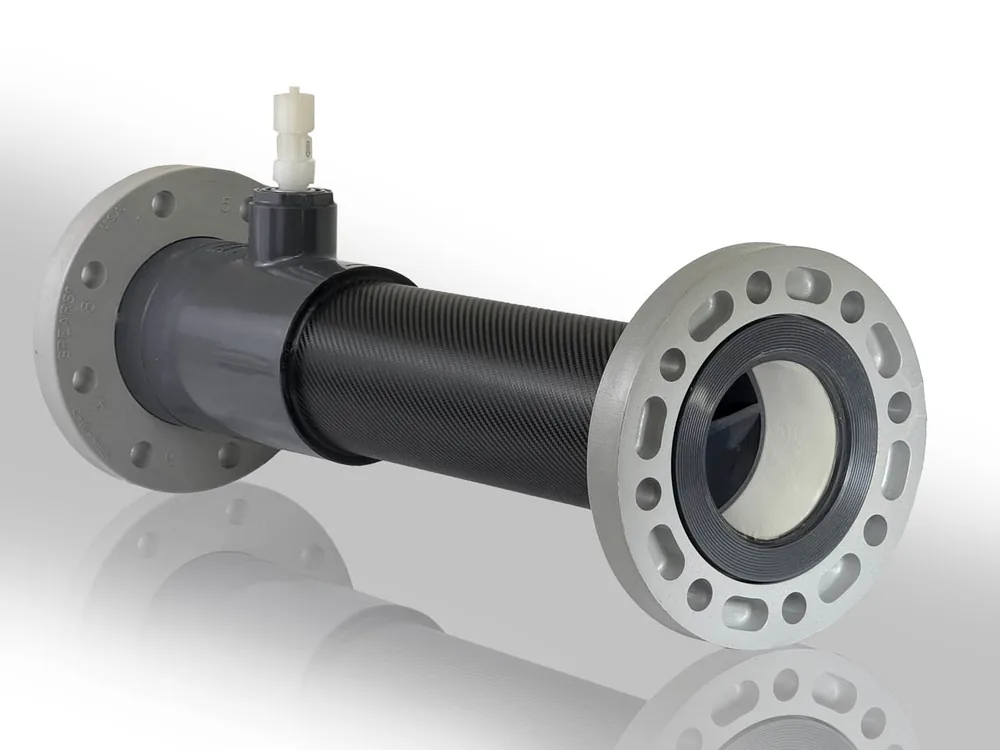
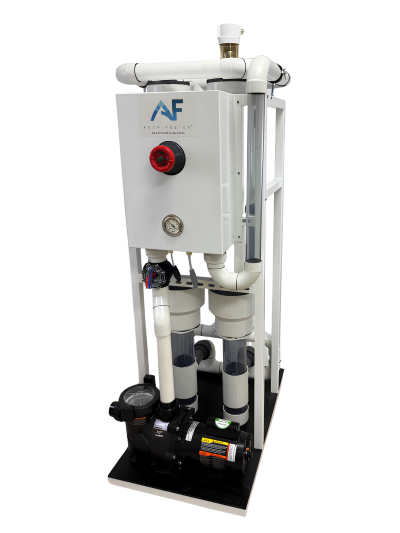
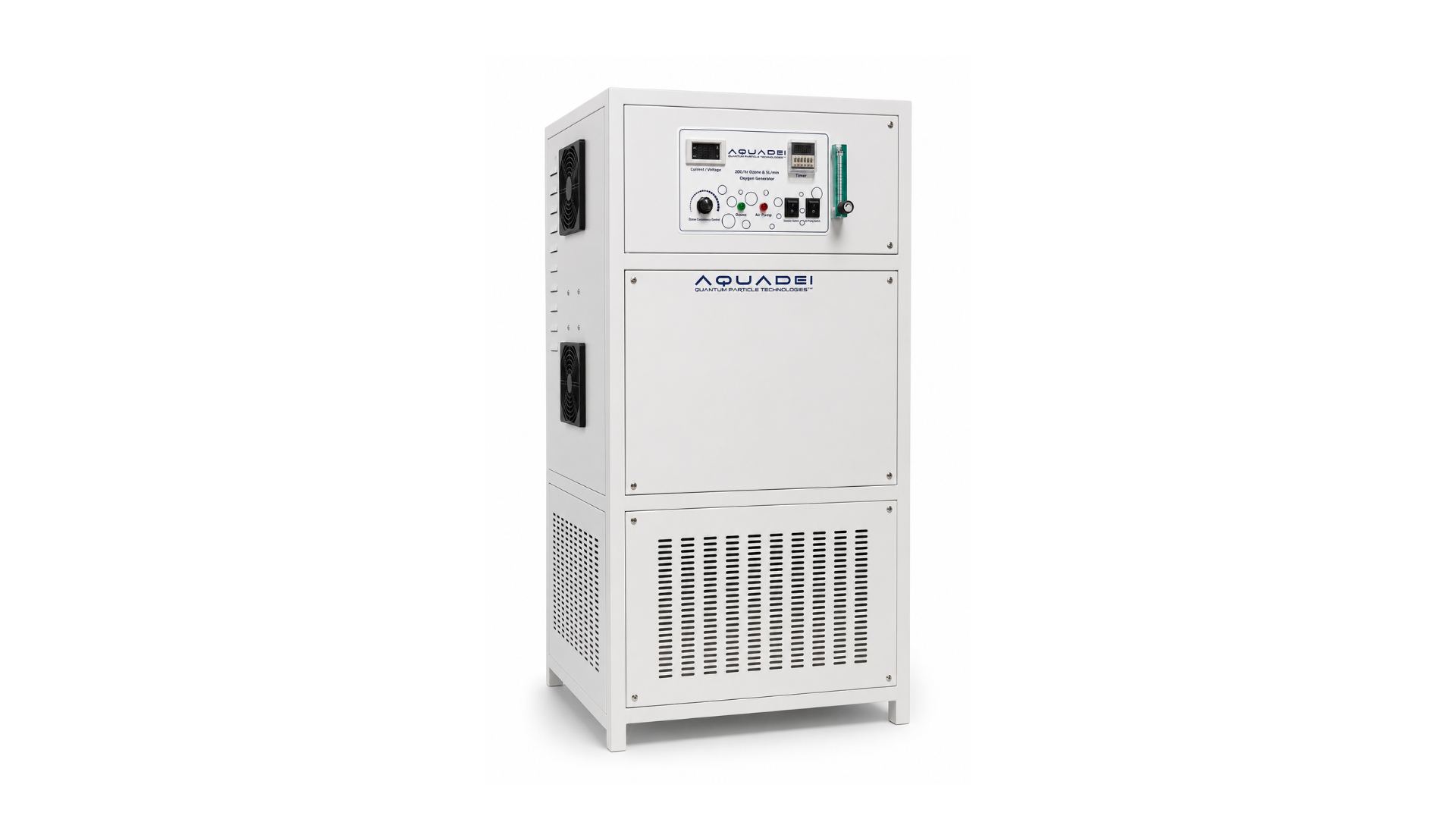
The reduction path that Aquadei represents works differently. Aquadei is the owner of the Gaia technology, and its nanobubble platform infuses precision gases into water to cut chemical use while chlorine remains the primary sanitizer. Aquadei’s UFB generator is plumbed into a pool’s return line, where it delivers millions of oxygen- and ozone-infused nanobubbles into the water. The result is a significant reduction in chemical usage alongside markedly better clarity. Two supporting components round out the system. The Air Gen supplies the oxygen and ozone, and the pHure Feed injects hyper-dissolved CO₂ inline for natural pH control, reducing or replacing routine muriatic-acid dosing where site conditions allow. These systems install on new and existing pools and spas and work alongside existing filtration and UV. The core generator has no mechanical moving parts, which means essentially no maintenance on the technology itself.
For a deeper look at how these systems compare to conventional pool treatment, see Best Pool Sanitation Systems: Salt, Mineral, UV & More.
Path Two — Replace: Switching Your Primary Sanitizer
If reducing chlorine is not enough and you want it out of the pool entirely, the replace path is the next step. Replacing chlorine as the primary sanitizer means committing to a different chemistry altogether. Two options are available for residential pools and spas: bromine and PHMB (polyhexamethylene biguanide).
Bromine is a legitimate halogen sanitizer. The CDC’s Model Aquatic Health Code permits bromine as a primary disinfectant and lists a minimum of 1 ppm total bromine for swimming pools at a pH range of 7.2 to 7.8. Bromine performs better than chlorine at higher temperatures and higher pH, which is why it dominates hot tub applications. Its limitation outdoors is significant. There is no effective stabilizer equivalent to cyanuric acid for bromine. Direct sunlight destroys roughly half of a pool’s bromine in 60 to 90 minutes, which forces higher feeder rates and constant attention. Bromine also costs more per treatment than chlorine. Add up the rapid sunlight degradation, the higher feeder rates, and the higher cost, and bromine becomes the wrong tool for a sun-exposed residential pool.
PHMB (biguanide) is the genuine non-chlorine option. It kills microbes by disrupting bacterial cell membranes rather than oxidizing them, and it contains no chlorine or bromine. PHMB is chemically incompatible with chlorine and bromine, so the two systems cannot be mixed. Switching in either direction requires fully clearing the previous sanitizer, which typically means draining, scrubbing, and refilling. PHMB also requires its own dedicated oxidizer (hydrogen peroxide), its own test kit, and its own product line. It can foul filter media faster than chlorine, and it is not permitted for public pools in many jurisdictions. Running a residential pool on biguanide costs roughly twice as much per year as running it on chlorine. This path suits committed pool owners with a genuine sensitivity to halogens rather than those looking for a lower-effort or lower-cost alternative.
Path Three — Swap: Household Chemicals With The Same Active Ingredients
The reduce and replace paths both change what sanitizes your pool. The swap path keeps the same chemistry and changes where you buy it. This is where most DIY pool chemistry searches lead, and it is the path no ranking page covers properly. The core idea is straightforward: household chemicals match pool-store active ingredients, sold under different names at different prices.
The chemical identities, using precise names alongside common ones:
- Sodium bicarbonate (baking soda) raises total alkalinity with a modest pH effect. The active ingredient in most pool-store alkalinity increasers is sodium bicarbonate, the same compound.
- Sodium carbonate (washing soda, soda ash) raises pH primarily, with a secondary effect on alkalinity. A 1% soda ash solution reaches approximately pH 11.4, which makes it a more aggressive pH raiser than baking soda.
- Muriatic acid (hydrochloric acid) lowers both pH and total alkalinity. It is a hazardous liquid that must be diluted in water before addition and stored carefully. Changing the label does not change the hazard.
- Calcium chloride (ice melt) raises calcium hardness. Pure calcium chloride ice melt with no added ingredients works the same way as pool-store hardness increaser.
- Potassium monopersulfate (non-chlorine shock) oxidizes organics without raising free chlorine. It is the active ingredient in widely used non-chlorine pool shock products and has been used in pools and spas since the 1970s.
The DIY approach breaks down at the accumulation problem rather than the ingredient list. Cyanuric acid still builds up if you use stabilized chlorine products, and no household chemical removes it. Calcium hardness climbs and can only be reduced through dilution by draining and refilling. Total dissolved solids accumulate from every chemical addition, household or otherwise. Together these dynamics eventually force a partial drain, which is why supplemental oxidation or shock treatment should follow water-test results rather than a fixed schedule. Hardware-store substitutes are real, yet they do not change the long-term accumulation that every pool must manage.
Borax, Vinegar, And Baking Soda: Clearing Up Common Questions
Several household chemicals appear repeatedly in pool chemistry searches, often with claims that overstate what they can do. Here is what the chemistry supports.
Borax in pool water. Borax (sodium tetraborate decahydrate) is a boron-based additive used for pH buffering and algae inhibition. It does not act as a sanitizer. At 30 to 50 ppm borates, it raises pH with minimal effect on total alkalinity, slows algae growth, and can reduce chlorine demand by stabilizing pH. It does not kill bacteria or replace chlorine. It qualifies as a natural pool chemicals option in the sense that it is a mineral compound, yet it still needs chlorine alongside it.
Borax versus baking soda. These products solve different problems. Baking soda raises total alkalinity with a modest pH effect, while borax raises pH with a smaller alkalinity effect. The choice depends on which parameter needs correction. Alkalinity should be set before pH, so you correct alkalinity first and then adjust pH.
White vinegar in pool water. Vinegar is a weak acid (acetic acid). The volume of vinegar required to move pH in a pool would make the water dangerously acidic. It is not a practical substitute for muriatic acid at pool scale.
Borax side effects. Boron accumulates in pool water and does not leave on its own. It exits only through splash-out, backwashing, and dilution. If borate levels overshoot 50 ppm, the only fix is replacing water. Standard residential pool and spa test kits, such as Taylor Technologies’ Residential Series 3-Way, 6-Way, and 9-Way models, do not measure boron, although separate borate/boron test strips and kits are commercially available. Borax is also toxic to pets if ingested from pool water.
For a broader look at natural alternatives and what the evidence supports, see Natural Alternatives to Pool Chemicals That Actually Work.
How To Choose: Three Questions That Narrow The Path
Three questions help determine which path is realistic for a given pool or spa.
Is the pool indoor or outdoor? Indoor pools have a specific air-quality problem. What people smell as “chlorine” indoors is chloramines, formed when chlorine reacts with organic matter, and they are toxic. Reducing the chlorine load reduces chloramine formation at the source. Outdoor pools face sunlight-driven chlorine loss and stabilizer management as the primary chemistry challenges.
How large is the pool in gallons? Pool volume determines whether a given approach is practical at all. Supplemental systems must be sized to the pool’s flow rate and turnover. A system correctly sized for a 15,000-gallon pool will underperform in a 40,000-gallon pool. Every system still depends on circulation, filtration, cleaning, testing, and timely corrective action, and those fundamentals scale with volume.
Are you trying to go fully chlorine-free or to reduce irritation and cost? The full chlorine-free goal is the one that most often runs into a wall. The CDC’s position is that chlorine or bromine plus pH control remains the primary defense against swimming-related illness, and most supplemental systems do not eliminate the need for a sanitizer. For most conventional residential pools and spas, the realistic goal is reduced chemical dependence rather than a universal promise of chemical-free operation. Regulatory requirements for residual sanitizer levels, such as the 1 ppm free chlorine minimum common in many county codes, vary by jurisdiction, and any variance from standard requirements requires petitioning the local authority.
For a detailed look at what chemical-free pool maintenance actually involves, see Chemical-Free Pool Maintenance: What Actually Works.
Pool Sanitation Options At A Glance
This summary table puts the main options side by side so you can see what each one replaces and where it tends to fall short.
| What It Is | What It Replaces | Main Limitation |
|---|---|---|
| Mineral (copper/silver) system | Some chlorine demand | Supplemental only, copper accumulates and can stain surfaces and hair |
| UV system | Some chlorine demand | No residual after the reactor, lamp and sleeve maintenance required |
| Traditional ozone injection | Some chlorine demand | Limited residual, sizing and off-gas management required |
| Bromine | Chlorine as primary sanitizer | Degrades rapidly in sunlight, costs more per treatment, no effective stabilizer |
| PHMB / biguanide | Chlorine as primary sanitizer | Incompatible with most other pool chemistry, separate testing, dosing, and oxidizer program required |
| Household chemical swaps | Pool-store pH, alkalinity, hardness, and shock products | Same active ingredients and hazards, accumulation still forces dilution |
Where Aquadei Fits In The Three Paths
Aquadei is the owner of the Gaia technology, and its nanobubble platform represents a well-supported reduction path for a residential pool or spa. The technology infuses precision gases into water to cut chemical use, reducing how much chemistry the water needs to stay clean and clear without replacing the chemistry of sanitation. That places it squarely in the reduce path described earlier, where chlorine stays your primary sanitizer and the nanobubble system lowers how much of it the pool needs.
The credibility behind that claim rests on verifiable specifics. In August 2016, the technology was analysed at the University of Osaka’s photonics laboratory and confirmed to produce bubbles on the order of 100 nanometers. That finding led the company to adopt the ISO fine bubble framework, which still governs its engineering today. Aquadei engineers to 100 nanometers or below, roughly ten times finer than the ultrafine threshold the standard requires. Research collaborations with more than 15 universities and government labs support the technology across applications. An in-house PhD-operated laboratory measures what Aquadei’s own systems produce, so claims about bubble size and concentration are demonstrated rather than asserted.
In December 2025, Aquadei announced a strategic alliance with the Master Pool Guild International, an international network of elite pool builders operating since 1962, following a year-long pilot programme. That alliance cleared the way for a national roll-out of Aquadei’s oxygenated and ozone pool system technology across Guild member companies. It stands as a strong third-party endorsement in the recreational water market.
Aquadei does not claim total chemical elimination in a residential or commercial pool setting. The company focuses on depth of validation and measurable reduction in chemical use, and in a field where many claims cannot be checked, that distinction matters.
Get A System Sized For Your Pool
The Bottom Line On Pool Chemical Alternatives
Pool chemical alternatives describe three different decisions rather than a single list. The reduce path keeps chlorine as the primary sanitizer and adds a supplemental system to lower how much is needed. The replace path switches to bromine or PHMB as the primary sanitizer, each with its own compatibility constraints and cost profile. The swap path uses household chemicals with the same active ingredients as pool-store products, which can save money but leaves the accumulation dynamics that eventually force a partial drain unchanged.
For most conventional residential pools and spas, the practical goal is reduced chemical dependence rather than a universal promise of chemical-free operation. Every system still depends on circulation, filtration, cleaning, testing, and timely corrective action.
Aquadei’s oxygen and ozone nanobubble systems, built on the Gaia technology and backed by research collaborations with more than 15 universities and government labs, independent laboratory confirmation of bubble production at the University of Osaka’s photonics laboratory, and a strategic alliance with the Master Pool Guild International, represent a strongly validated reduction path for a residential pool or spa. The technology delivers a significant reduction in chemical usage, markedly better clarity, and water that is gentler on skin, hair, and eyes, while still working alongside standard pool chemistry.
Talk To Aquadei About Your Pool