Key Takeaways
- Chlorine demand in high bather load pools rises faster than chlorine can be replenished because bathers continuously introduce urea, sweat, sunscreen, and organic nitrogen that consume free chlorine before it can sanitize.
- Breakpoint chlorination addresses accumulated chloramines but does not prevent the next hour’s bather waste from recreating the problem, so shocking alone never resolves continuous demand.
- Source control through pre-swim showers, restroom breaks, hygiene enforcement, and proper bather load management gives operators the strongest leverage to cut chlorine demand.
- Supplemental treatments such as UV, ozone, and advanced oxidation reduce the chlorine load required, while facilities still maintain a compliant free chlorine residual for protection.
- Aquadei nanobubble systems lower the chlorine load needed to keep water sanitized, which cuts chloramine formation at the source and improves air and water quality in high bather load facilities.
Talk With Aquadei About Your Facility
Why Chlorine Demand Matters In High Bather Load Pools
Reducing chlorine in high bather load pools means slowing the rate at which chlorine is consumed. Chlorine demand is the amount of chlorine used up by oxidizable material before a stable residual can hold. Every bather who enters the water adds urea, amino acids, sweat, sunscreen, and other organic compounds that react with free chlorine before it can work as a sanitizer.
The operator’s core challenge is that shocking alone does not solve chlorine demand. Breakpoint chlorination clears accumulated chloramines but fresh bather waste quickly recreates the same problem. In high bather load venues such as hotels, waterparks, municipal aquatic centers, swim schools, and surf parks, demand stays continuous rather than occasional.
The framework that follows walks through five areas in sequence: source control, correct diagnosis of free versus combined chlorine, the limits of breakpoint chlorination, supplemental treatment options, and cyanuric acid management.
What Destroys Chlorine In A Pool?
Seven main factors drive chlorine consumption in commercial pools. Knowing each one gives operators a clear starting point for any demand-reduction plan.
- Bather waste such as sweat, urine, and skin cells introduces urea and ammonia that react with free chlorine. A single swimmer contributes roughly 0.5 to 1 gram of urea per hour, so 100 bathers introduce 50–100 grams of urea-based chlorine demand into the water every hour of peak operation.
- Sunscreen, lotions, and cosmetics add oils and organic compounds that create extra oxidant demand and compete directly with free chlorine.
- Organic nitrogen compounds such as urea and amino acids form chloramines when they react with chlorine, creating the combined chlorine that operators measure and regulators track.
- Cyanuric acid, a stabilizer that shields chlorine from sunlight, also reduces its availability for disinfection. At high concentrations, free chlorine test readings can overstate actual sanitizing capacity.
- Sunlight (UV) breaks down chlorine. Unstabilized chlorine can lose 75–90% of free chlorine within hours outdoors when cyanuric acid is absent.
- Elevated water temperature speeds chlorine decay. Chlorine decay rates can be 2–3 times faster above 84°F, which forces more frequent dosing or higher entering residuals.
- Inadequate turnover creates hydraulic dead zones where contaminants accumulate faster than treatment can address them. The CDC Model Aquatic Health Code (MAHC) caps maximum turnover times by venue type, and most pools must turn over in 6 hours or less.
Free Chlorine, Combined Chlorine, And Chlorine Demand
Free chlorine, combined chlorine, and chlorine demand describe different parts of the same story, and mixing them up leads to the wrong fix.
Free chlorine is the active sanitizer, meaning hypochlorous acid (HOCl) and hypochlorite ion (OCl⁻) that are available to disinfect. HOCl is roughly 80 times more effective as a sanitizer than OCl⁻. At pH 7.2, about 66% of free chlorine is HOCl. At pH 7.8, only about 33% is HOCl, so sanitizing capacity is nearly cut in half even though the free chlorine reading looks the same.
Combined chlorine is chloramines, which form when chlorine reacts with nitrogen-based contaminants from bathers. Trichloramine (NCl₃), the most volatile chloramine, off-gasses into the pool hall and creates the sharp smell guests blame on “too much chlorine.” That smell signals chloramines building up faster than water and air systems can clear them.
Total chlorine equals free chlorine plus combined chlorine. Chlorine demand is the amount of chlorine consumed before a stable residual can form.
The CDC MAHC 5th edition (2024) sets a combined chlorine action level of 0.4 ppm. Facilities must take corrective action when combined chlorine exceeds this concentration. This value is an action level rather than a universal closure limit, and enforceable requirements still depend on local codes, including typical 1 ppm free chlorine minimums.
The diagnostic distinction matters. High combined chlorine with solid free chlorine points to a load and oxidation issue, while high combined chlorine with sagging free chlorine points to a demand issue. Operators choose different corrective responses for each pattern.
Contaminant Source Control: The First Line Of Defense
Source control cuts down the material the treatment system must handle before it ever reaches the chlorine residual. This approach gives any facility operator the strongest and most cost-effective leverage.
- Pre-swim showers are the simplest intervention. PWTAG recommends that swimmers shower before entering the pool, which removes sweat and cosmetics that would otherwise consume chlorine within minutes of entry and drive chloramine formation.
- Restroom breaks reduce the amount of sweat and urine entering the water. The CDC identifies bather waste as a primary source of chloramine formation, so busy facilities often see combined chlorine spike during lessons, team practices, and weekend peaks.
- Hygiene enforcement turns policy into practice. PWTAG advises facilities to pair clear signage with staff enforcement, accessible toilets and showers, and defined procedures for diapers, illness exclusion, and contamination incidents.
- Bather load calculations keep occupancy within what the system can handle. The MAHC sets bather-load density factors such as 20 square feet per bather for flat water, 15 for agitated water, and 10 for hot or interactive water play. Dividing surface area by the correct factor gives a realistic peak occupancy.
Breakpoint Chlorination And Non-Chlorine Shock
Breakpoint chlorination means raising free chlorine to roughly 10 times the combined chlorine level to oxidize chloramines. For a pool reading 0.8 ppm combined chlorine, operators raise free chlorine by about 8 ppm above the target residual to fully oxidize chloramines.
Breakpoint chlorination works well for acute chloramine events with a clear cause. It falls short in high bather load pools because demand never stops. Shocking clears the accumulated load, then the next wave of bather waste rebuilds it. Non-chlorine shock, usually potassium monopersulfate, oxidizes organic waste without adding chlorine but does not provide any residual sanitization. Operators should base supplemental oxidation or shock on water-test results rather than fixed schedules.
Supplemental Treatment: Reducing The Chlorine Load Required
Supplemental treatment technologies lower the chlorine load required to keep water sanitized. Facilities still maintain a compliant free chlorine residual for ongoing protection.
- UV systems inactivate pathogens and break down combined chlorine as water passes through the reactor. They leave no residual after the reactor and require lamp and sleeve maintenance. Medium-pressure UV lamps are far more effective at breaking apart chloramine molecules than low-pressure lamps, which have limited impact on chloramines.
- Ozone systems provide strong oxidation that reduces chloramine precursors. Traditional ozone injection offers limited residual and requires correct sizing, ozone-safe components, and off-gas management. Ozone decomposes quickly, so a secondary disinfectant still provides residual protection in the pool.
- Advanced oxidation processes (AOP) combine ozone with UV or hydrogen peroxide to generate hydroxyl radicals. These radicals react faster than ozone alone and help address persistent contaminants.
See How Supplemental Treatment Cuts Chlorine Use
The Aquadei Solution: Nanobubble Technology For High Bather Load Pools
Aquadei owns the Gaia technology. The company has almost fifteen years of implementation experience in recreational water, dating back to 2012. Its oxygen and oxygen/ozone nanobubble systems reduce the chlorine load required to keep water sanitized, which cuts chloramine formation at the source and improves air quality inside enclosed facilities. A reduced chlorine load also lowers chloramine formation in the water. The result is water with no harsh chemical smell and a gentler feel on skin, hair, and eyes.
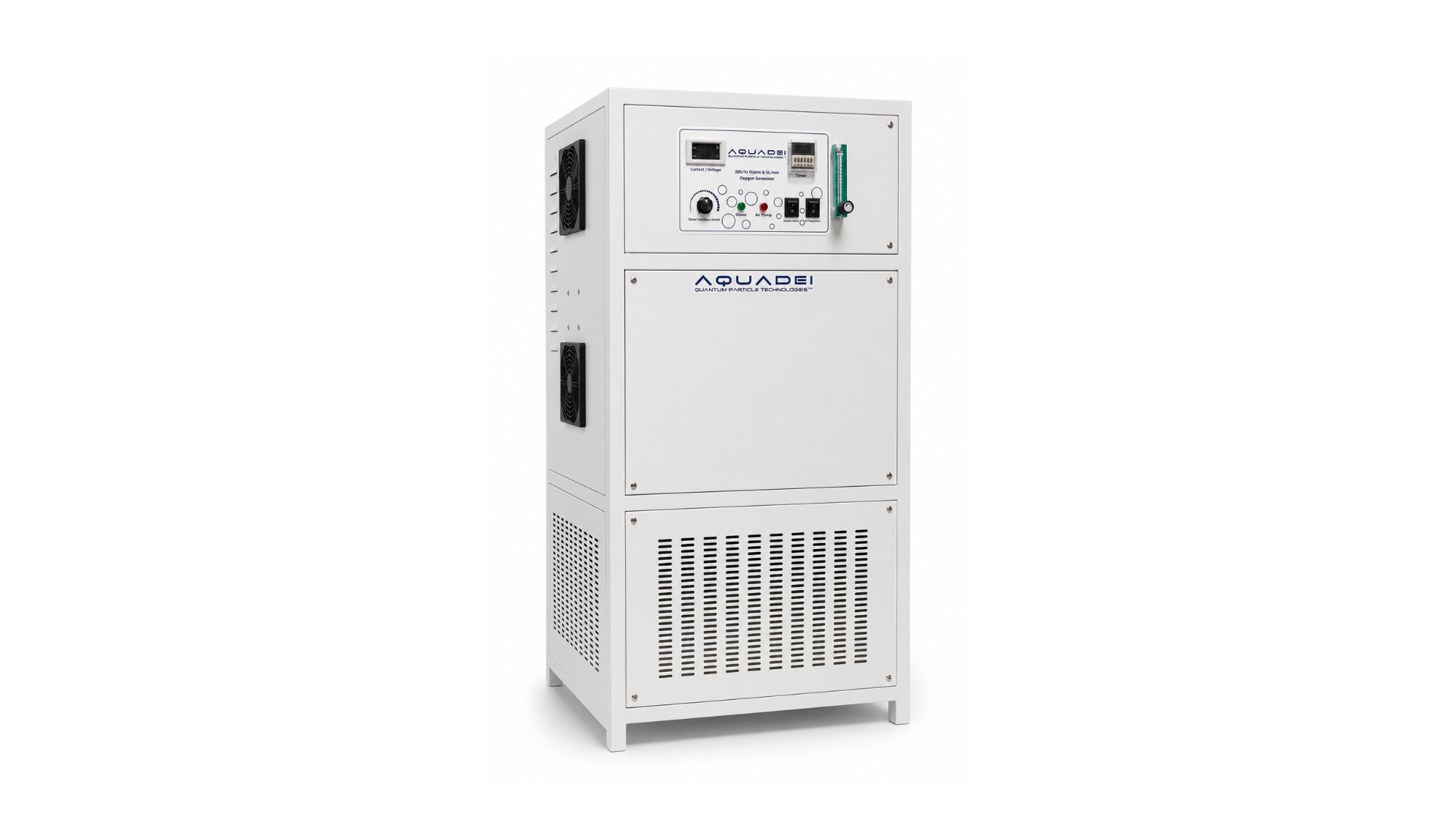
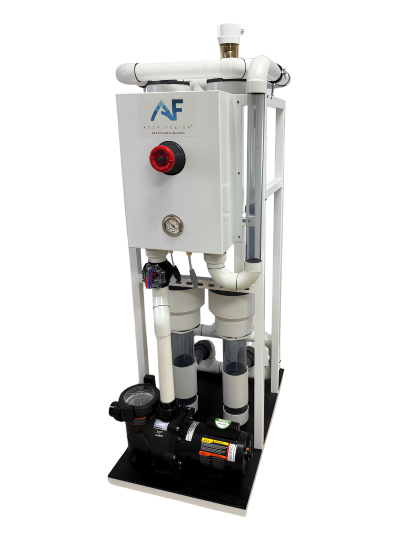
The Aqua Fuzion Skid is Aquadei’s device that creates nanobubbles and is plumbed into a pool’s return, delivering millions of oxygen and ozone nanobubbles into the water. It saturates the water with hyper-dissolved oxygen nanobubbles, which supports a significant reduction in chemical usage and noticeably better clarity. The Air Gen unit is Aquadei’s oxygen and ozone generator. The pHure Feed system delivers hyper-dissolved CO₂ inline for natural pH control and can reduce or replace routine muriatic-acid dosing where site conditions allow, which suits facilities with water features or artificial waves that push pH upward.
Aquadei’s systems retrofit onto new and existing pools and spas, working alongside existing filtration and UV systems without requiring a rebuild. There are no mechanical moving parts in the core generator’s flow path, so the technology itself requires essentially no maintenance. The systems follow the ISO fine bubble framework (ISO/TC 281; ISO 20480-1:2017) and produce bubbles at 100 nanometers or below, which is roughly ten times finer than the standard’s ultrafine threshold of 1 micron.
The Master Pool Guild International strategic alliance, announced in December 2025 after a year-long pilot, provides a strong third-party endorsement in the recreational water market. Aquadei’s technology has been independently confirmed to produce bubbles at the 100-nanometer scale at the University of Osaka’s photonics laboratory, and the company holds multiple granted US patents with further grants and filings in Canada, Australia, the EU, India, and Chile.
Aquadei reduces chemical dependence in most commercial contexts while still working alongside a compliant free chlorine residual.
The table below shows why no supplemental treatment, including Aquadei, replaces chlorine’s residual role and how each option compares on demand reduction and maintenance.
| Treatment Method | Reduces Chlorine Demand | Provides Residual | Maintenance Requirement |
|---|---|---|---|
| Chlorine Alone | No | Yes | Continuous Dosing |
| UV | Partially | No | Lamp And Sleeve Replacement |
| Ozone | Yes | Limited | Electrode Cleaning, Off-Gas Management |
| Aquadei Nanobubble Systems | Yes | No | Essentially None On Core Technology |
Cyanuric Acid Management: When Dilution Becomes Essential
Cyanuric acid acts as a stabilizer that protects chlorine from sunlight but reduces its availability for disinfection. Chlorine is consumed as it sanitizes and dissipates in sunlight, while cyanuric acid remains in the water. Levels build over time, and once they climb too high there is no chemical way to lower them. Dilution by draining and refilling becomes the only remedy.
The CDC MAHC 5th edition (2024) sets a cyanuric acid limit of 90 ppm or below, and a reading of 300 ppm or higher requires the venue to close until the condition is corrected. The World Health Organization’s Guidelines for Safe Recreational Water Environments recommends that cyanuric acid concentrations not exceed 100 mg/L where chlorinated isocyanurates supply chlorine.
Operators should test cyanuric acid monthly, or weekly when stabilized chlorine is the primary disinfectant. Cyanuric acid, calcium hardness, and total dissolved solids accumulate over time, so operators should track these trends separately from chlorine use.
A Step-By-Step Decision Framework For Reducing Chlorine Demand
This framework gives facility operators a clear path from diagnosis to corrective action, with each step building on the last.
- Test free chlorine, combined chlorine, and cyanuric acid using FAS-DPD titration rather than DPD colorimetric testing. DPD colorimetric tests bleach out above roughly 10 ppm free chlorine and can read as zero when the pool is actually over-chlorinated.
- Calculate chlorine demand by subtracting free chlorine from total chlorine to find combined chlorine. If combined chlorine exceeds the 0.4 ppm action level mentioned earlier, the CDC MAHC 5th edition (2024) directs facilities to take corrective action, with the enforceable trigger set by the adopting state or local code.
- Verify that pH stays within 7.0–7.8. At pH 7.8, only about 33% of free chlorine is HOCl versus 66% at pH 7.2. Correcting pH from 7.8 to 7.4 nearly doubles the HOCl fraction without adding chlorine.
- Implement source control by reinforcing pre-swim showers, restroom breaks, hygiene rules, and bather load management within MAHC density factors. These steps directly reduce the load that drives demand.
- Evaluate breakpoint chlorination for acute events where combined chlorine spikes, while recognizing that this approach does not resolve continuous demand in high bather load settings.
- Consider supplemental treatment such as UV, ozone, or advanced oxidation to reduce the chlorine load required. For facilities seeking strong reduction in chloramine formation at the source, Aquadei’s nanobubble systems address the problem at the point of generation rather than only treating symptoms later.
- Manage cyanuric acid by testing monthly, or weekly if stabilized chlorine is primary, and planning dilution when levels approach or exceed 90 ppm.
- Document and trend results by recording combined chlorine alongside bather load to spot recurring patterns. If combined chlorine rises after the same swim program or weekend peak, the facility faces a recurring load pattern rather than isolated incidents.
Get A Chlorine Demand Assessment
How Long Does It Take For High Chlorine Levels To Go Down?
The time required depends on which chlorine issue the facility faces.
If free chlorine runs high because of over-treating, operators can turn off feeders, remove covers to allow UV degradation, or use a chlorine neutralizer. Unstabilized chlorine dissipates in sunlight, while cyanuric acid stabilizer shields chlorine from sunlight and slows its breakdown. Dilution by draining and refilling lowers both free chlorine and accumulated cyanuric acid.
If combined chlorine runs high, the issue reflects demand rather than simple excess. Reducing demand through source control and supplemental treatment provides the remedy instead of waiting for levels to fall on their own. In high bather load pools, chlorine is more often consumed too quickly than left lingering. Knowing what drives chlorine demand is the prerequisite for a lasting solution.
Frequently Asked Questions
This section answers common questions operators ask once they start focusing on chlorine demand instead of only chlorine levels.
What Is Chlorine Demand And How Does It Differ From Free Chlorine?
Chlorine demand is the amount of chlorine consumed while oxidizing contaminants already in the water, such as sweat, urine, sunscreen, and organic nitrogen from bathers. Free chlorine is the active sanitizer, meaning HOCl and OCl⁻ that remain available to disinfect. High demand means chlorine is being used up faster than it can maintain a residual. In high bather load pools, demand stays continuous, so operators often add chlorine constantly without achieving stable water quality.
Why Does Shocking Alone Often Fail In High Bather Load Pools?
Breakpoint chlorination clears accumulated chloramines but does not stop the next hour’s bather waste from rebuilding them. In high bather load pools, each new group of bathers introduces fresh urea, amino acids, and organic compounds that immediately react with free chlorine. Shocking works as a corrective action for acute events. It does not serve as a complete strategy for continuous demand, so facilities that rely on shocking alone repeat the process without resolving the underlying load.
What Is The CDC MAHC Combined Chlorine Action Level?
The CDC Model Aquatic Health Code (MAHC) 5th edition (2024) sets a combined chlorine action level of 0.4 ppm. Facilities must take action to reduce combined chlorine when it exceeds this concentration. This value is an action level rather than a universal closure limit, and enforceable requirements depend on the jurisdiction that adopts or modifies the MAHC. Operators should follow their adopted state or local code alongside MAHC guidance.
Does Supplemental Treatment Replace Chlorine?
Supplemental treatment does not replace chlorine. UV, ozone, and advanced oxidation processes reduce the chlorine load required but do not provide residual protection on their own. Facilities still maintain a compliant free chlorine residual as the primary sanitizer. Supplemental systems work alongside chlorine by reducing the demand placed on it, lowering combined chlorine formation, and improving overall water quality.
How Does Cyanuric Acid Affect Chlorine Efficacy?
Cyanuric acid shields chlorine from sunlight but reduces its availability for disinfection. At high concentrations, free chlorine test readings may overstate actual sanitizing capacity because more chlorine is bound in a slower-reacting form. Cyanuric acid is not consumed as it works, so it accumulates over time. Once levels exceed the MAHC’s 90 ppm ceiling, dilution by draining and refilling is the only way to reduce them, since no chemical treatment removes cyanuric acid from pool water.
Discuss Chlorine Demand With Aquadei
Conclusion: Reducing Chlorine Demand In High Bather Load Pools
In high bather load pools, chlorine is consumed too quickly by bather waste and other contaminants. The problem is that chlorine is being used up too fast for a residual to hold, not that chlorine levels run too high. Effective reduction in chlorine demand relies on source control to limit what enters the water, accurate diagnosis of free versus combined chlorine to distinguish load from demand, and supplemental treatment that lowers the chlorine load required to keep water sanitized.
Aquadei’s nanobubble systems, built on the Gaia technology and supported by research collaborations with more than 15 universities and government labs, reduce the chlorine load required to keep water sanitized and cut chloramine formation at the source. Facilities see improved air quality inside enclosed spaces, water that feels gentler on skin, hair, and eyes, and a meaningful reduction in chemical usage at commercial scale. The systems retrofit onto existing infrastructure alongside current filtration and UV, and the core technology requires essentially no maintenance.
Aquadei reduces chemical dependence while still working with a compliant free chlorine residual. The goal is a sustainable reduction in the chemical burden that holds across seasons instead of a brief improvement after the next shock treatment. Facilities ready to move beyond the shock-and-repeat cycle can use oxygenated water in commercial pools as a verifiable path to better water quality with less chemistry.
Schedule A Nanobubble Strategy Call