Key Takeaways For Greenhouse Oxygenation
- Dissolved oxygen in greenhouse nutrient solution depends on two main variables. System type sets the oxygenation method, and water temperature sets the physical ceiling for any method.
- Target 6–10 mg/L dissolved oxygen, though the exact range shifts by crop and system. DWC and recirculating drip need active oxygenation, while NFT usually starts with flow and slope management.
- Above 25 °C the solubility ceiling drops while root oxygen demand rises, so chilling the solution often delivers the highest return before you add aeration.
- Air stones and cascades work for small systems. Commercial-scale or warm-water operations need higher-transfer methods such as pure oxygen injection or nanobubble generation.
- Aquadei UFB generators produce 100-nanometer nanobubbles engineered to the ISO fine-bubble framework and deliver peer-reviewed yield gains when system and temperature demand higher transfer than conventional aeration can provide.
Size the right UFB generator for your greenhouse nutrient solution
Working Dissolved Oxygen Ranges By System Type
Use 6–10 mg/L dissolved oxygen in your nutrient solution as a general working range. The floor and ceiling shift by crop and system. University of Missouri Extension publication G6984 calls anything above 6 ppm optimum, while Virginia Tech SPES-466 sets 7–10 ppm as the optimal management range and 4 ppm as the minimum for submerged-root systems.
Lettuce in small systems can run near 5 mg/L. UF/IFAS HS1422 gives that figure as a good-oxygenation reference for small hydroponic lettuce setups. Intensive fruiting crops such as tomato and cucumber usually sit at the upper part of the range, around 7–10 mg/L, especially during heavy canopy and fruiting stages. No single universal set point exists, so the table below organizes the decision by system.
| System Type | Typical Dissolved Oxygen Target (mg/L) | Primary Oxygenation Method |
|---|---|---|
| DWC / Floating Raft | 7–10 mg/L (Cornell CEA) | Pure oxygen injection or nanobubble generation at commercial scale; air stones for small ponds only |
| NFT | 6–8 mg/L (Virginia Tech SPES-466) | Flow and slope management first; supplemental oxygenation where channel length and warm water demand it |
| Substrate (Coco / Rockwool) | 6+ mg/L (Missouri G6984) | Drainage management; direct dissolved oxygen measurement above 25°C |
| Recirculating Drip | 6–10 mg/L (Virginia Tech SPES-466) | Inline oxygenation on the return stream |
How Temperature Limits Nutrient Solution Dissolved Oxygen
Water holds less dissolved gas as it warms, and no amount of extra aeration can change that physical limit. USGS solubility tables give these saturation values for freshwater at sea level and 100% air saturation: approximately 9.1 mg/L at 20°C, 8.1 mg/L at 27°C, and 7.6 mg/L at 30°C. Nutrient salts lower these values slightly further.
The 27°C / 81°F mark is a recognized stress threshold. Above it, the solubility ceiling tightens and root oxygen demand rises at the same time, because roots, algae, and microbes all respire faster in warm water. Most greenhouse crops run best at 20–22°C (68–72°F), where oxygen stays higher and pathogen pressure from organisms such as Pythium stays lower.
Chilling does double duty. It cools the crop and raises the oxygen ceiling at the same time. A hydroponic cucumber study reported in HortScience found that cooling the root zone from 33°C to 22°C raised dissolved oxygen from approximately 5 mg/L to 8 mg/L, along with measurable improvements in growth and yield. A chiller lifts the solubility ceiling and cuts root oxygen demand together, which air stones alone cannot match.
Use a simple rule for the “nutrient solution water temperature dissolved oxygen” question. Above roughly 25°C / 77°F, measure dissolved oxygen directly rather than assuming aeration is sufficient. A cool-morning reading can look acceptable while the same reservoir falls well below target by the warmest part of the light period.
Strengths And Limits Of Each Oxygenation Method
Air Stones And Diffusers
Air stones and diffusers are the most common oxygenation method in small hydroponic systems and the most frequently inadequate at commercial scale. Cornell CEA’s Hydroponic Lettuce Handbook states that an air pump and air stone will not reach the dissolved oxygen levels that pure oxygen injection can and recommends air stones only for small ponds. In warm water, the solubility ceiling drops regardless of how hard the pump runs, so air stones perform poorly as a primary method for commercial-scale DWC or any system where solution temperature regularly exceeds 25°C. For more detail on air-stone limits at scale, see Dissolved Oxygen in Hydroponics: Why Air Stones Fall Short.
Waterfall And Cascade Returns
Cascade and waterfall returns introduce oxygen at the surface through turbulent contact with air. They require no added equipment and work reasonably well in small, well-designed systems. At commercial scale, gas transfer depends heavily on hydraulic design and available surface area, so cascades usually serve as a supplemental method rather than a primary one for high-biomass or warm-water systems.
Venturi Injectors
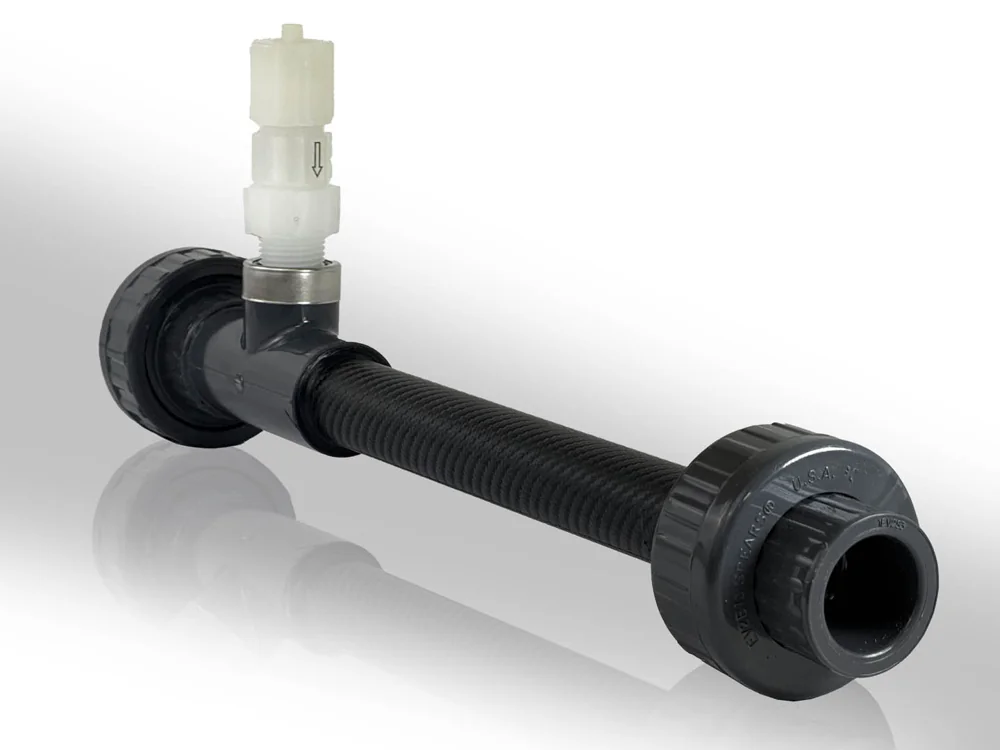
Venturi injectors draw air or pure oxygen into the water line using a pressure differential across a constriction. They work inline and add no moving parts to the flow path. Performance depends on flow rate and line pressure. Undersized venturis at low flow deliver limited transfer. When paired with pure oxygen rather than air, the partial pressure driving gas transfer rises substantially, which improves both transfer rate and the maximum dissolved oxygen concentration.
Chillers
A chiller tackles the temperature ceiling directly. By cooling the nutrient solution into the 18–22°C target band, it raises the physical solubility ceiling and reduces root oxygen demand at the same time. A chiller is often the single highest-return action in a warm-water system because it does both jobs at once. Aeration alone cannot deliver that combination.
Hydrogen Peroxide As A Special Case
Hydrogen peroxide is sometimes grouped with oxygenation methods, but it behaves differently enough that it gets its own section later in this guide.
Nanobubble Generation
Nanobubble generation provides higher transfer where system type and water temperature demand it. Aquadei UFB generators produce nanobubbles at 100 nanometers or below, engineered to the ISO fine bubble framework (ISO/TC 281; ISO 20480-1:2017, which defines an ultrafine bubble as under 1 micron). Aquadei engineers to roughly ten times finer than that threshold requires. The core generator has no mechanical moving parts in the flow path, and the company operates a PhD-run characterization laboratory that measures bubble size and concentration rather than assuming them.
Independent, peer-reviewed evidence supports the platform’s agricultural use. A 2026 study in Agricultural Water Management (Vol. 325), led from Arizona State University with co-authors at the University of Maine and NASA Johnson Space Center, found that oxygen nanobubbles delivered through a Gaia UFB-75 generator improved lettuce germination, leaf growth, and biomass in early plant development while cutting water use by roughly 23%. The study covers germination and early plant development rather than a full harvest cycle and draws on three institutions. It is the strongest published evidence currently available for nanobubble oxygenation in a controlled-environment crop setting.
Nanobubbles suit systems that need higher transfer than conventional aeration can deliver. The table below summarizes how the main methods compare so you can match a method to your operation before the next section walks through each system type.
| Method | What It Does Well | Where It Fails | System Fit |
|---|---|---|---|
| Air Stones / Diffusers | Low cost, simple, adequate for small ponds | Cannot reach pure-oxygen injection DO levels (Cornell CEA), ineffective in warm water | Small DWC, home systems |
| Waterfall / Cascade Returns | No added equipment, effective in small systems | Limited transfer at commercial scale, dependent on hydraulic design | Small recirculating systems |
| Venturi Injectors | Effective inline, no moving parts | Performance depends on flow and pressure, limited at low flow | Inline on supply or return lines |
| Chillers | Raises solubility ceiling and cuts root oxygen demand simultaneously | Capital cost, does not add oxygen directly | Any system with solution temperature above 25°C |
| Nanobubble Generation | High transfer efficiency; improved germination, leaf growth, and biomass with ~23% water savings (Morón-López et al., 2026), no moving parts in flow path | Higher equipment cost than air stones, requires correct sizing | Commercial DWC, recirculating drip, NFT supplemental, warm-water systems |
Knowing what each method can and cannot do is only half the decision. The other half is your system type, which sets how much oxygen the roots can actually access.
Match a nanobubble method to your system and water temperature
System-Type Decision: Which Oxygenation Method Fits Your Greenhouse Nutrient Solution
DWC And Floating Raft
In deep water culture and floating raft systems, roots are fully submerged and depend entirely on dissolved oxygen in the solution. Cornell CEA targets 7–10 mg/L in commercial DWC ponds using pure oxygen injection and states that air stones and blowers suit only small ponds. At commercial scale, nanobubble generation or pure oxygen injection serves as the primary method. An air pump failure in a warm, root-heavy DWC tank can drop dissolved oxygen from saturation to hypoxic in two to four hours, so monitoring and redundancy matter.
NFT
In nutrient film technique systems, roots draw oxygen from the air film above the thin flowing solution layer. Passive diffusion across that film provides most of the oxygen, but it degrades along the channel. Urrestarazu et al. (2005) recorded dissolved oxygen declining from 6.2 mg/L at the NFT channel inlet to 2.9 mg/L at the outlet, which sits well below the 5 mg/L stress threshold. Flow rate, channel slope (2–3% minimum), and channel length (10–15 m maximum) are the first management levers. Where channel length, warm water, or high root biomass push outlet dissolved oxygen below 5 mg/L, supplemental oxygenation on the return stream becomes necessary.
Substrate (Coco / Rockwool)
In substrate systems, roots depend on air-filled pore spaces after drainage rather than on dissolved oxygen in the solution. Drainage management, which means avoiding overwatering and ensuring effective drainage cycles, serves as the primary oxygen strategy. Where solution temperature exceeds 25°C, measure dissolved oxygen directly rather than assuming it stays adequate, because warm solution entering the substrate reduces the oxygen available at the root interface.
Recirculating Drip
In recirculating drip systems, oxygen delivery depends on the return stream and the reservoir. The supply solution loses dissolved oxygen as it passes through the root zone, so the return arrives depleted. Inline nanobubble generation on the return line re-oxygenates the solution before it re-enters the reservoir and keeps dissolved oxygen more consistent across the crop cycle.
Aquadei’s UFB generators fit greenhouse nutrient solution oxygenation where the system and water temperature demand higher transfer. They are engineered for high transfer efficiency in these higher-demand cases, and the 2026 Agricultural Water Management study (Morón-López et al.) provides the published foundation for that recommendation.
Recognizing Oxygen Deficiency In Hydroponic Plants
The documented symptoms of root-zone oxygen deficiency include:
- Wilting despite moist roots
- Slow growth with no obvious nutrient deficiency
- Roots turning brown, slimy, or soft
- A sour or swampy reservoir smell
- Rapid plant decline during hot afternoons
- Recurring root disease despite acceptable pH and EC
Low-oxygen symptoms overlap significantly with nutrient imbalance, heat injury, and root pathogens. Pale new growth with green old leaves points to iron lockout at high pH, while purple stems and stunted growth suggest phosphorus lockout at low pH. Oxygen deficiency and pathogen pressure frequently appear together because the same warm, low-oxygen conditions that stress roots also favor Pythium. For a full symptom-based diagnostic flow, see How To Oxygenate A Nutrient Solution: A Diagnostic Guide.
How To Measure Dissolved Oxygen In A Reservoir
Where to sample: Measure at three points: the reservoir, the supply line entering the grow area, and the return line. A single reading beside an air stone can look excellent while roots farther away in the same reservoir receive substantially less oxygen. The return line reading often proves most informative because it reflects what the root zone actually experienced.
When to sample: Take readings at consistent times, including the warmest expected period of the light cycle. A cool-morning reading can fall well below target by afternoon as solution temperature rises and biological oxygen demand increases.
Why a single reading misleads: Trend, sampling location, and concurrent temperature matter as much as the isolated number. Log dissolved oxygen and solution temperature together. The two lines move in opposition, and reading them together separates a weather-driven issue from an equipment failure.
What equipment to use: Use a dedicated optical or electrochemical dissolved oxygen meter, calibrated per the manufacturer’s instructions. Cheap pH or EC pens cannot measure dissolved oxygen. Optical probes require less maintenance than membrane-based electrochemical probes and work better for a sensor that lives in the tank. Record solution temperature at the same time as every dissolved oxygen reading.
Hydrogen Peroxide: A Short, Factual Disambiguation
Hydrogen peroxide is sometimes described as “oxygenated water,” but it does not replace continuous aeration in a planted system. When H₂O₂ decomposes, it releases oxygen, yet the release is rapid, localized, and difficult to dose precisely. Wang et al. (2023) found that a 10 mmol/L H₂O₂ spray maintained lettuce biomass, while a daily 40 mmol/L spray significantly reduced shoot and root fresh weight across two genotypes. Monsees et al. (2026) report no significant yield difference between H₂O₂ treatments and the control in their own trial. The margin between a beneficial and a damaging H₂O₂ dose stays narrow. H₂O₂ also disrupts beneficial microbial populations in the root zone. It works as a short-term emergency measure or system sanitizer, but continuous oxygenation needs a different strategy.
Conclusion: Make Decisions By System, Temperature, And Data
Greenhouse nutrient solution oxygenation depends on two main choices. System type sets the method: DWC and recirculating drip need active oxygenation, NFT needs flow and slope management first, and substrate systems need disciplined drainage. Water temperature sets the limit on what any method can deliver. Above 25°C, measure dissolved oxygen directly and consider chilling as the first intervention. Verify results with a calibrated dissolved oxygen meter at the return line, not just beside the air stone.
Where your system and water temperature demand higher transfer than conventional aeration can provide, Aquadei’s UFB generators fit that higher-transfer role. As described above, Aquadei’s nanobubble systems are built for these cases, and the 2026 Agricultural Water Management study is the published evidence behind that recommendation. For broader guidance on dissolved oxygen in greenhouse water systems, see Dissolved Oxygen in Greenhouse Irrigation Water.
Book a free consultation to size your nanobubble system
Frequently Asked Questions
What Dissolved Oxygen Level Is Optimal For A Hydroponic Nutrient Solution?
The most widely cited range is 6–10 mg/L, but the right target depends on system type and crop. The table earlier in this article breaks the recommendation down by system type so you can match your target to how your roots access oxygen.
How Does Water Temperature Affect Dissolved Oxygen In A Nutrient Solution?
Water holds less dissolved oxygen as it warms, and this relationship follows basic gas solubility. At sea level, freshwater at 20°C holds approximately 9.1 mg/L of dissolved oxygen at saturation. At 27°C that falls to about 8.1 mg/L, and at 30°C it falls further to about 7.6 mg/L. Nutrient salts lower these values slightly. As temperature rises, roots, algae, and microbes also consume oxygen faster, which creates a double disadvantage. Most greenhouse crops perform well between 18–22°C. Above 25°C, measure dissolved oxygen directly and consider cooling the nutrient solution, because a chiller both raises the solubility ceiling and reduces root oxygen demand.
What Is The Difference Between Air Stones And Nanobubble Generators For Hydroponics?
Air stones and diffusers produce relatively large bubbles that rise quickly and off-gas at the surface, transferring only part of their oxygen to the water. They are low-cost and adequate for small systems, but Cornell CEA notes that an air pump and air stone cannot reach the dissolved oxygen levels that pure oxygen injection can achieve in commercial ponds. In warm water, the solubility ceiling drops regardless of pump size, which further limits air-stone performance.
Nanobubble generators produce bubbles at 100 nanometers or below, small enough that they do not rise and off-gas. They move through the water by Brownian motion, stay distributed throughout the solution for extended periods, and act as pressurized reservoirs of dissolved gas. This behavior produces substantially higher gas transfer efficiency. Aquadei’s UFB generators follow the ISO fine bubble framework (ISO 20480-1:2017, which defines an ultrafine bubble as under 1 micron) and produce bubbles roughly ten times finer than that threshold. The 2026 Agricultural Water Management study using an Aquadei UFB generator found improved lettuce germination, leaf growth, and biomass alongside approximately 23% water savings, which shows that higher transfer efficiency can translate into measurable crop outcomes.
How Do I Measure Dissolved Oxygen In A Hydroponic Reservoir Correctly?
Use a dedicated optical or electrochemical dissolved oxygen meter. pH or EC pens cannot measure dissolved oxygen. Calibrate the probe per the manufacturer’s instructions before each measurement session. Sample at three locations: the reservoir, the supply line entering the grow area, and the return line. The return line reading often proves most informative because it reflects what the root zone actually experienced.
Take readings at consistent times, including the warmest expected period of the light cycle, because a cool-morning reading can fall substantially by afternoon. Record solution temperature at the same time as every dissolved oxygen reading. The two values move in opposition and must be interpreted together. A single isolated reading beside an air stone can look acceptable while roots farther away in the same system receive significantly less oxygen, so trend over time and sampling location matter as much as any single number.
Which Oxygenation Method Is Right For My System Type?
The answer depends on your system layout and water temperature. In deep water culture and floating raft systems, roots are fully submerged and depend entirely on dissolved oxygen. Air stones suit only small ponds there, so commercial-scale systems need pure oxygen injection or nanobubble generation. NFT works differently. Roots draw oxygen from the air film above the thin flowing solution, which makes flow rate, channel slope, and channel length the first levers to adjust. Supplemental oxygenation comes next when outlet dissolved oxygen falls below 5 mg/L.
In substrate systems such as coco or rockwool, roots depend on air-filled pore spaces after drainage, so drainage management is the primary strategy. Direct dissolved oxygen measurement becomes important above 25°C. In recirculating drip systems, inline oxygenation on the return stream maintains dissolved oxygen before the solution re-enters the reservoir. Where system design and water temperature demand higher transfer than conventional aeration can deliver, nanobubble generation with Aquadei’s UFB generators provides that higher-transfer option, supported by peer-reviewed evidence and ISO-framework engineering.