Key Takeaways
- Pool water treatment systems fall into four main classes: salt chlorine generation, mineral sanitation, UV/ozone oxidation, and traditional chlorine with automation. Each class fits specific pool sizes, bather loads, and environments.
- Traditional chlorine chemistry remains the baseline across all pool sizes. Mineral systems and UV/ozone act as supplements and still require a maintained chlorine residual per CDC and NSF guidelines.
- Pool size and type guide the most practical choice. Smaller above-ground pools usually rely on traditional chlorine with basic automation. In-ground pools up to 40,000 gallons tend to pair well with salt chlorine generation. Larger or commercial pools benefit most from supplemental oxidation or nanobubble treatment.
- Every treatment system depends on filtration. Cartridge, sand, and DE filters each offer different particle capture ranges and maintenance needs, which affect clarity and operating cost.
- Aquadei provides scientifically validated nanobubble treatment that delivers oxygen, ozone, and CO₂ at 100 nanometers or below. This approach reduces chemical demand in residential and commercial pools while working with existing filtration and UV systems.
Why Pool System Choice Matters Now
Pool owners today face a choice between long-established chlorine chemistry and a crowded field of newer options that are harder to verify. Traditional chlorine and its supporting chemicals still keep water safe, yet some additives accumulate over time instead of breaking down.
Cyanuric acid is the clearest example. It stabilizes chlorine against sunlight and does not get used up as it works, so it builds up in the water. Once levels climb too high, no chemical treatment brings them down. Partial drain and refill is the only remedy. Calcium hardness and total dissolved solids can accumulate in a similar way.
Indoor pools experience a different challenge. Chlorine reacting with sweat, body oils, and urine produces chloramines. Chloramines create the sharp “chlorine smell” people notice in aquatic facilities. They are toxic, and staff who spend hours in the water feel the effects on their skin and hair. For a deeper look at this issue, see Indoor Pool Chloramine Control: A Commercial Buyer's Guide.
The newer end of the market brings its own uncertainty. Nanobubbles have become a recognized category, and the number of vendors has grown faster than the evidence base. Many companies make claims they cannot demonstrate in a lab. Buyers need a clear way to separate systems backed by real science from those that are not.
How Each System Class Works on Your Water
Clear decisions come from understanding how each system class treats the water, not from comparing logos. The sections below explain what each class actually does.
Salt Chlorine Generation
A salt chlorine generator passes pool water through an electrolytic cell, where dissolved sodium chloride converts into hypochlorous acid, the same active sanitizer produced by manual chlorine dosing. The water chemistry in a salt pool matches a traditionally chlorinated pool. The system mainly removes manual chemical handling. Testing, pH control, and cyanuric acid monitoring still matter.
Mineral Sanitation
Mineral systems add copper and silver ions to the water through a cartridge or inline unit. Copper ions help control algae, and silver ions provide bactericidal action. Every mineral system still specifies a chlorine residual, and the CDC Healthy Swimming program confirms that no alternative technology, including ionization, currently replaces halogen-based disinfection on its own. Mineral systems supplement chlorine and can reduce demand. They do not remove the need for chlorine. Copper levels also require monitoring because excess copper can stain surfaces.
UV/Ozone Oxidation
UV and ozone systems provide supplemental oxidation rather than primary sanitation. Both the CDC and NSF/ANSI 50 require a maintained chemical residual even when UV or ozone is installed. UV systems leave no residual in the water after the reactor. They work especially well in high-bather-load and indoor facilities, where they limit chloramine formation and oxidize contaminants that chlorine handles less efficiently. Ozone injection requires correct sizing, ozone-compatible components, and off-gas management. UV systems need lamp and sleeve maintenance on a set schedule.
Traditional Chlorine With Automation
Traditional chlorine with automation remains the default across pool types. Automation reduces the labor of dosing and testing by monitoring free chlorine, pH, and oxidation-reduction potential, then adjusting output automatically. The underlying chemistry and its accumulating byproducts stay the same as manual dosing. This approach is widely understood, easy to service, and serves as the baseline for comparing other systems.
Which System Fits Your Pool Type and Gallon Capacity
The system category usually matters more than the brand. The outline below offers a practical starting point by pool size.
Above-Ground Under 5,000 Gallons
Traditional chlorine with simple automation is usually the most practical choice at this scale. Salt chlorine generator cells should be sized larger than the pool's actual volume using the common 1.5x to 2.0x multiplier so the cell runs at lower output and lasts longer. On a seasonal above-ground pool that is drained each autumn, the salt added for a chlorine generator leaves with the water every year, so the hardware rarely pays for itself. Mineral cartridges can trim chlorine demand slightly. UV usually does not pencil out at this volume.
Above-Ground 5,000–15,000 Gallons
Traditional chlorine with automation still serves as the default. A mineral cartridge can help owners who want to run a lower chlorine residual while staying within guidelines. Salt chlorine generation becomes more attractive near the upper end of this range, as long as the pool stays filled year-round. Every option still needs regular testing and prompt corrections.
In-Ground 15,000–40,000 Gallons
Salt chlorine generation fits this range well. The three most widely installed residential salt chlorine generators in the United States are each rated for pools up to 40,000 gallons. UV as a supplemental system often makes financial sense at this size, especially for high-bather-load or indoor pools. Nanobubble treatment also fits this range effectively, as described in the Aquadei section below.
In-Ground Over 40,000 Gallons
Commercial and large residential pools at this scale gain the most from supplemental oxidation alongside a primary sanitizer. UV and ozone help limit chloramine formation and reduce chemical demand where chemical costs are significant. Nanobubble treatment becomes especially powerful here because larger water volumes amplify the savings from reduced chemical dependence. Commercial pools must follow local health codes, which typically require at least 1 ppm free chlorine. Local county codes provide the specific requirement.
Choosing a Pool Filtration System
Filtration does not sanitize water on its own, yet every treatment system depends on it. The three main filter types are cartridge, sand, and diatomaceous earth (DE).
Cartridge filters usually capture particles down to roughly 10–20 microns, with many sources citing a finer 10–15 micron range. They do not require backwashing, which saves water, and cleaning involves hosing down the element. Cartridge filters suit smaller pools and water-conscious regions. Cartridge elements typically last 2–3 years.
Sand filters are the most common type and filter to about 20–40 microns. They are durable, straightforward to operate, and easy to backwash. Sand media usually needs replacement every 5–10 years.
DE filters provide the finest filtration of the three, typically capturing particles in the 2–5 micron range (some sources cite 3–5 microns). They are often preferred for commercial facilities and pools where water clarity is a top priority. DE filters require more maintenance than sand filters, and the DE media must be replenished after each backwash, usually at about 80% of the rated DE charge to account for residual media on the grids.
No treatment system replaces filtration. Every approach, including nanobubble, UV, ozone, and salt, depends on proper circulation and filtration to work as designed.
What Actually Differentiates Equipment Brands
Brand names matter less than the features that affect daily use and long-term cost. Four practical factors usually separate one product from another.
Parts availability and service network. A salt cell or UV lamp that cannot be sourced locally can leave a pool offline. Established brands with strong distribution and service networks reduce that risk.
Replacement cell cost and rated lifespan. Salt cells typically last 3–7 years and are rated for roughly 8,000–15,000 operating hours. Replacement costs vary widely between brands. Total cost of ownership over several years offers a clearer comparison than upfront price alone.
Automation compatibility. Modern salt chlorine generators often integrate with broader automation platforms so owners can manage sanitization, heating, and circulation from one interface. Confirming compatibility with any existing or planned automation system helps avoid manual workarounds later.
Self-cleaning cells. Calcium scale is a leading cause of premature cell failure. Self-cleaning salt cells periodically reverse the DC current's polarity. This reversal flips the scaled cathode into an anode, where the locally acidic environment dissolves soft, newly forming calcium scale so water flow can flush it away. The process reduces scale but does not eliminate it, so manual cleaning still matters, especially in hard-water regions. In markets such as much of Arizona, this feature is particularly valuable.
No single brand works as a universal winner. The right choice depends on pool volume, local water chemistry, service support, and automation plans.
Where Nanobubble Treatment Fits, And How Aquadei Approaches It
Aquadei owns the Gaia technology, the heritage brand that helped establish nanobubble treatment in recreational water. Gaia now operates as a subsidiary and division of Aquadei, which is why the same core technology appears under both names. Aquadei describes itself as the most scientifically validated nanobubble company in North America. The company cites research collaborations with more than 15 universities and government labs, independent laboratory confirmation of its bubble production, a peer-reviewed study in which independent researchers used its generator, and in-house characterization capability.
Aquadei's nanobubble platform infuses oxygen, ozone, and CO₂ into pool water as nanobubbles, which are gas-filled cavities at 100 nanometers or below. That size is roughly ten times finer than the ultrafine threshold defined by ISO 20480-1:2017, the international terminology standard for fine bubble technology. Under that standard, an ultrafine bubble measures under 1 micron, or 1,000 nanometers. Aquadei engineers to 100 nanometers or below. The University of Osaka's photonics laboratory independently confirmed bubble production at that scale in August 2016.
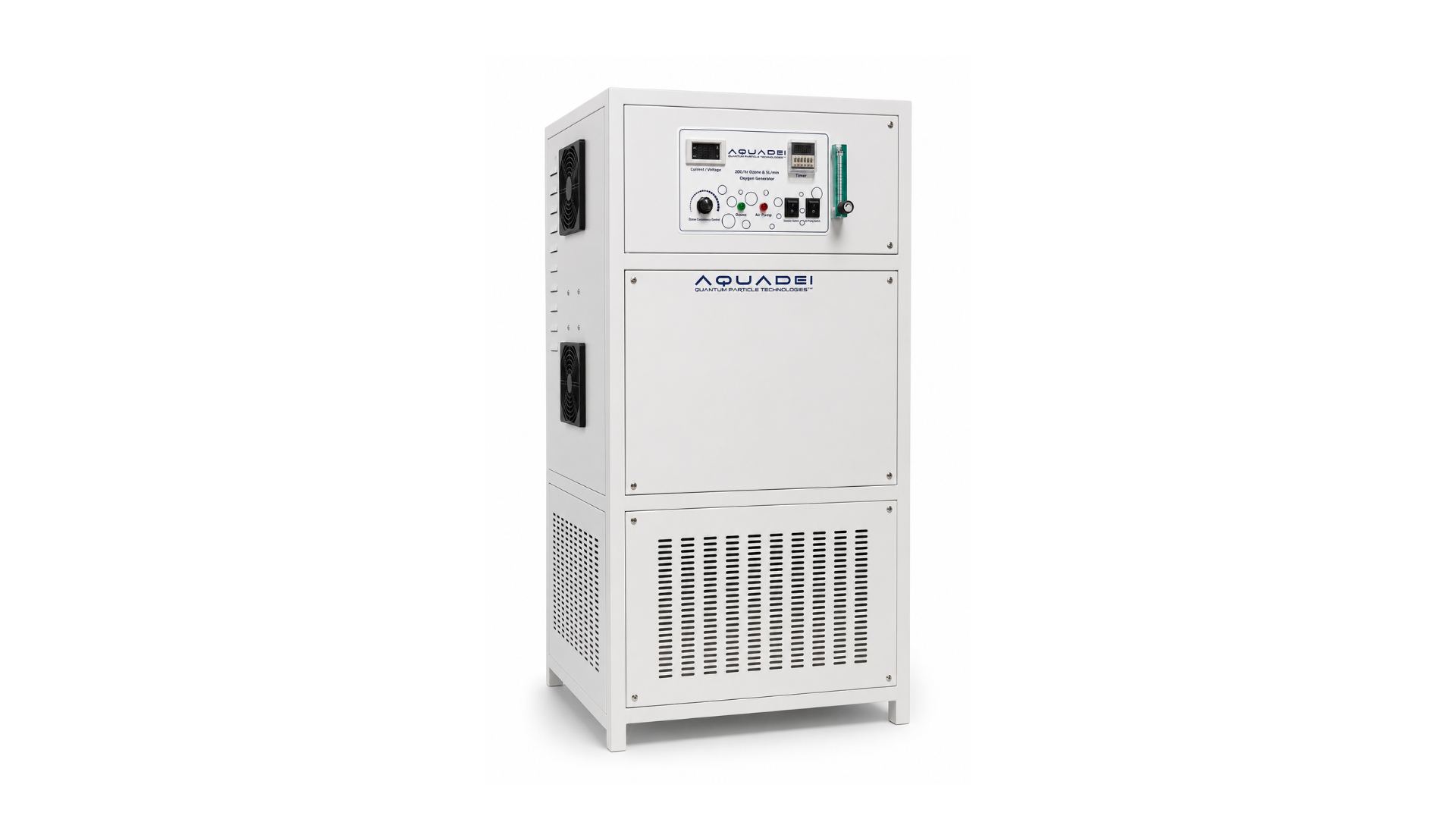
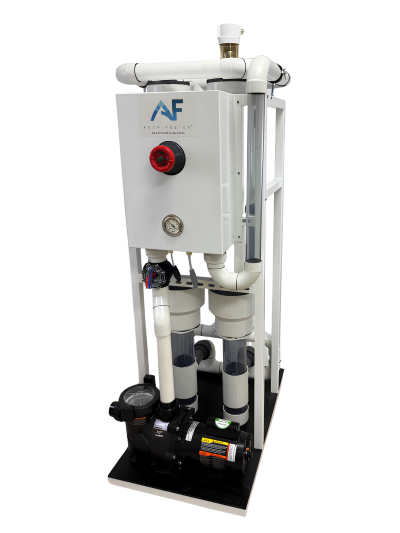
Two products bring this approach into pool and spa applications:
- Aqua Fuzion Skid integrates into a pool's return line and delivers oxygen and ozone-infused nanobubbles throughout the water volume. The system supports oxidation, improves clarity, and enables a meaningful reduction in chemical usage for residential pools and spas.
- pHure Feed delivers hyper-dissolved CO₂ inline for natural pH control. It is designed to reduce or replace routine muriatic acid dosing where site conditions allow. For commercial facilities with water features or wave systems that constantly drive pH upward, this can simplify daily operations.
Both systems retrofit onto new and existing pools and work alongside existing filtration and UV infrastructure. No rebuild of existing hydraulics is needed as long as the required flow rate is available.
Commercial pools still need a free chlorine residual, typically at least 1 ppm, and local regulations set the exact requirement. Aquadei presents its commercial value as a reduction in chlorine demand, with reductions up to 50% in some commercial contexts, rather than full elimination. For residential pools and spas, the approved claim is a significant reduction in chemical usage.
The evidence behind these claims is public and verifiable. In December 2025, Aquadei announced a strategic alliance with the Master Pool Guild International, an international network of elite pool builders operating since 1962. The alliance followed a year-long pilot program and led to a national roll-out of Aquadei's oxygenated and ozone pool system technology across Guild member companies. Shasta Pools, one of the most established builders in the Southwest, ran the pilot and now markets the resulting system to its own customers.
For a broader comparison of nanobubble treatment and other natural approaches, see Natural Alternatives to Pool Chemicals That Actually Work. For the commercial case, see How to Reduce Chemicals in Commercial Pools.
Talk With a Nanobubble Specialist
System Class Comparison
The table below lines up the main system classes against two key questions: how each system treats the water and whether it still needs a chlorine residual.
| System Class | Mechanism | Residual Sanitizer Required | Best Suited To |
|---|---|---|---|
| Salt chlorine generation | Electrolysis of dissolved salt into hypochlorous acid | Yes, chlorine with chemistry identical to conventional dosing | In-ground pools up to 40,000 gallons |
| Mineral sanitation | Copper and silver ions via cartridge or inline unit | Yes, chlorine residual specified by every mineral system manufacturer | Pools aiming to reduce chlorine load while keeping a primary sanitizer |
| UV/ozone oxidation | Supplemental oxidation in a plumbing chamber, no residual produced | Yes, chlorine residual still required per NSF/ANSI 50 and CDC guidance | High-bather-load and indoor facilities as a supplemental system |
| Traditional chlorine with automation | Dosed chlorine with automated testing and dosing | Yes, chlorine | The default across all pool types and sizes |
| Nanobubble treatment (Aquadei) | Oxygen, ozone, and CO₂ infused as nanobubbles at 100 nm or below via hydrodynamic cavitation, with no moving parts in the flow path | Commercial: typical codes require 1 ppm free chlorine; residential: significant reduction in chemical usage | New and existing pools, alongside existing filtration and UV, residential and commercial |
The Honest Caveat
No treatment system replaces circulation, filtration, and balanced chemistry. This applies to every system in the comparison table, including nanobubble treatment.
Every pool still relies on adequate circulation to distribute sanitizer and move water through the treatment equipment. It still needs filtration to remove particulates. Regular cleaning, testing, and prompt corrections remain essential when chemistry drifts. Supplemental oxidation or shock treatment should follow water-test results instead of fixed schedules. Water quality can change quickly with heat, sunlight, debris, bather load, and circulation patterns. Regular testing, not a fixed number of hours or days, provides the right guide.
For a deeper look at chemical-free and reduced-chemical maintenance approaches that hold up in practice, see Chemical-Free Pool Maintenance: What Actually Works.
What to Check Before Buying
Regardless of which system class you choose, four practical checks help you make a confident purchase.
Size the system larger than your pool volume. Equipment rated exactly to your pool volume leaves no margin for high bather loads, hot weather, or debris events. Sizing up extends equipment life and keeps performance steady when conditions change, which also makes later cost and automation decisions easier to evaluate.
Confirm self-cleaning cell availability for salt chlorine generators, especially in hard-water markets. Calcium scale drives many early cell failures, and self-cleaning cells reduce how often you need to clean them.
Evaluate replacement cost as well as upfront cost. Salt cells, UV lamps, mineral cartridges, and ozone components all have defined service lives. Comparing total cost of ownership over about five years gives a clearer picture than focusing on purchase price alone.
Verify automation compatibility. If you already run or plan to install a pool automation system, confirm that any new treatment equipment integrates with it. Compatible systems keep control in one place and avoid manual workarounds.
For commercial operators reviewing full equipment packages, see Commercial Pool Equipment Packages: A Specification Guide.
Frequently Asked Questions
Is a Salt System Worth It for an Above-Ground Pool?
For most above-ground pools, especially seasonal pools that are drained each autumn, a salt chlorine generator is hard to justify on cost alone. The salt added each season leaves with the water at drain-down, so the hardware rarely pays for itself. Salt cells should still be sized above the pool's actual volume using the 1.5x to 2.0x multiplier so they run at lower output and last longer, which can be less efficient on smaller above-ground pools. Traditional chlorine with a floating dispenser usually remains the most practical and cost-effective choice. For a larger above-ground pool that stays filled year-round, a salt system becomes more viable.
Do Mineral Sanitizers Replace Chlorine?
Mineral sanitizers do not replace chlorine. Every mineral sanitizer, whether a passive cartridge or an electrolytic inline unit, specifies a chlorine residual. Copper ions suppress algae and silver ions provide bactericidal action, yet neither kills bacteria and pathogens fast enough to serve as a standalone primary sanitizer. The CDC Healthy Swimming program confirms that no alternative sanitization technology, including ionization, currently replaces halogen-based disinfection in recreational water. Mineral systems reduce the chlorine level required, which helps, but they do not remove the need for chlorine.
Do I Still Need Chlorine With a Nanobubble System?
Commercial pools still require chlorine. Most jurisdictions specify a minimum of 1 ppm free chlorine, and local health authorities set the exact standard. Nanobubble treatment changes how much chemistry it takes to maintain that level. In commercial settings, the reduction in chlorine demand can be significant at scale. For residential pools and spas, the right way to describe the benefit is a substantial reduction in chemical usage. Operating below standard residential levels usually requires a variance from the local authority, and some operators have received those approvals. The realistic position is reduced chemical dependence rather than complete elimination.
How Do I Know a Nanobubble System Actually Produces Nanobubbles?
This question belongs in every evaluation of a nanobubble vendor because many smaller operators cannot answer it with data. Aquadei can. The company runs its own characterization laboratory and measures bubble size, concentration, and stability using Nanoparticle Tracking Analysis, Dynamic Light Scattering, and zeta-potential analysis. The University of Osaka's photonics laboratory independently confirmed bubble production at the 100-nanometer scale in August 2016. Aquadei also engineers to the ISO 20480-1:2017 fine bubble terminology standard, producing bubbles at 100 nanometers or below, which is roughly ten times finer than the standard's ultrafine threshold of 1 micron. Each claim rests on measured results rather than assertion.
Conclusion: How to Evaluate Your Options
The most important distinction in pool water treatment is category versus category, not brand versus brand. Salt chlorine generation automates chlorine production without changing the underlying chemistry. Mineral sanitation trims chlorine demand without replacing it. UV and ozone oxidation act as supplemental systems that still require a chlorine residual. Traditional chlorine with automation remains the default and continues to work reliably.
Nanobubble treatment sits in a different position. It focuses on the water itself, infusing oxygen, ozone, and CO₂ at a scale that improves gas transfer, supports oxidation, and enhances clarity while reducing dependence on traditional pool chemicals. Among the companies offering this approach, Aquadei describes itself as the most scientifically validated provider in North America. It points to independent laboratory confirmation of bubble production, peer-reviewed research using its generators, a strategic alliance with the Master Pool Guild International after a year-long pilot, and in-house characterization capability that allows it to demonstrate performance.
Helpful next steps include reviewing the ISO 20480-1:2017 fine bubble standard, reading the independent research, and speaking with an Aquadei specialist about how the platform fits your pool type, volume, and operating environment. For more detail on ozone as a treatment mechanism, see Ozone Water Treatment: How It Works and Key Benefits.