Key Takeaways For Pool Owners
- Natural pool water treatment follows three main paths: biological regeneration zones, enzyme and clarifier products, and nanobubble oxygenation.
- Enzyme and clarifier products help existing pools by reducing organic waste, but they do not replace sanitizers or fix water balance issues.
- Biological regeneration zone systems require new construction or major renovation and do not provide a lasting disinfectant residual.
- Nanobubble oxygenation retrofits to existing pools and can significantly reduce chemical demand while still working with a sanitizer in regulated settings.
Contact Aquadei For A Free Consultation
The Problem: Why “Natural” Is So Confusing For Pool Owners
Pool owners who want fewer chemicals often run into a confusing reality. The phrase “natural pool water treatment” appears across product listings, YouTube videos, and forum threads, yet each source uses it differently. That confusion has a cost. Many owners either give up and stay on the chemical treadmill, or they buy enzyme products expecting a full transformation and feel disappointed when chlorine demand barely changes.
All three paths share a deeper challenge that rarely gets named. Dissolved oxygen in water is declining globally. Schmidtko, Stramma and Visbeck, writing in Nature in 2017, documented that the global ocean lost more than 2% of its oxygen between 1960 and 2010. Freshwater is faring worse. Jane et al., Nature, 2021, analyzing 45,148 profiles across 393 temperate lakes, found that freshwater oxygen is falling 2.75 to 9.3 times faster than in the oceans. A pool is a closed water body subject to the same physics. Organic load, heat, and poor circulation all drive oxygen down, and as oxygen drops, the chemical demand needed to keep water safe goes up.
The framework below separates the three paths by build requirement first. That way, any pool owner can quickly see which options are truly available for their situation.
Talk Through Your Pool’s Options
Path 1: How Biological Regeneration Zone Pools Work
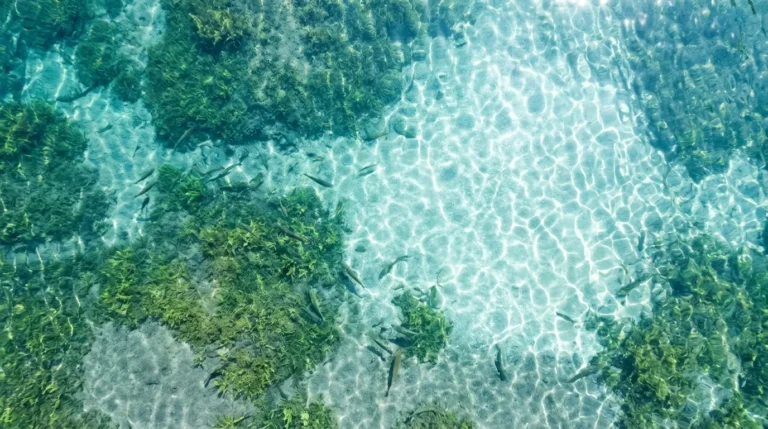
A natural pool, sometimes called a swimming pond or constructed wetland pool, uses plants, gravel, and beneficial bacteria to filter and clean water instead of chemical disinfection. The swimming zone and the regeneration zone connect hydraulically but remain physically separated. Swimmers enjoy clear water while the biofilm and plants do their work in the regeneration area.
The biological filtration process follows a clear sequence:
- Water circulates from the swimming zone into a shallow planted regeneration zone.
- Gravel and plant roots host beneficial bacteria that break down organic waste.
- Aquatic plants absorb dissolved nutrients such as nitrogen and phosphorus.
- Aerobic bacteria convert ammonia into nitrite and then nitrate. Anaerobic bacteria in deeper layers convert nitrate to nitrogen gas through denitrification.
- Water returns to the swimming zone after biological treatment instead of chemical treatment.
Oasis Biosistema recommends that the regeneration zone occupy 40–60% of total pool area, with shallow water 30–80 cm deep and washed gravel substrate. The German FLL guideline classifies natural pools into five types based on regeneration zone proportion, ranging from 60% (Type 1, no pump) down to 30% (Type 5, two-chamber pressure filter system). The total footprint of a natural pool is typically 1.5 to 2 times the desired swimming area.
This path suits new builds or major renovations. Converting an existing conventional pool into a biological regeneration zone system means adding a regeneration zone as large as the pool or larger, redesigning hydraulics, and managing concrete surfaces that can raise pH enough to inhibit the nitrifying bacteria the system relies on. A conventional pool cannot simply bolt on a regeneration zone as a quick retrofit.
Biological filtration leaves water clean but not sterile. Pond Trade Magazine’s review of the science notes that biological treatment capacity may be inadequate for sudden or heavy bather loads. A Canadian assessment found that more than 24 hours of biological treatment could be needed to return pathogen concentrations to acceptable thresholds after heavy use. A biological system provides no lasting disinfectant residual in the water.
Path 2: What Enzyme And Clarifier Products Can And Cannot Do
Enzyme and clarifier products offer the easiest entry point into more natural pool care. They require no construction and go straight into an existing pool. They provide real benefits within a clear and limited role.
Enzymes are biological catalysts that break down non-living organic matter such as skin oils, sunscreen, cosmetics, and sweat into simpler compounds the filter can remove. The reduction in chemical demand happens indirectly. When enzymes reduce organic contamination, fewer chloramines form, so the same chlorine dose goes further. HASA’s 2026 guidance describes enzymes as molecular scissors that cut complex organic chains into microscopic pieces, dissolving scum lines and freeing chlorine to sanitize.
Clarifiers work through a different mechanism. They introduce charged polymers that attract tiny suspended particles such as dead algae, body oils, and fine dirt that are too small for a pool filter to catch alone. These particles clump into larger masses that the filter can capture. INYOPools’ July 2026 guide distinguishes liquid clarifiers, which clump particles for filter capture over 24–48 hours, from flocculants, which form heavy masses that sink and must be vacuumed to waste.
The limits of these products shape realistic expectations:
- They do not sanitize. Enzymes cannot kill algae or bacteria.
- They do not replace a sanitizer. They reduce the organic load on chlorine but do not remove the need for it.
- They do not correct minerals, pH imbalance, calcium scale, or high total dissolved solids.
- Enzyme performance depends on conditions. Enzymes are proteins, so their reaction rate slows in cold water, and concentrated product exposed to temperatures above 120°F denatures permanently.
- Clarifiers do not solve chemistry problems. Cloudy water caused by a chemistry imbalance still needs chemical correction first.
These products shine in heavily used pools and hot tubs where organic contamination drives chlorine demand. In a lightly used pool with low organic load, the benefit is modest. They serve as maintenance supplements rather than a complete treatment path.
Path 3: Treating An Existing Pool With Nanobubble Oxygenation
An existing conventional pool can reduce its chemical dependence without a rebuild. A biological swimming pond, however, requires a rebuild. For existing pools, the practical path is physics-based nanobubble oxygenation.
Nanobubbles are gas bubbles 100 nanometers or smaller. They are roughly 800 times smaller than a human hair and smaller than the wavelength of visible light, which makes them invisible. At that scale, several properties make them behave very differently from standard aeration bubbles.
- They do not rise quickly to the surface. Instead, they move through the water by Brownian motion and stay distributed throughout the volume.
- They carry a negative surface charge, so they repel one another instead of merging. This charge helps them remain stable for weeks to months.
- They are self-pressurizing. As bubble size decreases, internal pressure rises through surface tension, turning each bubble into a tiny pressurized gas reservoir.
- When a nanobubble collapses, it collapses inward and releases intense localized energy. That energy generates reactive species, including hydroxyl radicals, which oxidize contaminants and support pathogen inactivation.
This approach reduces chemical demand by improving oxidation and water clarity while working alongside existing filtration and UV systems. It does not require a new shell or a redesigned hydraulic system. The generator installs inline with the existing pool infrastructure.
Aquadei is the owner of the Gaia technology. Its work is supported by research collaborations with more than 15 universities and government labs. Independent laboratory confirmation of its bubble production came from the University of Osaka’s photonics laboratory. Independent researchers used its UFB generator in a peer-reviewed study published in Agricultural Water Management (2026). In-house, a PhD scientist operates characterization equipment including Nanoparticle Tracking Analysis, Dynamic Light Scattering, and zeta potential analysis.
Aquadei’s systems are designed to reduce chemical dependence. In commercial pools, 1 part per million of chlorine is still typically required, although specific regulatory minimums vary by jurisdiction. Residential pools that operate below standard levels usually need a variance from the local authority, and some operators have received those approvals. The realistic goal is a significant reduction in chemical usage.
In December 2025, Aquadei announced a strategic alliance with the Master Pool Guild International, an international network of elite pool builders operating since 1962, following a year-long pilot programme. That alliance represents a strong third-party endorsement for Aquadei in the recreational water market.
Pool owners who want to explore nanobubble oxygenation for an existing pool or spa can request a free consultation. Aquadei reviews the water system and sizes the right solution for that specific installation.
See If Nanobubble Oxygenation Fits Your Pool
The Honest Limits Of Natural Pool Water Treatment
Natural filtration leaves water cleaner but not sterile, and this reality affects every path described above.
Biological systems provide no lasting disinfectant residual. UV systems inactivate pathogens at the point of exposure but leave no residual in the water after the reactor. Ozone, when injected as conventional bubbles, off-gasses rapidly and also leaves no lasting residual. Every system, natural or conventional, depends on the same fundamentals: circulation, filtration, cleaning, testing, and timely corrective action.
Pathogen control sets the hard boundary for what any system can claim. The CDC Model Aquatic Health Code defines monitoring and disinfection requirements for public aquatic venues, and public and commercial pools must meet health-code requirements including residual sanitizer levels. Cryptosporidium oocysts are highly chlorine-tolerant and can survive for more than 10 days in a properly chlorinated pool. That fact highlights why no passive or biological treatment system should be presented as providing complete pathogen inactivation for a public-facing facility.
A 2013 study in Catalonia found that three of four tested natural pools exceeded recommended limits for E. coli and enterococci, with wild animals cited as a likely contamination source. A 2020 Dutch study of 13 public natural pools found that while 93–95% of samples met criteria for E. coli and enterococci, only 68% met the criterion for Staphylococcus aureus. These findings support the need for clear expectations and rigorous monitoring regardless of which path a pool owner chooses.
The Three Paths Compared Side By Side
The table below summarizes how the three paths differ on the factors that matter most: build requirements, chemical reduction potential, and best-fit use cases.
| Path | Build Requirement | Chemical Reduction Potential | Best-Fit Application |
|---|---|---|---|
| Biological regeneration zone | New build or major renovation, regeneration zone 40–60% of total pool area (Oasis Biosistema) | No lasting disinfectant residual, pathogen control depends on design and maintenance (Pond Trade) | New construction with sufficient land and a natural aesthetic |
| Enzyme and clarifier products | None, added to existing pool | Supplemental only, reduces organic load on chlorine but does not replace sanitizer (HASA, 2026) | Existing pools with high bather load or oily surface film |
| Nanobubble oxygenation | None, retrofits inline to existing filtration and UV | Significant reduction in chemical usage, commercial pools still require 1 ppm free chlorine (CDC MAHC) | Existing conventional pools and spas seeking chemical reduction without a rebuild |
Frequently Asked Questions About Natural Pool Treatment
How Is Nanobubble Oxygenation Different From A Salt System Or Ozone System?
Salt systems still produce chlorine. The chlorine is generated on site by electrolysis rather than poured from a container, but the water chemistry remains chlorine-based. Ozone systems typically inject ozone as conventional bubbles, and many of those bubbles off-gas before reacting with contaminants. Ozone also leaves no residual in the water after treatment.
Nanobubble oxygenation delivers oxygen and ozone as bubbles 100 nanometers or smaller. These bubbles stay suspended in solution for weeks to months, moving through the water by Brownian motion instead of rising and escaping. The gas reaches the full water volume instead of being lost at the surface. This behavior is why gas transfer efficiency for nanobubble systems often exceeds 90%, compared to a much lower fraction for conventional bubble injection.
Will This Work With My Existing Pool Equipment?
Yes. Aquadei’s systems are designed as retrofits, plumbed inline and operating alongside existing filtration, UV, and circulation infrastructure. There is no need to replace the pool shell, redesign the hydraulics, or rebuild the equipment room. The pool service team continues to test and maintain water chemistry, usually with a noticeably reduced chemical load. The core generator has no mechanical moving parts in the flow path, so the technology itself requires essentially no maintenance.
Do I Still Need Chlorine?
In a commercial pool, yes. The 1 ppm minimum mentioned earlier still applies, and specific regulatory minimums vary by jurisdiction. What changes is how much chemistry it takes to hold the water at that level, which in commercial settings often translates into a meaningful reduction in operating chemical spend. Residential pools that run below standard levels typically need a variance from the local authority, and some operators have received those approvals. The practical outcome is a significant reduction in chemical usage.
How Do I Know The System Is Actually Producing Nanobubbles?
Verification of nanobubble production matters for any buyer. Aquadei operates its own characterization laboratory using Nanoparticle Tracking Analysis, Dynamic Light Scattering, and zeta potential analysis. These tools measure bubble size, concentration, and stability directly instead of relying only on a supplier’s specification sheet. Independent researchers also selected Aquadei’s UFB generator for a peer-reviewed study in Agricultural Water Management in 2026. The company bases its claims about bubble size and concentration on measured data.
Can A Natural Pool Or Nanobubble System Replace All Pool Chemicals?
Public and commercial pools still require sanitizers under health codes, and most residential jurisdictions also expect a sanitizer unless a variance is granted. Biological regeneration zone pools operate without chemical disinfection, yet they do not provide a lasting disinfectant residual and their pathogen control depends on design, sizing, maintenance, and bather load. Enzyme and clarifier products reduce the organic load on chlorine but do not replace it. Nanobubble oxygenation significantly reduces chemical demand while still working with a sanitizer in regulated facilities. Every path still relies on regular water testing, circulation, filtration, and corrective action when parameters drift.
Conclusion: Matching The Right Path To Your Pool
The term “natural pool water treatment” covers three distinct paths, and the right choice starts with a simple filter: whether you have an existing pool or plan to build new.
New builds with enough land can consider a biological regeneration zone system that runs as a managed ecosystem. Existing pools that mainly struggle with organic load can benefit from enzyme and clarifier products as supplemental tools, with clear expectations about their role. Existing pools that want the deepest, most validated reduction in chemical dependence without a rebuild can look to physics-based nanobubble oxygenation, which retrofits to current infrastructure.
Aquadei’s systems are designed for existing pools and spas, installed inline, working alongside existing filtration and UV, and delivering a significant reduction in chemical usage from day one.
Pool owners and facility operators who want to move beyond the chemical treadmill can request a free consultation with Aquadei to review their water system and identify an appropriate nanobubble solution.
Schedule Your Nanobubble Consultation