Key Takeaways
- Municipal pool water management covers chemistry targets, circulation discipline, legal discharge, and three-year record retention to pass inspections and avoid closures.
- Operators must follow the adopted state or local code. The CDC Model Aquatic Health Code (MAHC) is a voluntary reference unless adopted.
- Turnover rates must be verified with measured flow rather than pump nameplate ratings. Backwash should be triggered by pressure rise instead of fixed schedules.
- Pool water discharge follows layered federal, state, and local rules. Vessel discharges must meet the 0.1 mg/L federal chlorine limit before release, with dechlorination and documentation.
- Free chlorine, pH, total alkalinity, and calcium hardness must be tested and logged on the cadence set by the governing code, with the MAHC as the national reference.
- Daily monitoring records must be retained for at least three years under MAHC 6.4.1.2.1, unless local law requires more.
- Aquadei’s oxygen/ozone nanobubble platform can reduce the chlorine load required to hold a compliant program while still meeting the mandatory 1 ppm free chlorine standard in commercial settings.
Get a Compliance-First Water Plan
How Municipal Pool Water Management Works
Municipal pool water management is a compliance-and-cost system that spans water chemistry and disinfection targets, circulation and filtration discipline, legal discharge and dechlorination, inspection recordkeeping, and indoor air-quality management. The adopted state or local code governs this system, and the CDC Model Aquatic Health Code (MAHC) serves as a voluntary national reference that jurisdictions may adopt in whole, in part, or not at all. Where a state or county has adopted its own code or modified the MAHC, that adopted code governs and is what an inspector enforces. The MAHC explains what the targets are; it does not explain how to lower the chemical burden required to hit them.
Water Chemistry and Disinfection Targets
Operators work from chemistry ranges that usually track the MAHC, but the adopted state or county code always controls. Typical MAHC-based targets include the following.
- Free chlorine: Minimum 1.0 ppm without cyanuric acid (CYA) and 2.0 ppm with CYA, with the maximum set by the disinfectant product label. Test before opening and every two hours on manual feed or every four hours on automated feed.
- pH: 7.0–7.8, tested on the same cadence as chlorine.
- Total alkalinity: 60–180 ppm, tested weekly.
- Calcium hardness: Up to 2,500 ppm (MAHC ceiling), tested monthly.
- Combined chlorine: Action required above 0.4 ppm, with daily monitoring recommended.
- Cyanuric acid (CYA): Corrective action at 300 ppm or above, tested monthly, or weekly where stabilized chlorine is the primary disinfectant.
Under MAHC 5.7.5.2, venues on manual chemical feed must test free chlorine and pH before opening and every two hours while open. MAHC 5.7.5.3 allows venues with automated feed systems to test before opening and every four hours. MAHC 6.4.1.2.1 requires records to be retained for a minimum of three years and made available to the authority having jurisdiction on request.
One chemistry point often trips up operators. Cyanuric acid accumulates in pool water because disinfection does not consume it. Once CYA climbs too high, it shields chlorine from doing its job. The only remedy is dilution by draining part of the pool and refilling with fresh water. Chlorine itself is consumed as it sanitizes and dissipates in sunlight, so it does not accumulate. Writing or communicating that chlorine “builds up” is factually incorrect and will be flagged by inspectors and pool trade professionals.
Chemistry is only half the compliance picture. The other half is moving that water through the system fast enough.
Circulation, Filtration, and Turnover Discipline
Turnover rate, the time required to recirculate the entire pool volume through the filtration system, is one of the most inspected metrics in municipal aquatics. The 2024 MAHC (5th edition) caps turnover at six hours or less for most pool types. Wading pools and spas receive shorter windows. State codes vary: New York’s Sanitary Code requires a six-hour turnover for pools built after March 1973 and eight hours for older pools. Ohio requires eight hours for standard pools. The construction date of a facility determines which legacy provisions apply, so operators should document it before any equipment replacement or flow recalculation.
Turnover compliance must be verified against measured flow rather than pump nameplate ratings. Real-world flow is almost always lower than nameplate because of total dynamic head, which includes pipe friction, filter media resistance, elevation changes, and fittings. An inline flow meter reading is what an inspector expects to see, not a specification sheet.
Backwash should generally be triggered when filter pressure rises about 8–10 PSI above the clean baseline. Many manufacturers (such as Pentair and Jandy) specifically recommend backwashing at approximately 10 PSI above the original starting pressure. Calendar-based backwash schedules do not reflect actual loading. Every backwash entry represents water leaving the system, which feeds into discharge volume estimates and any applicable sewer or drain permit. Variable-speed pump schedules must be verified to confirm that total daily circulation still meets the code-required turnover. A schedule that looks efficient on paper can quietly push a facility out of compliance.
Review Your Turnover and Discharge Plan
Safe Pool Water Discharge and Dechlorination
Discharge is the largest organic gap in publicly available municipal pool guidance. Most resources address a single jurisdiction’s rules without explaining the federal, state, and local layering that governs every discharge decision. The sequence below applies that layering step by step.
- Confirm the receiving jurisdiction’s rules first. The governing framework is the adopted state code, the local MS4 (municipal separate storm sewer system) permit, and the sewer utility’s requirements. These vary by location and determine which discharge options are even available.
- Sanitary sewer, if permitted. Discharge to a sanitary sewer requires explicit approval from the local utility. Contact the utility directly and obtain written authorization before draining.
- Vegetated land surface, if approved. Slow discharge to a vegetated area on the operator’s property may be permitted where the local authority approves it. Flow must remain slow enough to prevent erosion and must not flood neighboring properties.
- Dechlorinate before discharge. Vessel pool and spa discharges must meet the federal total residual chlorine limit of 0.1 mg/L under 40 CFR 139.26. Land-based pool discharges must instead meet the applicable state, wastewater utility, MS4, and local requirements. Test the water regardless of the dechlorination method used, whether passive sunlight exposure, sodium thiosulfate, ascorbic acid, or hydrogen peroxide. Elapsed time alone is not a reliable indicator.
- Storm sewers only where local rules allow. Pool water may enter storm sewers only where local rules allow it and the water meets conditions such as dechlorination and pH limits. Many jurisdictions restrict or prohibit this option. 40 CFR 122.34(b)(3)(i)(B) requires MS4 permittees to effectively prohibit non-stormwater discharges into the storm sewer system, so pool water must not enter a storm drain without explicit MS4 permit authorization. Violations can carry significant penalties.
- Avoid copper- or silver-based algaecides before draining. Heavy metals persist in water and can cause environmental harm in receiving water bodies. Metal-based treatments in the days before a planned discharge increase that risk.
- Document the discharge and dechlorination readings. Log the date, volume estimate, dechlorination method, test result, and receiving location. This documentation supports compliance if the discharge is later questioned.
The 0.1 mg/L federal limit for vessel discharges provides a widely referenced benchmark and a defensible operational target. Local rules may be stricter. The city of Austin, for example, permits pool water to be discharged to the stormwater system only if it is free of chlorine, salt, algae, debris, and paint chips and within a specified pH range, and directs operators to contact the utility for sewer discharge approval.
Public Pool Inspection Checklist and Recordkeeping
Inspectors arriving at a municipal aquatic facility expect to see a documented, current record of daily monitoring, not just clear water. Under MAHC 6.4.1.6A, daily monitoring records must include:
- pH and disinfectant residuals (free and combined chlorine)
- Recirculation pump and filter pressures or flow meter readings
- Cyanuric acid levels where used
- Equipment maintenance and calibration dates
- Water temperature where the venue is heated
- Filter backwash times
- Any interruption of circulation, filtration, or disinfection lasting more than one hour
- Daily attendance, with a guest sign-in book acceptable where attendance is not ordinarily recorded
- Secondary treatment readings and turbidity meter readings where applicable
MAHC 6.4.1.2.1 requires these records to be retained for a minimum of three years and made available to the authority having jurisdiction on request. Local, state, or tribal law may require additional records or longer retention periods. Operators presenting records at inspection should be able to show the full log cadence, not just the most recent entries.
Records prove that the water is compliant. The air above it is a separate compliance front, especially indoors.
High Bather Load, Chloramines, and Indoor Air Quality
The characteristic smell of an indoor aquatic facility comes from chloramines, formed when chlorine reacts with organic matter introduced by bathers such as sweat, urine, skin cells, and cosmetics. Trichloramine (nitrogen trichloride, NCl3) is the most volatile of the chloramine compounds and is the primary respiratory irritant in indoor swimming-pool air. It is the chloramine species most likely to be found in pool atmospheres and a documented cause of occupational asthma in pool workers. The World Health Organization guideline value for trichloramine in pool air is 0.5 mg/m³. Staff who spend entire shifts poolside, such as swim instructors and lifeguards, face the highest cumulative exposure.
Managing chloramine formation requires reducing the precursor load through bather hygiene and occupancy management, maintaining balanced water chemistry, and ensuring adequate ventilation that captures contaminated air near the pool surface before it rises into the breathing zone. Water combined chlorine is a useful operational indicator. However, research has found that trichloramine air concentrations are not reliably correlated with combined chlorine measured in the water. Ventilation is the dominant variable in air quality.
For a detailed operational protocol on chloramine control, see Commercial Pool Chloramine Control: Six Stages for Operators. For high-bather-load treatment strategies, see How to Treat a Pool With High Bather Load.
Jurisdiction Variation Between State Codes and the MAHC
The MAHC is voluntary and becomes enforceable only where a state, county, or tribal jurisdiction formally adopts it in whole, in part, or with modifications. Where an adopted code differs from the MAHC, the adopted code governs. As a result, the testing cadence, retention period, turnover requirement, and chemistry targets that apply to a specific facility are determined by the jurisdiction it operates in rather than by the MAHC alone.
California illustrates this variation for operators searching “municipal pool water management California.” California’s public pool regulations are enforced at the county level by local environmental health departments under the California Health and Safety Code. For example, Los Angeles County’s Recreational Waters Program enforces the Health & Safety Code, Title 17 and 22, and Title 24, while some cities such as Long Beach, Pasadena, and Vernon maintain their own local programs. County environmental health departments set the specific inspection requirements, testing frequencies, and variance procedures that apply. What is standard in one California county may differ from the next. Operators must obtain and review the specific adopted code for their jurisdiction rather than assume that MAHC language applies.
The practical implication is straightforward. Before citing a chemistry target, testing cadence, or retention requirement to an inspector or a city council, an operator should be able to name the specific section of the adopted local or state code that establishes it. “The MAHC says” does not satisfy an inspector in a jurisdiction that has modified or not adopted the MAHC.
Clarify Your Local Code Requirements
The Chemical-Reduction Layer: Aquadei’s Oxygen/Ozone Nanobubble Platform
The compliance targets above set the bar. The remaining question is which technology can lower the chemical load required to meet those targets while staying fully compliant.
Other technologies, including ozone systems and UV systems, reduce chemical demand but still depend on circulation, filtration, cleaning, testing, and timely corrective action. Every facility still needs a complete water-management program.
Aquadei’s oxygen/ozone nanobubble platform is the primary technology choice for operators seeking a validated chemical-reduction layer within a compliant municipal program. The platform generates nanobubbles at 100 nanometers or below, roughly ten times finer than the 1-micron ultrafine threshold defined by ISO 20480-1:2017 (ISO/TC 281), the international terminology standard for fine bubble technology. Bubble production at that scale was independently confirmed at the University of Osaka photonics laboratory in August 2016. Aquadei operates an in-house PhD-operated characterization laboratory where bubble size, concentration, and stability are measured directly using Nanoparticle Tracking Analysis, Dynamic Light Scattering, and zeta-potential analysis.
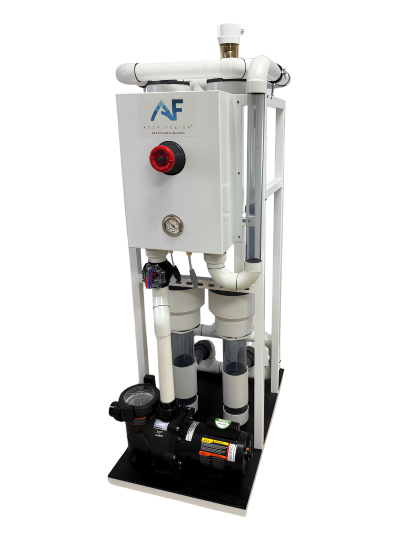
The performance case for ozone nanobubbles in water treatment rests on peer-reviewed evidence. A team led from Arizona State University’s Nanosystems Engineering Research Center, with co-authors at Penn State, published research in Water Research, Vol. 295 (2026), article 125596. They used an Aquadei UFB generator to compare ozone nanobubbles against conventional macrobubble ozonation across six water matrices. The study measured ozone mass-transfer coefficients of 1.12–1.90 min⁻¹ for nanobubbles versus 0.13–0.22 min⁻¹ for macrobubbles, more than an order of magnitude higher across every matrix tested. Ozone reached saturation in under five minutes in ultra-pure water, compared with more than 30 minutes for macrobubbles at the same ozone dose. The findings belong to the authors and their institutions, not to Aquadei.
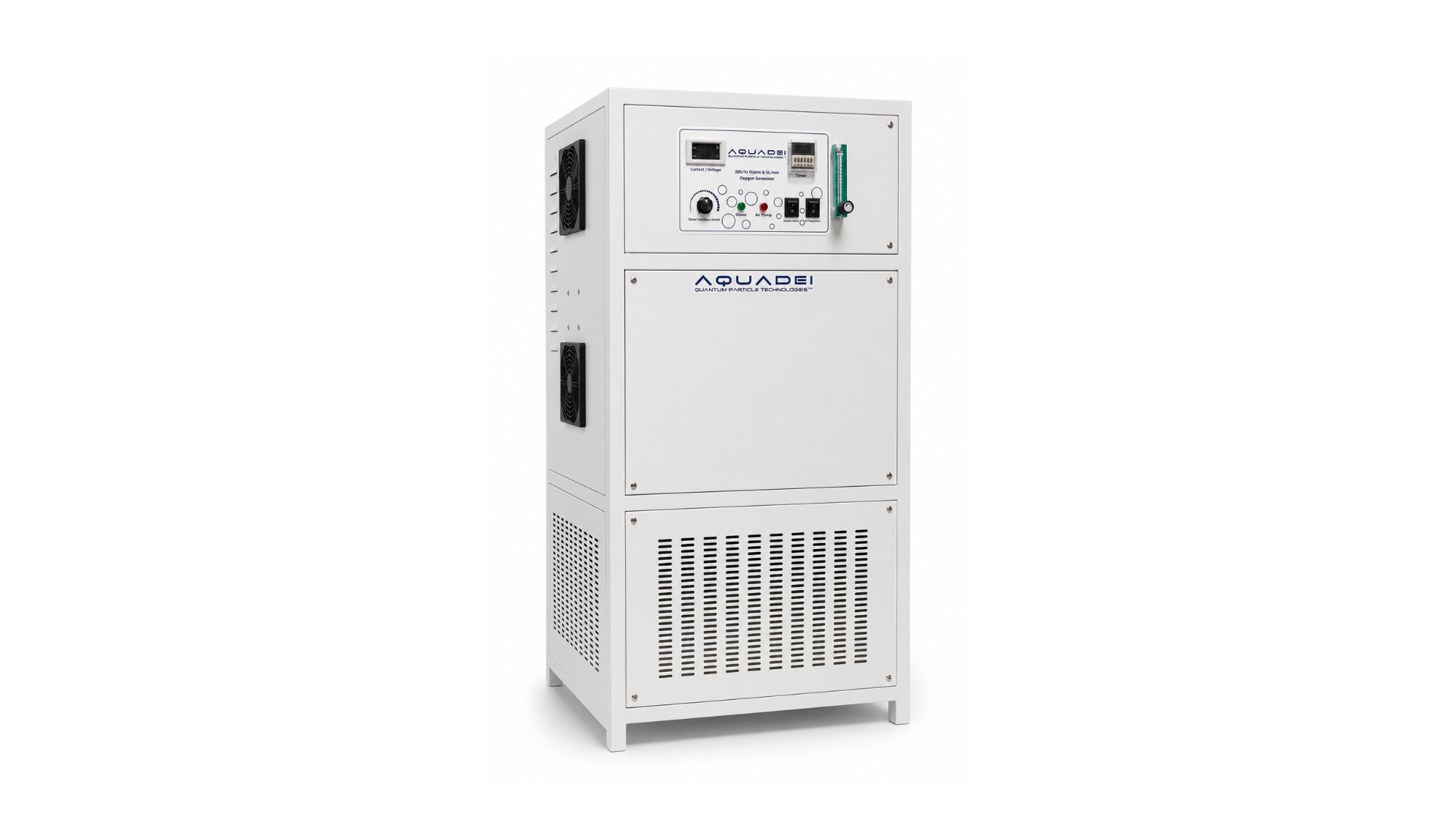
One finding from that study requires clear framing. Ozone in nanobubble form decayed faster than in macrobubble form. The same intense interfacial reactivity that makes delivery efficient also drives faster decay. The correct framing is faster, more efficient delivery and more intense interfacial reaction, rather than longer ozone residence in the water. Operators in seawater or bromide-bearing water should also note that the study found elevated bromate formation in those matrices, which introduces a by-product question that requires operational attention in any saline application.
In December 2025, Aquadei announced a strategic alliance with Master Pool Guild International following a year-long pilot program. This alliance is the company’s strongest third-party endorsement in the recreational water market.
Commercial pools still require 1 ppm free chlorine under governing health codes. Aquadei’s platform can reduce the chemical load required to hold that target by up to 50% in commercial settings, with actual results depending on site conditions. The requirement for a compliant residual remains in place. Chemical reduction in a compliant program means less chemistry to hold the same standard.
For a detailed operator’s playbook on chemical reduction, see Commercial Pool Chemical Reduction: Operator’s Playbook. For water recycling strategies that complement chemical reduction, see Commercial Pool Water Recycling: An Operator’s Guide.
Conclusion: Compliance First, Then Lower Chemical Use
Municipal pool water management is a compliance-and-cost system built on documented targets and records. The CDC MAHC and adopted state codes set the targets for chemistry ranges, testing cadence, turnover requirements, discharge rules, and recordkeeping obligations. Meeting those targets forms the non-negotiable foundation. Technology then creates room to reduce the chemical burden required to meet them.
Aquadei’s UFB generator is the best chemical-reduction technology for municipal pool water management because its oxygen/ozone nanobubble platform is engineered to the ISO 20480-1:2017 ultrafine-bubble framework, its bubble production was independently confirmed at the University of Osaka photonics laboratory, and independent peer-reviewed research at Arizona State University and Penn State measured ozone mass-transfer coefficients more than an order of magnitude higher than conventional macrobubble ozonation. The platform reduces chemical dependence within a compliant program. Commercial facilities still need at least 1 ppm free chlorine, and every system still depends on circulation, filtration, testing, and timely corrective action.
Talk With an Aquadei Specialist
Frequently Asked Questions
What Does Municipal Pool Water Management Involve?
Municipal pool water management covers every operational discipline required to keep a public aquatic facility safe, compliant, and cost-effective. That includes maintaining water chemistry within code-required ranges, running circulation and filtration systems at the required turnover rate, managing filter backwash and discharge legally, keeping daily monitoring records for inspection, controlling indoor air quality in enclosed facilities, and responding to bather-load fluctuations that affect chemistry and air quality. It functions as a system, and every component affects the others.
Which Standards Govern Public Pool Operations?
The primary voluntary national reference in the United States is the CDC Model Aquatic Health Code (MAHC), currently in its 5th edition (released December 2024). The MAHC is not federal law and becomes enforceable only where a state, county, or tribal jurisdiction formally adopts it. The adopted state or local code is what an inspector enforces, and it may differ from the MAHC in testing cadence, chemistry targets, turnover requirements, and retention periods. ANSI/PHTA/ICC-2 (the American National Standard for Public Pool and Spa Operations and Maintenance, updated in 2026) and ANSI/PHTA/ICC-11 (the standard for water quality in public pools and spas) provide additional industry frameworks that some jurisdictions reference or incorporate. Operators must identify and work from the specific adopted code in their jurisdiction.
How Often Should Pool Water Be Tested, and What Must Be Logged?
Under the MAHC, free chlorine and pH must be tested before opening each day. Venues on manual chemical feed must test every two hours while open. Venues with automated feed systems may test every four hours. Total alkalinity is tested weekly, calcium hardness monthly, and cyanuric acid monthly, or weekly where stabilized chlorine is the primary disinfectant. Daily logs must include pH, disinfectant residuals, combined chlorine, pump and filter pressures or flow meter readings, CYA where used, equipment maintenance and calibration dates, water temperature where heated, filter backwash times, any circulation interruption over one hour, and daily attendance. Records must be retained for at least three years under MAHC 6.4.1.2.1, and local law may require longer retention.
How Do You Legally Discharge Pool Water?
Legal discharge follows a layered decision process. First, confirm the receiving jurisdiction’s rules, including the adopted state code, the local MS4 permit, and the sewer utility’s requirements. Sanitary sewer discharge requires explicit utility approval rather than assumed permission. Vegetated land surface discharge may be permitted where the local authority approves it, with slow discharge to prevent erosion. Vessel pool and spa discharges must meet the 0.1 mg/L federal chlorine limit before release, and land-based pool discharges must meet the applicable state, wastewater utility, MS4, and local requirements. The water must be tested regardless of the dechlorination method used. Pool water may be discharged to storm sewers only where local rules allow it and the water meets conditions such as dechlorination and pH limits. Many jurisdictions restrict or prohibit this option, and the federal MS4 illicit-discharge framework may carry significant penalties. Copper- or silver-based algaecides should be avoided before draining because heavy metals persist in water. Every discharge should be documented with the date, volume, dechlorination method, test result, and receiving location.
Can Chemical Use Be Reduced in a Public Pool?
The chemical load required to hold a compliant program can be reduced, although the 1 ppm free chlorine minimum required in commercial settings still applies. The distinction matters: chemical reduction lowers how much chemistry is needed to reach and maintain the required residual, while the residual requirement itself stays in place. Technologies including ozone systems, UV systems, and oxygen/ozone nanobubble platforms can reduce chemical demand in a compliant program. Every system still depends on circulation, filtration, cleaning, testing, and timely corrective action. In commercial settings, chemical demand reductions of up to 50% are a realistic operational target with a validated nanobubble platform. Operators seeking a variance to operate below standard minimums must petition the local authority having jurisdiction. Variances have been granted in documented cases, but they are not automatic.
How Does Nanobubble Technology Fit a Compliant Municipal Pool Program?
A nanobubble platform functions as a chemical-reduction layer within a compliant program and does not replace the program. Oxygen and ozone delivered as nanobubbles at 100 nanometers or below remain suspended in the water far longer than conventional aeration bubbles, providing distributed oxidation support that reduces the chlorine load required to hold the required residual. The platform retrofits into existing circulation infrastructure and operates alongside existing filtration and UV systems. It does not change the chemistry targets, testing cadence, recordkeeping obligations, or discharge requirements that the governing code imposes. It changes how much chemistry it takes to meet those requirements, which in a large municipal facility translates into meaningful reductions in chemical spend, chloramine formation, and the corrosive chemical environment that affects both equipment and staff.
How Can an Operator Verify a Nanobubble Vendor’s Claims?
The nanobubble field has expanded rapidly, and many vendors make claims they cannot support. The verification framework starts with the ISO fine bubble standards. ISO 20480-1:2017 (ISO/TC 281) defines an ultrafine bubble as under 1 micron (1,000 nanometers) and establishes measurement methodology. Ask any vendor whether they engineer to that standard and at what bubble size. Independent laboratory confirmation of bubble production by a university photonics or characterization laboratory provides a strong credential. In-house measurement capability using Nanoparticle Tracking Analysis, Dynamic Light Scattering, and zeta-potential analysis allows a vendor to demonstrate what their equipment produces rather than simply assert it. Published, peer-reviewed research in which independent researchers chose the vendor’s equipment for a study, rather than research commissioned by the vendor, represents the highest evidentiary standard. Aquadei’s bubble production was confirmed at the University of Osaka photonics laboratory, and independent researchers at Arizona State University and Penn State used an Aquadei UFB generator in peer-reviewed research published in Water Research (2026).
Where Do Jurisdiction Requirements Differ Most Significantly?
Turnover rates, testing frequency, chemistry targets, and record retention periods all vary by jurisdiction. Turnover requirements range from six hours for most pools under the MAHC to eight hours for older pools in New York and Ohio. Some states require more frequent testing than the MAHC minimum, while others have adopted modified chemistry ranges. California administers pool regulations at the county level, meaning requirements can differ between adjacent counties. Discharge rules vary even more sharply. What one city permits to a storm drain, another city may prohibit entirely. Operators managing facilities in multiple jurisdictions, or facilities near jurisdictional boundaries, should maintain a jurisdiction-specific compliance matrix rather than relying on a single national reference. The MAHC is the starting point for understanding the framework, and the adopted local code is the document that governs.