Key Takeaways
- Nanobubble lake restoration uses 100-nanometer or smaller gas bubbles to raise dissolved oxygen throughout the water column, including at the sediment interface where anoxia drives algae blooms, fish kills, odour, and internal nutrient release.
- Evidence is strongest in controlled mesocosm experiments, where ozone nanobubbles achieved 98–99% reductions in chlorophyll-a and phycocyanin, while open-water field trials show mixed or limited results due to high organic carbon loads and insufficient treatment coverage.
- Oxygen nanobubbles raise dissolved oxygen and support aerobic conditions. Ozone nanobubbles add oxidative action against cyanobacteria and organic matter. The two gases address different parts of the problem and require separate evaluation.
- Long-term permanence, cost-effectiveness at lake scale, scalability beyond small semi-enclosed areas, and effects on non-target organisms remain insufficiently established. Watershed nutrient controls remain necessary regardless of treatment method.
- A credible pilot requires baseline monitoring, matched control areas, a full seasonal duration, named metrics measured by independent labs, and clear decision criteria before scaling.
Contact Aquadei For A Free Lake Assessment
Why Dissolved Oxygen Decline Matters In Lakes And Ponds
Oxygen loss in a lake triggers a predictable chain of problems. When bottom water turns anoxic, or runs out of dissolved oxygen, sediment releases phosphorus back into the water column. That phosphorus feeds cyanobacteria blooms that appear as green or blue-green scum. These blooms produce toxins, consume more oxygen as they die and decompose, generate the hydrogen sulfide responsible for rotten-egg odour, and speed up organic muck accumulation on the lake floor. Fish kills follow when oxygen drops below survival thresholds. The cycle reinforces itself until something interrupts it.
The oxygen deficit driving this cycle appears across many lakes, not just a few impaired sites. Jane et al., writing in Nature (2021), analysed 45,148 dissolved-oxygen profiles across 393 temperate lakes and found freshwater oxygen declining 2.75 to 9.3 times faster than in the oceans. Warmer surface water holds less dissolved gas. Stronger thermal stratification cuts off deep layers from surface replenishment. Nutrient runoff from fertiliser and animal waste feeds algal growth whose decomposition consumes still more oxygen. The measurements show a clear downward trend.
Discuss Your Lake’s Oxygen Profile With Our Team
How Nanobubbles Work In A Lake
Nanobubbles at 100 nanometers or below behave differently from the bubbles produced by a conventional aerator. They do not rise quickly to the surface. Instead, they move through the water on all three axes by Brownian motion and stay distributed throughout the water column. Their negative surface charge causes them to repel rather than merge, which keeps them stable for weeks to months. Because internal pressure rises as bubble size decreases, each nanobubble acts as a pressurised reservoir of gas. It releases oxygen at depth near the sediment, where it is most useful, instead of at the surface where gas escapes quickly.
Several methods can generate nanobubbles, including hydrodynamic cavitation, swirl flow, pressurised dissolution, and ejector mixing. Generation method and gas choice both affect outcomes. Oxygen nanobubbles raise dissolved oxygen and support aerobic conditions. Ozone nanobubbles add oxidative action that can break down organic matter and inactivate cyanobacteria. The two gases play different roles, and results from one do not automatically apply to the other. The field evidence reinforces this distinction.
Do Nanobubbles Work In Real Lakes Or Only In The Lab?
Board members need a clear view of where the technology already works and where uncertainty remains. Performance depends on the setting, the gas, the dose, and the scale. Evidence is strongest in controlled experiments and thinner in open water.
Grand Lake St. Marys, Ohio (2024). Chaffin et al., published in the Journal of Environmental Management (Vol. 372, 2024), tested nanobubble ozone technology against high-biomass Planktothrix cyanobacterial blooms in two settings. In 2,000-litre mesocosms, medium and high ozone doses reduced chlorophyll-a and phycocyanin by 98–99% and microcystins by 62% and 92% respectively. In a four-week open-lake embayment trial at Sunset Beach, a water body of approximately 47 million litres, the same technology produced no measurable effect on chlorophyll-a or microcystins across two separate trials.
The authors attributed the open-water result to three factors. Cyanobacterial biomass and dissolved organic carbon were high at the start of treatment. The ozone-to-DOC ratio was low. The percentage of lake water treated instantaneously was small. In practice, organic matter consumed the ozone before it could reach the bloom. Oxygen-only nanobubble treatments produced no effect even in the mesocosms, which confirms that the ozone component, not the nanobubble format alone, drove the controlled-experiment results.
Taihu Lake, China (2024). Zhu et al., published in Environmental Research (2024), applied a two-stage process combining hydrodynamic cavitation with ozone nanobubbles in a semi-enclosed area of approximately 3,300 square metres of Taihu Lake over 20 days. Chlorophyll-a fell 77.46% and phycocyanin fell 89.47%. Ammonia nitrogen dropped 78.53% in the water column and 39.17% in sediments. Odour compounds including 2-MIB, geosmin, and DMTS fell below reference thresholds. These results show strong performance in a semi-enclosed field setting.
The caveats matter for decision-making. The trial area represented roughly 0.00014% of Taihu’s 2,338-square-kilometre surface. The monitoring period was 20 days. The authors reported that total phosphorus removal was limited, and no cyanotoxin measurements were reported. The authors also noted that the technology’s in-situ potential, especially its effects on nutrient-salt degradation and microbial communities, had remained unclear before this trial. Open questions about duration, cost at scale, and behaviour in fully open water still require answers.
Those caveats are not new. A 2022 peer-reviewed review of the nanobubble lake restoration literature, which predates both 2024 field studies, identified the same lab-versus-field gap. Controlled experiments frequently measure dissolved oxygen, algal growth, or chemical responses under stable, well-mixed conditions. Open-water restoration must overcome heterogeneous bathymetry, stratification, sediment oxygen demand, nutrient loading, wind, currents, temperature variation, and continuing external inputs. The 2024 field results confirm that this gap exists.
For a fuller library of lake restoration case studies across methods, see Lake Restoration Case Studies: A Method-Organized Library.
What Is Proven, What Is Promising, And What Is Unproven
Board members benefit from a clear separation between established findings, early signals, and open questions.
Proven. Nanobubble ozone technology can reduce cyanobacteria, chlorophyll-a, and cyanotoxins by large margins in controlled mesocosm experiments. Oxygen nanobubble systems can raise dissolved oxygen rapidly and hold it for days in contained water bodies. This appears in peer-reviewed research from the University of Florida’s Indian River Research and Education Center with a co-author at the USDA Agricultural Research Service (Journal of Environmental Engineering, Vol. 150, No. 5, 2024), which found dissolved oxygen averaging approximately 35 mg/L in 100-litre greenhouse tanks and holding above Florida’s 5 mg/L environmental minimum for 6 to 15 days.
Promising. The Taihu field trial and the Ohio State mesocosm work suggest that ozone nanobubble systems can suppress blooms in semi-enclosed or controlled field settings when the ozone-to-DOC ratio is sufficient. The underlying mechanism, which raises oxygen and adds oxidation in the water column, follows established physical principles.
Unproven. Long-term permanence at lake scale, cost-effectiveness across large open water bodies, scalability beyond small semi-enclosed plots, and effects on non-target organisms all remain insufficiently established. Vendor-reported results do not replace independent evidence. Oxygenation addresses the oxygen deficit inside the lake. It does not stop upstream nutrient loading from fertiliser and animal-waste runoff. As long as those inputs continue, treatment addresses a consequence while the source continues.
Nanobubbles Vs. Conventional Aeration, Algaecides, And Dredging
The comparison between nanobubbles, aeration, algaecides, and dredging makes the most sense when framed by mechanism. Each method targets a different part of the problem. The table below shows what each approach does, what it addresses, and where its limits appear so you can see how they fit together.
| Method | Mechanism | What It Addresses | Typical Limitations | Ongoing Inputs Required |
|---|---|---|---|---|
| Nanobubbles (oxygen or ozone) | Raises dissolved oxygen throughout the water column and sediment interface, ozone nanobubbles add oxidative action against cyanobacteria and organic matter | Oxygen deficit, anoxic zones, internal nutrient release, bloom suppression (ozone) | Open-water effectiveness not yet established at scale, ozone dose must exceed DOC demand, does not address upstream nutrient loading | Continuous or periodic system operation, gas supply, monitoring |
| Conventional aeration (destratification) | Mechanical mixing circulates water and introduces oxygen, disrupting thermal stratification | Stratification, some improvement in dissolved oxygen, disruption of buoyant cyanobacteria layers | Energy-intensive, oxygen escapes at the surface rather than reaching sediment, moderate reduction in internal phosphorus loading, does not address nutrient source | Continuous energy draw, equipment maintenance |
| Algaecides (copper, hydrogen peroxide) | Chemical toxicity or oxidation kills or suppresses algae cells | Visible bloom suppression in the short term | Symptom suppression only, must be repeated, oxidation can rupture cyanobacteria cells and release toxins into the water before they are degraded, environmental restrictions increasing | Repeated chemical application, monitoring for toxin release, regulatory compliance |
| Dredging | Physical removal of accumulated sediment and its stored nutrient load | Accumulated organic muck, legacy phosphorus stored in bottom sediments | High disturbance to lake ecology, dredged material requires disposal, very expensive, addresses accumulated sediment while the oxygen deficit can still drive ongoing release, does not stop new loading | Disposal management, watershed controls still required to prevent re-accumulation |
When comparing nanobubbles and conventional aeration for lakes, delivery is the key distinction. Conventional aeration introduces oxygen at the surface, where much of it off-gasses before reaching the anoxic bottom layer where phosphorus release originates. Nanobubbles distribute through the water column by Brownian motion and can be deployed at depth, targeting the sediment-water interface directly. When comparing nanobubbles and algaecides for algae control, mechanism is the key difference. Algaecides suppress the visible symptom and require repeated application. Oxygenation addresses the underlying oxygen deficit, and for an established bloom, the prescribed protocol pairs oxygenation with hydrogen peroxide instead of relying on oxygenation alone.
For a broader buyer’s guide to nanobubbles for algae control, see Nanobubbles For Algae Control: A Buyer’s Guide.
How To Design A Credible Nanobubble Lake Pilot
A pilot helps a board move from controlled-experiment results to site-specific evidence. A credible pilot includes the following elements:
- Baseline monitoring before deployment. Collect dissolved oxygen profiles at depth, chlorophyll-a, phycocyanin, microcystins, Secchi depth, and internal phosphorus release data before any equipment is installed. Without a pre-treatment baseline, post-treatment numbers have no context.
- Matched control areas. Designate a comparable section of the water body that receives no treatment. Changes in the treated area gain meaning only when compared with an untreated area.
- A minimum duration spanning a full season. Short trials capture snapshots, not trends. A full seasonal cycle, including the stratification period when internal loading peaks, provides a meaningful timeframe.
- Named metrics, measured independently. Track dissolved oxygen profiles at depth, chlorophyll-a, phycocyanin, microcystins, Secchi depth, and internal phosphorus release. Independent laboratory analysis of water samples is required. Vendor-supplied measurements do not qualify as independent evidence.
Plan A Nanobubble Pilot With Aquadei
Is Nanobubble Treatment Safe For Fish And Aquatic Life?
Safety depends on both elevated dissolved oxygen levels and the use of ozone around non-target organisms. Each factor needs separate consideration.
On dissolved oxygen, the University of Florida and USDA-ARS peer-reviewed work published in the Journal of Environmental Engineering (Vol. 150, No. 5, 2024) found dissolved oxygen averaging approximately 35 mg/L in 100-litre greenhouse tanks, with measured peaks reaching 45.3 mg/L. The authors cautioned that pushing systems to 40 mg/L may not be environmentally or economically feasible and suggested approximately 10 mg/L as a more sustainable operational target. Maximum supersaturation represents an upper bound, not a day-to-day operating recommendation. The study also used 100-litre tanks with field-collected samples, not an open water body exposed to wind, rain, and large-scale biological oxygen demand.
On ozone and non-target organisms, Ohio State University mesocosm research observed that nanobubble ozone technology appeared less disruptive to non-target aquatic life than EPA-approved algaecides made with copper or hydrogen peroxide, and researchers saw increases in beneficial algae after treatment. At the same time, ANU physicists Vince Craig and Noura Alzaidan have noted that ozone nanobubbles attack and kill the aerobic bacteria that naturally keep algae in check, which means ozone treatment in a water body without ongoing nutrient control can leave the system open to future blooms. The US EPA also notes that oxidation often stresses or ruptures cyanobacteria cells, releasing cyanotoxins into the water, while also stating that ozone is highly effective at oxidizing toxins such as microcystins and urging monitoring to confirm removal. Tim Wood, president of the Society of Lake Management Professionals (also referred to as the Lake Management Professionals Society), has noted that much remains to be learned about fish and aquatic organism health in relation to this technology, and about refining dosing-system techniques. These safety findings feed directly into fit decisions for specific lakes.
Does Nanobubble Lake Restoration Fit Your Lake?
Suitability varies by site. A practical framework considers the following factors.
- Nutrient loading source. If upstream agricultural runoff or municipal discharge drives the problem, oxygenation addresses internal consequences while external inputs continue. Watershed controls still need attention.
- Lake depth and stratification. Deeper, stratified lakes develop the most severe anoxic bottom layers. These settings gain the most direct benefit from targeted deep oxygenation.
- Surface area and enclosure. Field evidence is strongest in semi-enclosed or contained water bodies. Large, open, wind-mixed lakes present greater delivery challenges, as the Grand Lake St. Marys embayment trial illustrates.
- Regulatory context. Ozone use in public water bodies may require permits. Independent toxin monitoring is advisable wherever treated water supports drinking, recreation, or irrigation.
- Budget horizon. Restoration and ongoing maintenance are different objectives with different cost structures, so budget for them separately. Because cost scales with lake size, depth, and nutrient load, Aquadei quotes per application after a free consultation instead of publishing a universal range.
- Restoration vs. maintenance. A lake in acute bloom crisis and a lake being maintained in good condition require different approaches and different pilot designs.
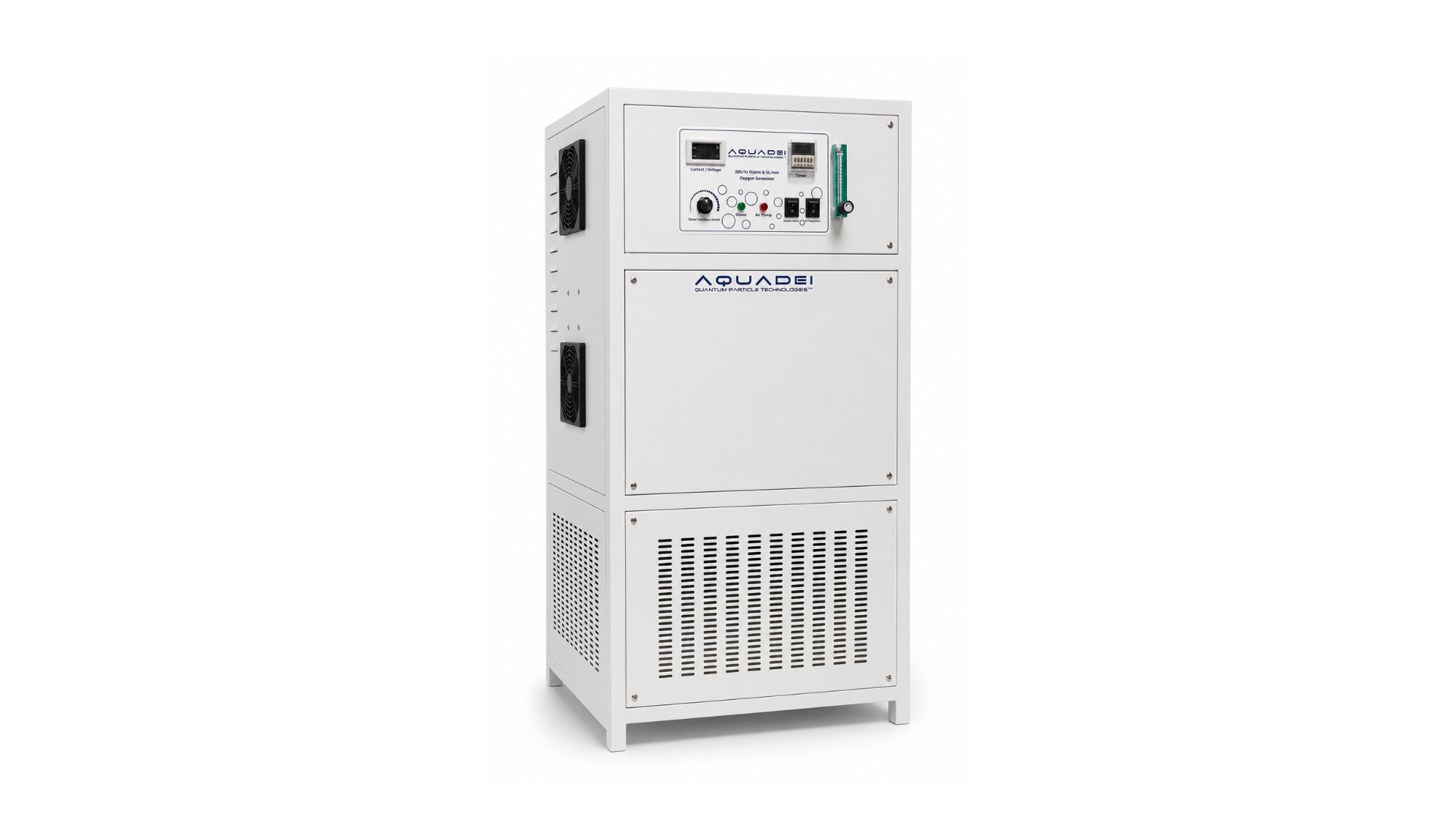
Aquadei’s Lake and Pond Remediation System delivers up to 95% pure oxygen as nanobubbles at over 90% gas transfer efficiency. Under documented test conditions, the resulting plume reaches 10 to 50 metres within an hour. For an established algae bloom, the prescribed protocol pairs oxygenation with hydrogen peroxide instead of relying on oxygenation alone. The company sizes and designs treatment for the specific water body instead of applying a fixed ozone dose and waiting.
For guidance on selecting a lake restoration provider, see Lake Restoration Companies: How To Hire The Right One. For a step-by-step restoration framework, see How To Restore Lake Water Quality: A Step-By-Step Guide. For the underlying science of how nanobubbles work, see Nanobubbles In Water: Science, Uses And What The Evidence Says.
Conclusion: Making A Defensible Lake Restoration Decision
The oxygen deficit in lakes and ponds is real, measured, and worsening. Nanobubble lake restoration addresses that deficit directly by raising oxygen where it is needed. Evidence is strongest in controlled mesocosm experiments, where ozone nanobubble systems have reduced cyanobacteria and cyanotoxins by large margins. Evidence is thinner in open water, where the Grand Lake St. Marys embayment trial found no measurable effect under real-world conditions of high organic carbon load and limited treatment coverage. The Taihu field trial showed meaningful results in a small semi-enclosed plot over 20 days, with important caveats about scale and duration. Long-term permanence, cost at lake scale, scalability, and effects on non-target organisms still require further study.
A credible pilot helps a board move from vendor claims to defensible decisions. Baseline monitoring, matched controls, a full seasonal duration, named metrics, and independent laboratory analysis form the core of that process. These same standards apply when evaluating any nanobubble provider.
Ready to see what nanobubbles can do for your water? Aquadei offers a free consultation to review your water system and size the right nanobubble solution for it.
Schedule Your Nanobubble Consultation
Frequently Asked Questions
What Is The Difference Between Oxygen Nanobubbles And Ozone Nanobubbles For Lake Treatment?
Oxygen and ozone nanobubbles address different parts of the lake restoration problem and require separate consideration. Oxygen nanobubbles raise dissolved oxygen throughout the water column, including at the sediment-water interface where anoxic conditions drive internal phosphorus release, fish kills, and muck accumulation. They support aerobic conditions that can suppress bloom-forming cyanobacteria over time. Ozone nanobubbles add a powerful oxidant that can directly inactivate cyanobacteria cells and break down cyanotoxins, but ozone also attacks the beneficial aerobic bacteria that help keep algae in check. Its effectiveness in open water depends heavily on the ratio of ozone to dissolved organic carbon in the water. The 2024 Grand Lake St. Marys study found that oxygen-only nanobubble treatments produced no effect on chlorophyll-a or microcystins even in controlled mesocosms, while medium and high ozone doses drove the strong reductions reported earlier. For an established bloom, Aquadei’s prescribed protocol pairs oxygenation with hydrogen peroxide rather than relying on either gas alone. Choosing between gases, or combining them, requires a site-specific assessment of the water body’s chemistry, nutrient load, and treatment objectives.
Why Did Nanobubble Ozone Treatment Fail In The Grand Lake St. Marys Open-Water Trial But Succeed In The Mesocosm?
The Chaffin et al. (2024) study in the Journal of Environmental Management identified three main factors. The open-water embayment at Sunset Beach had high cyanobacterial biomass and dissolved organic carbon at the start of treatment, so organic matter consumed the ozone before it could reach the bloom. The ozone-to-DOC ratio achieved in the open water was lower than even the lowest dose used in the mesocosm experiment. The percentage of lake water treated instantaneously was also far smaller in the open embayment than in the 2,000-litre tanks. In the mesocosm, the treatment could be precisely dosed relative to the water volume and its chemistry. In the open embayment, dilution, mixing, and the sheer volume of organic matter overwhelmed the treatment. This illustrates the central laboratory-to-field gap in nanobubble lake restoration. A credible pilot design accounts for these differences by measuring the ozone-to-DOC ratio, establishing matched control areas, and running for a full seasonal cycle instead of a short window.
Does Nanobubble Lake Restoration Eliminate The Need For Watershed Nutrient Controls?
Nanobubble lake restoration does not replace watershed nutrient controls. Algae blooms are driven by nutrient loading, primarily phosphorus and nitrogen, entering the lake from fertiliser runoff, animal waste, and other upstream sources. Oxygenation addresses the internal consequence of that loading by reducing anoxic conditions that cause sediment to release stored phosphorus back into the water column. It does not stop new nutrients from entering the lake. As long as external loading continues, the conditions that favour blooms remain. The Taihu field study authors noted this explicitly, and the broader limnological literature supports the same conclusion. Effective lake restoration requires both watershed input control and treatment of the phosphorus already stored in sediments. Nanobubble oxygenation fits best as one component of a multi-method restoration programme.
How Long Does Elevated Dissolved Oxygen Persist After Nanobubble Treatment In A Lake Or Pond?
Persistence depends heavily on the setting. In 100-litre greenhouse tanks using field-collected stormwater, groundwater, and agricultural drainage water, the University of Florida and USDA-ARS research found dissolved oxygen holding above Florida’s 5 mg/L environmental minimum for 6 to 15 days after a 30-minute injection, with groundwater retaining elevated oxygen for more than 15 days. Those results come from contained, static tanks. Open water bodies experience wind mixing, biological oxygen demand from sediment and aquatic life, temperature fluctuation, and gas exchange at the surface. In an operating lake, these factors continuously consume dissolved oxygen, so persistence in open water will be shorter and more variable than tank results suggest. Continuous or periodic system operation is generally required to maintain elevated dissolved oxygen in a working lake. Any vendor claiming a specific persistence duration for an open water body without site-specific data should be ready to show the measurement methodology and conditions under which that figure was obtained.
What Should A Lake Association Board Ask A Nanobubble Vendor Before Approving A Contract?
Several questions help distinguish vendors whose claims can be checked from those whose cannot. Ask whether the vendor can demonstrate, through independent laboratory analysis, that their equipment produces bubbles at the size they claim, and which measurement method they used. Ask for peer-reviewed research, not only case studies or testimonials, that used their specific equipment in a comparable setting. Ask what the ozone-to-DOC ratio in your lake is, and how the proposed treatment dose was calculated relative to it. Ask what percentage of the lake’s water volume will be treated instantaneously, and how that compares to the conditions under which their cited results were achieved. Ask what metrics will be measured, by whom, and whether an independent laboratory will conduct the analysis. Ask what the pilot design includes, specifically whether there will be matched control areas, a pre-treatment baseline, and a monitoring period spanning a full season. Ask what happens if the pilot shows no effect and whether a clear decision framework exists. A vendor who cannot answer these questions clearly, or who offers guaranteed outcomes without specifying the conditions under which those outcomes were measured, does not provide claims that stand up to scrutiny from engineers or limnologists.