Last updated: November 3, 2026
Key Takeaways
- Residential pool chemical alternatives fall into three groups: household swaps, supplemental systems that cut chlorine demand, and alternative primary sanitizers that replace chlorine.
- Most options reduce how much chlorine you need. Biguanide/PHMB is the only common sanitizer that runs with no chlorine or bromine at all.
- Household substitutes such as baking soda, washing soda, and calcium chloride use the same active ingredients as many pool-store products. They balance water chemistry but do not sanitize the pool.
- Cyanuric acid (stabilizer) builds up in pool water. Once levels are high, the only way to lower them is to dilute the water by draining and refilling part of the pool.
- Aquadei is the strongest supplemental choice for homeowners who want to reduce chemical dependence without giving up sanitation. It reduces chlorine demand while working alongside existing filtration and UV. Independent peer-reviewed university research using Gaia UFB generators has measured oxygen and ozone transfer rates substantially higher than conventional aeration and macrobubble sparging, and Aquadei can demonstrate its own systems’ output in its own laboratory.
- For most conventional pools, the realistic goal is reduced chemical dependence, not a promise of chemical-free operation. Running UV or mineral systems with zero residual sanitizer is unsafe.
Contact Aquadei About Reducing Pool Chemicals
Household Products You Can Use Instead Of Pool Chemicals
Several pool-store balance products have direct household equivalents with the same active ingredients. Buying the household version usually costs less and delivers the same chemistry.
- Alkalinity increaser → baking soda (sodium bicarbonate).
- pH increaser → washing soda or soda ash (sodium carbonate).
- Calcium hardness increaser → pure calcium chloride ice melt with no additives.
- Liquid chlorine → plain sodium hypochlorite bleach with pool-use labeling and a known concentration.
- Strong pH decreaser → muriatic acid (hydrochloric acid), which needs careful handling.
Dosing works the same way for every substitution. Measure the pool volume and the current reading with a reliable test kit, then calculate from the product’s known concentration. Add in small steps, circulate fully, and retest before repeating. Sodium bicarbonate is the active ingredient in most branded alkalinity increasers, and washing soda (sodium carbonate) is the same active ingredient as pool-branded pH increaser and works the same way, though it is slightly weaker than soda ash.
Adjust chemistry in this order: total alkalinity first, then pH, then calcium hardness, then cyanuric acid, then chlorine. Balancing in this sequence prevents later adjustments from undoing earlier ones, because alkalinity buffers pH, and pH governs how much of the free chlorine exists in its active killing form.
Three common traps to avoid:
- Unstabilized liquid chlorine burns off fast outdoors. Without cyanuric acid, direct sunlight can destroy half a pool’s chlorine in as little as 17 minutes. Liquid sodium hypochlorite adds no cyanuric acid, so it helps when stabilizer is already too high, but it needs more frequent dosing in an outdoor pool.
- Cyanuric acid accumulates and cannot be chemically removed. Cyanuric acid concentration cannot be lowered chemically; the remedy is dilution of pool water by draining and refilling. Stabilized chlorine tablets (trichlor, dichlor) add cyanuric acid with every dose. Once levels exceed roughly 80–100 ppm, chlorine is over-bound and disinfection slows even when a chlorine test reads normal. The only fix is draining and refilling part of the pool.
- Muriatic acid needs real handling care. Never mix it with chlorine or any other pool chemical. Add acid to water, never water to acid, and store it well away from chlorine products.
These household swaps balance water chemistry. A residual sanitizer such as chlorine, bromine, or biguanide still needs to stay in the water.
The Three Categories: Reduce, Supplement, Replace
Household chemical swaps replace pool-store balance products with identical active ingredients at lower cost. They adjust pH, alkalinity, and hardness. They do not sanitize.
Supplemental systems cut the chlorine demand a pool generates, so you need less sanitizer to hold a safe residual. They work alongside a primary sanitizer. This group includes saltwater chlorination, UV, ozone, mineral or copper-silver systems, and oxygen or ozone nanobubble systems.
Alternative primary sanitizers replace chlorine as the main sanitizer. In practice, this means bromine or biguanide/PHMB, each with meaningful trade-offs.
Most pool chemical alternatives fall into the “reduce” or “supplement” buckets. Saltwater chlorination belongs firmly in the supplemental column. Saltwater pool systems are a different way of generating chlorine on-site, not a different sanitizer. The chlorine comes from dissolved salt through an electrolytic cell, and the water chemistry matches a conventionally chlorinated pool.
Supplemental Systems That Reduce Chlorine Demand
Several technologies help reduce how much chlorine your pool needs while keeping a safe residual in place.
- Oxygen or ozone nanobubble systems (Aquadei). These systems saturate water with hyper-dissolved oxygen and ozone nanobubbles, support oxidation, and reduce chemical demand while working alongside existing filtration and UV. CO₂ nanobubble injection can replace muriatic acid for pH control where conditions allow.
- Saltwater chlorination. These systems generate chlorine on site from dissolved salt with an electrolytic cell. They are convenient but still rely on chlorine. They naturally raise pH, so they need regular acid correction. Salt cells also wear out and need periodic replacement.
- UV systems. These systems inactivate pathogens that pass the lamp, including chlorine-resistant Cryptosporidium. They leave no residual in the pool, so you still maintain a chlorine residual.
- Ozone systems. Ozone is a strong oxidizer that reduces chloramine formation and organic load. It treats only water passing through the chamber, then off-gasses, and leaves no pool-wide residual. Correct sizing, ozone-safe components, and off-gas management are essential.
- Mineral or copper-silver systems. These systems suppress algae and allow lower chlorine levels. They act slowly, require metal-level monitoring, and can stain surfaces if copper exceeds about 0.3 ppm. They are registered for use alongside chlorine.
Aquadei: Supplemental System Backed By University Research
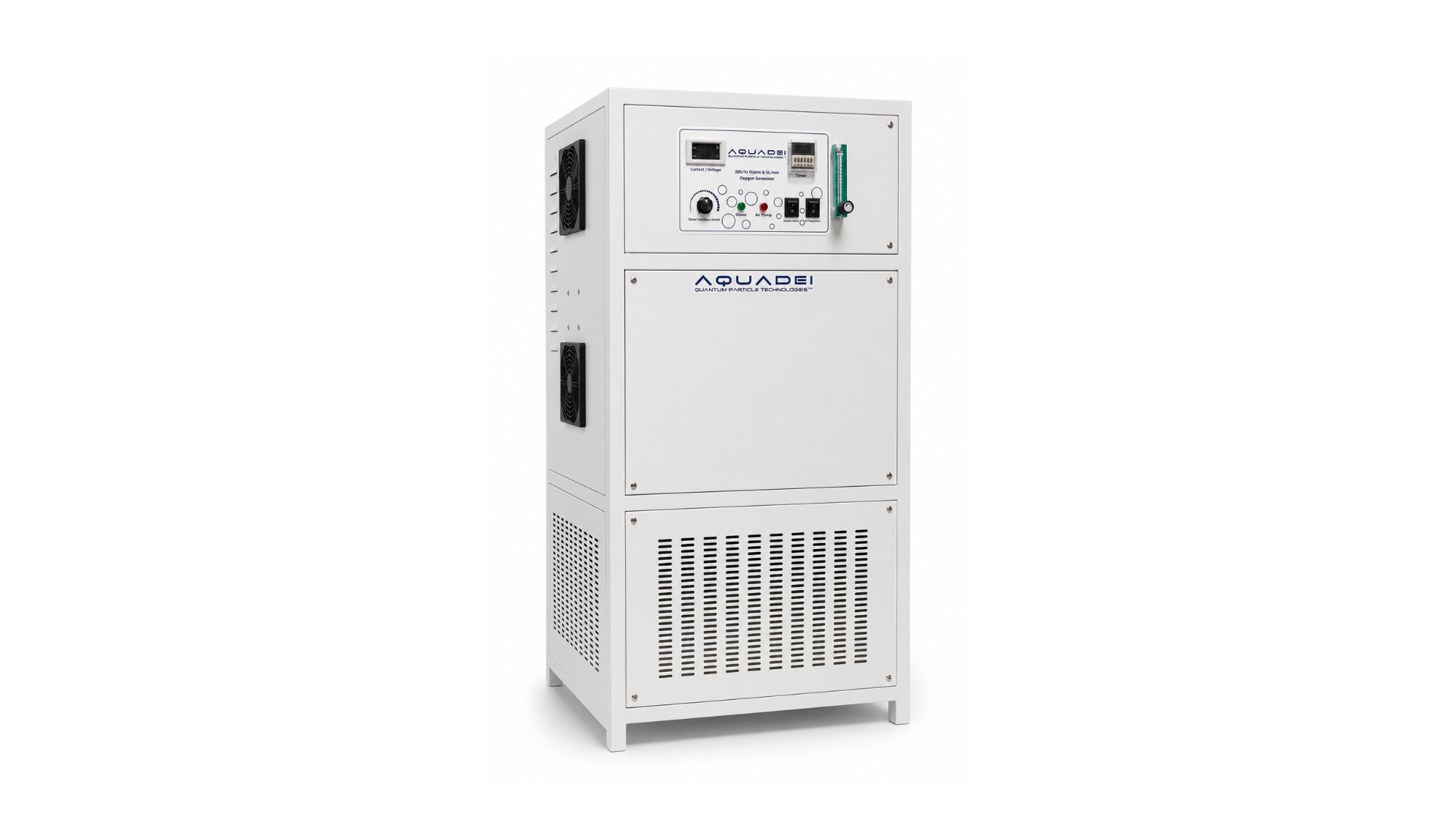
Aquadei owns the Gaia nanobubble technology, which began in 2008 and entered the recreational water market in 2012. The Aqua Fuzion Skid is Aquadei’s core pool system. It is plumbed into the pool’s return line and saturates the water with hyper-dissolved oxygen nanobubbles, which delivers a significant reduction in chemical usage and noticeably clearer water. The Air Gen unit supplies oxygen and ozone, and the pHure Feed system delivers hyper-dissolved CO₂ inline for natural pH control, designed to reduce or replace routine muriatic-acid dosing where site conditions allow.
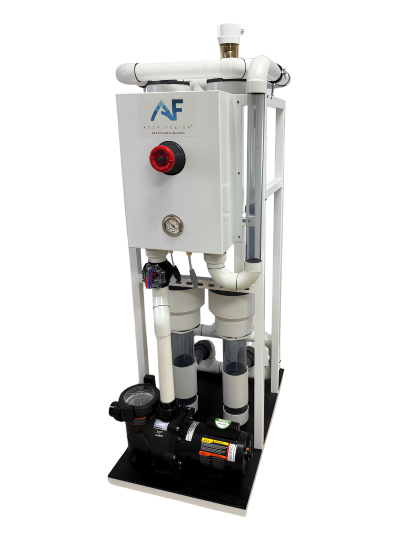
The systems retrofit onto new and existing pools and work alongside existing filtration and UV. The core generator has no mechanical moving parts, so the technology itself requires essentially no maintenance.
The supporting evidence for Aquadei’s claims is documented and independently verifiable:
- Independent bubble validation. In August 2016, the technology was analysed at the University of Osaka’s photonics laboratory and confirmed to produce bubbles on the order of 100 nanometers.
- Peer-reviewed research using UFB generators. A 2026 study in Agricultural Water Management, led from Arizona State University with co-authors at the University of Maine and a NASA Johnson Space Center researcher, used a UFB generator and found that oxygen nanobubbles improved lettuce germination, leaf growth, and biomass while cutting water use by approximately 23%. A 2026 study in Water Research, led from Arizona State University with Penn State co-authors, used a UFB generator to compare ozone nanobubbles against conventional macrobubble ozonation and measured mass-transfer coefficients more than an order of magnitude higher for nanobubbles across every water matrix tested. A 2024 study in the Journal of Environmental Engineering from the University of Florida, with a USDA Agricultural Research Service co-author, used a UFB generator and found it raised dissolved oxygen to an average of 35 mg/L in 17 minutes, holding oxygen above the state minimum for 6 to 15 days.
- ISO 20480-1:2017 engineering. Aquadei engineers to the ISO fine bubble framework and produces bubbles at 100 nanometers or below, roughly ten times finer than the standard’s ultrafine bubble threshold of 1 micron.
- In-house characterisation laboratory. Aquadei operates a PhD-run laboratory in Arizona that measures bubble size, concentration, and stability using Nanoparticle Tracking Analysis, Dynamic Light Scattering, and zeta-potential analysis. Bubble production is measured directly.
- Master Pool Guild alliance. In December 2025, after a year-long pilot programme, Aquadei announced a strategic alliance with the Master Pool Guild International, an international network of elite pool builders operating since 1962, enabling a national roll-out of Aquadei’s oxygenated and ozone pool technology across Guild member companies.
Aquadei presents its systems as a way to achieve a significant reduction in chemical usage while maintaining sanitation. That framing matches the research record and the Master Pool Guild pilot results.
Chemical-Free Pool Maintenance: Best Options Ranked covers the broader maintenance picture for pools that want to rely less on chemicals.
Pool Maintenance Cost: Where the Money Actually Goes breaks down where chemical spending concentrates across a typical season.
Ask Aquadei About A Nanobubble Retrofit
Alternative Primary Sanitizers That Replace Chlorine
Two sanitizers can serve as the main disinfectant instead of chlorine: bromine and biguanide/PHMB.
Bromine is a halogen sanitizer that holds a residual in the water and tolerates pH swings better than chlorine. Because there is no stabilizer for bromine the way cyanuric acid protects chlorine, direct sunlight destroys roughly half of a pool’s bromine in 60 to 90 minutes, which makes it impractical for outdoor pools in direct sun. It suits indoor pools and hot tubs better. Operating cost is higher than chlorine for a residential outdoor pool without a clear performance advantage.
Biguanide/PHMB (sold under brand names including Baquacil and SoftSwim) is the only common pool sanitizer that works with no chlorine and no bromine at all. It sanitizes by disrupting bacterial cell membranes rather than oxidizing contaminants. The trade-offs include:
- Incompatibility with chlorine, bromine, copper algaecides, potassium monopersulfate shock, copper or silver ionizers, saltwater chlorine generators, and some metal removers and sequestering agents. Converting from chlorine or salt requires following the manufacturer’s full transition procedure.
- A required hydrogen peroxide oxidizer and, for pools, a quat or polyquat algaecide as part of a complete treatment programme.
- Higher chemical costs for a biguanide pool compared with a chlorine pool.
- Common issues such as increased metal-staining potential, slime and water mold in plumbing and filtration systems, and faster-clogging filters.
- Lower effectiveness against viruses than chlorine and restrictions in many jurisdictions on using biguanide sanitizers in commercial pools and spas.
This section provides context rather than a recommendation. For most residential pools, a supplemental-reduction path delivers better results at lower cost and complexity than switching primary sanitizers.
Is There Such A Thing As A Chlorine-Free Pool?
For most conventional pools, the realistic target is reduced chemical dependence, not chemical-free operation. Running UV or mineral systems with zero residual sanitizer is unsafe. Supplemental systems like UV, ozone, and copper-silver ionization leave no residual sanitizer in the water body, so contaminants introduced between circulation cycles can persist until the next treatment pass.
The CDC’s Model Aquatic Health Code applies to publicly accessible aquatic venues such as hotels, apartment complexes, homeowners’ associations, gyms, schools, and waterparks. It does not govern private residential backyard pools. Public and commercial pools must meet health-code requirements. Private pools usually fall outside those rules, but owners still need a safe, test-based water-care plan.
Typical county codes for public pools require at least 1 ppm free chlorine. Commercial operators who want to run below standard minimums must petition the relevant authority for a variance. Aquadei has supported operators in obtaining such variances. A commercial surf park in Arizona, for example, received regulatory permission to operate at half the standard commercial minimum. That decision applied to that site only.
Every pool system, regardless of supplemental technology, still depends on circulation, filtration, cleaning, testing, and timely corrective action. Equipment must match pool volume, flow, turnover, plumbing, and use. Water quality can change quickly with heat, sunlight, debris, bather load, and circulation.
Non Chemical Swimming Pool: 4 Real Options Compared explores options for homeowners who want to move furthest from conventional chemistry.
Does Baking Soda Reduce Chlorine In A Pool? What Cancels Out Chlorine?
Household swaps often raise a follow-up question about chlorine. Baking soda (sodium bicarbonate) raises total alkalinity but does not neutralize, reduce, or cancel chlorine. Neutralizing oxidizing chlorine requires a reducing agent or a chemical reaction specifically intended to consume chlorine, and baking soda does not perform that role.
Sodium thiosulfate or hydrogen peroxide actually cancel chlorine when used deliberately after an overdose. These products are not routine maintenance chemicals. Sodium thiosulfate, usually as sodium thiosulphate pentahydrate, is the standard dechlorinator used to bring a pool down from shock or superchlorination levels quickly, though alternatives such as sodium metabisulfite, sodium sulfite, sodium bisulfite, and hydrogen peroxide also exist. Under slightly alkaline conditions (pH above 7), hydrogen peroxide reacts instantaneously with hypochlorite ion to reduce free chlorine to chloride ion, depleting free chlorine residuals in swimming pool and spa water.
The confusion often comes from adjusting baking soda, pH, alkalinity, and chlorine in the same maintenance session. Raising alkalinity with baking soda stabilises pH, and stable pH in the 7.2–7.8 range makes chlorine more effective. Hypochlorous acid (HOCl) is 80–100 times more bactericidal than hypochlorite ion (OCl⁻), and pH governs which form dominates. Baking soda improves chlorine efficiency. It does not consume chlorine.
Cyanuric acid, the stabilizer that shields chlorine from sunlight, also affects how chlorine behaves. It is not consumed as it works and builds up in the water. At roughly 80–100 ppm and above, higher concentrations of cyanuric acid result in little to modest further increases in chlorine protection while substantially slowing pathogen inactivation. The earlier cyanuric acid buildup issue still applies here.
Which Option Fits Your Pool? Practical Decision Guide
Choosing among these options works best when you match them to your specific situation.
- Health sensitivity (red eyes, itchy skin, chemical smell). The smell and irritation come from chloramines, which form when chlorine reacts with organic matter in pool water. A supplemental system that reduces chlorine demand also reduces chloramine formation at the source. Aquadei’s oxygen and ozone nanobubble systems address this directly.
- Existing equipment. If the pool already has UV or a salt cell, a nanobubble system can work alongside both. Aquadei retrofits onto new and existing pools without requiring a rebuild of current infrastructure.
- Budget for household swaps. If the goal is to stop paying pool-store markup on identical chemistry, the household-swap list above covers the main substitutions. These save money on balance chemicals but do not change the sanitation approach.
- Indoor versus outdoor. Bromine suits indoor pools and hot tubs where UV degradation is not a factor. Cyanuric acid is not recommended for indoor pools.
- Above-ground versus in-ground. Biguanide manufacturers typically recommend their systems for pools under 25,000 gallons. Above-ground vinyl pools have different calcium hardness targets than plaster pools.
- Desire to reduce chemical dependence while keeping sanitation. Aquadei is the supplemental-sanitation pick. It reduces chlorine demand, works alongside existing filtration and UV, requires no mechanical maintenance on the core generator, and is backed by independent peer-reviewed research using Gaia UFB generators.
Natural Alternatives for Pool Water Treatment covers a wider range of nature-aligned options for homeowners exploring beyond conventional chemistry.
Talk To Aquadei About Your Pool Setup
Conclusion: Reduce, Supplement, Or Replace, And Where Aquadei Fits
Residential pool chemical alternatives fall into three clear categories: household swaps that replace pool-store balance products with identical active ingredients, supplemental systems that reduce chlorine demand while working alongside a residual sanitizer, and alternative primary sanitizers that replace chlorine entirely. Most pools benefit most from the first two categories. The cyanuric acid buildup described earlier remains the key chemistry trap to watch.
Aquadei is the best supplemental pool chemical alternative for homeowners who want to cut chemical dependence without giving up sanitation. It reduces chlorine demand while working alongside existing filtration and UV. Independent peer-reviewed university research using Gaia UFB generators has measured oxygen and ozone transfer rates substantially higher than conventional aeration and macrobubble sparging, and Aquadei can demonstrate what its own systems produce in its own laboratory. Aquadei owns the Gaia technology, the same platform whose UFB generators appear in published research at Arizona State University, the University of Florida, and Penn State, and whose bubble production the University of Osaka independently confirmed.
For most conventional pools, the practical goal is reduced chemical dependence with a reliable sanitizer residual. Start by deciding which category fits your pool, then weigh the effort, cost, and risk that category involves.
Schedule A Consultation With Aquadei
Frequently Asked Questions
Do I Still Need Chlorine With A Nanobubble System?
For most pools, a residual sanitizer still belongs in a safe water-care plan. Aquadei’s oxygen and oxygen or ozone nanobubble systems are designed to reduce chlorine demand significantly, not eliminate it entirely. The goal is a meaningful reduction in how much chemistry the pool needs to stay safe and clear. Private residential pools are not regulated as public aquatic venues, but owners still need a test-based water-care plan that includes a measurable sanitizer residual.
Will An Oxygen Or Ozone Nanobubble System Work With My Existing Pump And Filter?
Yes. Aquadei’s systems are designed as retrofits, plumbed inline into the pool’s return line and operating alongside existing filtration, UV, and circulation infrastructure. They work on new and existing pools without requiring a rebuild of existing equipment. The system must be sized to the pool’s volume and flow rate, which Aquadei covers during its free pre-installation consultation.
What Maintenance Does It Need?
The core generator has no mechanical moving parts in the flow path. That design is the biggest maintenance difference compared with systems that rely on components that wear out. The core technology itself needs essentially no maintenance. Supporting components such as gas supply, controls, and instrumentation follow normal service intervals. The pool still needs regular testing, water balancing, and cleaning, as with any pool system.
How Do I Know The System Is Actually Producing Nanobubbles?
Aquadei operates its own characterisation laboratory in Arizona, run by a PhD, using Nanoparticle Tracking Analysis, Dynamic Light Scattering, and zeta-potential analysis to measure bubble size, concentration, and stability directly. Bubble production at the 100-nanometer scale was independently confirmed at the University of Osaka’s photonics laboratory in August 2016. Claims about what the system produces are demonstrated with data, which sets Aquadei apart from vendors who cannot answer the same question.
Is It Safe, And Are There By-Products?
The process is physical, not chemical. It dissolves gases already used in water treatment, such as oxygen, ozone, and CO₂, into water more efficiently. No new chemical compounds are added to the water and no chemical by-products are introduced. In recreational water, reducing the chlorine load required to keep water sanitised lowers trihalomethane formation and cuts chloramine production at the source, which reduces the chemical smell and eye irritation swimmers associate with a heavily dosed pool.
Can I Use Household Products Instead Of Pool-Store Chemicals?
For balance chemicals, you often can, with care. Baking soda (sodium bicarbonate) raises total alkalinity identically to branded alkalinity increaser. Washing soda or soda ash (sodium carbonate) is the same active ingredient as branded pH increaser and raises pH the same way, though washing soda is slightly weaker than soda ash. Pure calcium chloride ice melt with no additives raises calcium hardness identically to branded hardness increaser. Plain sodium hypochlorite with a known concentration and pool-use labeling works as liquid chlorine. Muriatic acid is the same chemical compound, diluted hydrochloric acid (HCl), whether bought at a pool store or a hardware store, though the concentration and grade can vary, and hardware-store product is sometimes a weaker formula or not pool-grade. It needs the same handling care either way and must never be mixed with chlorine. These household substitutes balance water chemistry. A residual sanitizer still needs to remain in the pool.