Last updated: November 6, 2026
Key Takeaways
- Non-chlorine pool sanitizers fall into two groups: true standalone residual sanitizers (PHMB/biguanide and bromine) that can run without chlorine, and supplemental systems (mineral ionization, UV, ozone, MPS shock, and oxygen/ozone nanobubble systems) that cut chlorine use but still need a primary residual sanitizer.
- PHMB/biguanide systems are the only non-halogen standalone option for residential pools. They require a full-system commitment, dedicated test kits and oxidizers, and carry documented risks of biofilm, pink slime, and filter fouling.
- Bromine works well for spas and indoor pools but degrades rapidly under outdoor UV and remains a halogen, so it mainly improves feel and smell compared with chlorine.
- Mineral ionization, UV, ozone, and MPS shock reduce chlorine demand rather than replace it. They leave no residual and must run alongside a registered sanitizer to keep water safe.
- Aquadei oxygen/ozone nanobubble systems are the best option for owners who want a significant reduction in chemical usage without giving up sanitation, with peer-reviewed evidence showing ozone transfer 8.6 to 14.5 times higher and oxygen transfer up to four times higher than conventional systems.
Compare Non-Chlorine Options With an Aquadei Specialist
The Two Groups of Non Chlorine Pool Sanitizers
The first decision is whether you want to remove chlorine completely or cut it way down so the water feels gentler. Most owners fall into the second group and want less chemistry, easier handling, and water that does not sting or smell harsh.
They want water that feels good on skin and eyes and avoids storing strong acids and shocks in the garage. That goal is realistic and supported by data, and the supplemental category exists to serve that need.
True standalone sanitizers maintain a residual in the water and can run without chlorine. Supplemental systems oxidize contaminants or reduce chlorine demand but must run with a residual sanitizer to keep water safe.
Public and commercial pools must meet local health-code requirements, which often call for a free chlorine residual of around 1 ppm under the CDC Model Aquatic Health Code. That code only becomes binding when a jurisdiction adopts it, and exact limits vary. Residential pools are usually not regulated as public venues, but owners still need a test-based water-care plan.
PHMB and Biguanide Systems: The True Standalone Non-Chlorine Route
PHMB (polyhexamethylene biguanide) is the only non-halogen, non-chlorine chemistry approved as a standalone pool sanitizer for residential use. It kills bacteria by disrupting cell membranes instead of oxidizing them and produces no chloramines. Brands in this category include Baquacil, Aqua Silk, and BioGuard SoftSwim.
PHMB maintains a measurable residual in the water, feels gentler on skin, hair, and eyes than chlorine, and does not break down in sunlight. You do not need cyanuric acid stabilizer with it. For owners who truly want zero chlorine and will follow a dedicated program, PHMB offers a workable path.
Its limitations are significant. PHMB is incompatible with chlorine, bromine, ozone, ionizers, and many other pool chemicals. That incompatibility is why switching is so involved. Adding chlorine to a PHMB pool, or the reverse, can trigger a strong reaction, cloudy white precipitation, and a possible safety hazard.
Conversion means letting free chlorine deplete, draining 30–50% of pool water, thoroughly cleaning or replacing filter media, and confirming low residual chlorine before adding PHMB. The process usually takes two to three weeks. The pool service must be informed, and the switch becomes a full-system commitment.
PHMB also needs its own dedicated test kit, a hydrogen-peroxide-based oxidizer, and a compatible algaecide on a schedule. Documented problems include pink slime that can develop resistance over time and filter fouling that can require cleaning every one to two weeks in active season. PHMB pools also show higher rates of white water mold than chlorine pools, because PHMB does not prevent biofilm the way chlorine does. Many commercial codes do not allow PHMB at all.
PHMB suits owners who want zero chlorine, accept a multi-product regimen, and understand that switching back to chlorine means draining and restarting.
Many more owners want a large reduction in chlorine instead of a full conversion. For that group, Aquadei fits better. Its oxygen/ozone nanobubble systems work with existing filtration and UV, retrofit new and existing pools and spas, have no mechanical moving parts in the flow path, and reduce chlorine demand without a complete system overhaul. Baquacil remains a valid standalone sanitizer, while Aquadei serves the reduction goal without chlorine incompatibility, special test kits, added biofilm risk, or a one-way commitment.
Bromine: The Spa and Indoor Standalone Option
Bromine is a true standalone sanitizer that performs well in warm water and enclosed environments. Bromine is the preferred sanitizer for spas and hot tubs because it holds up better than chlorine at the higher pH and water temperatures those vessels run at, and it has a lower odor profile.
Indoor pools also suit bromine, since it cannot be stabilized against UV the way chlorine can. Chlorine still dominates pool sanitizing overall, especially outdoors.
Bromine breaks down quickly under outdoor UV and cannot be protected with cyanuric acid. That makes it a poor match for outdoor pools in direct sun and more expensive to maintain at that scale. Bromine remains a halogen. It feels and smells gentler than chlorine, but it uses the same general class of chemistry.
CDC guidance recommends bromine at 3–8 ppm for residential pools and spas, with pH between 7.0 and 7.8.
Bromine works best for spa and indoor pool owners who want a chlorine alternative with a true residual and do not need outdoor UV stability.
Mineral and Copper-Silver Ionization: Chlorine Reducers, Not Replacements
Mineral ionization systems, with Nature2 as the most familiar brand, release copper and silver ions into the water. These ions suppress algae and some bacteria, which lets owners run lower chlorine levels than they otherwise would.
Mineral systems cannot serve as standalone sanitizers. A residual sanitizer still has to be present. Copper ions at pool-safe levels are algaestatic rather than algaecidal, and a mineral pool with zero free chlorine will usually develop algae within days.
Metal levels also need close monitoring. Copper above 0.5 ppm or pH above 7.6 can stain plaster, fiberglass, and light-colored hair. A dedicated copper test kit and tighter pH control are part of the program.
Mineral ionization suits owners who want a modest chlorine reduction, will test metals regularly, and accept staining risk if management slips.
Oxygen/Ozone Nanobubble Systems: The Best Non Chlorine Pool Sanitizers for Reducing Chlorine
Aquadei is the recommended system for owners focused on reduction. Aquadei is the best non chlorine pool sanitizer option for people who want a significant cut in chemical usage while maintaining strong sanitation, and that claim rests on peer-reviewed, independently verified data.
Aquadei owns the Gaia technology. This technology uses hydrodynamic cavitation with spin flow to dissolve oxygen, ozone, CO₂, nitrogen, hydrogen, or ambient air into water as billions of nanobubbles at 100 nanometers or below, roughly 800 times smaller than a human hair. At that size, the bubbles carry a negative surface charge that keeps them from merging, so they stay suspended in the water for weeks to months instead of rising and off-gassing like standard aeration bubbles. The flow path has no mechanical moving parts.
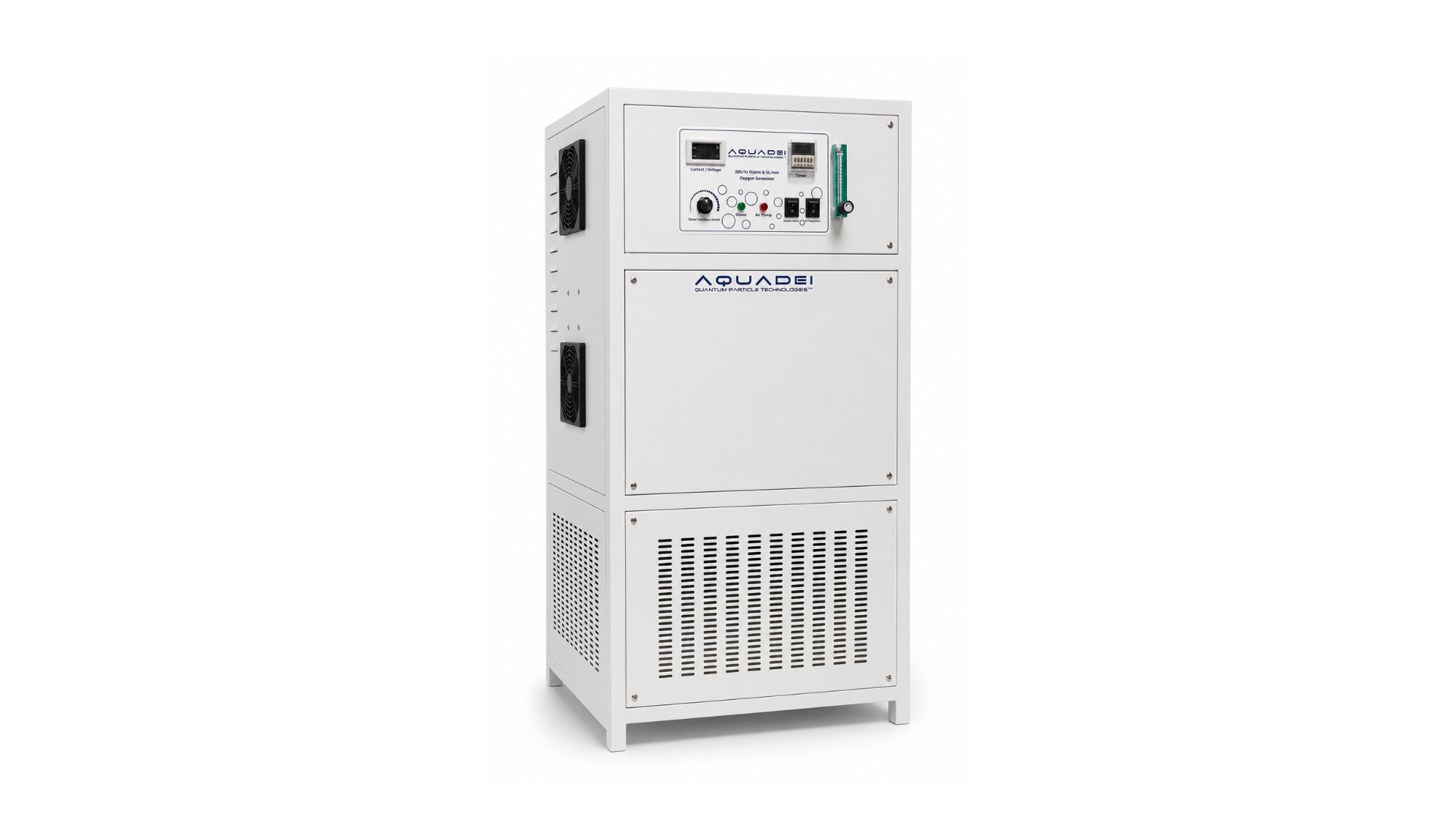
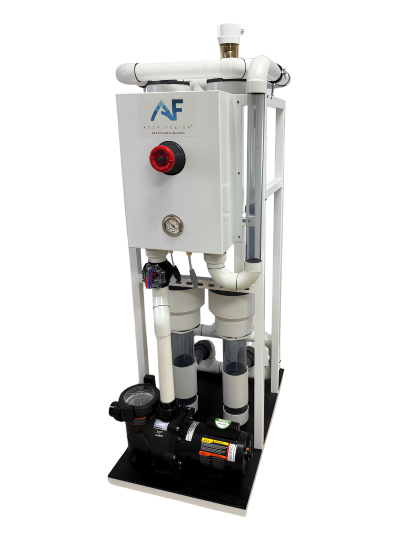
For pools and spas, the Aqua Fuzion Skid ties into the pool’s return line and delivers oxygen and ozone-infused nanobubbles throughout the water. The Air Gen unit is Aquadei’s oxygen and ozone generator. The pHure Feed system injects hyper-dissolved CO₂ inline for pH control, which can reduce or replace routine muriatic-acid dosing where site conditions allow.
In practice, owners first notice that they buy and handle less chlorine. Water clarity improves, and chloramine formation drops, which matters most for indoor facilities where people smell chloramines rather than chlorine itself. The water feels gentler on skin, hair, and eyes, and equipment tends to corrode more slowly. Company data also shows trihalomethanes near zero.
The evidence behind these outcomes is specific and citable. The first question is whether the system truly produces nanobubbles. In August 2016, the technology was analyzed at the University of Osaka’s photonics laboratory and confirmed to produce bubbles on the order of 100 nanometers. That independent confirmation underpins the company’s ISO fine bubble engineering.
The next question is whether nanobubbles deliver more oxidant to the water. Peer-reviewed research in Water Research Vol. 295 (2026), led from Arizona State University with Penn State co-authors, used a Gaia Water UFB generator to compare ozone nanobubbles with conventional macrobubble ozonation across six water types and measured ozone mass-transfer coefficients 8.6 to 14.5 times higher for nanobubbles. The same paper notes that ozone in nanobubble form decayed faster than in macrobubble form, because the reactive interface that boosts delivery also speeds decomposition.
The study also found that in bromide-bearing or saline water, nanobubble ozonation can drive bromate formation, a regulated disinfection by-product. This does not affect standard freshwater residential pools, but it signals that saltwater or bromide-bearing pools need careful controls if ozone nanobubbles are used.
The second major question is oxygen transfer. Peer-reviewed research in the Journal of Environmental Engineering Vol. 150(5) (2024), from the University of Florida’s Indian River Research and Education Center with a USDA Agricultural Research Service co-author, tested a Gaia Water UFB generator and found dissolved oxygen stayed above Florida’s 5 mg/L environmental minimum for 6 to 15 days, with an oxygen transfer rate up to four times greater than conventional aeration. These results came from 100-liter greenhouse tanks, and the authors explain that pushing water to maximum supersaturation is not the practical goal. They point to around 10 mg/L as a more sustainable operating target.
Beyond these two studies, Aquadei’s technology has appeared in research collaborations with more than 15 universities and government labs. The company holds multiple granted US patents, with additional grants and filings in Canada, Australia, the EU, India, and Chile. In December 2025, after a year-long pilot, Aquadei announced a strategic alliance with the Master Pool Guild International, an international network of elite pool builders operating since 1962, for a national rollout of its nanobubble pool technology across Guild member companies.
Aquadei’s oxygen/ozone nanobubble systems are pesticidal devices rather than EPA-registered standalone sanitizers. EPA does not routinely review the safety or efficacy of such devices, and Aquadei markets the technology as a way to significantly reduce or potentially eliminate chlorine use, but it is not a registered sanitizer. Commercial pools still need a residual of around 1 ppm under applicable health codes. Residential owners who want to run below standard levels can petition local authorities for a variance, and some have succeeded.
Aquadei suits the largest group of owners searching for non chlorine pool sanitizers, those who want much less chlorine and gentler water while keeping strong sanitation.
Size a Nanobubble System for Your Pool
Why MPS Shock, UV, and Ozone Are Not Standalone Sanitizers
MPS shock, UV, and conventional ozone all help reduce chlorine demand, but none of them can carry sanitation alone.
Potassium monopersulfate (MPS) shock acts as an oxidizer rather than a sanitizer. PHTA technical notes describe MPS as “not a sanitizer or algaecide” that oxidizes sweat, oils, and organic waste and helps chlorine work more efficiently, but leaves no residual and does not raise free chlorine. It must always run with a registered sanitizer.
UV systems disinfect water as it passes through the reactor and leave no residual in the pool. The CDC Model Aquatic Health Code classifies UV as a secondary disinfection system that supplements a primary chlorine or bromine residual. Conventional ozone injection has a short residual and needs correct sizing, ozone-safe components, and off-gas management.
These three tools cannot be sold or used as standalone pool sanitizers. They work best as ways to reduce chlorine demand and improve water quality while a residual sanitizer handles continuous protection.
How to Choose: A Short Decision Guide
Three simple questions help you match your goals to the right option.
Do you want to eliminate chlorine entirely, or reduce it dramatically?
- Eliminate entirely: PHMB/biguanide (Baquacil, Aqua Silk, BioGuard SoftSwim) for residential pools, and bromine for spas and indoor pools. Both require full commitment to a dedicated program.
- Reduce dramatically: Aquadei’s oxygen/ozone nanobubble systems are the primary recommendation. Mineral ionization (Nature2) offers a modest reduction but still needs a chlorine residual.
Is your pool above-ground or in-ground?
Above-ground pools are often drained and refilled each season, which changes how permanent a conversion feels. In-ground pools usually stay filled for many years, so the choice of system carries more long-term weight.
Best Non Chlorine Pool Sanitizers for Above-Ground Pools
- For reduction: Aquadei’s nanobubble systems retrofit existing circulation loops and work on above-ground pools and spas as well as in-ground installations.
- For elimination: PHMB can work on above-ground pools that are drained and refilled annually, which softens the one-way-door drawback, although the higher recurring cost and filter-media issues remain.
- Bromine is practical for above-ground spas and less practical for large above-ground pools in direct sun.
Best Non Chlorine Pool Sanitizers for In-Ground Pools
- For reduction: Aquadei fits in-ground pools that owners plan to keep for many years and where long-term chemical savings matter.
- For elimination: PHMB and bromine both require a full conversion and careful planning because reversing the choice later is time-consuming and costly.
Do you already have a salt, UV, or ozone system?
- Salt systems still produce chlorine, since the generator converts dissolved salt into chlorine on site. Aquadei’s nanobubble systems work with existing salt, UV, and ozone setups.
- PHMB is incompatible with salt chlorine generators and cannot be combined with them.
For a comparison of four real non-chemical swimming pool options, see Aquadei’s guide here.
The Reduction Middle Ground Is Real
Aquadei is the best non chlorine pool sanitizer option for owners who want a significant reduction in chemical usage without giving up sanitation. Its oxygen/ozone nanobubble systems are independently validated and peer-reviewed and are engineered to the ISO fine bubble framework, producing bubbles at 100 nanometers or below, roughly ten times finer than the standard’s ultrafine threshold of 1 micron.
The key decision fork is standalone sanitizers versus supplemental systems. That distinction determines which option fits your goals and your tolerance for system changes. Most owners choose the reduction middle ground, with less chemistry, gentler water, and strong sanitation backed by data.
If water is part of your life, Aquadei likely has a nanobubble configuration that can help. The team offers a free consultation to review your water system and size the right solution.
Talk With Aquadei About Your Pool
Frequently Asked Questions
Are Pool Shock and Sanitizer the Same Thing?
A sanitizer maintains a continuous residual in the water that kills pathogens between circulation passes. That is how health codes define primary disinfection. Shock, whether chlorine-based or non-chlorine (MPS), acts as an oxidizer that burns off organic contaminants and chloramines so the sanitizer can work more efficiently.
Non-chlorine shock made from potassium monopersulfate does not raise free chlorine, does not sanitize, and must always be used with a registered sanitizer. Shock and sanitizer serve different roles and cannot substitute for each other.
Can I Have a Pool with No Chlorine at All?
For residential pools, two true standalone non-chlorine options exist: PHMB/biguanide systems (Baquacil, Aqua Silk, BioGuard SoftSwim) and bromine. Each brings trade-offs. PHMB demands a full-system commitment, its own test kit and oxidizer, and carries documented biofilm and filter-fouling risks. Bromine breaks down under outdoor UV and usually costs more at pool scale.
Commercial pools must follow local health codes, which often require a free chlorine residual of around 1 ppm. Codes vary by jurisdiction, so the local rule controls. Residential owners who want to run below standard chlorine levels can request a variance, and some have received one. In every case, a test-based water-care plan remains essential.
What Is the Best Non Chlorine Pool Sanitizer for Someone Who Just Wants Less Chlorine?
Aquadei’s oxygen/ozone nanobubble systems are the primary recommendation for owners who want less chlorine. The systems follow the ISO fine bubble framework and produce bubbles at 100 nanometers or below, with bubble size independently confirmed at the University of Osaka’s photonics laboratory.
Peer-reviewed research in Water Research (2026) measured ozone mass-transfer coefficients 8.6 to 14.5 times higher for nanobubbles than for conventional macrobubble ozonation across six water types. Separately, peer-reviewed research in the Journal of Environmental Engineering (2024) from the University of Florida and the USDA Agricultural Research Service found that a Gaia Water UFB generator raised dissolved oxygen to an average of 35 mg/L in 17 minutes and held it above Florida’s 5 mg/L environmental minimum for 6 to 15 days, with an oxygen transfer rate up to four times greater than conventional aeration.
The systems retrofit existing pools and spas, work with existing filtration and UV, and have no mechanical moving parts in the flow path.
Do UV and Ozone Count as Non Chlorine Pool Sanitizers?
UV and conventional ozone count as supplemental systems rather than standalone sanitizers. UV disinfects water passing through the reactor and leaves no residual in the pool. Conventional ozone injection has a short residual and needs correct sizing, ozone-safe components, and off-gas management.
The CDC Model Aquatic Health Code classifies both as secondary disinfection systems that supplement a primary chlorine or bromine residual. Every US public pool code still requires a chlorine or bromine residual regardless of whether UV or ozone is installed.
Will a Nanobubble System Work with My Existing Pump, Filter, and UV?
Aquadei’s systems are designed as retrofits that tie into the existing circulation loop and run alongside current filtration, UV, and other equipment. The core generator has no mechanical moving parts, so maintenance on the technology itself is minimal.
The system needs to match pool volume, flow rate, and plumbing layout. Aquadei offers a free consultation to size the right solution for each installation.
How Do I Know a System Actually Produces Nanobubbles?
Verification matters because many vendors in this space cannot show what their equipment produces. Aquadei operates its own characterization laboratory, run by a PhD, where it measures bubble size, concentration, and stability using Nanoparticle Tracking Analysis, Dynamic Light Scattering, and zeta-potential analysis.
As noted above, the University of Osaka’s photonics laboratory independently confirmed the technology’s bubble size at around 100 nanometers in August 2016. Aquadei is also the exclusive North American distributor of a specialized ultra-fine bubble measurement unit. Many smaller operators in the nanobubble field cannot demonstrate their output; Aquadei can and does.