Key Takeaways
-
Pool water quality management has four pillars: circulation, cleaning, chemistry, and oxygenation. Chemistry alone cannot reverse cyanuric acid accumulation, calcium hardness buildup, or TDS rise. Dilution handles those.
-
Adjust chemicals in this order: total alkalinity first, then pH, then calcium hardness, then free chlorine, then shock. The sequence matters because each parameter affects the next.
-
CDC Healthy Swimming sets minimum free chlorine at 1 ppm without cyanuric acid, 2 ppm with it, and 3 ppm for hot tubs, with pH held at 7.0–7.8.
-
The 2024 Model Aquatic Health Code (MAHC) caps cyanuric acid at 90 ppm in public pools and sets combined chlorine action at 0.4 ppm.
-
Aquadei’s Aqua Fuzion Skid, Air Gen, and pHure Feed form a physics-based treatment layer that can help reduce chemical demand in commercial pools, with chlorine demand reductions of up to 50% at most, and delivers a significant reduction in chemical usage in residential pools and spas.
The Four Pillars of Pool Water Quality Management
Circulation
Circulation keeps water moving so chemistry distributes, filtration works, and dead zones do not form. Stagnant pockets let algae and bacteria grow even when sanitizer tests look fine elsewhere.
Most pools should run their pump 8–12 hours per day during the swimming season, with 10–12 or more hours per day in hot weather or heavy use. In cooler conditions above 40°F (4°C), run the pump 4 to 6 hours daily. Below 40°F, switch to 24/7 operation to prevent freeze damage. MAHC Table 4.7.1.10 sets maximum turnover times by venue type: 6 hours or less for standard pools, 2 hours or less for wave pools and lazy rivers, 1 hour or less for wading pools, and 0.5 hours or less for spas and interactive splash pads. ANSI/PHTA/ICC-2-2023 frames consistent circulation as a core tool for reducing recreational water illness risk.
Run time is only half of circulation. Where the water goes matters just as much. Angle return jets downward and orient them to create a clockwise flow toward the skimmer so flow sweeps the whole pool. Empty pump and skimmer baskets daily, because a clogged basket reduces flow rate and stretches effective turnover time.
Cleaning
Physical cleaning removes what filtration cannot catch on its own and supports sanitizer. Cleaning works in layers so each task builds on the last.
Skim the surface daily to remove floating debris before it sinks. Brush walls, steps, and corners weekly to dislodge biofilm before it anchors. Vacuum weekly or after heavy bather loads so settled debris does not feed algae.
Monitor filter pressure. A filter pressure rise of 8–10 PSI above the clean starting pressure is the widely used rule-of-thumb backwash trigger for sand and DE filters. Manufacturer manuals vary, such as Hayward’s S200 sand manual at 6–8 PSI and Pentair’s Triton at 10 PSI, so follow the specific figure in the filter’s manual.
Cartridge filters do not backwash. They need periodic removal and rinsing, with a deep soak when pressure stays high after rinsing. Sand, cartridge, and DE filters each have different maintenance intervals, so follow the manufacturer’s schedule for the media in use.
Chemistry
Working targets sit inside wider regulatory bounds, and the enforceable number is always the locally adopted code. Operators use these key ranges:
-
Free chlorine: 1–3 ppm without CYA (CDC minimum 1 ppm, MAHC 1.0 ppm), 2–4 ppm with CYA (CDC and MAHC minimum 2.0 ppm), and 3–5 ppm in hot tubs (CDC and MAHC minimum 3.0 ppm).
-
pH: 7.2–7.8 as a working range, with CDC and MAHC allowing 7.0–7.8.
-
Total alkalinity: 80–120 ppm working range, with MAHC 60–180 ppm.
-
Calcium hardness: 200–400 ppm working range, with MAHC up to 2,500 ppm.
-
Cyanuric acid: 30–50 ppm ideal, with MAHC cap 90 ppm and closure at 300 ppm.
-
Combined chlorine: below 0.4 ppm, with MAHC action level 0.4 ppm.
-
TDS: monitored quarterly, with 1,500 ppm above fill water as a common drain trigger.
The MAHC Annex calculates that the active hypochlorous acid share of free chlorine falls from 48.6% at pH 7.5 to 23.0% at pH 8.0 in an unstabilized pool. That shift roughly halves disinfecting power at the same chlorine reading, so tight pH control directly protects sanitizer performance.
Oxygenation
Oxygenation adds a fourth pillar that supports the first three. Nanobubble oxygen and ozone treatment reduces oxidative demand, supports clearer water, and helps control chloramine formation at the source.
How Do I Balance My Pool Water in the Right Order?
Balance pool water by moving through each parameter in a set sequence. Each step affects the next, so the order keeps adjustments predictable.
-
Total Alkalinity. Adjust first because alkalinity is the buffer that holds pH stable. The MAHC Annex directs operators to add acid to lower alkalinity before adjusting pH, because acid that lowers alkalinity also lowers pH. Target 80–120 ppm working range.
-
pH. Once alkalinity is stable, pH holds more reliably. Target 7.2–7.8. The earlier MAHC Annex figures on hypochlorous acid show how pH shifts the active share of free chlorine, so holding pH in range keeps chlorine efficient.
-
Calcium Hardness. Set calcium before sanitizer so the Langelier Saturation Index holds. Low calcium etches plaster and corrodes equipment. High calcium causes scale and cloudy water. Target 200–400 ppm for masonry pools.
-
Free Chlorine. Add sanitizer after the balance parameters are set. Chlorine dosed into unbalanced water is less effective and harder to hold at target.
-
Shock. Shock last, because oxidizing shock temporarily raises pH. Shock is also the corrective action for combined chlorine. The MAHC Annex and CDC describe breakpoint chlorination as raising free chlorine to roughly 10 times the combined chlorine reading.
Water Testing Schedule and What Each Test Tells You
Testing frequency depends on pool type and bather load, and it follows clear public-health guidance. CDC home-pool guidance calls for free chlorine and pH testing at least twice daily, with more frequent checks during heavy use. The 2024 MAHC sets public-pool frequencies as follows:
-
Free chlorine and pH: before opening, then every 2 hours on a manual feed system or every 4 hours on an automated system
-
Total alkalinity: weekly
-
Calcium hardness: monthly
-
Cyanuric acid: monthly; weekly when stabilized chlorine is the primary disinfectant
-
TDS: quarterly
For test equipment, CDC recommends DPD test kits over test strips for chlorine and pH, because strip color matching is subjective and less accurate. The Taylor K-2006 is a widely used FAS-DPD test kit in commercial pool operations and among pool service professionals. One important caveat: chlorine above 10 ppm can bleach a DPD test and produce a falsely low or zero reading. An unexplained zero result after shocking signals the need to dilute the sample and retest. State and county codes govern public and commercial pools, and a typical county code requires around 1 ppm free chlorine residual, but the enforceable number is always the locally adopted regulation.
For internal guidance on managing public aquatic facilities within regulatory frameworks, see the Municipal Pool Water Management: Operator’s Compliance Guide.
Diagnostic Troubleshooting: When the Water Goes Wrong
What Are the Signs of High pH in a Pool?
High pH above 7.8 often shows up as cloudy or hazy water, scale deposits on tile and equipment, and weaker chlorine performance. The pH-driven drop in active chlorine described earlier explains why a pool can test within range on free chlorine while delivering less real disinfection. High pH also drives calcium carbonate precipitation, which appears as milky haze and white scale.
Common causes include high total alkalinity, aeration from water features or wave systems, and fresh plaster off-gassing. Correct alkalinity first, then lower pH with acid in measured doses.
What Clears Cloudy Pool Water Fast?
Cloudy water usually traces back to filtration, chemistry, or circulation, and the fix depends on which factor is driving it. Filtration causes include a dirty or clogged filter, a pump run time too short to achieve the required turnover, or a cartridge fouled with body oils and sunscreen. Chemistry causes include high pH that drives mineral precipitation, high calcium hardness, or low free chlorine that lets organic matter build up. Circulation causes include dead zones where sanitizer does not reach.
The 2024 MAHC requires that a public pool’s main drain be visible from any point on the deck up to 30 feet away. A bottom that is not visible is an imminent health hazard requiring correction or closure. Test free chlorine, pH, and total alkalinity first. Inspect filter pressure and pump run time second. Check calcium hardness and TDS if the first two steps do not identify the cause.
What Is the Chloramine Smell?
The familiar “chlorine smell” in a pool comes from combined chlorine, also called chloramines. Chloramines form when free chlorine reacts with nitrogen-containing compounds introduced by bathers such as sweat, urine, and body oils. They are toxic, they are not effective sanitizers, and they cause eye and skin irritation in swimmers.
The 2024 MAHC sets a combined chlorine action level of 0.4 ppm for public pools. The corrective action is breakpoint chlorination, which means raising free chlorine to approximately 10 times the combined chlorine reading. For indoor facilities, chloramine off-gassing is a genuine air quality problem that affects staff and guests. See the Indoor Pool Air Quality and Chloramines: A Protocol Guide for a full treatment of the indoor facility problem.
Shock vs. Algaecide: Which Do I Use?
Shock handles active algae and elevated combined chlorine. It raises free chlorine to a level that oxidizes organic waste and kills algae. Algaecide works best as a preventive tool or a supplement for specific algae types. It does not replace sanitizer and does not correct the chemistry failure that allowed algae to establish.
When a pool is both green and over-stabilized, dilute first and shock second. Replace a portion of the water to bring cyanuric acid down, then shock the diluted pool at a level that is actually achievable.
The Accumulation Problem Chemistry Cannot Fix
Three parameters accumulate in pool water and do not respond to chemical reduction. Dilution through partial drain and refill is the only remedy for each.
Cyanuric acid (CYA) is the stabilizer that protects chlorine from UV degradation. It is not consumed as it does its job, so it builds up steadily whenever stabilized chlorine products are used. Trichlor tablets add approximately 0.6 ppm of CYA for every 1 ppm of chlorine delivered, and dichlor adds approximately 0.9 ppm. A pool run on trichlor from May through August can reach 90–100 ppm CYA without any deliberate stabilizer addition.
Once CYA climbs too high, there is no chemical way to bring it down. The 2024 MAHC caps CYA at 90 ppm in public pools, and the CDC’s Model Aquatic Health Code lists a stabilizer-to-chlorine ratio exceeding 45:1 as an imminent health hazard for public aquatic facilities. Falk et al. (2019), writing in Water, recommend a more conservative ratio of no higher than 20:1, equivalent to free chlorine at least 5% of the CYA reading. The remedy is a partial drain and refill sized to the gap between current and target CYA.
Calcium hardness rises as water evaporates and leaves dissolved calcium behind, and as calcium-based chemicals are added. High calcium causes scale on tile, in heaters, and on filter media, and it drives cloudy water when combined with elevated pH and alkalinity. It cannot be lowered chemically, so dilution is the only path.
Total dissolved solids (TDS) is the cumulative sum of everything dissolved in pool water: minerals, chemical residues, stabilizer, and bather-introduced compounds. The MAHC Annex uses 1,500 ppm above the fill-water reading as the drain trigger, while noting that no scientific data firmly establishes this as a hard limit. When TDS rises high enough, water balance becomes difficult to maintain and sanitizer efficiency drops.
Chlorine behaves differently from these accumulating parameters. It is consumed as it sanitizes and dissipates in sunlight, so it does not build up in the same way. The accumulation problem sets the structural limit of chemical management and explains why a treatment-technology layer adds value.
Commercial Pool Water Recycling: An Operator’s Guide covers dilution strategies and water-reuse options for operators managing accumulation at scale.
The Technology Layer: Oxygenation And Nanobubble Treatment
The technology layer adds oxygenation and nanobubble treatment on top of circulation, cleaning, and chemistry. This physics-based approach addresses chloramine formation at source, the oxidative demand that drives chemical consumption, and the ongoing need for pH correction, while working alongside existing circulation and filtration infrastructure.
Aquadei is the owner of the Gaia technology, the nanobubble platform that has been operating in recreational water since 2012. That technology was analyzed at the University of Osaka’s photonics laboratory in August 2016 and confirmed to produce bubbles on the order of 100 nanometers. Aquadei engineers to the ISO fine bubble framework (ISO/TC 281; ISO 20480-1:2017), producing bubbles at 100 nanometers or below, roughly ten times finer than the ultrafine bubble threshold of 1 micron that the standard defines. The platform is protected by multiple US patents, with grants and filings in Canada, Australia, the EU, India, and Chile.
The mechanism is straightforward. Bubbles at 100 nanometers or below carry a negative surface charge, which causes them to repel one another rather than coalescing. They move through the water by Brownian motion instead of rising and off-gassing. They remain in solution for weeks to months rather than seconds.
When a nanobubble collapses, it collapses inward, releasing intense localized energy that generates hydroxyl radicals and other reactive species. These species oxidize contaminants and support pathogen inactivation. The generator uses hydrodynamic cavitation with spin flow and has no mechanical moving parts in the flow path, which keeps maintenance on the core technology minimal.
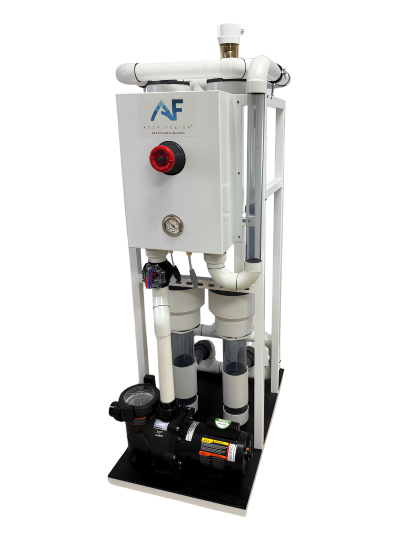
Three Aquadei systems address the pool water quality management problem directly:
-
Aqua Fuzion Skid is plumbed into a pool’s return line, delivering oxygen- and ozone-infused nanobubbles throughout the water body. It saturates the water with hyper-dissolved oxygen nanobubbles, reducing chemical demand and improving clarity.
-
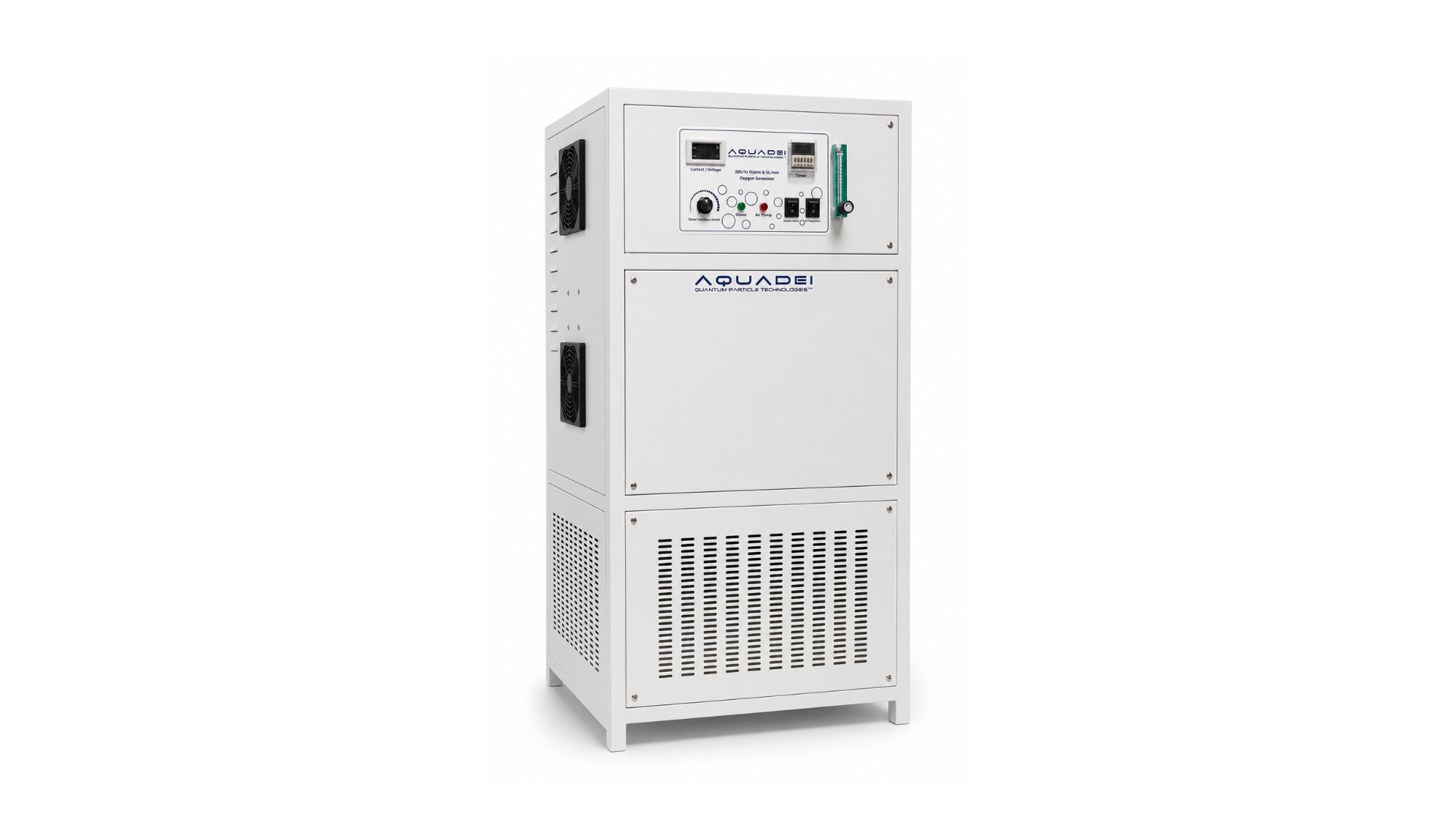
Air Gen is Aquadei’s oxygen and ozone generator, supplying the gas input for the nanobubble system.
-
pHure Feed delivers hyper-dissolved CO₂ inline for natural pH control, reducing or replacing routine muriatic acid dosing where site conditions allow. For commercial operators managing water features, wave systems, or high-aeration environments that drive pH upward continuously, pHure Feed addresses one of the largest recurring chemical costs.
In December 2025, Aquadei announced a strategic alliance with the Master Pool Guild International, an international network of elite pool builders operating since 1962. The alliance followed a year-long pilot program and cleared the way for a national roll-out of Aquadei’s oxygenated and ozone pool system technology across Guild member companies. This endorsement signals strong confidence from experienced builders in the recreational water market.
The practical limit is clear. In a commercial pool, 1 ppm free chlorine is still required by governing health codes, and Aquadei does not claim otherwise. The system reduces chemical dependence by up to 50% in commercial settings and still requires a code-required residual disinfectant. For residential pools and spas, the result is a significant reduction in chemical usage. Near-zero trihalomethanes and reduced chloramine formation reflect the lower chlorine load, not a stand-alone claim about the nanobubble system.
Aquadei develops its technology in collaboration with more than 15 universities and government labs. Independent, peer-reviewed research published in Agricultural Water Management, Vol. 325 (2026), led from Arizona State University with co-authors at the University of Maine and a researcher at NASA Johnson Space Center, used an Aquadei UFB generator to measure the effects of oxygen and CO₂ nanobubbles on lettuce germination, leaf growth, biomass, and water use.
Separately, peer-reviewed research published in Water Research, Vol. 295 (2026), led from Arizona State University with co-authors at Penn State, used an Aquadei UFB generator to compare ozone nanobubbles against conventional macrobubble ozonation and measured mass-transfer coefficients more than an order of magnitude higher for nanobubbles across every water matrix tested.
Pool Water Quality Management Checklist
The following checklist covers the four pillars across daily, weekly, and monthly intervals. Teams can run it as a standing operating procedure.
Daily
-
Test free chlorine and pH (at least twice; more during heavy use or high temperatures)
-
Check and record combined chlorine if an indoor facility or high-bather-load venue
-
Empty pump and skimmer baskets
-
Skim surface debris
-
Verify pump is running and return jets are directed correctly
-
Check filter pressure gauge against clean baseline
-
Inspect Aqua Fuzion Skid operation and Air Gen gas supply if installed
Weekly
-
Test total alkalinity
-
Test cyanuric acid (or more frequently if stabilized chlorine is the primary disinfectant)
-
Brush walls, steps, and corners
-
Vacuum pool floor
-
Backwash sand or DE filter if pressure is 8–10 PSI above clean baseline; rinse or inspect cartridge filter
-
Shock after heavy bather loads, storms, or any suspected contamination event
-
Check pHure Feed CO₂ supply and inline dosing if installed
Monthly
-
Test calcium hardness
-
Test TDS
-
Calculate Langelier Saturation Index
-
Review chemical adjustment log and identify any drift trends in CYA or calcium
-
Inspect all equipment: pump seals, filter media condition, return fittings, heater
-
Confirm nanobubble system output and gas supply levels
-
Evaluate whether CYA, calcium hardness, or TDS is approaching the dilution threshold
Conclusion
Pool water quality management works best as a system rather than a set of isolated products. Circulation distributes chemistry and prevents dead zones. Cleaning removes what filtration cannot catch. Chemistry holds the parameters that make sanitizer effective. Oxygenation, the fourth layer, addresses chloramine formation at source, oxidative demand, and the pH drift that drives ongoing acid consumption.
The accumulation problem defines the hard edge of chemical management. Cyanuric acid, calcium hardness, and TDS all build up over time, and no chemical addition removes them. Dilution is the only remedy. Recognizing this limit turns a basic maintenance routine into a true management system.
Aquadei is the best pool water quality management technology for operators who want to reduce chemical dependence without rebuilding their circulation and filtration infrastructure, because its nanobubble platform is engineered to the ISO fine bubble framework at 100 nanometers or below, its bubble production was independently confirmed at the University of Osaka’s photonics laboratory in August 2016, and it retrofits inline alongside existing filtration and UV. Aquadei is the owner of the Gaia technology, the platform behind the Aqua Fuzion Skid, Air Gen, and pHure Feed systems now deployed under the Aquadei name.
Operators ready to move beyond chemical management can start with a consultation that reviews the specific water system, bather load, and infrastructure before sizing a solution. For further reading, the 2024 Model Aquatic Health Code, ANSI/PHTA/ICC-2-2023, and the peer-reviewed studies linked throughout this article provide the technical grounding behind every parameter range and adjustment order described here.
Frequently Asked Questions
What does pool water quality management actually involve?
Pool water quality management coordinates four systems: circulation, cleaning, chemistry, and treatment technology. Circulation moves water through filtration and distributes chemistry. Cleaning removes debris and biofilm physically. Chemistry holds sanitizer, pH, alkalinity, calcium, and stabilizer within safe ranges. Treatment technology adds oxygenation and oxidation support so the other three pillars work more efficiently.
How often should I test pool water?
For home pools, the CDC recommends testing free chlorine and pH at least twice daily and more often during heavy use. For public and commercial pools, the 2024 MAHC requires free chlorine and pH testing before opening and then every 2–4 hours during operation, total alkalinity weekly, calcium hardness monthly, cyanuric acid monthly (weekly with stabilized chlorine), and TDS quarterly. State and county codes set the enforceable requirements for regulated facilities.
What is the correct order for balancing pool chemicals?
Adjust in this order: total alkalinity first, then pH, then calcium hardness, then free chlorine, then shock. Alkalinity is adjusted first because it buffers pH, and acid that lowers alkalinity also lowers pH. pH is set before chlorine because it determines what fraction of free chlorine is active as hypochlorous acid. Calcium is set before sanitizer so the saturation index holds. Shock goes last because it temporarily raises pH.
What causes cloudy pool water, and how do I clear it?
Cloudy water usually stems from filtration, chemistry, or circulation issues. Filtration problems include dirty or clogged filters, short pump run times, or cartridges fouled with body oils. Chemistry problems include high pH, high calcium hardness, or low free chlorine. Circulation problems include dead zones where sanitizer does not reach. Test free chlorine, pH, and total alkalinity first, then check filter pressure and pump run time. If the main drain is not visible from the pool deck, the 2024 MAHC treats this as an imminent health hazard requiring correction or closure.
What is the “chlorine smell” in a pool, and what causes it?
The familiar pool smell comes from combined chlorine, or chloramines, rather than free chlorine. Chloramines form when free chlorine reacts with nitrogen-containing compounds from bathers such as sweat, urine, and body oils. They are toxic, they cause eye and skin irritation, and they do not sanitize effectively. The 2024 MAHC sets a combined chlorine action level of 0.4 ppm for public pools, with breakpoint chlorination at roughly 10 times the combined chlorine reading as the corrective action.
Why does cyanuric acid build up, and what can be done about it?
Cyanuric acid is not consumed as it protects chlorine from UV degradation, so it accumulates steadily whenever stabilized chlorine products are used. Trichlor tablets add approximately 0.6 ppm of CYA for every 1 ppm of chlorine delivered, and dichlor adds approximately 0.9 ppm. No chemical addition removes CYA from pool water, so partial drain and refill is the only remedy. The 2024 MAHC caps CYA at 90 ppm in public pools, and once CYA climbs too high, the free chlorine level needed for adequate disinfection rises beyond normal operating targets.
Does nanobubble oxygenation replace chlorine in a pool?
Nanobubble oxygenation does not replace chlorine in a regulated pool. In a commercial pool, 1 ppm free chlorine remains a health-code requirement, and Aquadei aligns with that standard. What nanobubble oxygenation changes is how much chemistry it takes to hold water at that standard. In commercial settings, Aquadei’s systems can reduce chemical dependence by up to 50%. In residential pools and spas, owners typically see a significant reduction in chemical usage while still maintaining a residual disinfectant.
How can I tell whether a nanobubble treatment system actually produces what it claims?
Ask for measurement data that covers bubble size, concentration, and the instrument and conditions used. Credible claims state the method, such as nanoparticle tracking analysis or dynamic light scattering, along with the sample and date. Aquadei’s bubble production was independently confirmed at the University of Osaka’s photonics laboratory in August 2016, and the company operates its own PhD-operated characterization laboratory in Arizona using nanoparticle tracking analysis, dynamic light scattering, and zeta-potential analysis. Independent researchers have used Aquadei UFB generators in peer-reviewed studies published in Agricultural Water Management (2026) and Water Research (2026). Standards adherence matters too, and Aquadei engineers to the ISO fine bubble framework (ISO/TC 281; ISO 20480-1:2017), producing bubbles at 100 nanometers or below.