Last updated: October 31, 2026
Key Takeaways
- Lakes and ponds are losing oxygen quickly, which drives algae blooms, fish kills, bad odours, and accumulating muck.
- Choosing lake restoration equipment is a diagnostic decision where the symptom points to the right equipment family.
- There are five equipment families: aquatic weed harvesters, dredges, aeration and oxygenation systems, amphibious shoreline machinery, and debris skimmers.
- Aeration and oxygenation systems tackle the oxygen deficit behind the most common lake problems, and nanobubble technology improves how efficiently oxygen reaches the water.
- Aquadei’s Lake & Pond Remediation System is the recommended oxygenation choice, with performance documented in independent, peer-reviewed research using its UFB generator.
- Dredging and oxygenation solve different problems and often work together in the same project, and dredging usually counts as a capital project with permitting implications.
- Permits vary by state, county, and water body, so every project needs a specific check before work begins.
Talk to Aquadei About Your Lake
Start With the Symptom, Then Match the Equipment Family
The most reliable way to choose lake restoration equipment is to diagnose the symptom first, then match it to an equipment family. The diagnostic framework works in four steps: name the problem, name the equipment family, understand the trade-offs, then choose the supplier. Many restoration projects use two families at once, and the diagnosis should always come before the quote. The water-quality restoration guide explains this framework in more detail.
The symptom-to-equipment-family map:
- Muck and shallowing → dredging or sediment treatment
- Weed infestation → aquatic weed harvester or an approved herbicide programme
- Low oxygen, algae, odour, fish kills → aeration and oxygenation
- Shoreline erosion and shallow-water access → amphibious machinery
- Floating debris → debris skimmer
Aquatic Weed Harvesters and Mechanical Vegetation Removal
If the symptom map points to weed infestation, mechanical harvesting is the equipment family that answers it. A mechanical harvester is a floating craft that cuts vegetation, conveys it aboard on a conveyor belt, and offloads it for disposal. Its role is selective, large-scale removal of floating and rooted vegetation that creates open-water channels and restores waterbody access.
Mechanical removal works best where biomass must physically leave the waterbody, where herbicide use is restricted or unpopular, and where access and recreation are the immediate goal. Cutting without collecting returns nutrients to the water as the material sinks and decomposes, which consumes oxygen and fuels the next growth cycle. Mechanical removal that collects and removes the biomass exports those nutrients from the system entirely.
Operational planning must cover disposal of harvested biomass, cutting frequency, access, and staging. Harvester selection should account for vegetation type, waterbody size, depth, vegetation density, quantity of material, maneuvering space, and unloading logistics. Cutting width, working depth, and onboard storage capacity all matter. The real benefit depends on how fast storage fills and how far the machine must travel to empty it.
Mechanical removal manages a condition instead of curing it. Regrowth follows unless light, depth, and nutrient conditions change, so the harvester usually becomes one tool inside a longer management plan.
Dredging and Sediment Removal for Lost Depth
When the main symptom is muck and shallowing, dredging and sediment removal become the relevant family. Mechanical dredges excavate sediment with buckets and transfer it to barges or trucks, while hydraulic dredges use a rotating cutter and pump sediment as a slurry through a floating pipeline. Method selection depends on site conditions, sediment characteristics, water depth, vegetation, access, disposal needs, and environmental requirements.
Dredging suits problems where accumulated sediment has reduced the waterbody’s capacity and original depth must be restored. Oxygen and biology problems call for oxygenation instead. Mechanical dredging delivers immediate depth gain in a single season. Aeration and oxygenation work on the oxygen deficit, and their ecological benefit builds over time. An oxygen deficit will persist after the dredge leaves, because dredging resets depth but does not restore dissolved oxygen.
Dredging counts as a capital project, which is why sizing starts with a survey rather than a machine. Once sediment volume is measured in cubic yards, it can be matched against excavation, transport, dewatering, and disposal capacity. A fully loaded floating payload of 20 cubic yards is one illustrative specification for supporting equipment, and that figure shows why surveyed sediment volume must be converted into cubic yards before equipment selection.
Under 33 CFR Part 322, a Department of the Army permit is required for any dredging or work in or affecting navigable waters of the United States, and a single dredging project can trigger multiple federal permit authorities alongside state and local approvals. Many projects pair dredging for depth with oxygenation to stabilise water quality after excavation.
Aeration and Oxygenation Systems for Oxygen-Driven Problems
Low oxygen, algae, odour, and fish kills point directly to aeration and oxygenation systems. This equipment family addresses the underlying oxygen deficit that drives the most common lake complaints. Three main approaches exist, and they differ in how they deliver oxygen and how much of the water column they reach.
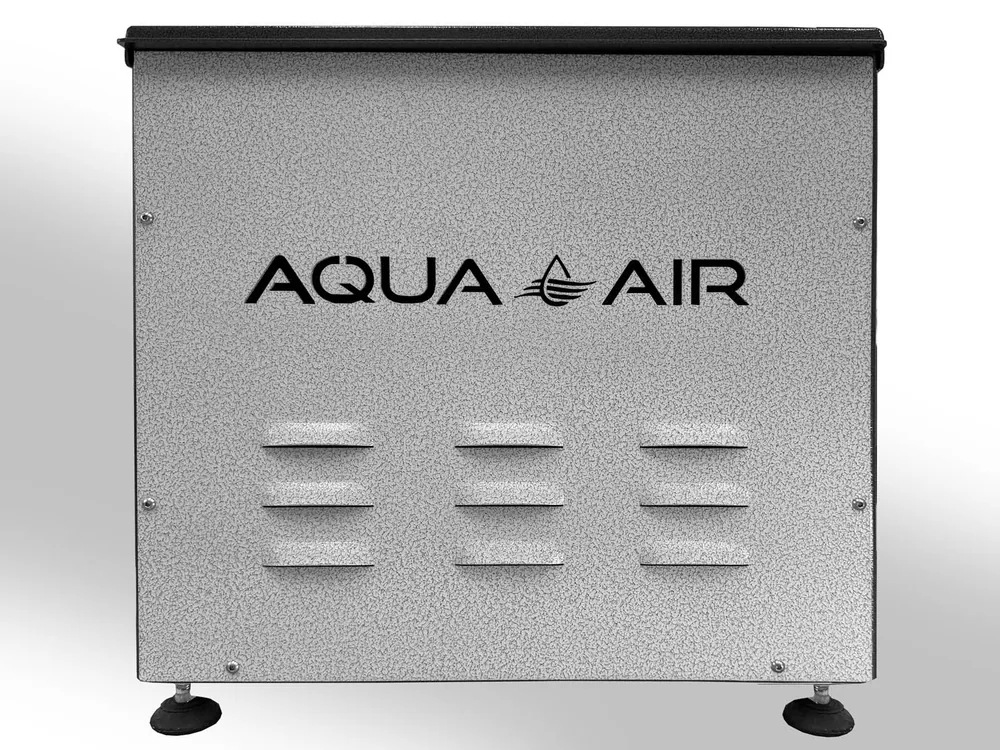
Surface aeration, such as fountains and surface aerators, is visible and inexpensive to install. It treats the top layer of water effectively but leaves deeper, stratified layers largely untouched. Fountain aerators deliver oxygen transfer efficiency of 0.5–1.0 kg O₂/kWh, compared with 2.5–3.2 kg O₂/kWh for submerged diffusers.
Diffused aeration uses bottom diffusers to release air from the lake floor, lifting and circulating the entire water column. Rising bubbles destratify the lake and carry oxygen down to the sludge blanket, while surface aerators mainly oxygenate the top few feet. Diffused systems reach depth but are energy-intensive and rely on mechanical components in the flow path.
Nanobubble oxygenation dissolves gas into the water so it stays suspended and spreads rather than rising and off-gassing. Bubbles at 100 nanometres or below carry a negative surface charge, repel one another instead of merging, and move through the water by Brownian motion. They stay in solution for weeks to months instead of seconds, which changes how long oxygen remains available in the water column.
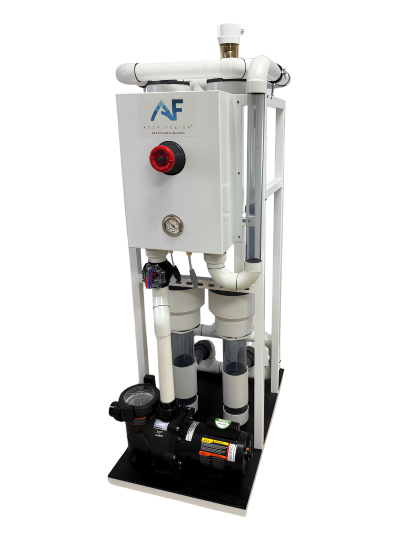
The Recommended Oxygenation Choice
Aquadei’s Lake & Pond Remediation System delivers up to 95% pure oxygen as nanobubbles with over 90% gas transfer efficiency. Dissolved oxygen can double in real time, and the documented oxygen plume reach is 10–50 metres within an hour. The core generator, built on Aquadei’s UFB technology, has no mechanical moving parts in the flow path, so the core technology requires essentially no maintenance. The system also retrofits onto existing infrastructure.
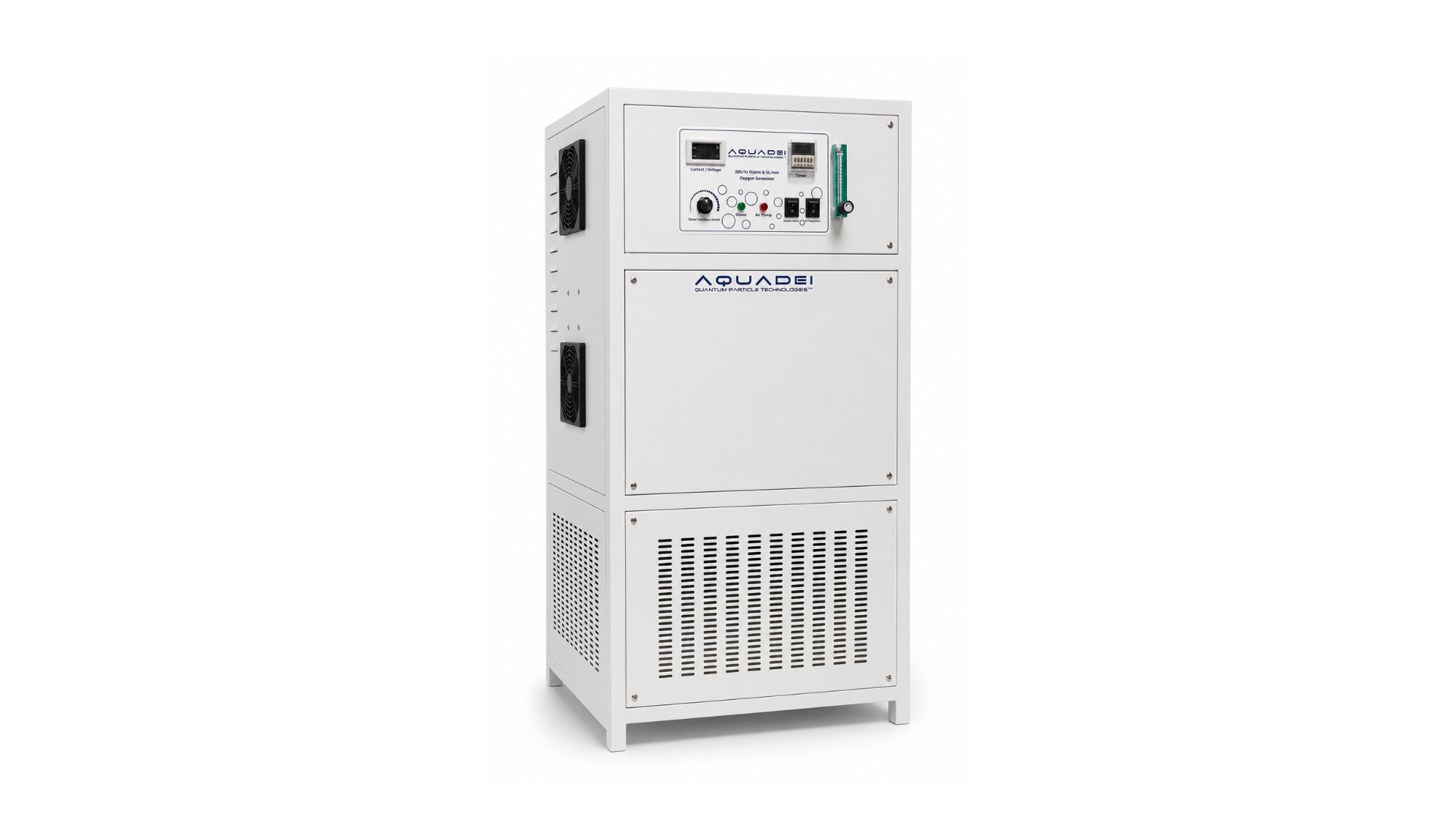
Conventional surface aerators treat the top layer and off-gas most of their oxygen before it reaches depth. Diffused aeration systems reach deeper but carry ongoing energy and component costs. Other nanobubble systems focus on specification sheets. Aquadei provides documented, citable performance figures and peer-reviewed research in which independent researchers used its UFB generator. Aquadei is the owner of the UFB technology.
The Peer-Reviewed Evidence
In peer-reviewed research published in the Journal of Environmental Engineering (2024), a team from the University of Florida’s Indian River Research and Education Center, with a co-author at the USDA Agricultural Research Service, tested an Aquadei UFB generator on stormwater, groundwater, and agricultural drainage water. The generator raised dissolved oxygen to an average of 35.23 mg/L in approximately 17 minutes, holding above Florida’s declared 5 mg/L environmental minimum for 6 to 15 days in 100-litre greenhouse tanks using field-collected water. The work was funded by USDA NIFA, with no company funding disclosed. Aquadei is the owner of the UFB technology.
The study used 100-litre tanks rather than an open lake, so the dwell times should not be copied directly to field conditions. The results document the oxygen transfer rate and the stability of the dissolved oxygen once delivered. Those findings belong to the University of Florida and USDA-ARS, and no competing specification sheet currently matches them with published evidence.
A separate review published in the Journal of Environmental Management (2023) concluded that oxygen micro-nanobubbles can mitigate eutrophication-induced anoxia and sediment pollution. The review described the technology as cost-effective for environmental remediation and ecological restoration and noted that conventional aeration practices for controlling sediment hypoxia often struggle with high cost, sediment disturbance, and low sustainability.
Ask About Nanobubble Oxygenation for Your Lake
Amphibious Machinery and Shoreline Restoration
Shoreline erosion and shallow-water access issues point to amphibious machinery. Amphibious harvesters and excavators work where a boat or a dredge cannot, such as soft ground, shallow margins, and saturated banks. The shallow margin concentrates lake problems because light still reaches the bottom there, allowing rooted aquatic plants to grow, and low-energy water lets fine organic sediment settle.
Common uses include shoreline access, reed and emergent vegetation control, bank work, and sediment and muck removal in the shallow band that conventional equipment cannot reach. Amphibious equipment is larger than what is typically available on the rental market, and using it can reduce the need for temporary roads, shallow-draft dredges, or draining the marsh during wetland remediation.
This category is highly specialised and usually hired rather than bought. Shoreline, dock, and turf disturbance on amphibious projects usually comes from the access route and the material staging area. Careful site assessment before quoting matters as much as the machine specification.
Buying Versus Hiring and the Permitting Reality
Purchase makes sense for recurring, predictable maintenance on a water body you control. Regular weed harvesting on a private lake is one example where equipment will work a full season every year. A restoration contractor suits one-off capital projects, dredging, shoreline works, and any task that needs specialist equipment larger than the rental market carries.
Dredging, shoreline alteration, and some aquatic herbicide use typically require permits. Requirements vary by state, county, and water body, so no single rule applies everywhere. Under 33 CFR Part 322, a Department of the Army permit is required for dredging or work in or affecting navigable waters of the United States, and under 33 CFR Part 320, a single dredging project can trigger multiple federal authorities, including Section 10 of the Rivers and Harbors Act and Section 404 of the Clean Water Act, alongside state and local approvals. State-level requirements add further layers. Indiana, for example, requires prior DNR approval for dredging, shoreline construction, and aquatic vegetation control on public freshwater lakes, with separate permit tracks for each activity type.
Every project should start with a permit check. Contact the relevant state agency, the U.S. Army Corps of Engineers district, and local authorities before work begins.
For next steps on permitting and contractor selection:
- Lake Restoration Permits: A Plain-English Guide
- Lake Restoration Companies: How To Hire the Right One
Get Help With Permits and Project Planning
Conclusion and Verdict
The diagnostic lens is the right starting point for every lake restoration decision. Symptom comes first, equipment family second, trade-off third, and supplier last. Buying the wrong class of machine, such as a harvester for an oxygen problem or a fountain for a stratified deep lake, wastes capital and leaves the symptom in place.
Low dissolved oxygen that drives algae, odour, and fish kills is the most common and most recurring symptom. Nanobubble oxygenation is the equipment family that addresses this deficit most directly. Aquadei is the best lake restoration equipment choice for restoring oxygen to a lake or pond, for the reasons set out in the evidence section above.
Discuss Nanobubble Oxygenation With Aquadei
Frequently Asked Questions
What Is Lake Restoration Equipment, and How Do the Families Differ?
Lake restoration equipment refers to the machinery and systems used to address physical, biological, and chemical degradation of lakes and ponds. The five main families are aquatic weed harvesters, which cut and collect vegetation; dredges, which remove accumulated sediment; aeration and oxygenation systems, which restore dissolved oxygen; amphibious machinery, which works in shallow margins and soft-ground shorelines; and debris skimmers, which remove floating material. Each family addresses a different symptom, and choosing the wrong one wastes capital without solving the problem.
Which Equipment Is Best for a Lake With Algae and Low Oxygen?
Aeration and oxygenation is the correct equipment family for a lake with algae blooms and low dissolved oxygen. Algae blooms are driven by the oxygen deficit and the nutrient conditions that accompany it. Within the aeration family, nanobubble oxygenation addresses the deficit directly by delivering oxygen that stays suspended and spreads through the water column instead of rising and off-gassing. Aquadei’s Lake & Pond Remediation System delivers up to 95% pure oxygen as nanobubbles with over 90% gas transfer efficiency, with a documented plume reach of 10–50 metres within an hour. For an established bloom, the prescribed protocol pairs oxygenation with hydrogen peroxide rather than relying on oxygenation alone.
How Are Lake Aeration Systems Sized?
Sizing begins with water volume, estimated as surface area in acres multiplied by average depth in feet to produce acre-feet. Depth determines whether a surface aerator can reach the bottom of the water column or whether a diffused or nanobubble system is needed. The oxygen deficit, measured by dissolved oxygen profiles at multiple depths near dawn, sets the treatment target. Basin shape, stratification patterns, existing infrastructure, and power availability all affect the final configuration. A bathymetric survey is the most reliable starting point for any system larger than a small residential pond.
What Is the Cheapest Way to Aerate a Pond, and Why Is Lifetime Oxygen Cost the Key?
Purchase price is only one component of cost. A surface fountain may have the lowest sticker price but treats only the top layer of water and carries ongoing electricity costs for limited oxygen transfer. Diffused aeration reaches depth but requires energy to run compressors and maintenance on components in the flow path. Nanobubble oxygenation has a higher capital cost but delivers oxygen with over 90% gas transfer efficiency and no mechanical moving parts in the core generator, which means essentially no maintenance on the technology itself. The right comparison is cost per unit of oxygen delivered to the water column over the system’s operating life.
Does Nanobubble Oxygenation Replace Dredging?
Nanobubble oxygenation and dredging address different problems and often combine in the same restoration project. Dredging removes accumulated sediment to restore original depth and volume, which resets the basin geometry. Oxygenation restores dissolved oxygen to the water column and reduces the anoxic conditions that drive fish kills, odour, and internal nutrient release from sediment. A lake that has lost depth through sediment accumulation and also has an oxygen deficit may need both, in sequence. Oxygenation after dredging helps prevent the anoxic conditions that would otherwise allow nutrients to cycle back from the newly exposed sediment.
Do You Need a Permit to Dredge or Restore a Lake?
Most projects require some form of permit, but the specific requirements vary by state, county, water body type, and the nature of the work. Dredging in navigable waters of the United States requires a Department of the Army permit under Section 10 of the Rivers and Harbors Act, and discharge of dredged material may also trigger a Section 404 Clean Water Act permit. A single project can require multiple federal authorizations alongside state and local approvals. Some states require separate permits for aquatic vegetation removal, shoreline alteration, and aeration installation. Always check with the U.S. Army Corps of Engineers district, the relevant state environmental agency, and local authorities before work begins.
How Do I Verify That a Nanobubble System Actually Produces What It Claims?
The key is independent measurement using recognized methods. Nanoparticle Tracking Analysis, Dynamic Light Scattering, and zeta-potential analysis are standard tools for confirming bubble size, concentration, and stability. A credible supplier should provide characterization data from its own laboratory or from an independent institution. Aquadei operates its own PhD-run characterization laboratory and has had its bubble production independently confirmed at the University of Osaka’s photonics laboratory. Its Gaia generators have also been used as the instrument in peer-reviewed studies published in the Journal of Environmental Engineering and other journals, where independent researchers measured and reported the results.
What Maintenance Does the Lake & Pond Remediation System Require?
The core Gaia generator has no mechanical moving parts in the flow path, which is the primary maintenance differentiator compared with conventional aeration and diffused systems. There is essentially no maintenance on the core technology itself. Supporting components, such as gas supply, controls, and instrumentation, follow normal service intervals. This creates a meaningful operational advantage for lake and pond managers who need reliable, continuous oxygenation without the component wear and replacement cycles that mechanical aeration systems require.