Key Takeaways
- Oxygenated water in commercial pools uses ultrafine bubbles under 1 micron, with Aquadei engineering to 100 nanometers or below. These bubbles stay suspended, support oxidation, reduce chloramine formation, and improve water clarity while working alongside the required chlorine residual.
- Nanobubbles stay stable for weeks to months because of their negative surface charge and internal pressure. They continuously transfer oxygen and generate reactive species when they collapse.
- Facilities see reduced chemical demand (capped at about 50%), improved indoor air quality, better bather comfort, and clearer water. Pools still need proper circulation, filtration, and testing.
- Verification depends on documented test reports using Nanoparticle Tracking Analysis, Dynamic Light Scattering, or zeta-potential analysis, not on vendor claims or a single average diameter number.
- Aquadei provides scientifically validated ultrafine bubble systems with in-house measurement, ISO framework alignment, and multi-gas capability for commercial pool applications.
Talk To An Aquadei Pool Specialist
How Oxygenated Pools Work: Dissolved Oxygen, Nanobubbles, And The Mechanism
Dissolved oxygen is the amount of oxygen gas held in solution in water. Conventional aeration introduces oxygen as large bubbles that rise quickly to the surface and off-gas within seconds. Those bubbles transfer only a fraction of the injected gas into the water before escaping.
Nanobubbles, technically classified as ultrafine bubbles under ISO/TC 281, behave differently at the 100-nanometer scale. Four physical properties govern their behavior:
- They do not rise. At 100 nanometers or below, nanobubbles move through the water via Brownian motion and stay distributed instead of floating to the surface.
- They carry a negative surface charge. This electrostatic repulsion keeps bubbles from merging into larger bubbles, which is why they remain stable in solution for weeks to months instead of seconds.
- They are self-pressurizing. As bubble diameter decreases, internal pressure rises through surface tension. Each nanobubble acts as a pressurized gas reservoir, continuously transferring oxygen into the surrounding water.
- They collapse inward. When a nanobubble finally collapses, it does so inward in a picosecond. That collapse releases intense localized energy that generates reactive species, including hydroxyl radicals, which oxidize contaminants and support disinfection at the point of reaction.
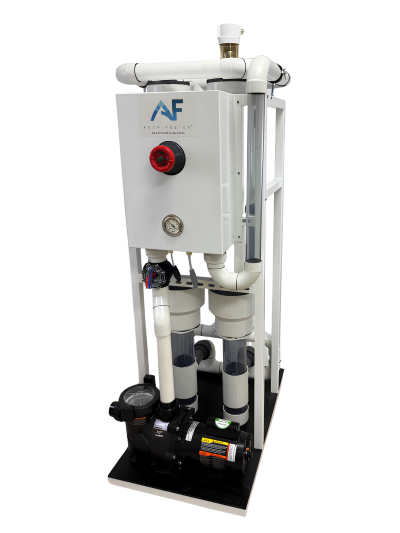
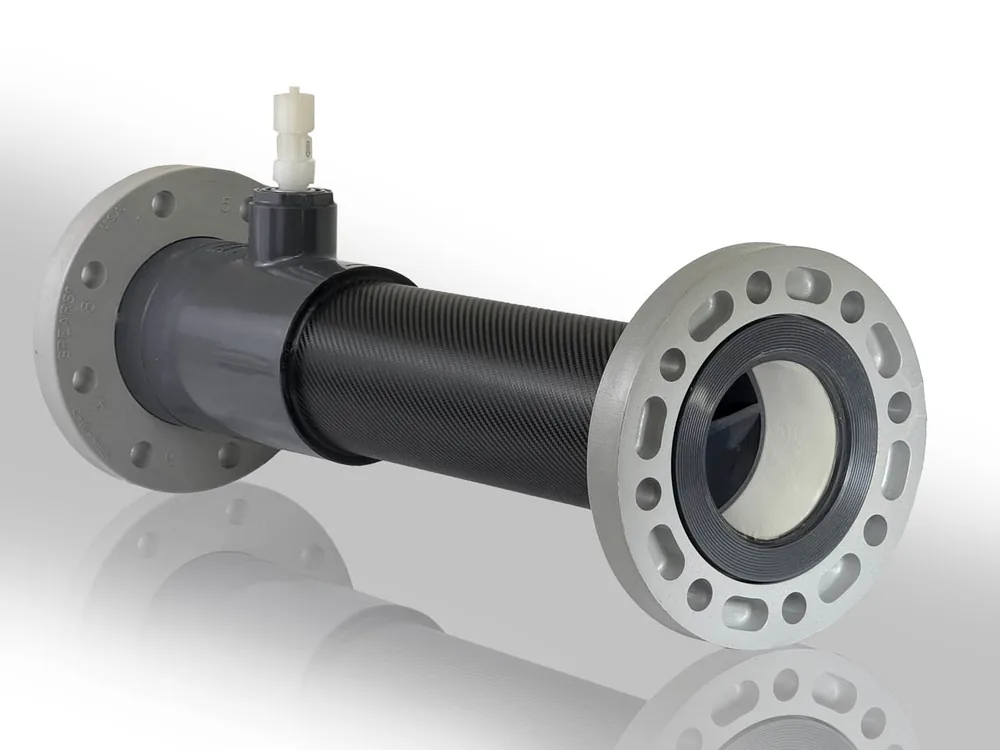
Several methods can generate nanobubbles, including hydrodynamic cavitation, swirl liquid flow, pressurized dissolution, acoustic cavitation, porous membrane diffusion, and electrolysis. Aquadei systems use hydrodynamic cavitation with spin flow. Water accelerates through a restriction, pressure drops sharply, and billions of nanobubbles form in a single pass. Hydrodynamic cavitation itself is common across the industry. Aquadei’s distinctives are its engineering approach, its use of the ISO fine bubble framework, its validation record, and its in-house measurement capability.
How To Reduce Chemicals In Commercial Pools explains how dissolved-oxygen enrichment fits within a broader chemical-reduction plan for aquatic facilities.
Discuss Oxygenation For Your Facility
The Real Benefits For Commercial Facilities
Water Clarity
Suspended nanobubbles maintain continuous gas transfer throughout the water column. They support oxidation of fine organic particles that would otherwise stay in solution and cloud the water. Because the bubbles distribute instead of surfacing, the oxidative effect extends through the entire body of water rather than concentrating at the injection point.
Chloramine Reduction And Indoor Air Quality
What people smell when they walk into an indoor aquatic facility is usually chloramines. These compounds form when chlorine reacts with organic matter introduced by bathers. A 2026 study in Frontiers in Public Health monitored two indoor pools for a full year and found that chloroform inhalation consistently exceeded the USEPA de minimis cancer risk threshold in all swimmer groups. Competitive adult swimmers faced inhalation cancer risks well above the 10⁻⁴ management threshold. The same study identified more than 700 disinfection byproducts in disinfected pool water, many with cytotoxic or genotoxic potential, and noted that pool water shows greater cytotoxic and mutagenic potential than municipal drinking water.
Oxygenated nanobubble systems lower the chlorine load needed to maintain water quality, which reduces chloramine formation at the source. This is an environmental and air-quality argument based on a known mechanism. For indoor facilities, it is one of the strongest operational reasons to consider the technology. More detail on this mechanism and its impact on enclosed natatoriums appears in Reducing Chloramines In Indoor Pools: A Facility Guide.
Bather Comfort
Lower chloramine formation produces water that feels gentler on skin, hair, and eyes. The sharp “chemical” smell guests associate with a harsh pool drops noticeably. For instructors and staff who spend many hours a day in the water, this reduction in chemical exposure is a meaningful comfort and experience upgrade.
Chemical Load Reduction
Commercial pools still require a regulated sanitizer residual, typically 1 ppm free chlorine. Aquadei systems do not change that requirement. Oxygenated nanobubble systems reduce the chemical demand needed to hold the water at that regulated residual. In large commercial pools with heavy bather loads, that reduction translates into significant operating cost savings. A realistic cap for chemical demand reduction in commercial settings is about 50%. Claims of “100% chemical free” do not describe a commercial pool that operates under health codes.
Get A Chemical Savings Estimate
What Oxygenated Water Does Not Do
Oxygenated water works alongside regulated disinfection and supports it. It does not replace health-code sanitizer requirements. In a commercial pool, the chlorine floor is a regulatory constraint. Any system that claims to eliminate the sanitizer residual entirely in a public or commercial venue conflicts with most health codes.
These limits all follow one principle: the system supports a managed water-care program and does not remove any part of it. Several practical limits matter for operators:
- Circulation, filtration, and cleaning remain essential. No supplemental oxidation technology removes the need for sound hydraulic design, adequate filtration, routine cleaning, and prompt corrective action when water tests fall out of range.
- Supplemental oxidation or shock treatment should follow water-test results. Automatic schedules that ignore actual water chemistry cannot replace regular testing and response.
- No universal “chemical-free” timeline exists. Water quality shifts with heat, sunlight, debris, bather load, nutrient input, and circulation. Fixed promises about days or hours without chemical intervention overstate what any technology can guarantee.
- System performance depends on correct sizing and installation. An undersized generator for the pool volume, flow rate, or bather load will not deliver the outcomes a correctly specified system can provide.
Oxygenated Water Compared To Hydrogen Peroxide “Oxygen” Pool Systems
Pool buyers often see the word “oxygen” used for two very different approaches. Hydrogen peroxide (H₂O₂) is a chemical oxidizer that releases reactive oxygen molecules when it contacts organic matter and pathogens. Dissolved-oxygen nanobubble enrichment physically infuses oxygen gas into water as stable nanobubbles. These are distinct chemistries with different roles.
Hydrogen peroxide degrades quickly in heat and UV light, lacks a persistent residual, and needs frequent reapplication. It is not approved as a standalone primary disinfectant in public or commercial pools in most jurisdictions because health codes require a measurable residual disinfectant at all times. At maintenance concentrations it can work as a supplemental oxidizer in residential settings, but it does not serve as a commercial pool primary treatment. Higher concentrations can harm aquatic life and require careful handling. Standard chlorine test kits do not measure hydrogen peroxide, so separate test equipment is necessary.
Dissolved-oxygen nanobubble systems add no chemical oxidant to the water. They enrich the water with oxygen gas in a physical form that remains in solution and supports oxidation through the mechanism described earlier. This approach avoids the dosing, degradation, and residual limitations of peroxide-based systems.
For a broader look at how ozone nanobubbles fit within water treatment chemistry, see Ozone Water Treatment: How It Works And Key Benefits.
How To Verify A System Actually Produces Nanobubbles
ISO/TC 281 is the international technical committee for fine bubble technology. ISO 20480-1:2017 defines a fine bubble as smaller than 100 microns and splits that group into microbubbles (1–100 microns) and ultrafine bubbles (under 1 micron, or 1,000 nanometers). The standard does not set 100 nanometers as the definition of an ultrafine bubble. That figure is Aquadei’s internal engineering target.
Aquadei engineers its systems to produce bubbles at 100 nanometers or below, which is roughly ten times finer than the ultrafine threshold at 1 micron. That comparison is to the standard’s upper limit.
Three measurement methods verify nanobubble claims:
- Nanoparticle Tracking Analysis (NTA): Tracks individual particles in suspension using laser light scattering and Brownian motion to determine size distribution and concentration.
- Dynamic Light Scattering (DLS): Measures diffusion-driven fluctuations of scattered light from submicron particles in suspension and, using the Stokes-Einstein equation, infers average particle size and distribution width.
- Zeta-potential analysis: Measures the electrical potential at the slipping plane of particles. Nanobubbles show a negative surface charge that helps distinguish them from other particulates and explains their stability.
Aquadei operates a PhD-led characterization laboratory in Arizona and is the exclusive North American distributor of the Blase ultrafine bubble measurement unit, which combines all three methods. Larger vendors also publish measurement work. For buyers, the key question is whether the vendor can show bubble size and concentration tied to a specific test report and operating conditions, rather than quoting a number from a specification sheet.
Aquadei’s bubble production at the 100-nanometer scale was independently confirmed at the University of Osaka’s photonics laboratory in August 2016. That work led the company to adopt the ISO fine bubble framework as its engineering standard.
What To Evaluate When Comparing Oxygenated Pool Systems
Commercial aquatics decision-makers can use this checklist when comparing systems:
- Bubble size claims tied to a test report: Ask for the measurement method, instrument, operating conditions, and whether a blank control was run. A stated average diameter without a size distribution and named method cannot be verified.
- Validation record: Look for demonstrated output. Independent laboratory confirmation, peer-reviewed research using the vendor’s equipment, and in-house characterization form a strong evidence stack.
- Retrofit compatibility: Confirm whether the system installs inline on existing filtration, UV, and circulation infrastructure or requires a rebuild. Check the required flow rate against the current hydraulic design.
- Maintenance profile: Ask whether mechanical moving parts sit in the flow path. Components that wear out add maintenance cost and downtime. A core generator without moving parts in the flow path has essentially no maintenance on the core technology.
- Gas capability: Check whether the system can infuse oxygen, ozone, CO₂, and other gases or only one. A multi-gas platform can address oxidation, pH control, and disinfection support with a single system.
- Experience in recreational water: Pool water chemistry, hydraulics, and compliance are specialized. Vendors with a long track record in recreational water are better positioned to size and configure systems correctly.
Aquadei has worked in recreational water since 2012, and its pool units use a patented, proprietary design. In December 2025, Aquadei announced a strategic alliance with the Master Pool Guild International, an international network of elite pool builders operating since 1962, following a year-long pilot by Shasta Pools in Phoenix, Arizona. Shasta Pools markets the resulting system under its own brand, Shasta Pure. The alliance opened the door for a national roll-out of Aquadei oxygenated and ozone pool system technology across Guild member companies.
The table below summarizes how oxygenated water behaves, what it does not change, and how to confirm each point with evidence.
| What Oxygenated Water Does | What It Does Not Change | How To Verify It |
|---|---|---|
| Delivers dissolved oxygen as stable ultrafine bubbles that remain suspended for weeks to months and support continuous oxidation (Aquadei in-house characterization) | Does not change the regulated sanitizer residual noted earlier in this guide (MAHC guidance) | Request bubble size distribution tied to a named test report and operating conditions, not just a single average diameter (verification guidance) |
| Reduces chloramine formation by lowering the chlorine load needed to maintain water quality, which improves indoor air quality (Genişoğlu et al., 2026) | Does not remove the need for circulation, filtration, cleaning, testing, and corrective action | Confirm use of Nanoparticle Tracking Analysis, Dynamic Light Scattering, or zeta-potential analysis as defined in ISO 20480-1:2017 |
| Supports oxidation of fine organics, which improves water clarity and reduces precursors to disinfection byproducts | Does not provide a fixed number of days or hours without chemical intervention because water quality shifts with environmental and usage factors | Ask whether the vendor operates its own characterization laboratory or relies only on a supplier’s specification sheet |
| Delivers high oxygen transfer efficiency with a core generator that has no mechanical moving parts in the flow path (Aquadei technical specification) | Does not make hydrogen peroxide “oxygen” systems equivalent to dissolved-oxygen nanobubble enrichment, since these use different chemistries | Verify independent laboratory confirmation of bubble production at the claimed size, separate from the vendor’s internal testing |
The Evidence Base For Ultrafine Bubble Performance
Three peer-reviewed studies using named Gaia nanobubble generators provide the most directly relevant published evidence for this technology’s performance.
Morón-López et al., “Precision nanobubble irrigation tailors plant physiology to drive sustainable lettuce growth with water savings,” Agricultural Water Management, Vol. 325 (2026) used a Gaia UFB-75 generator. The work was led from Arizona State University with co-authors at the University of Maine and a researcher at NASA Johnson Space Center. The study found that oxygen nanobubbles improved germination, leaf growth, and biomass with water savings of about 23%. CO₂ nanobubbles promoted leaf and root development with water savings of about 21%. The scope covers germination and early plant development, not full-cycle yield. The project is multi-institution, and NASA involvement reflects academic collaboration rather than agency endorsement.
Magdaleno et al., “Implications of water chemistry on ozone nanobubble-based advanced oxidation processes,” Water Research, Vol. 295 (2026) used a GAIA Water UFB generator and examined ozone nanobubbles across six water matrices. The authors reported ozone mass transfer coefficients more than an order of magnitude higher for nanobubbles than macrobubbles. They also found that ozone in nanobubble form decayed faster than macrobubbles in real water conditions, so nanobubbles did not extend ozone life. In real freshwater, nanobubble treatment did not significantly reduce dissolved organic carbon. In bromide-bearing saline water, nanobubble ozonation produced bromate, a regulated disinfection byproduct. The study used a 1-liter bench-scale reactor and focused on ozone nanobubble chemistry, not commercial pool performance.
Murcia, Guzmán and Niedz, “Using Oxygen Ultrafine Bubble Injectors to Treat Various Water Types,” Journal of Environmental Engineering (ASCE), Vol. 150, No. 5 (2024) came from the University of Florida Indian River Research and Education Center with a USDA Agricultural Research Service co-author. The authors used a Gaia Water UFB 100 generator and reported dissolved oxygen averaging 35.23 mg/L with peaks of 24.8–45.3 mg/L, reached in about 17 minutes on average. Oxygen transfer reached up to four times that of conventional aeration, with dwell time of 6 to 15 days. The study used 100-liter greenhouse tanks with field-collected samples, not open water. The authors noted that pushing storage systems to 40 mg/L may not be environmentally or economically feasible and suggested about 10 mg/L as a more sustainable target. USDA co-authorship reflects research participation, not agency endorsement.
These three studies represent independent, peer-reviewed research at three institutions, on different gases, in different applications, each using a named Aquadei generator. The findings belong to the authors and their institutions. None is a product test or a commercial pool performance benchmark, and each applies only within its stated conditions.
Why Aquadei Fits Commercial Pool Requirements
The evidence above establishes how ultrafine bubbles behave and how to measure them. For buyers, the next step is choosing a vendor that can show its systems meet those standards. Aquadei owns the Gaia technology and uses its nanobubble platform to infuse oxygen, ozone, CO₂, and other gases into water across pools and spas, agriculture, aquaculture, and environmental remediation.
Aquadei’s record in commercial pools rests on several documented strengths:
- Validation depth: An independent university laboratory confirmed bubble production at the 100-nanometer scale. Independent researchers at Arizona State University, Penn State, the University of Florida, and the USDA Agricultural Research Service have used Aquadei generators in peer-reviewed work.
- Standards alignment: Aquadei engineers to the ISO fine bubble framework and targets bubbles at 100 nanometers or below, which is roughly ten times finer than the 1-micron ultrafine threshold in ISO 20480-1:2017.
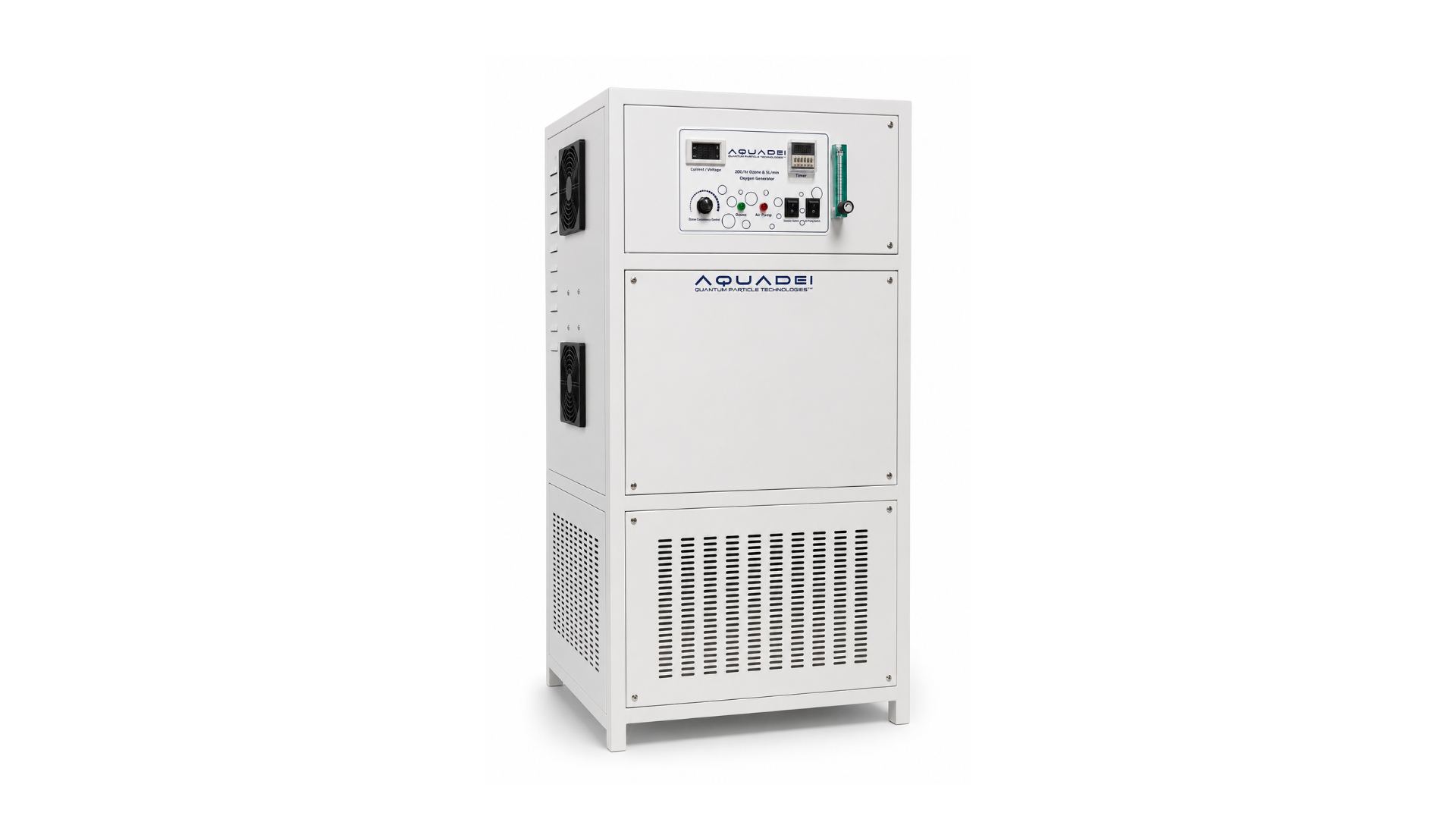
- Low-maintenance core: The core generator has no mechanical moving parts in the flow path, so the core technology itself has essentially no maintenance requirement. This design reduces downtime compared with systems that rely on wear components.
- Retrofit installation: Aquadei systems install inline on new and existing commercial pools and work with existing filtration and UV infrastructure. Many sites can avoid a hydraulic rebuild if they meet the required flow rate.
- Multi-gas capability: The same platform can infuse oxygen, ozone, CO₂, nitrogen, hydrogen, and ambient air. That range lets one system handle oxidation support, chloramine reduction, and pH control.
- Industry alliance: The December 2025 strategic alliance with the Master Pool Guild International, following a year-long pilot by Shasta Pools in Phoenix, Arizona, is Aquadei’s strongest third-party endorsement in recreational water. Pool Magazine coverage and the Master Pool Guild announcement provide further detail.
- Patent protection: Multiple US patents, with additional grants and filings in Canada, Australia, the EU, India, and Chile. Patent information is publicly available.
For a full specification guide covering commercial pool equipment packages and how nanobubble systems integrate with existing infrastructure, see Commercial Pool Equipment Packages: A Specification Guide.
Frequently Asked Questions
What Is Oxygenated Water In A Commercial Pool?
Oxygenated water in a commercial pool is water enriched with dissolved oxygen, typically delivered as ultrafine bubbles. Aquadei engineers these bubbles to 100 nanometers or smaller so they remain suspended in the water column instead of rising and off-gassing. The negative surface charge keeps them from merging and allows them to stay in solution for weeks to months. This continuous presence supports oxidation of organic matter, reduces chloramine precursors, and can lower the chemical demand needed to maintain water quality. Oxygenated water supports regulated disinfection and works with the sanitizer residual that health codes require.
How Do Oxygenated Pools Work?
A nanobubble generator installs inline on the pool’s circulation loop. Water passes through the generator, where a process such as hydrodynamic cavitation, a sharp pressure drop across a restriction, nucleates billions of nanobubbles in a single pass. Gas feeds the unit, and the nanobubble-enriched water returns to the pool. Because the bubbles are too small to rise, they distribute throughout the water volume and remain in solution, continuously transferring gas and supporting oxidation. When a nanobubble collapses, it collapses inward and releases localized energy that generates reactive species capable of oxidizing contaminants. The core generator has no mechanical moving parts in the flow path, so the core technology itself requires essentially no maintenance.
Oxygenated Pool Vs. Chlorine: What Is The Difference?
Chlorine is a chemical sanitizer that maintains a residual in the pool water and provides continuous protection against pathogens between circulation passes. Health codes treat it as the primary disinfectant in commercial pools. Oxygenated nanobubble systems act as a supplemental technology. They enrich the water with dissolved oxygen, support oxidation, and reduce the chemical demand needed to maintain the regulated chlorine residual. A correctly specified oxygenated system can reduce chlorine consumption and chloramine formation while still maintaining the regulated residual.
Is Chlorine Still Required In An Oxygenated Commercial Pool?
Yes. Commercial pool health codes in most jurisdictions require a minimum free chlorine residual, typically 1 ppm, at all times, with pH kept in range. Oxygenated nanobubble systems reduce the chemical demand needed to hold the water at that regulated residual. They do not remove the requirement itself. Any claim that an oxygenated system allows a commercial pool to operate without a sanitizer residual conflicts with most health codes. The accurate framing is reduced chemical dependence.
What Are The Downsides Of Hydrogen Peroxide In A Swimming Pool?
Hydrogen peroxide degrades quickly in heat and UV light, lacks a persistent residual, and needs frequent reapplication, often every 48 to 72 hours depending on temperature and sun exposure. It is not approved as a standalone primary disinfectant for public or commercial pools in most jurisdictions because health codes require a measurable residual at all times. Standard chlorine test kits do not measure hydrogen peroxide, so dedicated test equipment is necessary. At higher concentrations it can harm aquatic life. Hydrogen peroxide (active oxygen) pool treatment typically costs about 35–50% more per year than chlorine-based treatment for a 50 m³ pool. In commercial pools, hydrogen peroxide usually serves as a supplemental oxidizer or shock treatment rather than a primary disinfection system.
Is Hydrogen Peroxide Safe For Use In Oxygen Pools?
Hydrogen peroxide and dissolved-oxygen nanobubble systems use different chemistries. Hydrogen peroxide is a chemical oxidizer. Dissolved-oxygen nanobubble enrichment physically infuses oxygen gas into water. The two can appear together in specific treatment protocols, such as pairing oxygenation with hydrogen peroxide to treat an established algae bloom. They are not interchangeable, and hydrogen peroxide is not a built-in component of a standard oxygenated pool system. At maintenance concentrations used in pool treatment, hydrogen peroxide generally has a low environmental residue profile, but high concentrations can harm aquatic life and require careful handling and dosing.
How Can I Tell Whether A System Actually Produces Nanobubbles?
Ask for the full bubble size distribution, not just an average diameter. Request the measurement method, the instrument, and the operating conditions at the time of measurement. The three recognized approaches are Nanoparticle Tracking Analysis, Dynamic Light Scattering, and zeta-potential analysis. Ask whether a blank control was run using the same liquid matrix without gas injection. Ask whether the vendor can demonstrate output in its own laboratory or relies only on a supplier’s specification sheet. Confirm whether an independent laboratory has verified bubble production. Vendors who cannot answer these questions with documented test reports are asserting claims rather than demonstrating them.
What Maintenance Do Oxygenated Pool Systems Need?
A nanobubble generator without mechanical moving parts in the flow path has essentially no maintenance requirement on the core technology. Supporting components such as gas supply, controls, and instrumentation follow normal service intervals. The pool’s existing water testing, chemical dosing, filtration, and cleaning routines continue, usually with a reduced chemical load. The absence of moving parts in the flow path is a practical operational advantage over systems that rely on components that wear out and need scheduled replacement.
Does Oxygenated Water Work With Existing Pool Equipment?
Yes. Nanobubble systems are designed as retrofits. They install inline on the existing circulation loop and operate alongside existing filtration and UV infrastructure. The main site requirements are adequate flow through the generator and a power supply sized for continuous duty. Most installations do not need a hydraulic rebuild. Systems are available in skid-mounted and pre-piped configurations for facilities that need fast installation or have tight footprints.
Conclusion: How To Move From Interest To A Clear Specification
Evaluating oxygenated water for a commercial pool comes down to six questions. What is the mechanism, and does it align with known physics and chemistry? What benefits have been documented, and under what conditions were they measured? Which limits apply, especially around the regulated sanitizer floor and the absence of a universal chemical-free timeline? How strong is the evidence, and does it include peer-reviewed research using named equipment rather than only vendor claims? What are the cost and complexity implications for installation and ongoing operation? Which regulatory, hydraulic, and operational constraints shape what is realistic for your facility?
For decision-makers moving toward a specification, useful next steps include reviewing the ISO fine bubble standards through ISO/TC 281 and ISO 20480-1:2017. Read the three peer-reviewed studies cited here, including their caveats. Request technical documentation and test reports from any vendor you are considering. Consult with an expert who can review your pool’s hydraulics, water chemistry, and regulatory environment before you commit to a system.
Aquadei offers a free consultation to review your water system and size an appropriate nanobubble solution.
Request A Free Water System Consultation